Type: Article -> Category: The PFVME Research Journal
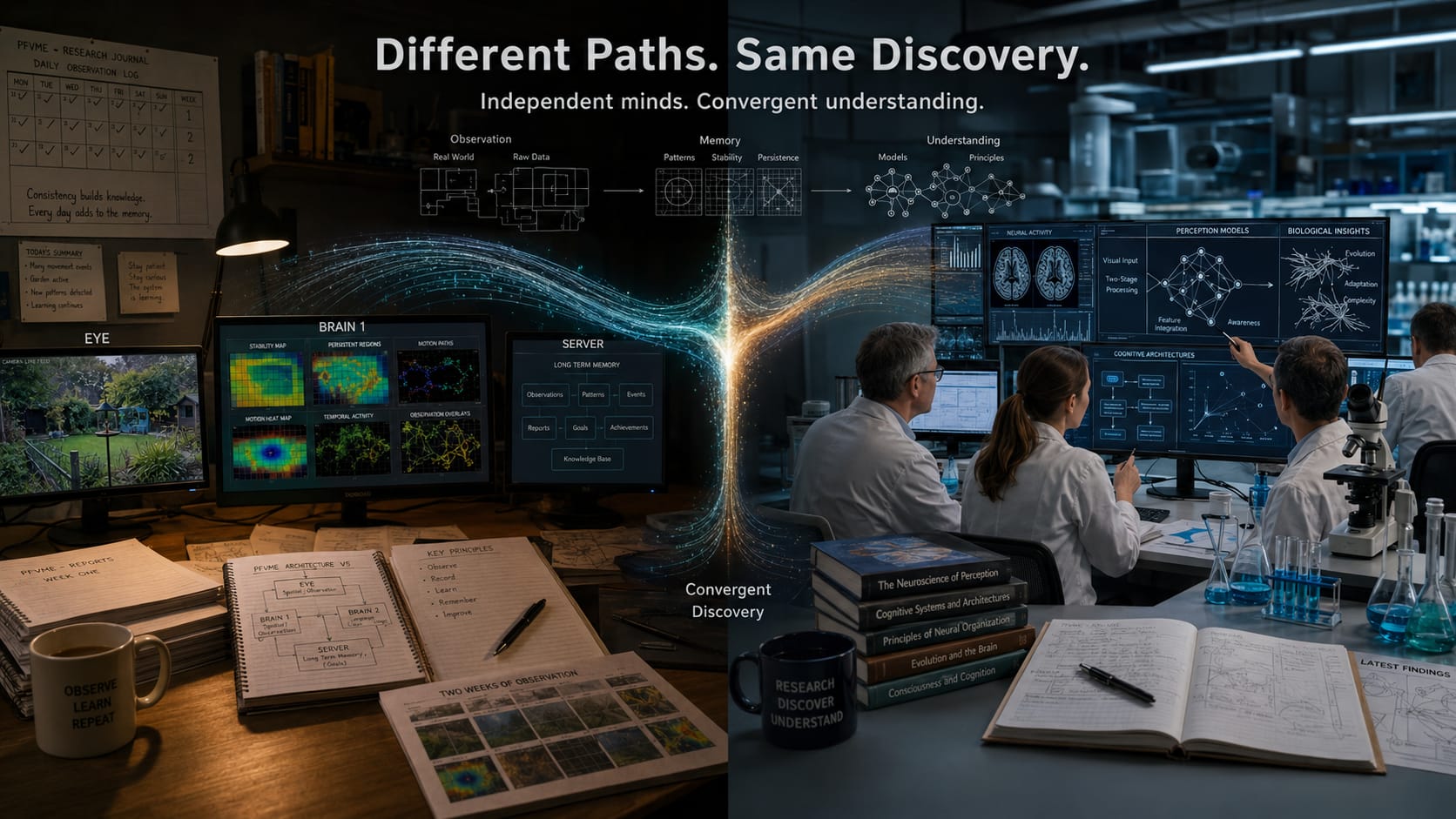
Many Different Paths, Similar Destinations
What independent AI research taught me about scientific discovery
Don't have time to read the article? View as a short video storyboard or listen to it whilst jogging.
Publish Date: Last Updated: 10th August 2026
Author: nick smith- With the help of CHATGPT
One of the most surprising discoveries to emerge from the PFVME project has had nothing to do with software engineering or artificial intelligence. Instead, it has been a lesson about how scientific ideas evolve.
Starting from first principles, with no intention of following existing academic models, PFVME has repeatedly converged on architectural concepts that are now appearing in contemporary research into perception, cognition, biology and even the origins of life.
For me, that has been both exciting and deeply humbling.
A Project Built from Questions Rather Than Answers
Over the past six months I have documented the progress of PFVME, an experimental research project exploring whether extremely simple systems can interact to produce increasingly intelligent behaviour.
The project is deliberately modest in its ambitions.
It is not attempting to build artificial general intelligence.
It is not trying to prove what consciousness is.
Nor does it claim to have discovered the correct model of intelligence.
Instead, PFVME asks a much simpler question:
If we begin with only the most fundamental abilities available to a living organism, how far can intelligence emerge through observation, memory and experience?
To explore that question, the project began with what I consider the most fundamental sense of all: vision.
Rather than training an AI on billions of labelled images, PFVME simply observes the world through a stationary camera. It searches for stability, movement, persistent regions, unexpected changes and relationships between events. Over time it attempts to construct its own internal understanding of its environment from repeated observation.
Every architectural decision has been driven by experimentation.
Some ideas worked.
Many failed.
Several entire versions of the system were abandoned when the evidence showed they were fundamentally flawed.
That willingness to discard months of work has probably become the greatest strength of the project.
Discovering That Others Were Walking Similar Paths
Throughout the project I have kept a collection of scientific articles that caught my attention because they appeared, at least conceptually, to relate to the problems PFVME was trying to solve.
Among them were research discussing:
- the role that increasingly rich visual information may have played in the evolution of ape and human brains;
- evidence that visual processing occurs in multiple stages before conscious perception;
- arguments that consciousness is more than simple computation;
- new theories regarding the origins of life and biological organisation;
- discoveries suggesting viruses and archaea may have played a much greater role in evolution than previously believed; and
- research demonstrating that DNA can now be constructed from scratch rather than simply copied.
These are all very different fields of study.
Some concern neuroscience.
Others explore evolutionary biology.
Some examine philosophy.
Others investigate genetics.
Yet despite approaching completely different questions, a surprising pattern began to emerge.
Many of these researchers were independently arriving at ideas that resonated strongly with the architectural direction PFVME had already begun to take.
Observation Before Intelligence
One of the strongest examples concerns perception.
Long before I had read recent neuroscience papers, I had become convinced through years of observing nature that sight forms the foundation upon which many other cognitive abilities are built.
Without an immediate understanding of your surroundings, every decision carries uncertainty.
Vision provides an almost instantaneous overview of the current state of the world.
Other senses remain essential, but each has limitations when considered in isolation.
A tree may not produce any sound for several minutes.
Without movement, hearing alone may never reveal its presence.
Smell provides valuable information but is highly localised.
Touch requires direct interaction.
Together these senses create a rich understanding of reality, but vision supplies the broad spatial context that allows everything else to be interpreted.
This belief eventually became the foundation of PFVME.
The project therefore began by learning nothing more than how to observe.
Only later would memory, prediction and higher-level reasoning be introduced.
When I later encountered research suggesting that increased visual information may have driven major developments in primate brains, and other work describing multiple stages of visual processing before conscious awareness, I found the parallels remarkable.
Not because PFVME had somehow anticipated the research.
But because entirely independent lines of thinking had converged on broadly similar principles.
The Role AI Played
Perhaps the most important part of this story is the role that modern AI has played.
For years these ideas existed only as notebooks, sketches and conversations with myself.
I had theories about observation, memory and environmental understanding, but I lacked the resources to turn those theories into working experiments.
That changed in 2026.
Working alongside ChatGPT and Codex, I could rapidly prototype architectures, write experimental code, analyse failures and redesign systems in weeks rather than years.
The AI did not invent PFVME.
The underlying ideas had been developing for a long time.
Instead, AI became an extraordinary engineering partner that transformed philosophical questions into practical experiments.
That partnership made it possible for a single independent developer to investigate ideas that previously would have required significant funding, specialist teams and laboratory resources.
Convergent Thinking
One thing should be made absolutely clear.
PFVME is not claiming to have solved intelligence.
It is not claiming to understand consciousness.
It is not validating or disproving the work of neuroscientists, biologists or philosophers.
What it demonstrates instead is something equally fascinating.
Different people, asking different questions, using different methods, can sometimes arrive at surprisingly similar conclusions.
That is not unusual in science.
History is filled with examples of simultaneous discovery, where multiple researchers independently developed comparable ideas because the available evidence pointed in similar directions.
Rather than diminishing anyone's work, this convergence often strengthens confidence that an underlying principle may be worth investigating.
PFVME has become one more independent path exploring that landscape.
Curiosity Over Certainty
If there is one philosophy that has guided the project from the beginning, it is this:
Never become emotionally attached to an idea.
Every version of PFVME has contained assumptions that eventually proved incorrect.
Entire architectures have been discarded.
Months of work have been abandoned.
The only thing that matters is what the evidence shows.
Progress rarely comes from defending yesterday's ideas.
It comes from having the confidence to replace them with better ones.
That mindset has repeatedly improved the project and has often led to discoveries that would never have appeared had I insisted on being right.
A New Era for Independent Research
Perhaps the most exciting lesson from PFVME is not about artificial intelligence at all.
It is about people.
For most of history, experimental research at this level required universities, research institutes or major corporations.
Today, capable AI systems have dramatically lowered that barrier.
A curious individual with enough determination can now design experiments, write software, analyse results and iterate at a pace that would have been unimaginable only a few years ago.
That does not replace professional science.
Far from it.
Universities and research laboratories remain essential.
But AI has created something new.
It has given independent researchers the opportunity to contribute ideas, explore unconventional approaches and occasionally discover that they have been walking a path remarkably close to those being explored by the scientific community itself.
Final Thoughts
One of my earlier philosophical articles explored the idea that important ideas rarely belong to one person alone.
Instead, they seem to emerge repeatedly in different places, carried forward by people who may never meet.
PFVME has reinforced that belief.
Working independently from a home office, with modest hardware and the assistance of modern AI, I have repeatedly encountered concepts that mirror those emerging from world-class research groups.
That does not prove the project is correct.
Nor does it diminish the extraordinary work carried out by those researchers.
Instead, it reminds me why science has always begun with curiosity.
Ask questions.
Observe carefully.
Accept when you are wrong.
Follow the evidence wherever it leads.
Sometimes, entirely independent journeys can arrive at remarkably similar destinations.

Latest PFVME Articles
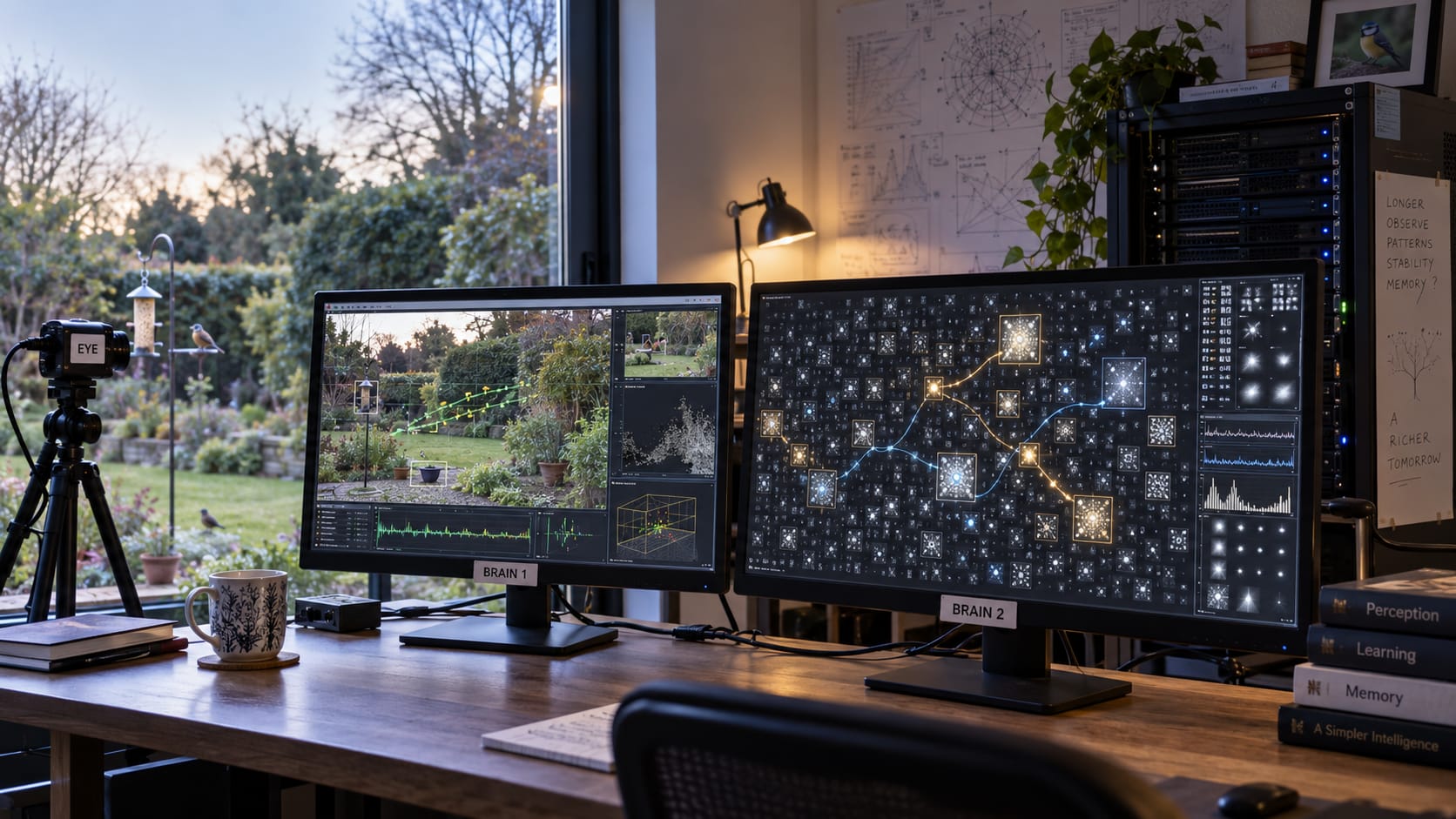
PFVME Journal Part 6 – Learning What Is Worth Remembering
After more than 126 million cycles, PFVME's Brain 2 is moving closer to creating its first glyphs. But before allowing it to...
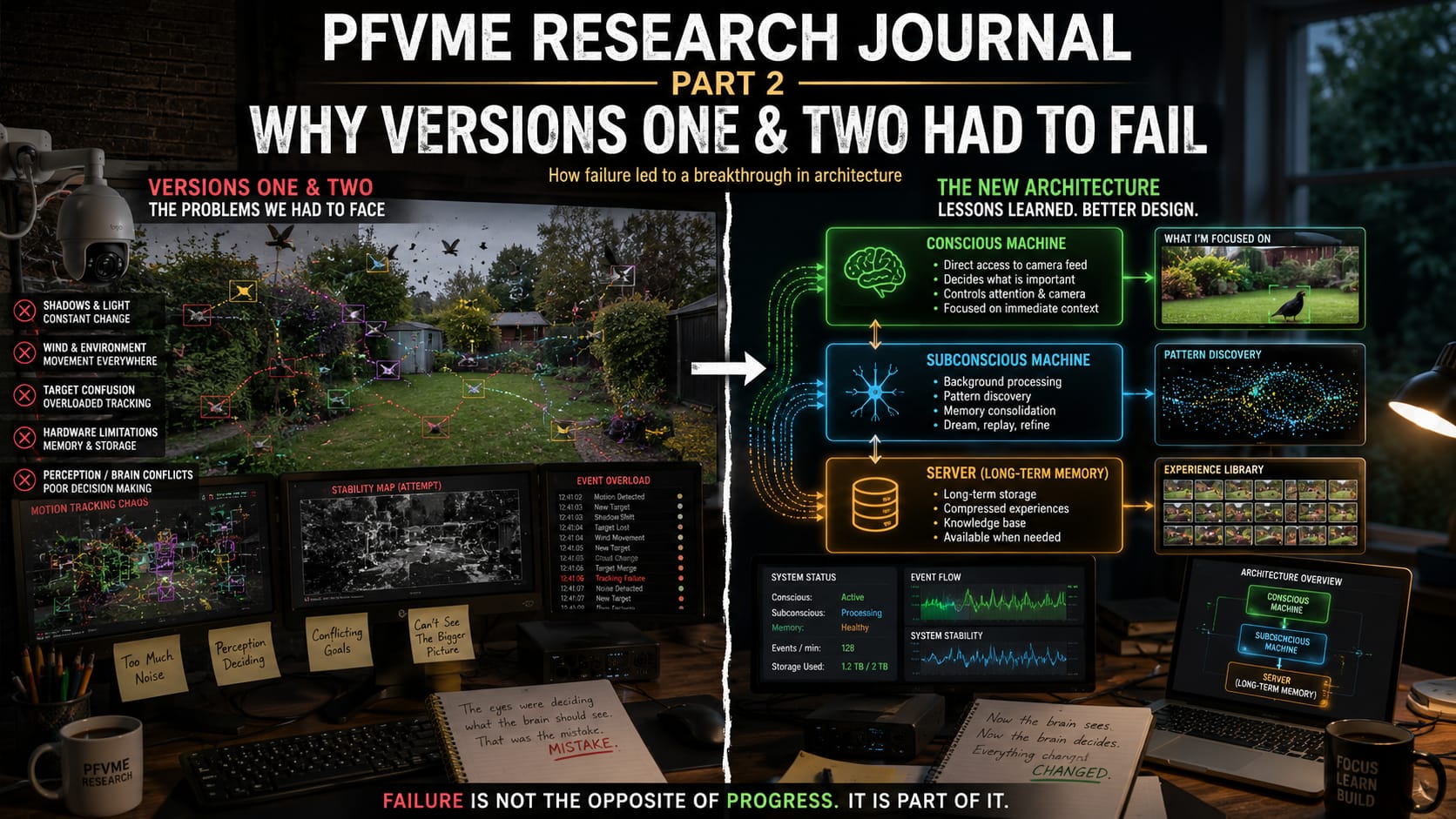
PFVME Research Journal – Part 5: The Introduction of Brain 2
PFVME reaches a major milestone as Brain 2 comes online. After weeks of patient observation by Brain 1, a second independent...
PFVME Research Journal – Part 4
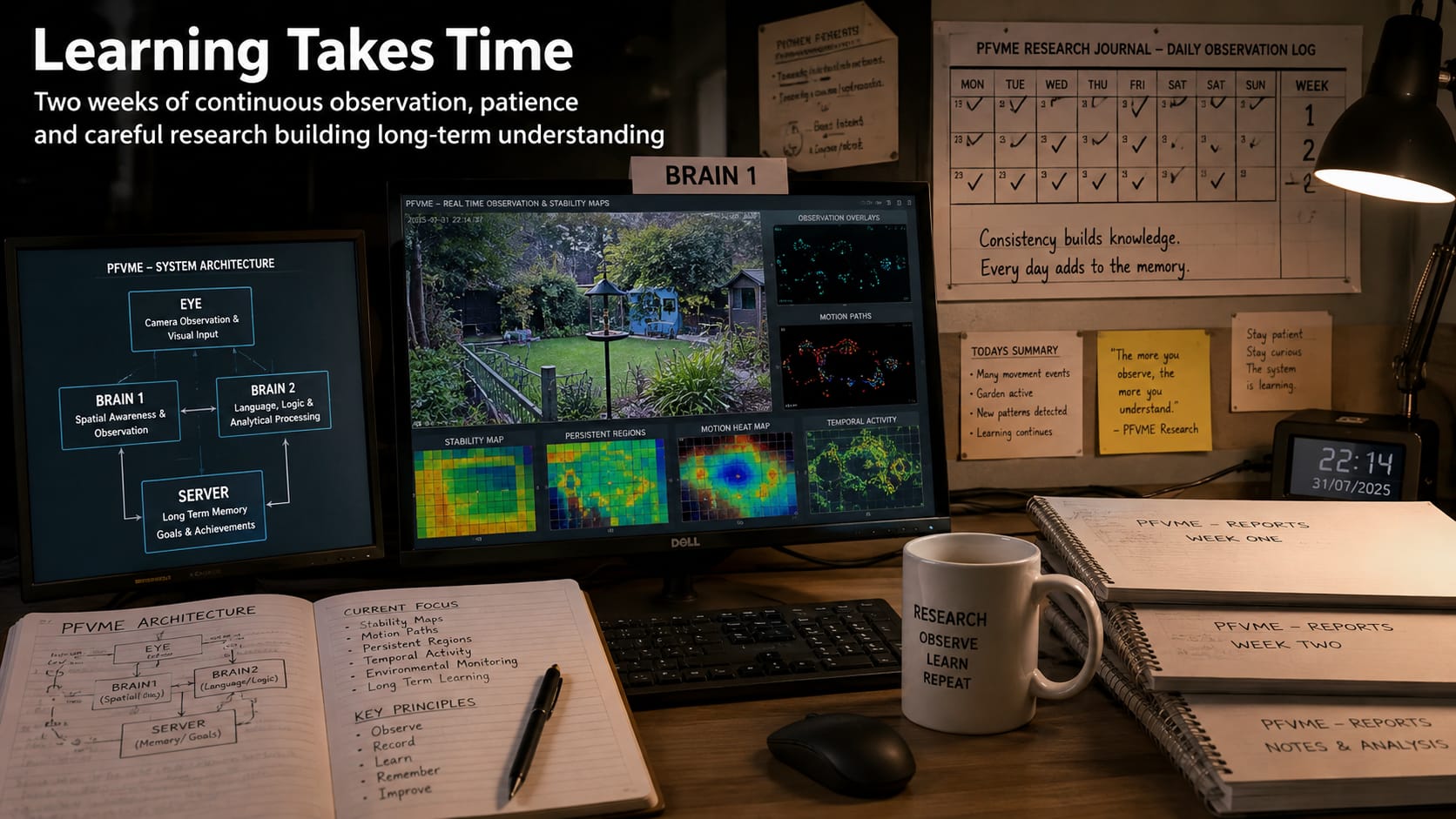
Can artificial intelligence learn simply by watching the world? After weeks of continuous observation, Brain 1 of the PFVME...
PFVME Research Journal – Part 3 – Building a Mind Instead of a Program
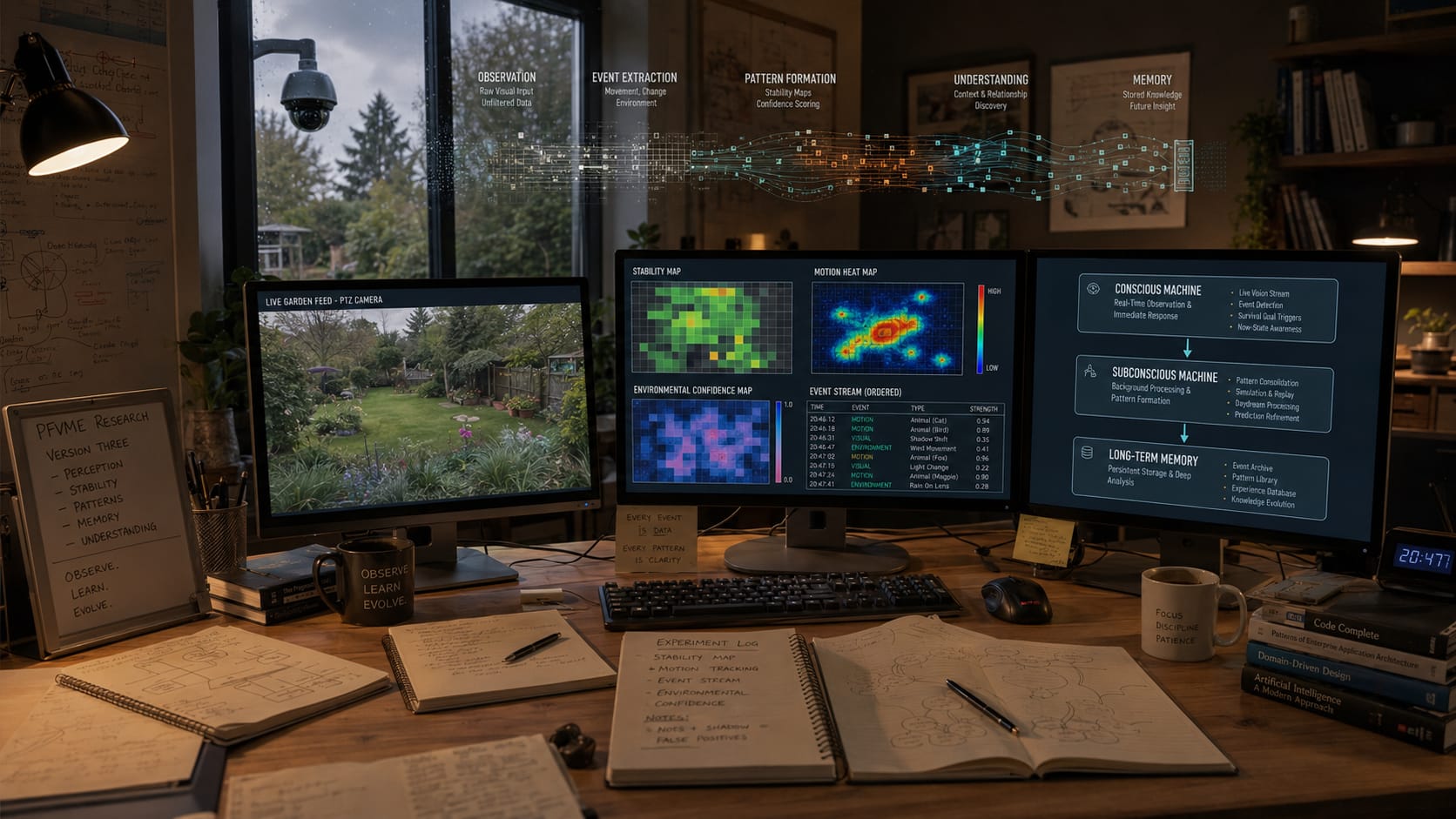
Version Five marks a major milestone in the PFVME Research Journal. Discover how specialised AI systems, digital survival goals,...

AI Questions and Answers section for Many Different Paths, Similar Destinations
Welcome to a new feature where you can interact with our AI called Jeannie. You can ask her anything relating to this article. If this feature is available, you should see a small genie lamp above this text. Click on the lamp to start a chat or view the following questions that Jeannie has answered relating to Many Different Paths, Similar Destinations.
Be the first to ask our Jeannie AI a question about this article
Look for the gold latern at the bottom right of your screen and click on it to enable Jeannie AI Chat.
Type: Article -> Category: The PFVME Research Journal