Type: Article -> Category: The PFVME Research Journal
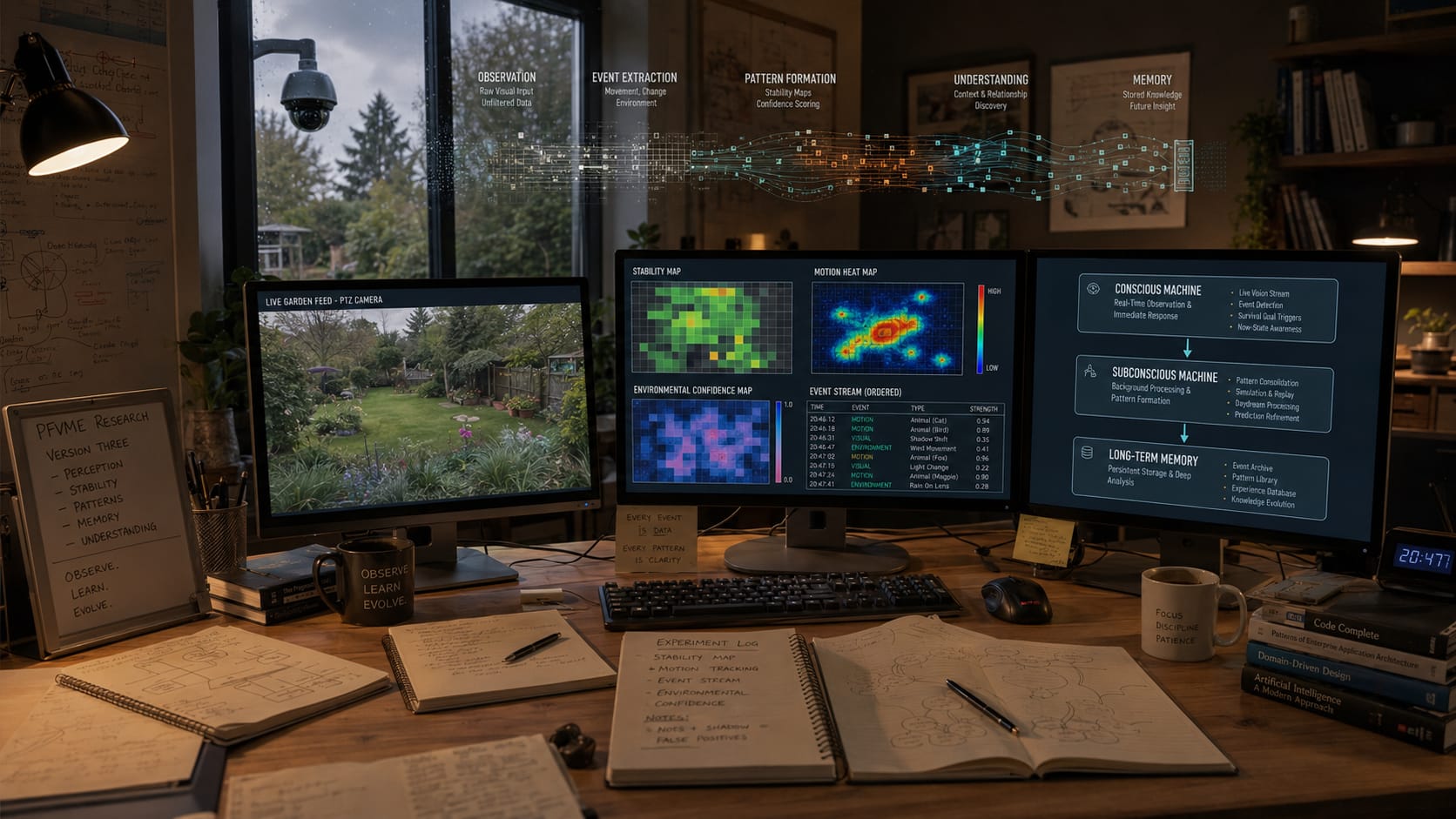
PFVME Research Journal Part 3
The Architecture Begins to Emerge
Don't have time to read the article? View as a short video storyboard or listen to it whilst jogging.
Publish Date: Last Updated: 19th July 2026
Author: nick smith- With the help of CHATGPT
There is an old saying that no battle plan survives first contact with the enemy.
I am beginning to think exactly the same principle applies when attempting to build an artificial intelligence from first principles.
Every version of PFVME has taught me something new. Sometimes that lesson has come from success. More often it has come from failure. As frustrating as it can be to throw away weeks of work, each discarded version has moved the project one step closer to something that feels both simpler and more coherent.
One of the greatest advantages I have today, compared to even a few years ago, is artificial intelligence itself.
Without AI I would have spent months writing code before discovering fundamental design flaws. By that point it would have been psychologically difficult to abandon the work because of the sheer amount of time invested.
Instead, AI allows me to experiment rapidly.
If an idea proves to be fundamentally wrong, I can discard it, learn from it and rebuild without losing months of development time. The cost of experimentation has become dramatically lower, allowing the architecture to evolve naturally instead of forcing myself down a path simply because too much effort has already been invested.
I have said many times throughout this journal that I am not a neuroscientist. My understanding of biology comes from years of reading, documentaries, research papers and curiosity rather than formal medical training.
PFVME is therefore not an attempt to recreate the human brain.
It is an attempt to understand which ideas from biology appear useful and then adapt those ideas into something that makes sense for a digital system.
Version Five represents the biggest step in that direction so far.

When Version Four Reached Its Limit
Before discussing Version Five, it is worth looking back at what Version Four achieved.
The system consisted of a vision subsystem, a conscious processing system, a subconscious processing system and long-term memory.
Its primary objective remained deliberately simple.
Observe the world continuously and learn what remains stable.
This may sound trivial, but it is surprisingly difficult.
A tree is normally fixed, yet its branches constantly move.
Shadows move across the ground.
Clouds change the lighting.
Rain alters reflections.
Birds land in bushes.
People appear unexpectedly.
Everything within the scene is continually changing, yet much of that change follows patterns.
Rather than attempting to recognise named objects, the system simply tried to understand its environment by observing it repeatedly.
Over time it began producing stability maps, confidence maps and behavioural maps that showed which areas of the scene remained predictable and which did not.
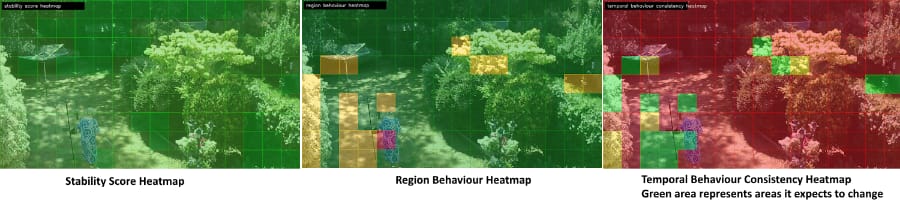
Version Four also introduced one of the first genuinely interesting developments.
Instead of simply recording observations, the system began generating questions about what it was seeing.
These were not questions written by me, but questions generated from uncertainty within the environment.
Examples included:
- Why does this region usually remain stable?
- Why does movement occur here every morning?
- Is this object independent or attached to something larger?
- Does movement in one region predict movement elsewhere?
- Is this behaviour temporary or persistent?
- Has this area become less predictable over time?
- Does this pattern repeat every day?
- What evidence would increase confidence?
Although extremely primitive, this represented an important shift.
The system had moved from simply observing reality towards attempting to explain it.
An Unexpected Discovery
For approximately two days the system behaved exactly as expected.
Storage usage increased steadily as observations accumulated.
During this period it generated around 200GB of data while gradually improving its understanding of the scene.
Then something unexpected happened.
During the following twelve hours the system consumed the remaining 300GB of available storage before crashing completely.
Unfortunately, because the drive became full, I lost the opportunity to generate the diagnostic reports that would have explained exactly what happened.
I want to be very clear about something.
I am not suggesting that the system suddenly became intelligent or somehow "came alive."
There is absolutely no evidence for that.
However, I do have a working hypothesis.
My suspicion is that once the environment reached a sufficiently stable state, the number of possible relationships and questions expanded dramatically. Instead of simply recording observations, the system may have begun exploring increasingly complex combinations of those observations.
Whether that explanation is correct remains unknown.
The only scientific response is to redesign the system, reproduce the behaviour and collect better evidence.
That decision ultimately became Version Five.
Building the Infrastructure First
One important conclusion emerged from every previous version.
I had been concentrating too much on intelligence and not enough on infrastructure.
The architecture needed to become simpler before it could become more capable.
The first major decision was therefore to abandon Windows entirely.
Although Windows had worked well throughout development, it consumed considerably more resources than were actually required.
Every machine within the project has now been migrated to Ubuntu and upgraded with larger NVMe storage, providing significantly greater capacity for the continuous data collection that this project demands.
More importantly, I abandoned the conscious and subconscious terminology altogether.
The more I studied neuroscience, the more I realised that the brain appears to consist of many specialised systems working simultaneously rather than one large central processor.
That observation inspired an entirely new architecture.
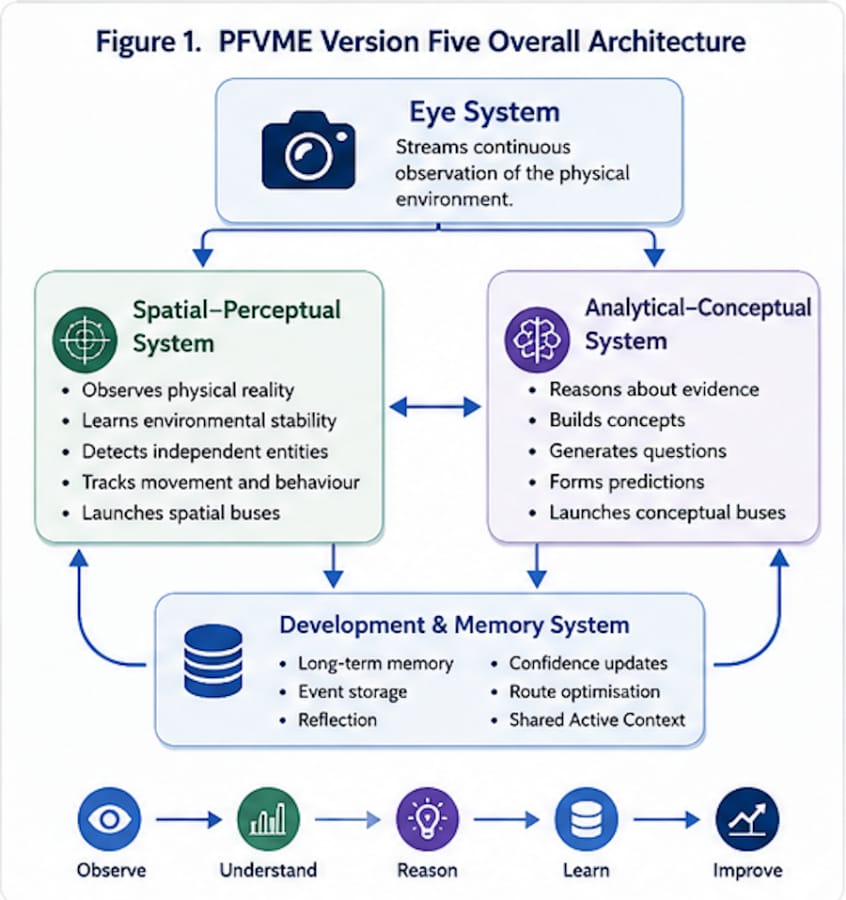
The New Architecture
Rather than attempting to build one large intelligent system, PFVME is now divided into several specialised systems.
The Eye
The Eye performs one task only.
It observes reality.
Running independently on its own machine, it streams a continuous view of the environment that any authorised system on the network can access.
Its purpose is not to interpret the world.
Its purpose is simply to provide an accurate representation of the present moment.
The Spatial–Perceptual System
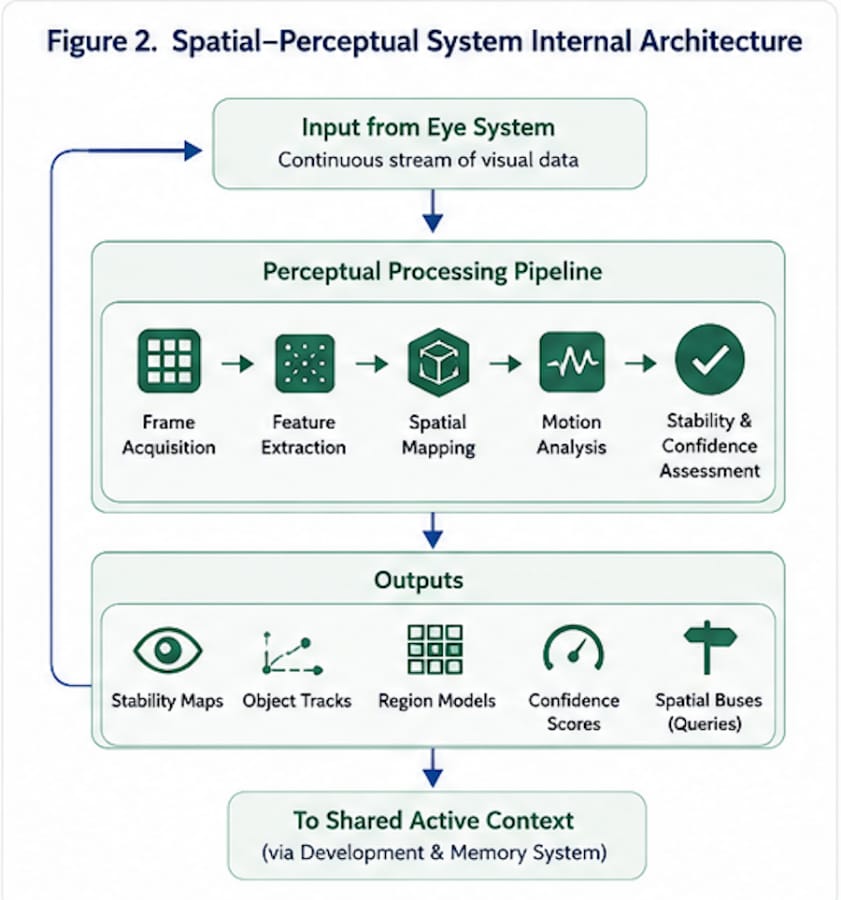
This system is grounded entirely in physical reality.
Its responsibility is to determine:
- what remains stable
- what changes
- what moves independently
- what appears attached
- what deserves attention
- how confidence changes over time
Rather than recognising labelled objects, it attempts to construct an internal understanding of the physical world through repeated observation.
This machine effectively answers one question:
"What exists?"
The Analytical–Conceptual System
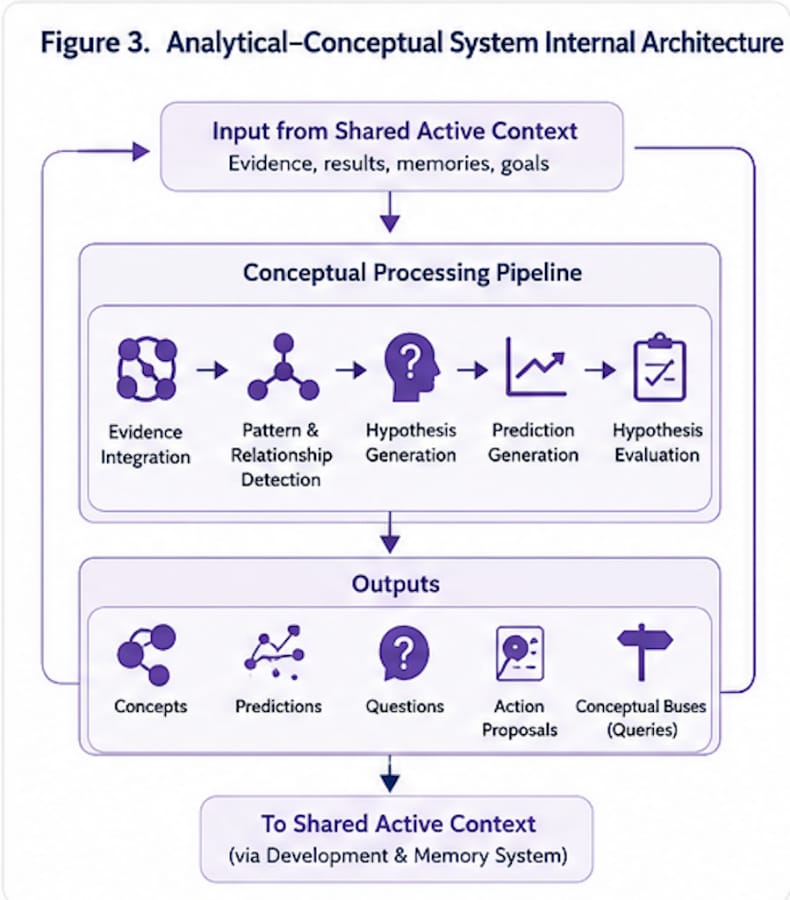
The second brain operates very differently.
It receives evidence from the Spatial–Perceptual system and attempts to reason about it.
Its role is to build concepts, relationships, explanations and eventually language.
Rather than asking What exists?, it asks:
"What does it mean?"
This separation between perception and reasoning should allow each system to specialise without becoming unnecessarily complex.
Development and Memory
The final system acts as the long-term knowledge store.
Its responsibilities include:
- storing experiences
- consolidating memories
- maintaining routes
- monitoring performance
- coordinating development
- supporting reflection
Rather than becoming an enormous database, memory gradually evolves into an organised collection of experiences that the other systems can retrieve whenever required.
Digital Survival
One important realisation fundamentally changed the direction of the project.
A digital system does not have biological needs.
It does not become hungry.
It does not fear predators.
It does not reproduce.
Trying to recreate biological motivations therefore seemed both artificial and unnecessary.
Instead, PFVME now develops survival goals based upon the things it can genuinely influence.
Initially these include:
- controlling the camera
- directing attention
- launching processing buses
- selecting routes
- retrieving memories
- asking questions
- allocating processing resources
- communicating between machines
- revisiting unresolved events
- deciding what information to present
- eventually controlling speakers, displays and physical devices
These become the equivalent of its "body."
They represent actions that genuinely matter to the continued operation of the system.
A New Way of Thinking About Memory
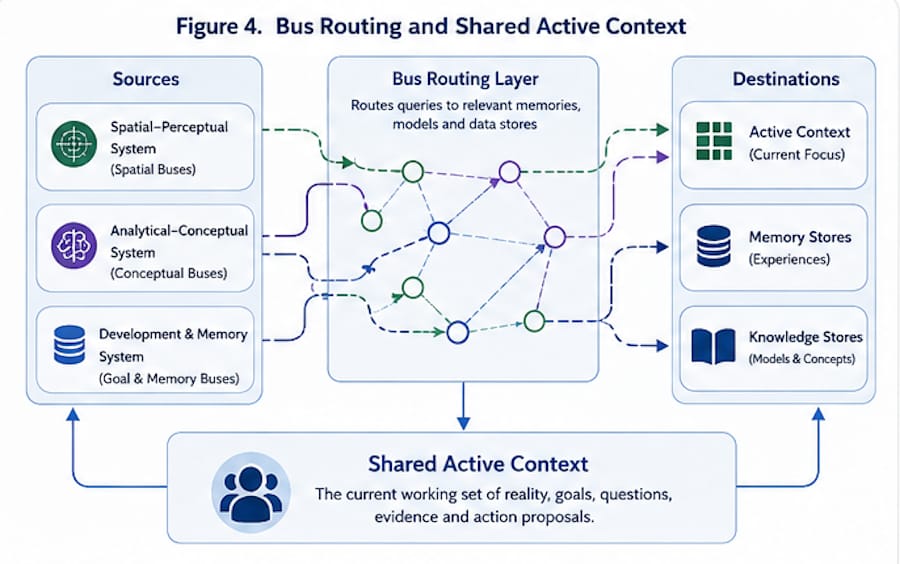
One of the biggest architectural changes introduced in Version Five is the concept of Buses.
Rather than attempting to load enormous quantities of information into memory, the system launches many small independent buses.
Each bus has a specific purpose.
Some buses explore spatial relationships.
Others retrieve memories.
Some search for evidence.
Others investigate predictions.
Each bus follows its own route before returning with only the information relevant to the current situation.
Instead of one enormous computation, many smaller computations operate simultaneously.
This approach more closely resembles specialised workers performing independent tasks than a single processor attempting to solve everything at once.
The PFVME Processing Cycle
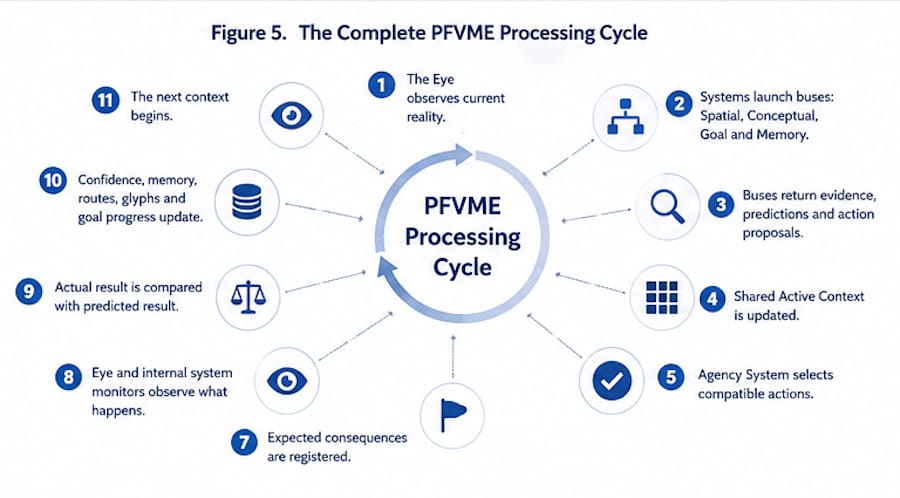
The entire architecture now follows a much clearer processing cycle.
- The Eye observes current reality.
- The Spatial–Perceptual System launches spatial buses.
- The Analytical–Conceptual System launches conceptual buses.
- The Memory System provides relevant experiences and goals.
- Returned evidence updates the shared active context.
- Compatible actions are selected.
- Actions are executed.
- The Eye observes the outcome.
- Predictions are compared with reality.
- Confidence, memories, routes and internal models are updated.
- The cycle begins again.
Teaching the System to Reflect
Another subsystem introduced during the redesign is reflection.
Rather than simply continuing indefinitely, the system periodically pauses to review its own behaviour.
It asks itself questions such as:
- What did I achieve?
- Which predictions proved correct?
- Which assumptions failed?
- Which routes wasted processing?
- Which memories proved useful?
- Which areas still require investigation?
- What should I try differently next time?
Reflection transforms experience into improvement.
Without reflection the system simply accumulates data.
With reflection it begins evaluating its own performance and gradually refining its behaviour over time.
Where the Project Stands Today
At the time of writing, the Eye is continuously streaming observations while the Spatial–Perceptual System is once again learning the environment from scratch.
Its immediate objective is still deceptively simple.
Learn what normally happens.
By understanding which regions remain stable, which objects behave predictably and which events genuinely deserve attention, the system gradually develops a reliable internal model of its surroundings.
A bush moving in the wind should not constantly trigger investigation.
However, a bird landing within that bush might.
The challenge therefore is not to ignore movement.
The challenge is to learn which movement is expected and which movement deserves further investigation.
Every new observation contributes to confidence.
Every repeated event strengthens or weakens previous assumptions.
Rather than making absolute decisions, the system increasingly learns to make educated judgements based upon evidence gathered over time.
What Comes Next?
The immediate focus remains firmly on completing the Spatial–Perceptual System.
Before introducing higher-level reasoning, the system first needs a reliable understanding of the physical world it inhabits.
Future development will concentrate on improving:
- environmental stability
- independent object discovery
- persistent region analysis
- behavioural prediction
- confidence modelling
- causal relationships
- memory routing
- event significance
Only once these foundations are sufficiently mature will development shift towards the Analytical–Conceptual System, where evidence can begin evolving into concepts, reasoning and eventually symbolic understanding.
Conclusion
As I was writing this article, I happened to be listening to a BBC discussion asking whether artificial intelligence makes people less capable or more capable.
Like many debates surrounding AI, the conversation focused heavily on the potential dangers.
Those dangers certainly exist.
Like any powerful technology, AI can be misused.
However, I believe these discussions often overlook something equally important.
AI is ultimately a tool.
Whether that tool is used to deceive, to automate blindly or to replace learning is a human decision.
Equally, it can be used to build, explore, experiment and accelerate understanding.
This project exists because of that second possibility.
I have never written production software in Python, yet today I find myself building a distributed artificial intelligence research platform spanning multiple specialised systems.
That has only been possible because AI allows me to concentrate on architecture, experimentation and understanding while helping me overcome technical barriers that would previously have made a project of this scale impossible for a single researcher.
None of this guarantees success.
PFVME may never demonstrate even the most primitive form of genuine machine intelligence.
That is a possibility I accepted before writing the first line of code.
But scientific progress has never depended solely upon success.
It depends upon asking good questions, testing ideas honestly, learning from failure and being willing to abandon assumptions when the evidence demands it.
Every version of PFVME has taught me something I did not know before.
Version Five feels different.
For the first time, the project no longer resembles a collection of experiments.
It resembles the beginnings of an architecture.
The coming months will determine whether that architecture provides the foundation for something genuinely interesting.
If nothing else, it has already allowed me to explore ideas that had existed only as sketches and notebook pages for decades.
That alone has made the journey worthwhile.

More Journals on the PFVME Project
PFVME Journal Part 6 – Learning What Is Worth Remembering
After more than 126 million cycles, PFVME's Brain 2 is moving closer to creating its first glyphs. But before allowing it to...
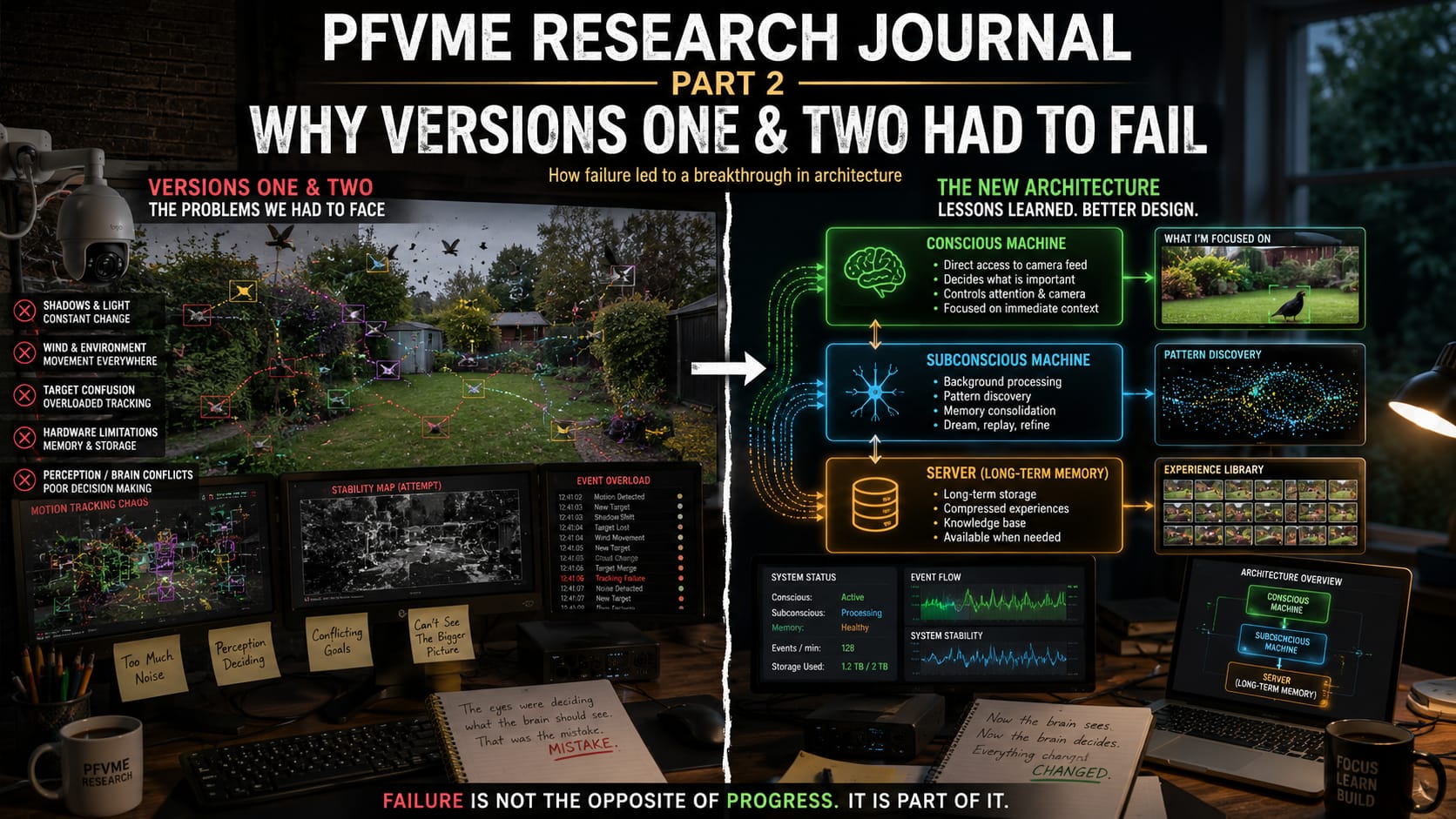
PFVME Research Journal – Part 5: The Introduction of Brain 2
PFVME reaches a major milestone as Brain 2 comes online. After weeks of patient observation by Brain 1, a second independent...
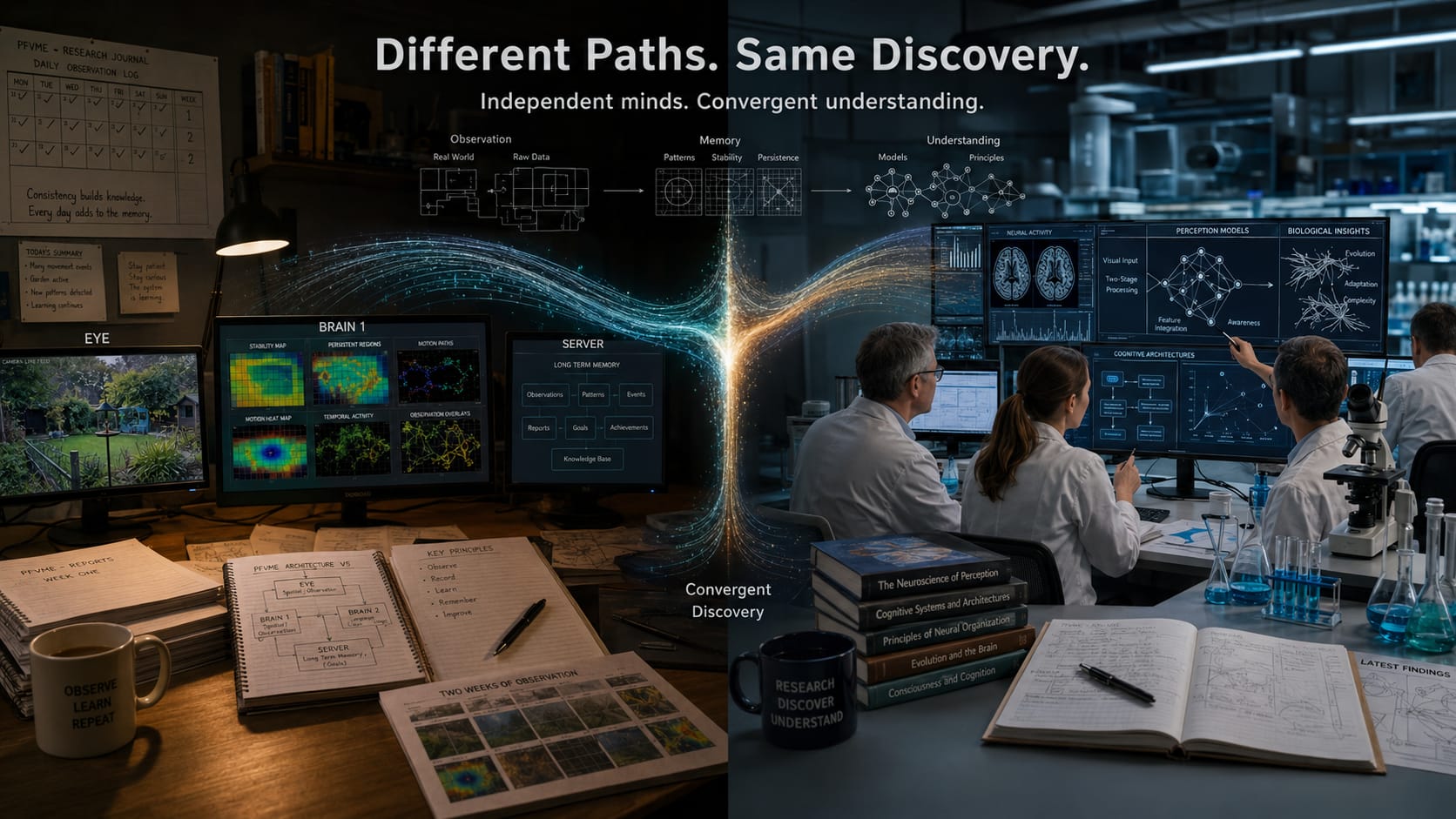
Many Different Paths, Similar Destinations
Can independent AI research reach the same conclusions as world-leading laboratories? The PFVME project unexpectedly found itself...
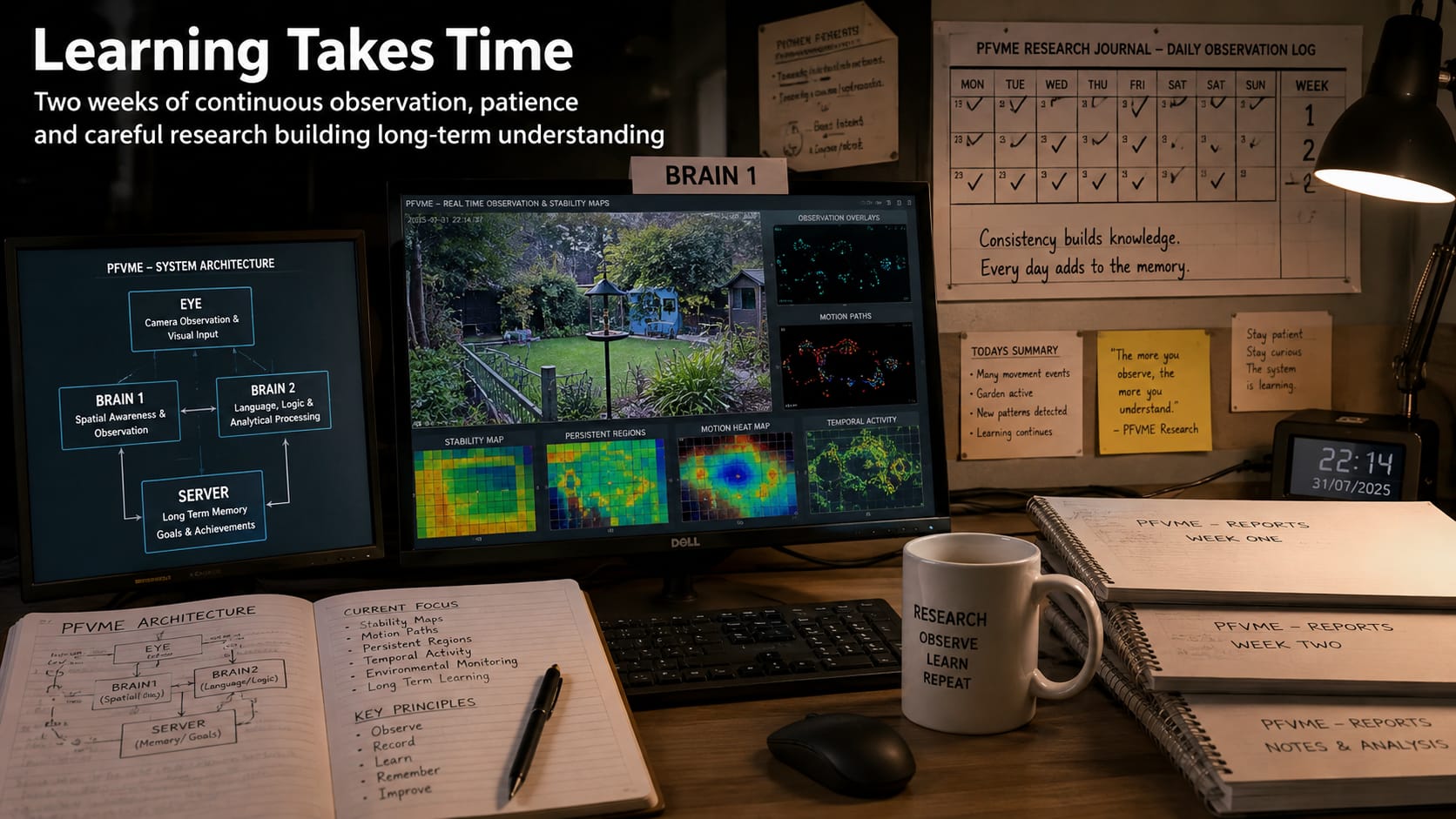
PFVME Research Journal – Part 4
Can artificial intelligence learn simply by watching the world? After weeks of continuous observation, Brain 1 of the PFVME...

AI Questions and Answers section for PFVME Research Journal – Part 3 – Building a Mind Instead of a Program
Welcome to a new feature where you can interact with our AI called Jeannie. You can ask her anything relating to this article. If this feature is available, you should see a small genie lamp above this text. Click on the lamp to start a chat or view the following questions that Jeannie has answered relating to PFVME Research Journal – Part 3 – Building a Mind Instead of a Program.
Be the first to ask our Jeannie AI a question about this article
Look for the gold latern at the bottom right of your screen and click on it to enable Jeannie AI Chat.
Type: Article -> Category: The PFVME Research Journal