Type: Article -> Category: The PFVME Research Journal
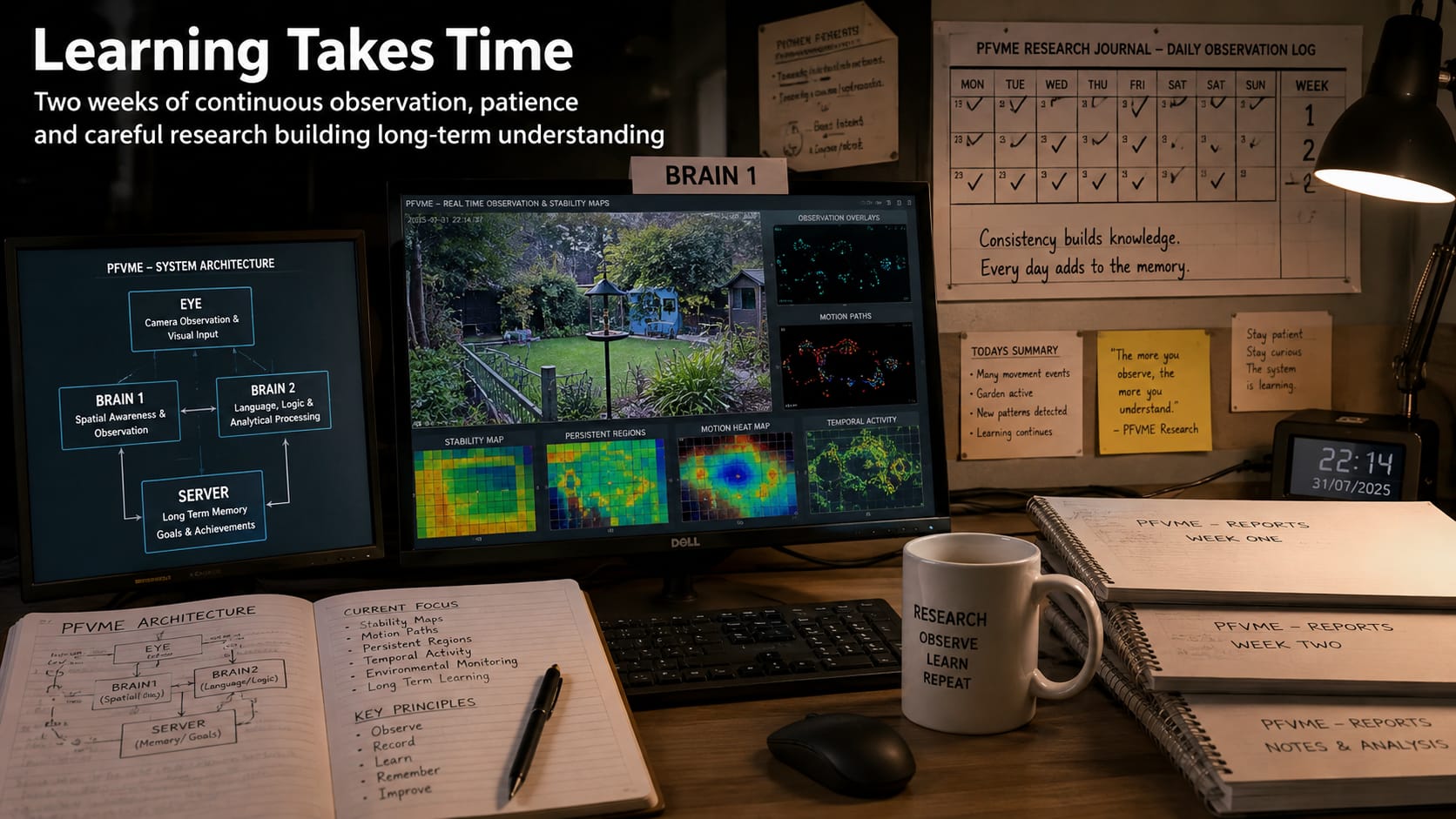
PFVME Research Journal – Part 4
Patience Is the Greatest Strength
Publish Date: Last Updated: 5th August 2026
Author: nick smith- With the help of CHATGPT
When I published the previous journal entry, Version Five of the PFVME project had reached an important milestone. The new architecture had been defined, the hardware was in place and Brain 1 had begun observing the world rather than simply reacting to it.
Since then I have deliberately resisted the temptation to make dramatic changes.
For many software projects that might sound counterintuitive. Developers are conditioned to write code, fix bugs, add features and push forward as quickly as possible. Modern AI coding assistants make that even easier. Features that once required days can often be implemented in an afternoon.
However, PFVME is not trying to build another application.
It is attempting to build the foundations of intelligence.
That changes everything.

A Project That Would Have Been Impossible Only a Few Years Ago
For anyone discovering these journals for the first time, PFVME is an experimental research project exploring whether simple interacting systems can produce increasingly intelligent behaviour without relying on enormous language models or expensive hardware.
The guiding principle has remained unchanged from the beginning:
Complexity should emerge from layers of simple systems rather than being programmed directly.
Only three years ago a project like this would have been extremely difficult for an individual developer to undertake. The amount of software engineering required would have demanded a small team.
Today the landscape is completely different.
Modern AI coding agents have become genuine development partners. They can produce boilerplate code, review architecture, suggest improvements, identify bugs and even debate alternative approaches.
Instead of replacing the developer, they dramatically increase what one developer is capable of achieving.
That has allowed me to spend less time writing repetitive code and more time thinking about the architecture itself—which is exactly where this project needs the most attention.
Brain 1 Begins to Mature

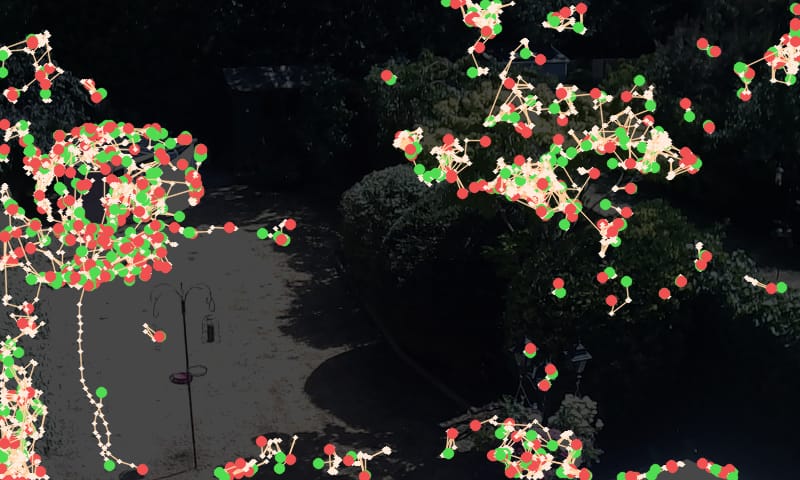
The majority of development over the last few weeks has focused on refining Brain 1.
Brain 1 is responsible for understanding the physical world.
It does not know what a bird is.
It does not know what a tree is.
It simply observes motion, persistence, stability, boundaries, relationships and changes over time.
That distinction is incredibly important because I want knowledge to emerge naturally from observation rather than being injected through predefined labels.
Instead of adding new headline features, most of the recent work has concentrated on improving the quality and consistency of observation.
The system has become significantly better at separating environmental movement from genuinely independent movement. Wind moving through trees, changing shadows and lighting variations are increasingly recognised as background environmental behaviour, allowing Brain 1 to devote more attention to objects that appear to possess their own independent motion.
The reporting system has also continued to evolve. The diagnostic reports now provide a much richer picture of what the machine believes is happening within its environment. Rather than simply logging movement, they reveal where activity repeatedly occurs, how stable regions become over time and where unexpected events challenge existing assumptions.
Another important refinement has been reducing the number of assumptions made by the software itself.
Whenever possible, the system now records raw evidence first and postpones interpretation until sufficient observations have accumulated. This approach produces slower progress initially but creates a much more reliable foundation for future learning.
Learning to Observe Before Learning to Think
One of the biggest architectural changes has actually been philosophical rather than technical.
Earlier versions naturally encouraged the software to make increasingly confident assumptions as soon as patterns appeared.
The newer design deliberately avoids that.
Human beings are frequently fooled by optical illusions, magic tricks and incomplete information because multiple systems within the brain reinforce the same incorrect conclusion.
Rather than treating this as a flaw, I believe it is actually an essential characteristic of intelligence.
Brain 1 and Brain 2 will therefore be allowed to reach the same incorrect conclusion when the available evidence supports it.
The important difference is what happens next.
When later observations contradict that belief, the assumption is revised rather than hidden.
Instead of pretending the mistake never happened, the system learns why it happened.
That creates something much closer to genuine experience than simply calculating the correct answer every time.
What the Reports Are Beginning to Show
The most encouraging development has not been spectacular demonstrations.
It has been consistency.
After allowing Brain 1 to observe the same environment for extended periods, the reports have become noticeably cleaner and more meaningful.
Stable regions are becoming genuinely stable.
Frequently travelled paths are becoming obvious.
Areas of repeated activity are beginning to separate naturally from background environmental motion.
Unexpected behaviour stands out far more clearly because the system now has a stronger expectation of what "normal" looks like.
This is exactly the kind of progress I had hoped for.
The reports are no longer dominated by noise.
Instead they are beginning to tell a story.
Where do independent objects usually appear?
Which areas remain unchanged for hours?
Which regions are consistently affected by wind?
Which events occur only rarely?
These are remarkably simple questions.
Yet together they form the beginnings of an internal model of reality.
Looking Ahead to Brain 2
With Brain 1 becoming increasingly reliable, attention is gradually shifting towards Brain 2.
Originally I described these components as something similar to conscious and subconscious systems, but I no longer think that terminology is accurate.
Instead, Version Five is evolving into a collection of specialist machines.
Each observes the same world but from a completely different perspective.
Brain 1 focuses on physics.
It understands movement, persistence, geometry and spatial relationships.
Brain 2 will observe exactly the same information but search for abstraction.
Rather than asking:
"What moved?"
it will begin asking:
"What appears to belong together?"
Several independently moving fragments may actually represent a single object.
A changing outline may indicate that an object is deformable rather than multiple separate entities.
Groups of observations may become a single higher-level concept.
Brain 2 therefore becomes a specialist in abstraction instead of physical observation.
The two systems will exchange hypotheses rather than absolute truths.
Agreement between them increases confidence.
Disagreement is equally valuable because it often signals that something new has been discovered or that an earlier assumption should be revised.
Neither machine is considered "correct."
Reality decides.
That philosophy mirrors the way scientific knowledge develops and, I hope, provides a far stronger basis for learning than forcing one system to dominate the other.
Why Patience Is the Greatest Strength
Modern AI development creates an interesting psychological trap.
Because code can now be generated at incredible speed, there is a constant temptation to move immediately onto the next feature.
A few successful tests...
A quick demonstration...
Then on to the next milestone.
For most software that approach makes perfect sense.
PFVME is different.
The objective is not to build software quickly.
The objective is to allow experience to accumulate.
No amount of additional code can replace time spent observing.
Associations cannot be rushed.
Patterns require repetition.
Expectations require evidence.
Even the simplest understanding of the world takes days of continuous observation before meaningful trends begin to emerge.
That has become one of the most valuable lessons of Version Five.
The best improvements over the last few weeks have not come from writing thousands of new lines of code.
They have come from allowing the existing system to watch, record and quietly learn from the same environment for long periods before making changes.
Only then do the reports become rich enough to expose weaknesses in the architecture and suggest genuine improvements based on evidence rather than assumptions.
In many ways that mirrors how biological intelligence develops.
Learning is not simply a function of computation.
It is a function of experience.
As Brain 1 continues to mature and Brain 2 begins its own journey into abstraction, I suspect patience will remain one of the most valuable design principles in the entire project.
Not because development is slow.
But because genuine understanding has never been something that can be hurried.

Latest PFVME Project Journals
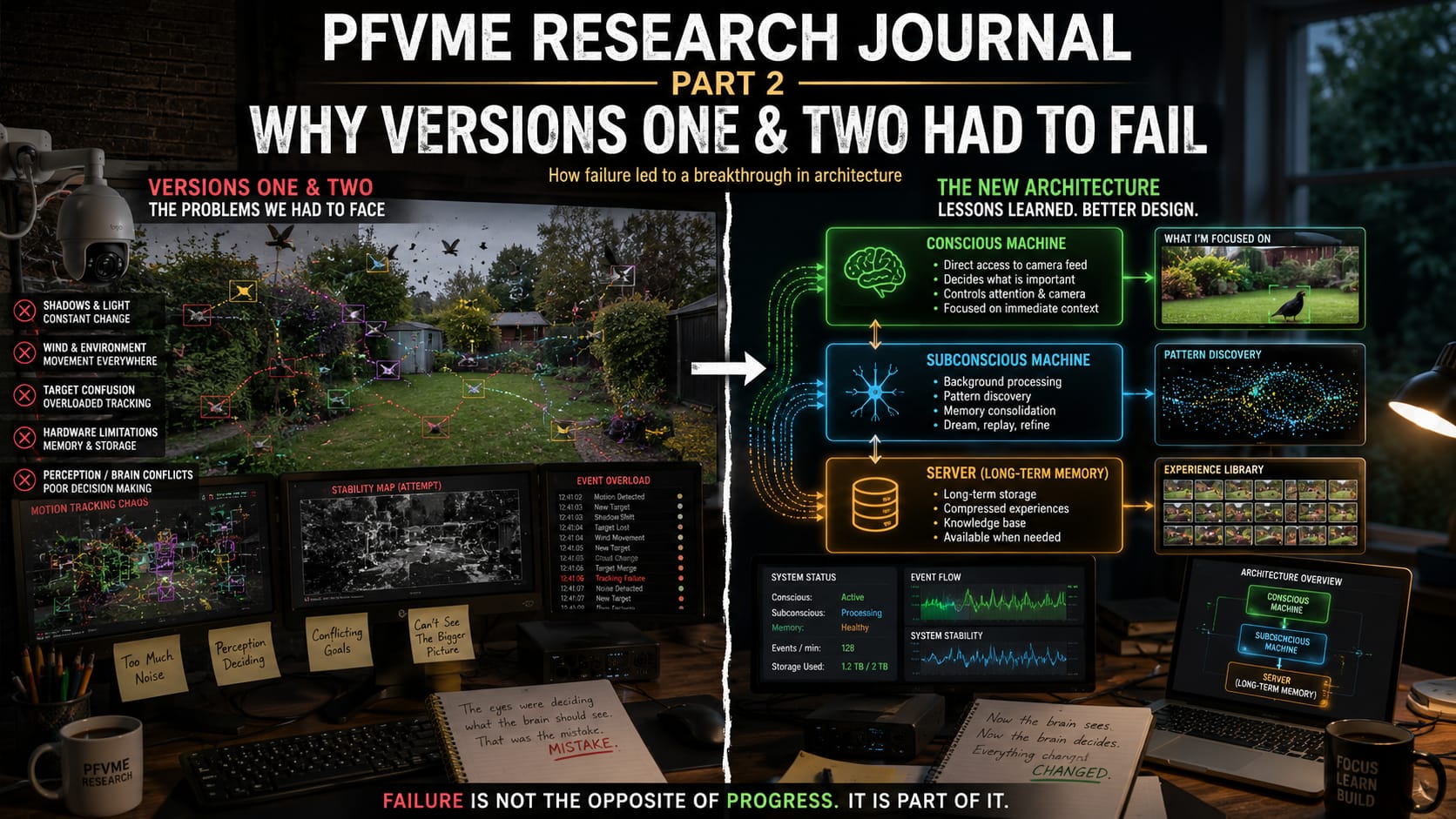
PFVME Research Journal – Part 5: The Introduction of Brain 2
PFVME reaches a major milestone as Brain 2 comes online. After weeks of patient observation by Brain 1, a second independent...
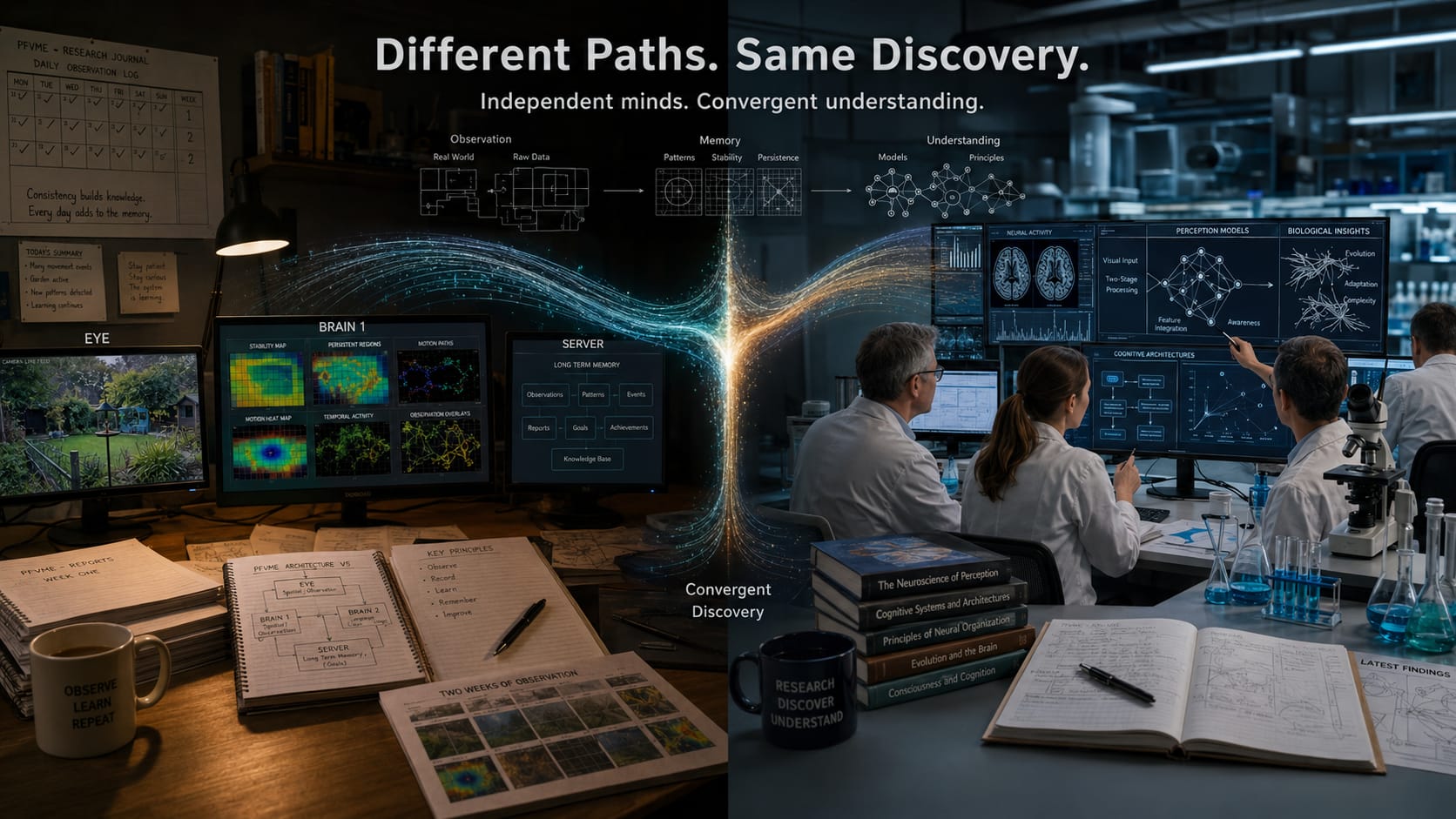
Many Different Paths, Similar Destinations
Can independent AI research reach the same conclusions as world-leading laboratories? The PFVME project unexpectedly found itself...
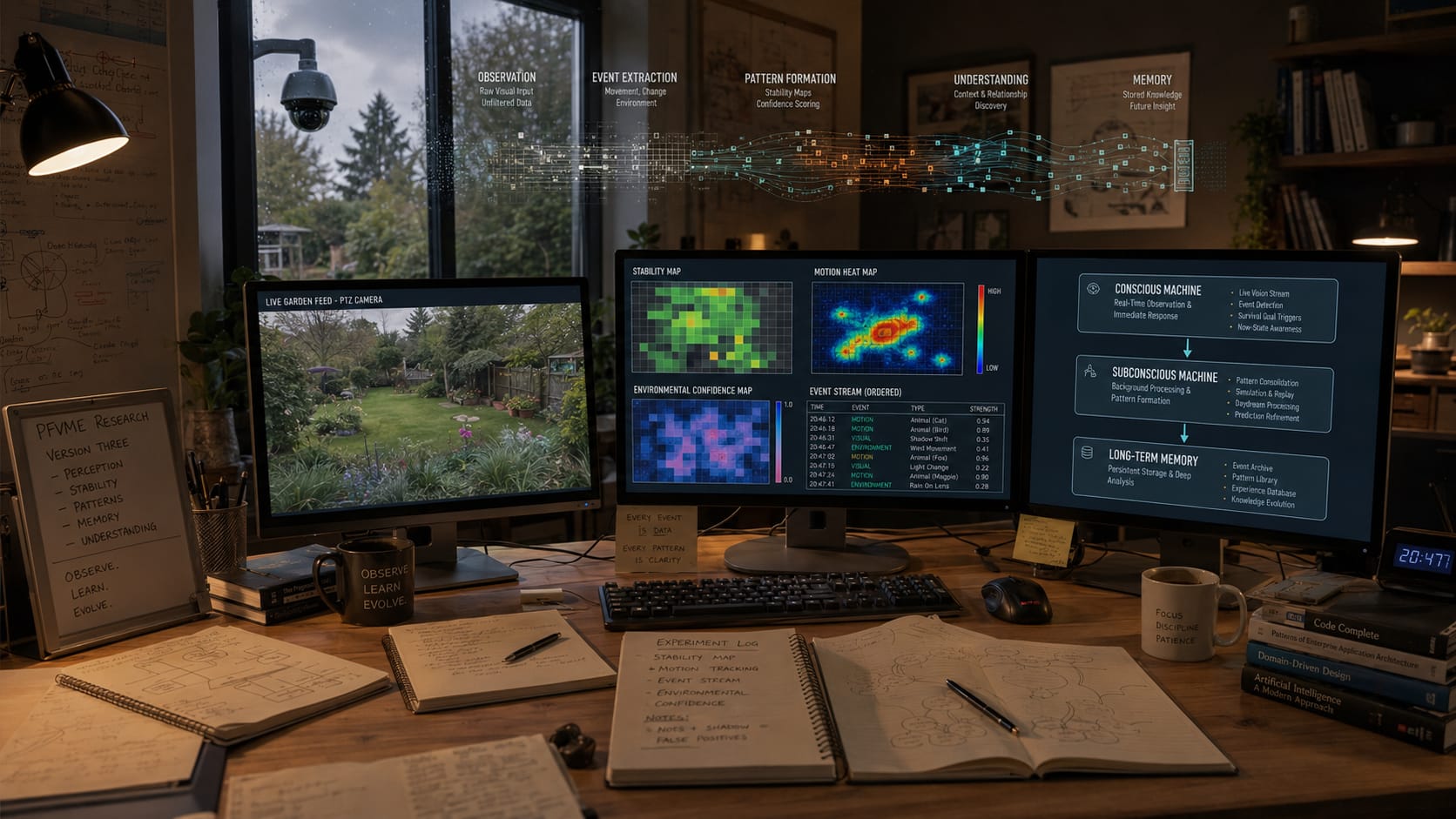
PFVME Research Journal – Part 3 – Building a Mind Instead of a Program
Version Five marks a major milestone in the PFVME Research Journal. Discover how specialised AI systems, digital survival goals,...
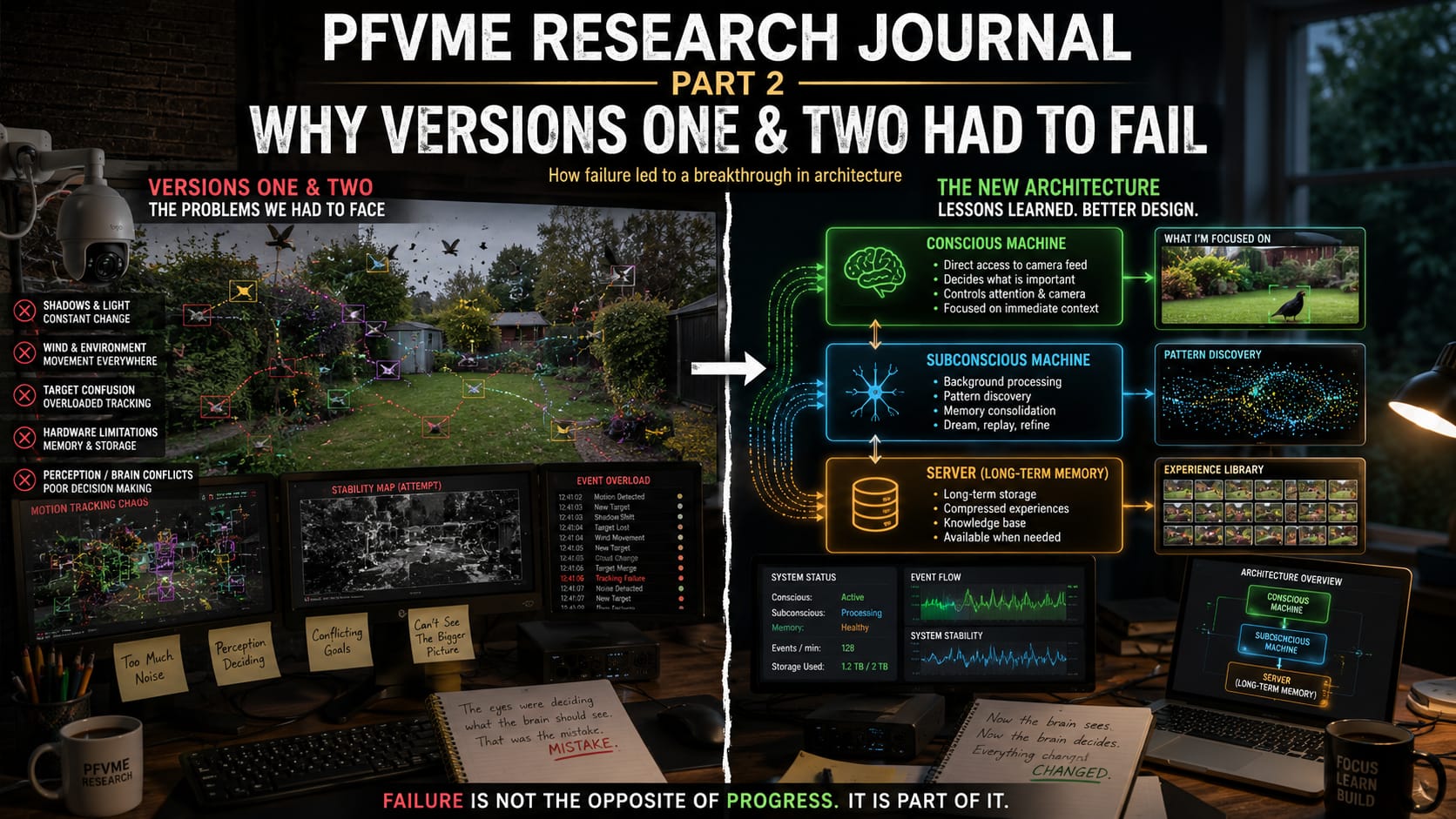
PFVME Research Journal Part Two - Why Versions One & Two Had to Fail
The first two versions of the PFVME project were never wasted effort. They revealed fundamental architectural flaws that...

AI Questions and Answers section for PFVME Research Journal – Part 4
Welcome to a new feature where you can interact with our AI called Jeannie. You can ask her anything relating to this article. If this feature is available, you should see a small genie lamp above this text. Click on the lamp to start a chat or view the following questions that Jeannie has answered relating to PFVME Research Journal – Part 4.
Be the first to ask our Jeannie AI a question about this article
Look for the gold latern at the bottom right of your screen and click on it to enable Jeannie AI Chat.
Type: Article -> Category: The PFVME Research Journal