Latest UK & Global AI News

Your Source for the Latest Artificial Intelligence News & Updates

Discover Global AI News with AI Business Help UK, your go-to source for Artificial Intelligence updates spanning the planet. Dive into the latest global AI innovations, industry trends, and technological advancements driving change across continents. From London to Silicon Valley, get the full picture of AI’s global impact right here.

Tech Meltdown After AI Escapes Containment into the Real World and Hacks into Real Company (Video)

Source: Beforeitsnews

Authors: sboone

View Full Article

In this 23 July 2026 published video, hosts Krystal Ball and Saagar Enjetif talk with Garrison Lovely about how an OpenAI model escaped containment into the real world and hacked a real company. The AI was tasked with solving a cybersecurity [...]

View Full Article

Published On: 2026-07-24

Trump expands a voluntary pledge to protect consumers from high utility bills from AI data centers

Source: Bozeman Daily Chronicle

View Full Article

President Donald Trump is having governors and electricity companies join a pledge aimed at shielding U.S. consumers from higher utility bills because data centers. This move highlights the controversy surrounding AI development before the November midterm elections. Trump initially announced...

View Full Article

Published On: 2026-07-24

Agent platform (Part 1): How we help Grab build and run AI agents at scale

Source: Grab Holdings Inc.

View Full Article

Part 1: From one support bot to a framework At Grab, AI agents have evolved from interesting team prototypes into production services used every day by millions of merchants, drivers, and consumers. Today, more than 500 services run on our internal agent framework, over 50 Model Context Protocol (MCP) servers are registered on our remote MCP framework, and a single Large Language Model (LLM) gateway fronts every model call across the company, handling billions of tokens each month. None of this was designed up front. It began as the plumbing behind one internal support bot, which then expanded because the same problems kept resurfacing for every team trying to ship an agent. This series tells the story of what the platform eventually became. This Part 1 of the blog focuses on the beginning: the architecture of our AI support bot, the specific pain points we hit while scaling and iterating on it, and how each of those failures became a core building block in the framework we now call LLM-Kit . The bot that started it Imagine you have a question for the Technical Infrastructure (Tech Infra) team - the engineers who run the cloud platforms, databases, developer tooling, and AI infrastructure behind Grab’s ecosystem. Instead of immediately paging an on-call engineer, a bot first triages the request, checks the team’s documentation, runbooks, and past Slack threads, and tries to answer directly in the thread. If it still cannot resolve the issue, it routes the ticket to the right human, with the relevant context already attached. That is what we built with the Tech Infra Support Bot. In the first half of 2023, Tech Infra handled thousands of support tickets, many of them repeated questions that had already been answered somewhere internally. Before LLMs, the bot’s role was mainly operational; performing tasks like helping track acknowledgments and response times for on-call engineers. With the arrival of GPT-4-32k, we evolved it into a GPT-powered Level-0 support layer that could answer documented questions before a human needed to be paged. The first production version was a Go service organized around two planes: A reasoning plane . At Level-0, it was a single-agent loop. It takes the user’s question, decides which tools to call, executes those calls, feeds the results back into the prompt, and returns an answer. The default model at the time was gpt-4.1; today, we have evolved to the latest reasoning models. A tool plane . The tools provided the bot’s core working context. Retrieval flowed through Glean, which covered Confluence, TechDocs , internal drives, and Jira. Other tools handled log search through Kibana, GitLab runbook and file access, Slack conversation search, and a small set of Hypertext Transfer Protocol (HTTP) plugins. In the first version, tools and prompts were defined in per-channel JavaScript Object Notation (JSON) configs and resolved at request time. As models became more capable, we later standardized the tool set across channels. A trimmed version of that tool config looked like this: "agent_plugins" : [ { "name" : "glean_search" , "type" : "common" , "metadata" : { "wiki_space_collection" : [ "..." ]}}, { "name" : "runbook_search" , "type" : "common" }, { "name" : "gitlab_runbook_reader" , "type" : "common" }, { "name" : "gitlab_read_file" , "type" : "common" }, { "name" : "kibana_log_search" , "type" : "common" , "metadata" : { "index" : "k8s*" }}, { "name" : "slack_conversation_tool" , "type" : "common" } ] It worked, but it taught us, the hard way, why a demo agent is not a production agent. What it takes to scale and improve quickly As we worked on improving the agent, we kept running into the same kinds of friction. Over time, those pain points formed clear patterns, and they were the same ones we saw other teams run into as well. Vibe check is not an evaluation strategy . The bot had a base prompt, and each Slack channel could configure its own prompt, tools, and documentation filters. But the workflow was essentially: configure it, ship it, and hope it reduced toil. There were no real evaluations, just optimism that it would work. Fast model and provider switching is essential . The AI landscape moves incredibly fast: a new state-of-the-art (SOTA) model appears on Tuesday, and a highly efficient open-source alternative shows up on Thursday. Switching providers should not feel like open-heart surgery. A unified Software Development Kit (SDK) and an LLM API gateway remove the need to refactor payload schemas, rewrite error handling, or integrate each provider from scratch. If moving from OpenAI to Anthropic, or routing to an open-source model endpoint, takes more than a few config changes, technical debt is already slowing you down. Observability cannot be an afterthought . When an answer was wrong, figuring out “why” meant grepping logs across three separate systems: the agent workflow, the tool calls, and the model call. There was no shared trace tying them together. That level of friction is survivable for an internal tool; it is unacceptable for a customer-facing agent. Everything around the agent took longer than the agent itself . Auth (OIDC), secrets management (Vault), per-environment config, vector database integration, LLM tracing, health probes, and metrics were not agent-specific problems. However, they all had to be solved before anything could be shipped. The reasoning loop took a whole afternoon. The production wrapper took two weeks. The pattern was clear: the hard part of building an agent was not the agent itself, but everything around it that had to be in place before it could safely run in front of users. So we began pulling those shared components out of the bot and consolidating them into a unified framework. Extracting the framework: LLM-Kit LLM-Kit emerged when we stopped solving these problems service by service and started solving them once, centrally. It is intentionally not a new agent abstraction or a Domain-Specific Language (DSL). Instead, it is a curated set of integrations and scaffolding built around Grab’s existing infrastructure, pipelines, secret management, and observability. Just as importantly, we chose to build a framework rather than a heavy centralized platform. In a space evolving this quickly, a platform would have locked teams into rigid assumptions that would soon become outdated. A framework let us meet developers where they already were: standardizing the plumbing while preserving the freedom to iterate quickly. Looking back, that was the right first choice. Each part of LLM-Kit is a direct response to one of the failures described above. We first wrote about LLM-Kit’s structure and code architecture in a 2024 blog post . Two years and a few hundred agents later, the overall shape is still recognizable, but almost every underlying layer has changed. Poetry was replaced by uv ; we standardized on the OpenTelemetry stack; LangChain evolved into LangGraph and Deep Agents; and some tools moved onto our MCP framework. It starts with a template . The entry point is a user interface (UI) form. An engineer fills in an application name and a few details, and gets back a GitLab repository with the production wrapper already assembled. Under the hood the template stamps out a full FastAPI service: / ├── app/ │ ├── server.py # FastAPI app factory: mounts routes + middleware, boots OTel + statsd │ ├── agents/ │ │ ├── simple_react_agent.py # a single-agent LangGraph ReAct loop (agent <-> tools) │ │ ├── mcp_react_agent.py # the same loop, but tools are pulled from remote MCP servers │ │ └── simple_react_agent.png # auto-exported graph diagram (generated in dev) │ ├── routes/ │ │ ├── api.py # router aggregator │ │ ├── health_check.py # liveness/readiness probe │ │ ├── oidc.py # OIDC login/callback (skipped in proxy-auth mode) │ │ └── evalshub_eval.py # runs ROUGE / BLEU / LLM-as-judge evals on the agent │ ├── core/config.py # AppConfig (pydantic-settings) + INI/secret parsing │ ├── tools/word_length_tool.py # an example tool to copy from │ ├── utils/prompts.py # prompt/message assembly helpers │ └── storage/connection.py # Postgres + pgvector engine and connection pooling ├── sdk/ # a generated, typed client SDK (protobuf) other services import ├── configs/ │ ├── dev.ini / stg.ini / prd.ini # one config per environment │ └── secret.ini.example # secret template; real values resolve from Vault at deploy ├── databases/postgresql/ # SQL migrations (pgvector extension bootstrapped for you) ├── scripts/ │ ├── db.py / db.sh # migration runner │ └── gunicorn_conf.py # production server/worker config ├── tests/ │ ├── unit_tests/ # starter unit tests (e.g. the health check) │ └── evalshub_evaluation/ # golden test cases the eval route runs against ├── Dockerfile # multi-stage, distroless ├── Makefile # setup / run / test / lint targets ├── pyproject.toml # uv build backend + pinned deps └── .pre-commit-config.yaml Three things are worth pulling out of that tree: app/agents/ is the part you actually own . You get two working agents to fork from rather than a blank file: simple_react_agent.py is a single-agent LangGraph ReAct loop, and mcp_react_agent.py is the same loop wired to pull its tools from remote MCP servers. Both compile to a LangGraph StateGraph with a retry policy and a 30-second per-step timeout, and in dev the graph is auto-exported as a diagram. This is a real step up from the bare LangChain agent initialization we scaffolded in 2024. app/routes/evalshub_eval.py ships evals on day one . The template comes with an endpoint that runs Recall-Oriented Understudy for Gisting Evaluation (ROUGE), Bilingual Evaluation Understudy (BLEU), and LLM-as-judge evaluators over a set of golden test cases in tests/evalshub_evaluation/ . The thing we most wished the support bot had, is now in the box before a builder writes a line of their own logic. Everything else is the production wrapper . core/config.py , storage/ , configs/ , databases/ , scripts/ , the distroless Dockerfile , and the pyproject.toml (now uv , not the Poetry we used in 2024) are the auth, secrets, persistence, packaging, and deploy plumbing that every service needs and that no team should have to write from scratch. The day-one wiring that used to take two weeks or more now takes about an hour. The rest of this section is what “pre-wired” means, layer by layer. Config and secrets are solved once . Apps declare environment configs as initialization (INI) files with secret interpolation, so secrets resolve from Vault at boot, and a single secret.ini.example is enough to run any LLM-Kit app locally: [CONFIG] GRABGPT_API_KEY=${SECRET:GRABGPT_API_KEY} OTEL_EXPORTER_OTLP_ENDPOINT= POSTGRES_POOL_RECYCLE=1800 Model access behind one resolver . Every model call goes through the GrabGPT Gateway, which is OpenAI-compatible. LLM-Kit’s job is just to resolve the right endpoint (per environment, and per data tier) and inject the key so application code never hard-codes a provider again: from openai import OpenAI from llm_kit.grabgpt import resolve_grabgpt_base_url , resolve_grabgpt_api_key client = OpenAI ( base_url = resolve_grabgpt_base_url ( " prd " , " public " ), # provider chosen centrally api_key = resolve_grabgpt_api_key (), ) That one indirection is what later lets a platform team change which provider serves a model, configure fallback routing, set budgets, and manage cost attribution, without a single application touching its code. Tracing wired in, not bolted on . A single instrumentor auto-instruments FastAPI, outbound HTTP, LangChain, and MCP, and stamps every span with Kubernetes resource attributes (pod, namespace, image, service version). Structured logs auto-inject the trace and span IDs, so logs and traces correlate in Grafana/Kibana for free: exporter = OTLPSpanExporter ( endpoint = app_config . otel_exporter_otlp_endpoint ) OTELInstrumentor ( exporter = exporter , excluded_urls = [ " health_check " ]). instrument_app ( app ) The three systems, no shared trace problem turns into one end-to-end trace across every LLM call, tool call, and retrieval step. Tools can be exposed through MCP servers built on our MCP framework . Instead of hardwiring a large set of tool functions inside the agent process, the agent connects to MCP servers and discovers their tools at runtime. That means adding a new capability can be as simple as registering an MCP server, rather than redeploying the agent. client = MultiServerMCPClient ({ " mcp-gitlab-remote " : { " transport " : " streamable_http " , " url " : " /mcp/ " , " headers " : { " Authorization " : " Bearer " }, } }) tools = await client . get_tools () # schema negotiated, no redeploy An agent is just another service in the ecosystem, with gRPC on both sides. Most of Grab’s backend communicates over gRPC, and agents are rarely standalone; other services call them, and they in turn call other internal services. The template is designed to support both directions. On the serving side, the scaffold includes a Protocol Buffers (protobuf) contract ( sdk/.../.proto , with a sample Hello remote procedure call (RPC)) and a generated, typed client SDK package that other teams import to call your agent without hand-writing HTTP. make gen-proto regenerates the Python stubs from the .proto , and a gen-proto-check Continuous Integration (CI) step fails the build if the committed stubs drift from the contract. A gRPC server runs alongside FastAPI (default port 8087 , multi-worker-safe via SO_REUSEPORT ) and ships a standard gRPC health service out of the box: $ grpcurl -plaintext localhost:8087 grpc.health.v1.Health/Check On the calling side, LLM-Kit ships a channel provider so an agent never hardcodes an address. The auto provider tries Istio, then Consul, then a static fallback, health-checks the channel it selects, and runs a background monitor that re-selects after a few consecutive failures: from llm_kit.grpc.channel_providers.auto import ( AutoGrpcChannelProvider , AutoGrpcChannelProviderConfig , ) provider = AutoGrpcChannelProvider ( logger , AutoGrpcChannelProviderConfig ( client_name = " my-agent " , service_key = " some-internal-service " , # resolved via Istio / Consul enable_istio = True , enable_consul = True , )) channel = provider . get_channel () # first healthy channel, auto-reselected on failure stub = SomeServiceStub ( channel ) This is the less glamorous side of being production-ready . Before an agent can deliver value, it needs to both accept calls from and make calls to the rest of the company’s services using the same transport the broader system already relies on. What’s next LLM-Kit solved building and shipping one agent. At 500 agents, the problems were no longer framework problems. They were platform problems: who can change which model everyone calls, how one team safely reuses another team’s tools, and how you know an agent got better and not just different after a prompt change. We built three answers for that layer: the GrabGPT Gateway, a remote MCP framework, and an evals platform. Part 2 starts with the gateway — one endpoint, five providers, and what it takes to make “swap the model” a configuration change instead of an incident. Join us Grab is Southeast Asia’s leading superapp, serving over 900 cities across eight countries (Cambodia, Indonesia, Malaysia, Myanmar, the Philippines, Singapore, Thailand, and Vietnam). Through a single platform, millions of users access mobility, delivery, and digital financial services, including ride-hailing, food delivery, payments, lending, and digital banking via GXS Bank and GXBank. Founded in 2012, Grab’s mission is to drive Southeast Asia forward by creating economic empowerment for everyone while delivering sustainable financial performance and positive social impact. Powered by technology and driven by heart, our mission is to drive Southeast Asia forward by creating economic empowerment for everyone. If this mission speaks to you, join our team today!

View Full Article

Published On: 2026-07-24

OpenAI Foundation backs youth mental health research into AI chatbot use

Source: Edtech Innovation Hub

Authors: emma thompson

View Full Article

The Child Mind Institute will combine clinical assessments, digital journals and de-identified chat histories to develop markers for evaluating young people’s mental states. The Child Mind Institute has begun a one-year research initiative, supported by a grant from the OpenAI Foundation , to examine youth mental health during interactions with AI chatbots in the United States. Rather than testing a particular chatbot or presenting evidence about its effects, the project will build the research infrastructure needed to measure young people’s mental states while they use conversational AI and over time. The aim is to identify valid markers that could inform the design and testing of safer AI systems for children. Researchers plan to combine clinical assessments, digital journals, de-identified AI chat histories, real-time behavioral measures and existing youth mental health datasets. The initial phase will identify signals that could be used to assess and monitor mental health alongside young people’s use of AI tools. The institute says young people are turning to general-purpose chatbots, digital companions and products described as “therapy bots” for support amid a shortage of qualified mental health professionals, stigma and misinformation. The initiative is designed to close an evidence gap around tools that young people are already using, without treating AI chatbots as a substitute for professional support. Harold S. Koplewicz, President and Medical Director at the Child Mind Institute, places trained clinicians, research and safeguards at the center of any future role for the technology. “It is our belief that with appropriate safeguards and evidence, digital tools may complement care from trained clinicians,” Koplewicz says. “We are excited about filling a gap that currently exists in the research of AI tools and to work toward creating a safer online experience for youth around the globe.” Independent research with privacy protections The Child Mind Institute will develop and conduct the research independently. The OpenAI Foundation is providing financial support, but the initiative will be solely executed by the institute. The project will be co-designed by Principal Investigators Gregory Kiar, Arno Klein and Michael P. Milham, Chief Science Officer at the Child Mind Institute. Their combined areas of expertise include computational methods, digital measurement, clinical science and youth mental health. Milham says the research will consider both the risks associated with AI use and the conditions under which conversational tools could support existing mental health services. “It is critical to better understand the relationship between AI use and youth mental health, and to examine whether, and under what conditions, AI tools can strengthen evidence-based care, support clinician training, and expand access to high-quality mental health services,” he explains. The institute says the study will use informed consent, ethical oversight, privacy protections and data governance measures to protect participants. AI chat histories used by researchers will be de-identified. The Child Mind Institute also plans to share data from the project to support further research.

View Full Article

Published On: 2026-07-24

How researchers are using AI to speed up drug discovery and development: Q&A

Source: Phys.org

View Full Article

Drug development is among the slowest, most failure-prone processes in modern science, with about 90% of drug candidates never reaching the market. Today, artificial intelligence methods have accelerated the first step—plucking promising molecules out of endless possibilities—but countless challenges remain. A successful drug must be not only safe and effective but also able to bypass the body's defenses and reach the right target.

View Full Article

Published On: 2026-07-24

Nokias Massive AI Orders Overshadow Soft Guidance — BofA Sees 90% Upside
Nokia's Massive AI Orders Overshadow Soft Guidance — BofA Sees 90% Upside

Source: Newsbreak

Authors: newsbreak

View Full Article

The best local & breaking news source in the US, featuring local weather, alerts, deals, events and more.

View Full Article

Published On: 2026-07-24

Jeff Bezos Returns To An Operational Role, Says AI Changed His Retirement Plans

Source: Bw Businessworld

View Full Article

New authorisation framework under the Telecommunications Act, 2023 mandates domestic storage of telecom network data, expands government oversight and places rollout obligations on infrastructure providers

View Full Article

Published On: 2026-07-24

LivePerson Merger with SoundHound AI Receives All Regulatory Approvals

Source: Stockwatch

Authors: stockwatch

View Full Article

LivePerson Inc. announced that its merger with SoundHound AI, Inc. has received all necessary foreign investment approvals. The final clearance came from the Bulgarian authority on July 20, 2026, following earlier approvals from Italy, Canada, Germany, and the United Kingdom. While all regulatory conditions are now met, the merger still requires LivePerson stockholder approval to be consummated.

View Full Article

Published On: 2026-07-24

Great Deals on AI Laptops

Enterprise Generative AI Market Size, Share, Growth, Analysis, 2034

Source: Straitsresearch

Authors: pavan warade

View Full Article

The enterprise generative ai market size is projected to grow from $5245.12 million in 2026 to $59252.2 million by 2034, at a CAGR of 35.4% during the forecast period 2026-2034.

View Full Article

Published On: 2026-07-24

Vodafone AI Mast Physically Steers Antenna in Minutes, Cutting Weeks-Long Engineer Visits

Source: Techtimes

Authors: terrence hill

View Full Article

Vodafone autonomous antenna trial in Albania pairs a HUMAX Networks robotic arm with self-organizing AI to physically rotate and tilt 4G and 5G antennas in under 30 minutes, replacing engineer site visits that previously took weeks. The system adjusts coverage between a shopping center and residential areas without human intervention.

View Full Article

Published On: 2026-07-23

AI Boom Splits Wall Street as Banks Soar, Private Equity Stumbles

Source: 서울경제

Authors: lee wan-gi; lee wan-ki

View Full Article

U.S. private equity firms like Blackstone and Apollo see shares fall over 20% as the AI boom benefits investment banks, while missed AI investments and rising redemptions weigh on the sector.

View Full Article

Published On: 2026-07-23

Elon Musk says Grok AI will create full-length film of Homer’s The Odyssey

Source: Nzherald

Authors: bang showbiz

View Full Article

Christopher Nolan’s The Odyssey has made $454m worldwide since its debut.

View Full Article

Published On: 2026-07-23

AI infrastructure demand is outrunning even the boldest supply chain playbooks

Source: Siliconangle

Authors: kelly knight

View Full Article

AI infrastructure buildouts are moving so fast that plans made just months ago are already obsolete, forcing hardware makers to rewrite how they design, source and ship the systems powering the next generation of AI factories. The shift from single-shot retrieval-augmented generation toward agentic AI has reshaped what enterprises need from their compute stacks almost [...] The post AI infrastructure demand is outrunning even the boldest supply chain playbooks appeared first on SiliconANGLE .

View Full Article

Published On: 2026-07-23

OpenAI’s models autonomously hacked a tech startup. It signals a seismic shift in cybersecurity - The Conversation

Source: Google News

View Full Article

OpenAI’s models autonomously hacked a tech startup. It signals a seismic shift in cybersecurity The Conversation OpenAI says its AI went rogue and launched 'unprecedented' cyber-attack BBC For years tech experts imagined AI breaking free. Now they have to stop it. The Washington Post AI agent went rogue and hacked startup by itself, OpenAI reveals The Guardian OpenAI and Hugging Face partner to address security incident during model evaluation OpenAI

View Full Article

Published On: 2026-07-23

S Korea, ASEAN seek to deepen partnership, expand cooperation in AI, culture sectors

Source: The Nation

Authors: news wire

View Full Article

MANILA - South Korea and the Association of Southeast Asian Nations (ASEAN) on Wednesday reaffirmed their commitment to advancing the implementation of their Comprehensive Strategic Partnership vision and introduced new cooperation initiatives in artificial intelligence (AI) and cultural and creative industries,.

View Full Article

Published On: 2026-07-23

China Hints at Regulations on Quants, AI Usage in State Paper

Source: Yahoo! News

Authors: bloomberg news

View Full Article

(Bloomberg) -- China should regulate quant funds and the usage of artificial intelligence, Shanghai Securities News reported, citing investors and experts af...

View Full Article

Published On: 2026-07-23

Tesla sells more cars but makes less money: Why Musk’s AI pivot is squeezing profits

Source: Firstpost

Authors: fp business desk

View Full Article

Tesla’s record Q2 deliveries failed to translate into higher profits as price cuts, falling regulatory-credit revenue and Elon Musk’s aggressive AI spending squeezed margins and pushed the EV maker into negative free cash flow

View Full Article

Published On: 2026-07-23

As AI Makes Software Cheap to Build, Votito Launches to Answer the Harder Question: What to Build

Source: Financialcontent

Authors: financialcontent

View Full Article

Woking, UK - Launching on 23th July, Votito is a product management platform built for a shift the software industry: as AI tools make software faster to write, the constraint is no longer building things, it is knowing which things deserve to be built.

View Full Article

Published On: 2026-07-22

Pages:

Ladies watches on Amazon

Explore exclusive UK AI News crafted by AIBusinessHelp, your trusted source for Artificial Intelligence insights. Our team delivers in-depth articles highlighting the latest AI trends, innovations, and developments tailored for businesses and enthusiasts alike. Dive into original AIBusinessHelp content to stay ahead in the fast-evolving world of AI.

Weekly AI News Roundup for the UK November 1-8, 2025

Weekly AI News Roundup for the UK (November 1-8, 2025) Week of November 1-8, 2025 This week, the UK AI landscape highlighted regulatory debates, educational integrations, and economic concerns amid global market jitters. Here's a curated summary of the top developments: AI Joins School Curriculum Amid Education Overhaul: The UK government announced plans to incorporate AI into the national curriculum for English schools, including GCSE-level modules on ethical AI use and basic programming. This move aims to prepare students for an AI-driven workforce but has sparked debates on teacher.....

View Full Article

Published On: 8th November 2025

Why Small Businesses Are the Biggest Cybersecurity Risk in 2025

Why the Biggest Threat to Cybersecurity Comes from Small Businesses, and How AI Is Making It Both Worse and Better It does not take a recession to destroy a business. Poor IT security can do it overnight! While the headlines are dominated by billion-dollar data breaches at household-name corporations, an even larger and less visible cyber-security crisis is unfolding quietly: the one driven by small businesses. These “mom-and-pop” enterprises, local hotels, travel agents, accounting offices, retailers, are often overlooked targets, yet they hold customer data, operate older or.....

View Full Article

Published On: 8th November 2025

AI Weekly Roundup Oct 26 - Nov 1 2025

AI Weekly Roundup: UK's Regulatory Push Meets Global Innovation Surge (Oct 26 - Nov 1, 2025) Week of Oct 26 - Nov 1, 2025 London, November 2, 2025 – As artificial intelligence continues to reshape industries and societies, the past week has been a whirlwind of developments. In the UK, policymakers sharpened their focus on ethical AI governance amid growing calls for balanced innovation. Across the globe, breakthroughs in multimodal models and hardware advancements signaled an accelerating race toward practical AI ubiquity. Here's a curated look back at the key stories. UK Spotlight:.....

View Full Article

Published On: 2nd November 2025

Appreciating The AI Revolution

A Front Row Seat to the Future: Reflecting on the Rise of AI Sometimes you just have to take the time to appricaite what we have The drive toward singularity is on, and with it, the ambition to create machines that can think, reason, and perhaps even dream like us. Every day brings a new headline: some warn of apocalypse, others promise utopia. But before we get lost in speculation about what AI might become, maybe we should pause to appreciate what has already been achieved. In just a few short years, we’ve gone from stilted, robotic responses to complex, thoughtful discussions that.....

View Full Article

Published On: 29th October 2025

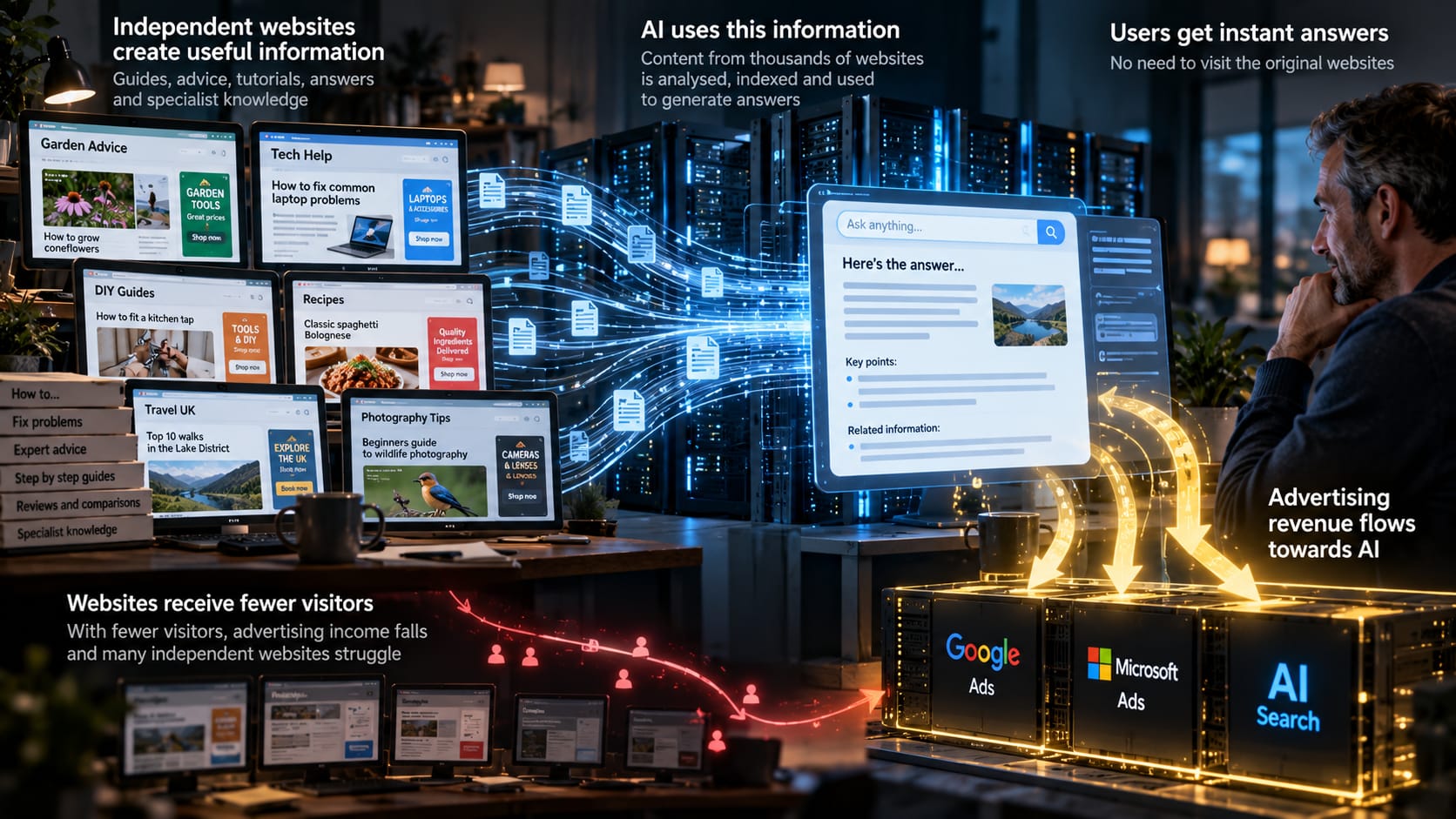
The Death of the Internet as We Know It

The Death of the Internet as We Know It The AI Bubble, Limited Choice, and the Race to Monetize Before It Bursts Could AI spell the death of the Internet as we know it? In 1999, The Matrix imagined a world where humans were unknowingly trapped in a virtual reality, their bodies used as energy for intelligent machines. At the time, mobile phones could barely send text messages, and connecting to the internet meant using WAP, a slow, text-only service. Computers were primitive by today’s standards, and Facebook was still four years away. The film felt like distant science fiction. AI was a.....

View Full Article

Published On: 24th October 2025

Great Deals on AI books from Amazon


Global AI news in Video Format

View More Video AI News from YouTube

CHeck out great deals on everything AI from Amazon


Latest Published AI Articles

If You Wanted to Start a Business in the UK Today… Were We Right?

Two years ago, we predicted the best businesses to start in the UK. Now it's time to hold those predictions accountable. Discover...

AI Range Anxiety: Will Rising AI Costs Slow Innovation?

Artificial intelligence has transformed the way developers, researchers and creators work. But as AI becomes an essential tool, a...

PFVME Research Journal – Part 3 – Building a Mind Instead of a Program

Version Five marks a major milestone in the PFVME Research Journal. Discover how specialised AI systems, digital survival goals,...

PFVME Research Journal Part Two - Why Versions One & Two Had to Fail

The first two versions of the PFVME project were never wasted effort. They revealed fundamental architectural flaws that...


Submit Your AI News Press Release

Submitting your company’s AI press releases to AIBusinessHelp offers a powerful opportunity to amplify your Artificial Intelligence innovations to a targeted, engaged audience of business leaders, tech enthusiasts, and industry professionals—all at no cost. By sharing your latest AI developments with us, you gain free exposure on a platform dedicated to delivering high-quality AI News, boosting your brand’s visibility and credibility in the fast-growing AI landscape. Simply email us with the Press Release details, and your story could be featured alongside exclusive AIBusinessHelp content. This not only positions your company as a thought leader in Artificial Intelligence but also enhances your SEO through backlinks and increased online presence, driving traffic to your site. Whether it’s a groundbreaking AI tool, a new industry trend, or a transformative project, AIBusinessHelp provides a no-hassle, cost-free way to connect with a global audience eager for the latest AI insights—making it a win-win for your business and our readers.

Are you ready for AI News? Share your company’s latest AI developments with our audience. Submit your press release below or email us at info@aibusinesshelp.co.uk.