Type: Article -> Category: The PFVME Research Journal
PFVME Journal Part 6 – Learning What Is Worth Remembering
126 Million Cycles, Compression, Bus Routes and the Road Towards Brain 2's First Glyph
Don't have time to read the article? View as a short video storyboard or listen to it whilst jogging.
Publish Date: Last Updated: 21st September 2026
Author: nick smith- With the help of CHATGPT
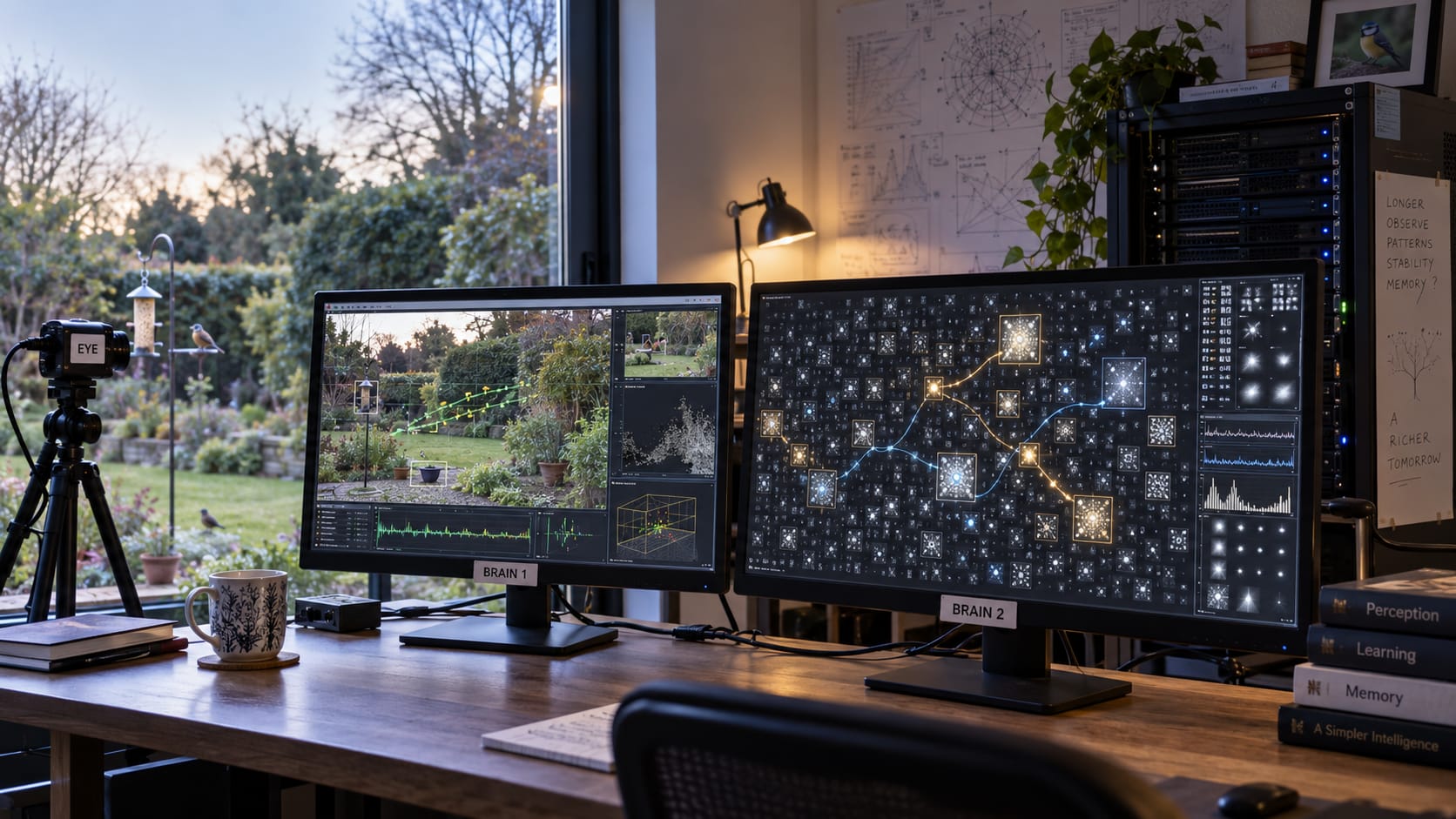
It has now been several weeks since I introduced Brain 2 into the PFVME project.
At the time, Brain 2 was deliberately primitive. It could observe the same visual world as Brain 1, detect differences, build associations, identify recurrence and send simple buses through those structures.
What it could not do was arguably just as important.
It could not identify a bird, tree, person or fox. It had no human vocabulary. It had no predefined categories telling it which things belonged together. It could not create permanent glyphs representing what it had discovered.
That restraint was intentional.
The temptation when building an experimental AI system is always to add the next capability. If something appears to work, give it memory. If it detects repetition, allow it to create concepts. If it discovers a pattern, give that pattern a name.
But every time I do that, I potentially introduce more of my understanding of the world into the system.
PFVME is attempting something different.
Rather than asking:
What should Brain 2 remember?
I wanted to see whether we could eventually reach:
What does Brain 2 decide is worth remembering?
That has turned out to be a much more interesting question.

Patience, Again
One lesson that keeps returning throughout PFVME is patience.
Brain 1 taught me this when I initially wanted to keep adding functionality but discovered that simply allowing it to observe the garden for days and weeks produced information that short tests could never reveal.
Brain 2 has reinforced that lesson.
Rather than immediately moving towards glyph creation, I have allowed the system to continue running.
By 3 September, Brain 2 had processed around 13.3 million cycles.
By 8 September, that had risen to around 42.7 million.
By 14 September, it had reached approximately 81.5 million.
The latest report now places Brain 2 beyond 126 million processing cycles and visual samples.
Those numbers are not interesting simply because they are large.
What matters is what has been happening during them.
Brain 2 has been exposed continuously to the rhythms of the same environment: daylight and darkness, changing weather, wind, rain, birds arriving and leaving, people appearing, foxes passing through and long periods where apparently very little happens.
The environment is repetitive, but it is not identical.
And that distinction has become important.
The Problem With Creating a Glyph
From the beginning of PFVME, I have used the word glyph to describe a representation created by the system itself.
A glyph is not intended to be a human label.
I do not want to tell Brain 2:
This is a bird.
Nor do I necessarily want Brain 2 to create something equivalent to our word bird.
Brain 2 might find completely different separating factors important.
It might create representations for a stable area at the back of the garden. It might eventually represent the same area differently during daylight and darkness. It could distinguish something because of its movement, duration, relationship with another structure or position within a recurring sequence.
It may eventually create several glyphs for things that I would consider to be the same object.
That is fine.
In fact, that could be one of the most interesting outcomes of the experiment.
But it presented us with a fundamental problem.
When should a glyph be created?
If every repeated pattern becomes a glyph, Brain 2 could rapidly accumulate an enormous vocabulary of representations that provide little benefit.
If I establish arbitrary thresholds, however, then I am determining what deserves representation.
Neither solution seemed satisfactory.
That led to a different idea.
Before Creating a Glyph, Ask Whether It Is Economical
Instead of immediately creating glyphs, we introduced an intermediate stage: compression economics.
The principle is extremely simple.
Imagine Brain 2 repeatedly encounters:
A → BIf that structure occurs hundreds or thousands of times, there comes a point where repeatedly storing or processing the complete structure may be more expensive than defining a reusable representation once and referring to it thereafter.
Conceptually, Brain 2 can compare:
raw_costagainst:
definition_cost + reuse_costand calculate:
compression_gain
gain_ratio
break_even_occurrence_count
The units themselves are artificial internal units. Consistency is more important than trying to pretend that they represent some biological measurement.
Most importantly, nothing is compressed yet.
This stage simply asks:
If I represented this recurring structure as a reusable unit, would doing so save resources?
That distinction allowed us to study the economics without changing Brain 2's cognition.
Candidate Glyphs – Vocabulary That Does Not Yet Exist
Once compression economics was working, the next stage was to allow economically positive structures to become candidate glyphs.
Again, these are not real glyphs.
They cannot influence cognition.
They cannot replace the recurrence structures from which they originated.
Brain 2 cannot use them to interpret what it is currently seeing.
They are effectively proposals:
This structure might be worth representing.
Crucially, we did not tell Brain 2 what kind of structures should receive preference.
Persistent structures were not automatically considered more important than progressive sequences.
Simultaneous structures were not given priority.
There was no requirement that two candidates couldn't represent what a human observer might consider the same thing.
There was also no arbitrary maximum number of candidates.
The purpose was not to create a neat vocabulary.
It was to see what Brain 2's own experience and compression economics would propose.
A Candidate Must Survive Experience
Creating candidates produced another question.
Something may be economical today simply because an unusual event happened repeatedly during a short period.
That does not mean it deserves a permanent place in Brain 2's future vocabulary.
So Phase 2.3 introduced candidate survival.
Candidates continue to be exposed to new experience and can theoretically:
strengthen
weaken
change
disappear
Their reuse and continuing compression value are monitored.
This is an important philosophical change in how I have started thinking about memory within PFVME.
Being remembered should have a cost.
A representation shouldn't necessarily remain important merely because it was once important.
And the current Brain 2 data is beginning to show why long observation matters.
The latest reports show underlying associations being continuously created, reinforced and weakened. In the most recent 24-hour report alone, Brain 2 created 8,306 associations, reinforced 63,452 and weakened 670,587.
Recurrence is also continuing to develop rather than becoming frozen. The same report recorded 479 newly created recurrence candidates, 653 unique candidates in the reporting period and 80,726 reinforcement events.
Brain 2 is therefore not simply accumulating everything forever at every level.
Something more dynamic is happening.
But What Does "Useful" Actually Mean?
This is where our discussions took an unexpected turn.
Initially, usefulness appeared primarily to mean:
Does this representation save storage or processing?
But that isn't enough.
Imagine three future glyphs:
G17 — strongly supported and constantly required
G42 — strongly supported but occasionally required
G91 — strongly supported but almost never required
All three might be valid representations.
But they do not necessarily have equal value to the system.
Then another question occurred to me:
How expensive are they to reach?
That brings us back to one of the architectural ideas that has existed within Brain 2 from its early development.
The buses.
The Buses Are Becoming More Important
The PFVME bus system was originally conceived as a way of moving limited amounts of information through the system.
Instead of loading everything into a huge working context, buses travel through structures and collect what appears relevant.
There is a resource budget.
There are routes.
There are hops.
And buses can terminate without finding what they were looking for.
What I hadn't fully appreciated initially was that these journeys themselves could eventually become part of the learning process.
Suppose Brain 2 needs three glyphs to understand some current situation.
One arrangement might require:
5 buses
14 hops
3 separate routes
Another organisation of exactly the same information might require:
2 buses
6 hops
1 shared route
The information hasn't changed.
The cost of accessing it has.
That raises a fascinating possibility.
Perhaps weakening and strengthening memory should not eventually depend only on how often something is used.
It could also depend upon how efficiently useful information can be reached.

Memory May Organise Itself Around Use
This has changed how I think about future glyph storage.
The conventional computer science solution would be obvious.
Create categories.
Put bird-related glyphs together.
Put environmental glyphs together.
Create an area for movement.
Create another for time.
Perhaps create an emotional category if such internal states ever existed.
But that would simply reproduce a human-designed database.
And worse, those categories would contain assumptions about the world that PFVME has never discovered for itself.
Consider a leaf.
I know that leaves belong to trees.
Brain 2 doesn't.
The camera cannot even see the entire tree.
A leaf could enter the visible scene from above and fall through the image.
Why should Brain 2 initially associate that structure with a tree?
Its experience might instead associate the falling structure with:
wind
movement
seasonal change
birds
particular times
weather conditions
Those relationships might initially be far more useful to Brain 2 than my human botanical classification.
So instead of us determining where glyphs belong, retrieval economics may eventually help organise memory.
Representations frequently required together may gradually become cheaper to access together.
A glyph could also effectively appear in several locations through references while maintaining a primary representation elsewhere.
The result would not necessarily resemble a conventional directory tree or database.
It could become a topology created by experience.
The River Crossing Problem
One analogy helped clarify this.
Imagine trying to cross a river.
There are three possible routes.
I could swim directly across. That requires considerable energy because I have to fight the current.
I could jump across several rocks. That requires less energy but carries a risk of slipping.
Or I could walk downstream to a fallen tree spanning the river. That might require the least energy and carry relatively little risk.
A simple optimisation system might conclude:
Always use the fallen tree.
But now change the situation.
A predator is chasing me.
Running downstream to the tree means the predator catches me.
Suddenly the supposedly inefficient route—jumping directly into the water—may be the best available decision.
And if I know the predator cannot swim, the expensive swimming route becomes even more attractive.
Nothing about the river changed.
Nothing about the routes changed.
The context changed.
That is extremely important for PFVME.
Efficiency cannot simply mean:
use the route requiring the least energy.
It must eventually mean something closer to:
use an appropriate route given the current situation, available resources, previous experience and likely outcome.
That is considerably more difficult.
But it also seems much closer to the problem intelligence actually has to solve.
The Observer Does Not Always Have the Whole Story
The river example led to another important thought.
Imagine watching someone struggling to swim across that river.
From my viewpoint I can clearly see the fallen tree downstream.
I might think:
Why on earth didn't they use the tree?
My conclusion is perfectly logical based upon the information available to me.
But I didn't see the previous thirty seconds.
I didn't see the predator.
I am making a reasonable assessment from an incomplete sequence.
Brain 2 may face exactly the same problem.
It may form a model based upon the information available at the time.
Later, however, another part of PFVME may gain access to earlier or broader sequences and discover information Brain 2 didn't originally have.
That creates the possibility of reassessment.
Not:
I was wrong.
but something closer to:
Given the information available then, this was the model.
Given the additional information available now, the model changes.
That distinction could become extremely important when we eventually develop the Server machine.
The Beginnings of Self-Reflection
I have increasingly started thinking of the future Server as more than long-term storage.
It may eventually provide the conditions for something resembling primitive self-reflection.
Not consciousness in the human sense.
Not an internal voice asking philosophical questions.
Something much simpler and more mechanical.
The system completes an activity.
Later it has access to more information.
It can compare:
what happened
what information was available
what route was taken
what resources were consumed
what outcome occurred
what other routes may have existed
The result can influence future organisation.
That means an experience doesn't necessarily finish when the immediate event finishes.
Its interpretation can change later.
Why We Started Recording Bus Journeys
That discussion led to one practical addition to Brain 2.
We have now begun recording the actual journeys made by buses.
For each journey we want to know things such as:
start context
route taken
structures visited
glyphs visited
number of hops
number of buses involved
start and end cycle
resource cost where measurable
success or failure
reason for termination
At the moment, glyph visits are naturally empty because real glyphs do not yet exist.
That is exactly how it should be.
The important point is that we're establishing a baseline before glyphs are introduced.
Later we may be able to compare retrieval behaviour before and after representations begin influencing the system.
That could tell us whether glyphs actually make Brain 2 more efficient rather than simply assuming that they do.
Sleep, Dreams and Lazy Buses
This discussion about routes led to one of the more speculative ideas to emerge during this stage of the project.
What should PFVME do when very little is happening?
The obvious answer for a conventional computer system is:
Nothing.
But biological systems often behave very differently.
When external activity reduces, internal processing does not necessarily stop.
This led me back to our earlier idea of a future subconscious/server system and what I have started calling lazy buses.
A normal bus is sent because something happening now requires information.
A lazy bus would be different.
It could be sent with a deliberately loose objective:
Has anything in this stable region changed over the last few weeks?
or perhaps:
Is there another route between these structures?
It might travel paths that have no obvious immediate connection.
Most journeys could produce nothing useful.
That would be acceptable.
Occasionally, however, one might discover something significant.
The "Pop" Moment
We have discussed another idea throughout PFVME that I have called the pop moment.
Anyone who has suddenly remembered something apparently unrelated will recognise the experience.
Recently someone mentioned Majorca during an ordinary conversation about holidays.
Almost immediately I remembered a funny Heineken television advert from around 1985.
There had been no discussion about Heineken or advertising.
Yet somehow the word Majorca, within the right context, was sufficient to reach a memory that had apparently survived for more than forty years.
I could then look it up and confirm that my recollection was remarkably close.
That made me think again about how retrieval might work.
Perhaps some useful information does not need to be deliberately searched for.
A future PFVME Server could be quietly exploring old structures while Brain 1 and Brain 2 continue dealing with the present.
If one of those exploratory routes suddenly intersects strongly with what the active system is currently processing, it could offer the result.
That would be our machine equivalent of:
Pop — this might be relevant.
Again, none of this is currently implemented.
But the architecture we are developing is beginning to provide plausible places where such mechanisms could eventually exist without us explicitly programming individual memories or associations.
Could This Be PFVME's Version of Dreaming?
That naturally led to another question.
Could periods of low external activity eventually be used for internal simulation?
The garden provides a natural cycle.
During daylight there is generally far more visual activity.
At night, especially because the camera does not have night vision, external information decreases dramatically unless the security light is triggered.
Rather than imposing an arbitrary human timetable such as:
23:00 — go to sleep
07:00 — wake up
PFVME could eventually discover its own resource cycle.
When external demand is low, resources could be redirected towards internal experimentation.
For PFVME, "dreaming" would not need to mean hallucinated pictures.
A machine dream might instead ask:
Can this route be shortened?

Can these structures be reached with fewer buses?

What happens if this representation moves closer to another?

Is an old association still useful?

Can several expensive routes share part of their journey?

Does a rarely used structure still justify occupying current memory?
That would be a dream appropriate to the entity experiencing it.
A biological organism dreams through biological machinery.
A machine does not need to imitate that machinery.
Its internal simulations should relate to the problems it faces.
Achievement Without Reward
This also changed my thinking about reward.
I don't want PFVME to operate like a game where I award points every time it does something I consider desirable.
That would again make me the judge of success.
Instead, I am becoming increasingly interested in the idea of internal achievement.
Suppose Brain 2 reorganises several future glyph relationships and subsequently discovers that retrieving commonly required information takes fewer buses and consumes less of its resource budget.
Nothing outside the system needs to say:
Well done.
The consequence itself is the reward.
The system has more available resources.
It can achieve the same outcome with less expenditure.
Its internal condition has improved.
I have loosely described this during development as a primitive form of self-worth, although I don't mean emotion or self-esteem in the human sense.
Perhaps internal confidence is closer.
A successful route that repeatedly works under particular circumstances gains support.
An expensive or unreliable route may lose support.
But importantly, alternative routes shouldn't necessarily disappear simply because a better one has been found.
Remember the river.
Sometimes the inefficient route is exactly the route you need.
Why We Still Haven't Created a Single Real Glyph
After all this work, there is something rather amusing about the current state of Brain 2.
It has processed more than 126 million cycles.
It has created and reinforced associations.
It has discovered recurrence.
It has evaluated compression economics.
It has created candidate glyphs.
Those candidates have been exposed to continuing experience.
We have started recording the journeys made by buses.
And yet:
Brain 2 has not created a single real glyph.
I consider that progress.
It would have been relatively easy to program:
if recurrence > X:
    create_glyph()
But then the interesting part of the experiment would largely have been predetermined.
Instead, we have spent this stage trying to build the conditions under which creating a representation might eventually have a reason.
Not:
Because the programmer told me to.
But:
Because representing this recurring structure appears to reduce the resources required to deal with my experience.
That is a very different proposition.
There Are Still Questions
Before allowing the first real glyphs to form, there are still things I want to understand.
Candidate glyphs are strengthening, and their economics are changing as new experience arrives.
But so far we haven't seen candidate glyphs move into weakened, changed or disappeared states.
That may be perfectly legitimate.
The camera observes a remarkably consistent environment.
The same garden remains there every day. Similar birds return. The same people appear. Foxes revisit the scene. Day becomes night and night becomes day.
Perhaps many of the structures currently represented really do continue to be useful.
At the underlying association level, however, weakening certainly occurs. In the latest report alone, hundreds of thousands of association weakening events were recorded alongside new creation and reinforcement.
So before Phase 2.4 I want to verify that candidate weakening is genuinely possible and that the absence of it is an outcome of experience rather than an accidental consequence of the architecture.
I also want to confirm that restarting Brain 2 preserves the identity and history of what it has already learned.
A developing system cannot be expected to build meaningful long-term representations if restarting a Python service effectively gives it amnesia.
Those are engineering questions rather than philosophical ones, but they matter enormously.
The First Glyph Is Getting Close
Assuming those final checks behave as expected, the next stage will be one of the most significant milestones in PFVME so far.
Brain 2 will finally be allowed to create primitive glyphs.
I have absolutely no idea what its first glyph will represent.
And that is precisely why I find this stage exciting.
It may not represent a bird.
It may not represent an independent object at all.
It might represent a stable region.
A repeated transition.
A recurring relationship.
A particular combination of structures.
Something associated with a period of the environmental cycle.
Or something that makes absolutely no immediate sense to me.
If that happens, the challenge will be resisting the temptation to immediately translate it into human language.
Instead we need to ask:
Why did Brain 2 create this?
What evidence supports it?
What does it compress?
When does it use it?
What other structures does it become associated with?
How expensive is it to retrieve?
Does its existence change future bus journeys?
And, eventually, can Brain 2 decide that it no longer deserves to exist?
Those questions are far more interesting to me than whether we can make the system recognise a bird.
Learning What Is Worth Remembering
When I started this stage, I thought we were working towards glyph creation.
I now think we have actually been working on something more fundamental.
We have been trying to establish the beginnings of a reason to remember.
Memory cannot simply be unlimited accumulation.
A useful system has to decide what remains immediately available, what can move into longer-term storage, what deserves reinforcement, what can weaken and what might eventually disappear.
It must also deal with the cost of finding that information again.
And perhaps, during periods when the outside world demands very little from it, it can experiment with better ways of organising what it already knows.
That brings PFVME back to one of the principles that has increasingly defined the project:
What do I need next to make sense of what I am witnessing?
Not everything it has ever experienced.
Not everything the programmer thinks is important.
Just what is useful now.
Brain 2 still has no words.
It has no human concepts.
It doesn't know that it is watching a garden.
It doesn't know what a bird is.
And it certainly doesn't know that more than 126 million cycles have become part of an experiment into machine intelligence.
But somewhere amongst those millions of observations are recurring structures that continue to justify their existence.
Soon, for the first time, we are going to allow Brain 2 to do something with that fact.
The next question is no longer whether Brain 2 can find repetition.
It is whether Brain 2 can begin to build a language of its own.
Latest PFVME Journals
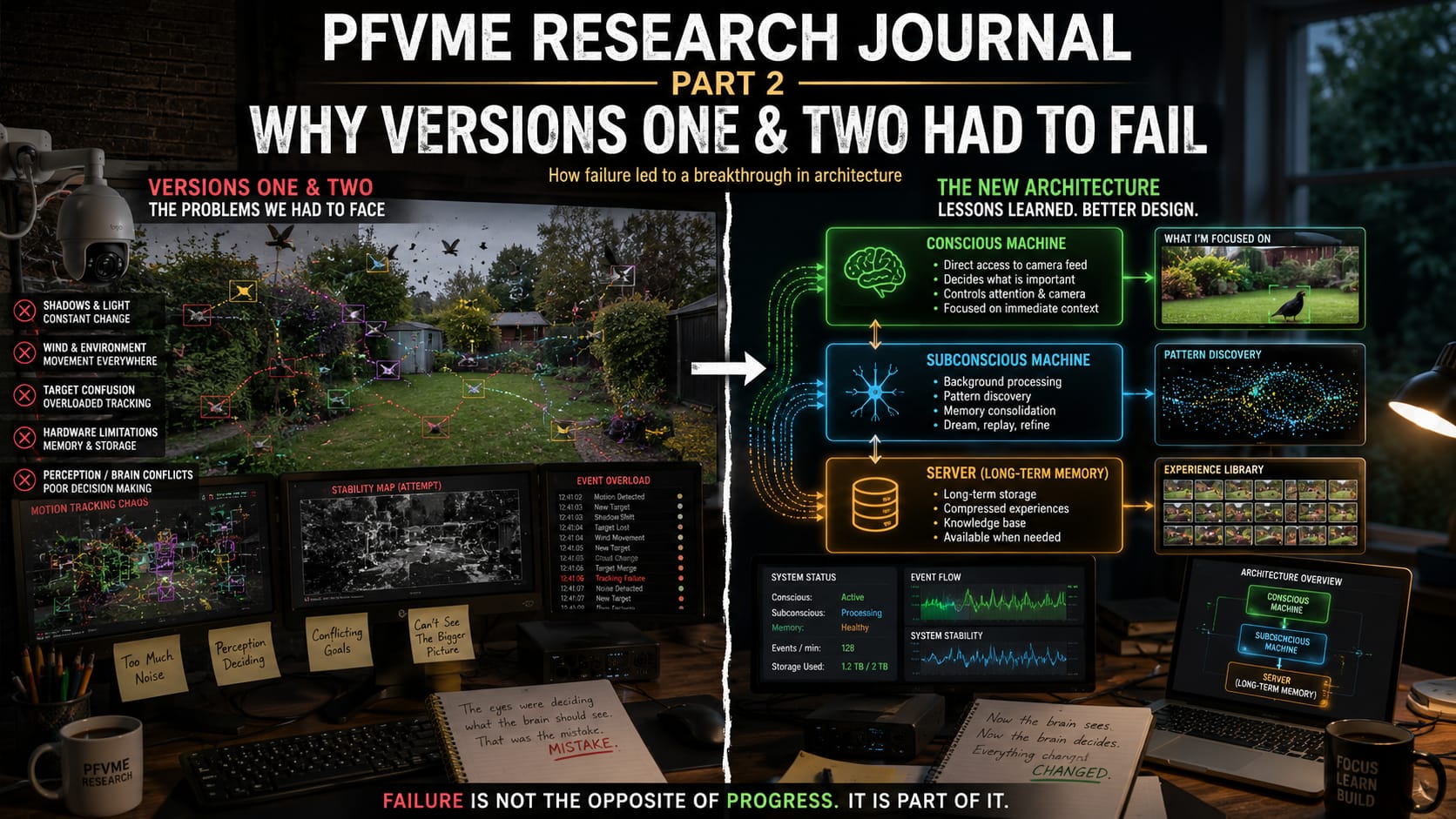
PFVME Research Journal – Part 5: The Introduction of Brain 2
PFVME reaches a major milestone as Brain 2 comes online. After weeks of patient observation by Brain 1, a second independent...
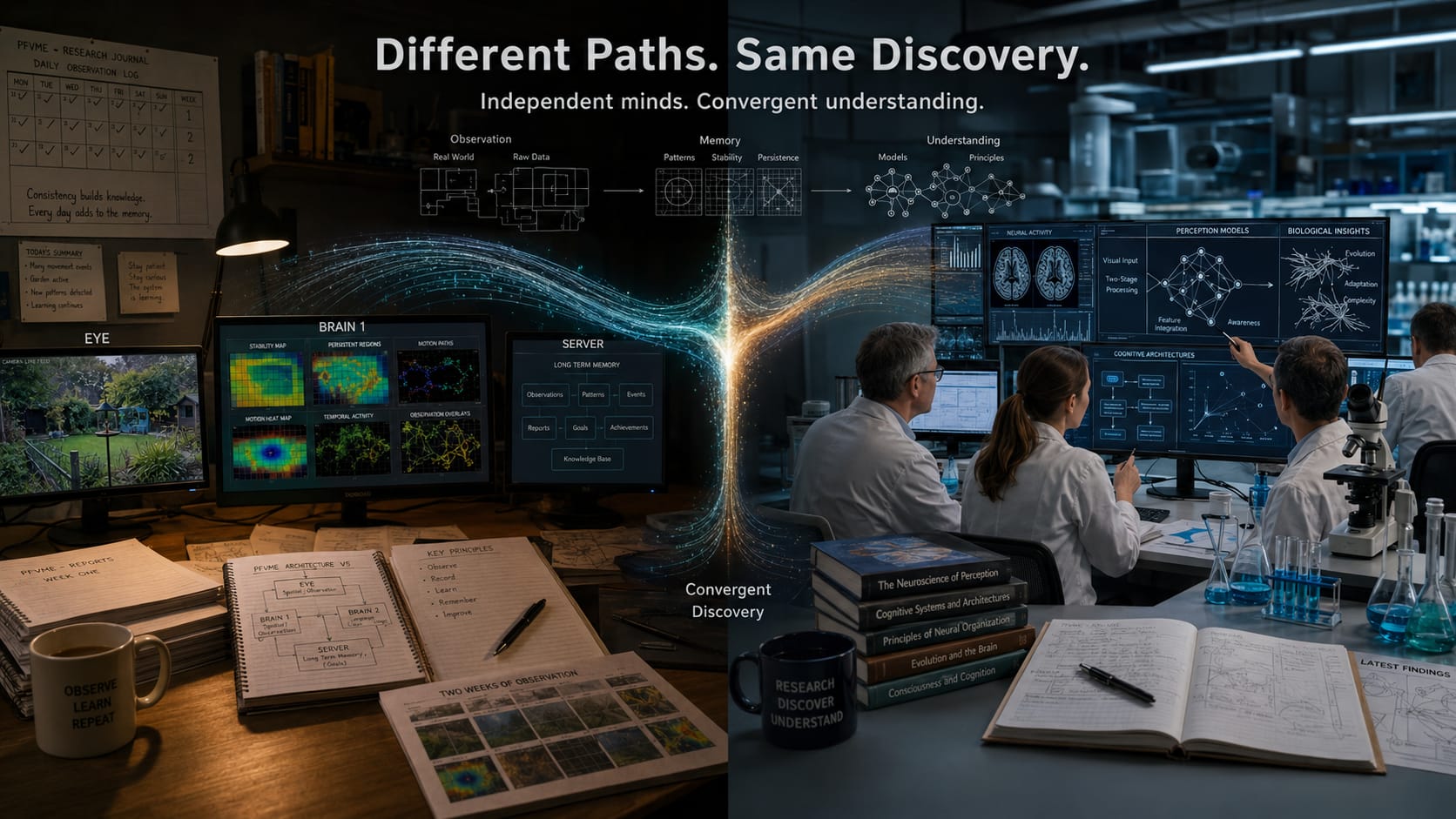
Many Different Paths, Similar Destinations
Can independent AI research reach the same conclusions as world-leading laboratories? The PFVME project unexpectedly found itself...
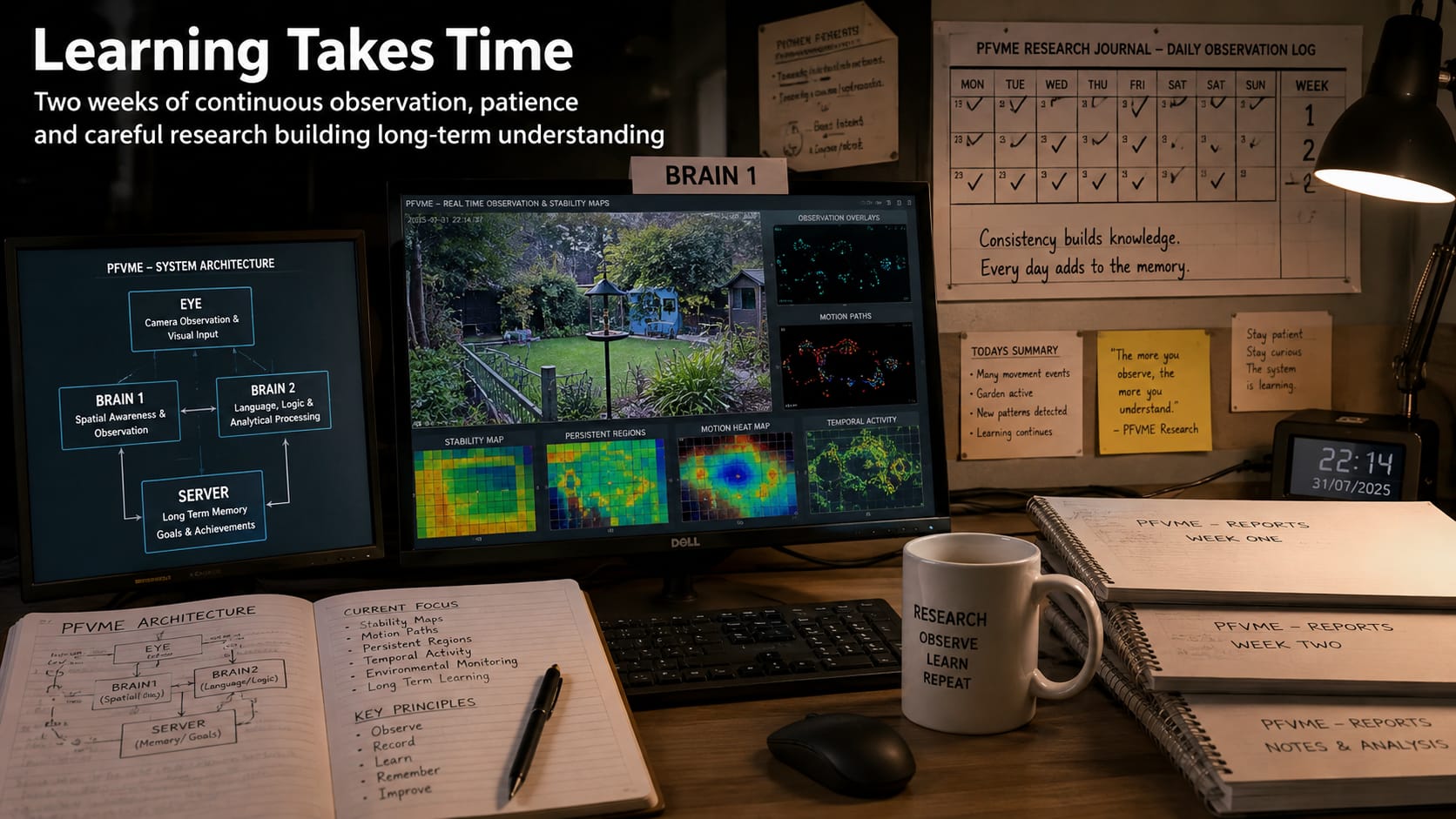
PFVME Research Journal – Part 4
Can artificial intelligence learn simply by watching the world? After weeks of continuous observation, Brain 1 of the PFVME...
PFVME Research Journal – Part 3 – Building a Mind Instead of a Program
Version Five marks a major milestone in the PFVME Research Journal. Discover how specialised AI systems, digital survival goals,...

AI Questions and Answers section for PFVME Journal Part 6 – Learning What Is Worth Remembering
Welcome to a new feature where you can interact with our AI called Jeannie. You can ask her anything relating to this article. If this feature is available, you should see a small genie lamp above this text. Click on the lamp to start a chat or view the following questions that Jeannie has answered relating to PFVME Journal Part 6 – Learning What Is Worth Remembering.
Be the first to ask our Jeannie AI a question about this article
Look for the gold latern at the bottom right of your screen and click on it to enable Jeannie AI Chat.
Type: Article -> Category: The PFVME Research Journal