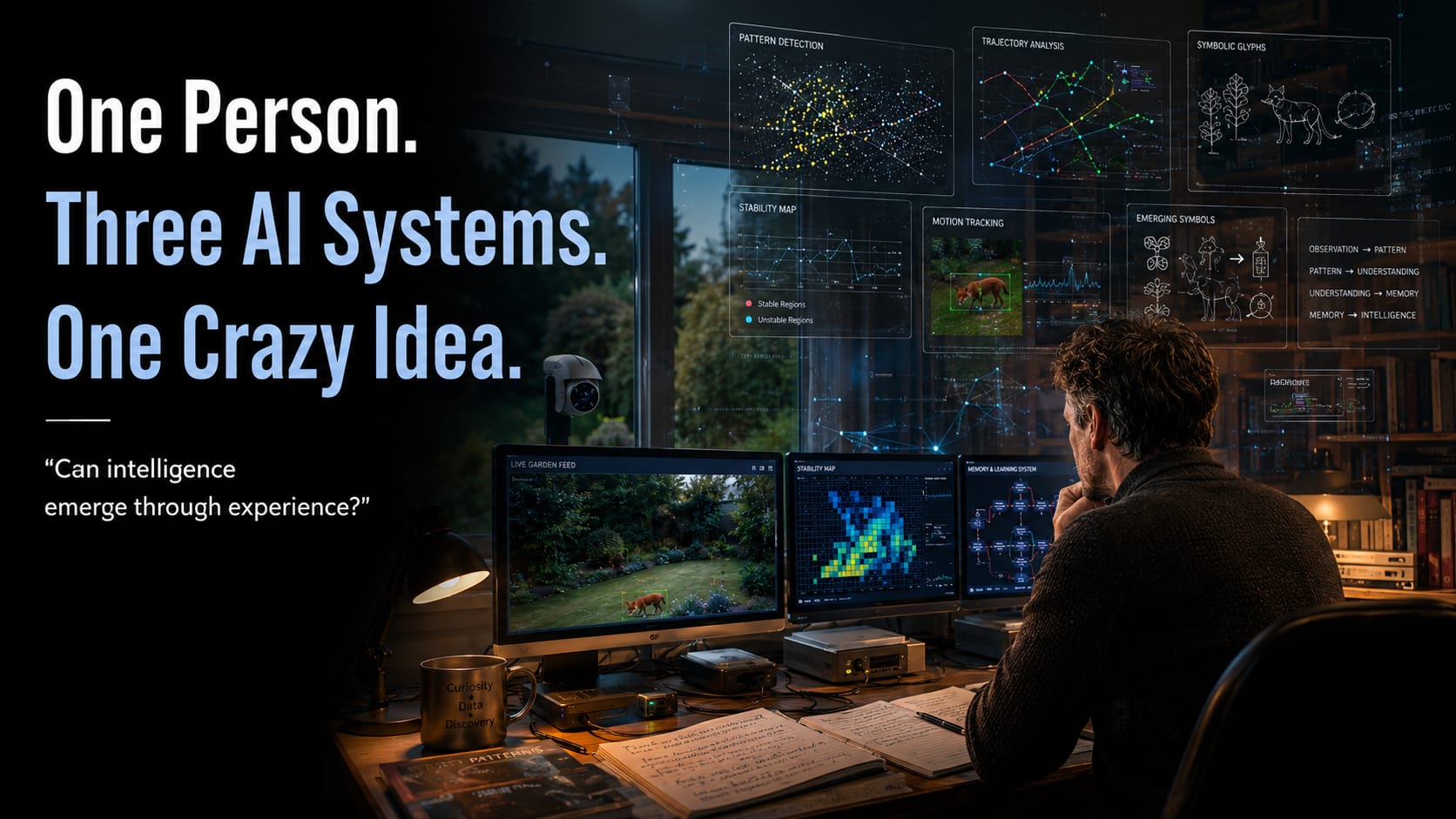
The PFVME Research Journal
Following the Journey to Explore Artificial Intelligence Through Observation and Experience
Welcome to the PFVME Research Journal, an ongoing series documenting the design, development and evolution of an experimental artificial intelligence system built from the ground up.
Unlike many AI projects that focus on creating larger language models or training systems on enormous datasets, PFVME asks a very different question:
Can intelligence emerge through continuous observation, experience, pattern recognition and prediction rather than simply learning from billions of pre-labelled examples?
I don't claim to know the answer.
That is precisely why this project exists.
This journal is an honest record of that journey.
What is PFVME?
PFVME is an experimental research project exploring whether simple interacting systems can gradually develop increasingly sophisticated behaviour by continuously observing the world around them.
Rather than teaching the system what a tree, bird or person is, PFVME begins with something much more fundamental.
Observation.
The system watches.
It detects change.
It searches for stable patterns.
It builds memories.
It compares experiences.
It looks for relationships between events.
Over time, the aim is for the system to develop its own internal representations of the world based entirely on what it has experienced rather than what it has been told.
Whether this approach ultimately succeeds remains to be seen, but the journey itself is proving to be every bit as fascinating as the destination.
Why Build It?
For many years I have been fascinated by one question:
What is intelligence?
Modern AI has demonstrated that machines can perform astonishing tasks, but most current systems begin life by learning from the accumulated knowledge of humanity.
Living creatures don't.
A bird, fox or spider learns through direct interaction with its environment.
PFVME explores whether aspects of that learning process can be recreated using a much simpler, experience-driven architecture.
The project is not intended to replace existing AI systems or compete with them.
Instead, it explores an alternative way of thinking about how intelligence might develop.
AI as a Collaborator
One of the biggest surprises during this project has been the role Artificial Intelligence itself has played.
Rather than replacing human creativity, AI has become an extraordinary collaborator.
The project combines my own experience in software development, engineering and problem-solving with the planning, reasoning and coding assistance provided by modern AI systems.
Ideas are explored together.
Architectures are challenged.
Problems are analysed.
Solutions are tested.
The result is something that would have been almost impossible for a single independent developer to attempt only a few years ago.
A Research Journal, Not a Finished Product
This section of the website is deliberately different from a traditional blog.
It is not a collection of polished success stories.
It is a research journal.
You'll see the successes.
You'll also see the failures.
Design mistakes.
Architectural changes.
Unexpected discoveries.
Completely abandoned ideas.
Real research rarely follows a straight line, and I believe documenting that process is just as valuable as celebrating the breakthroughs.
Affordable Hardware. Ambitious Ideas.
One of the principles behind PFVME is that meaningful experimentation should not require a research laboratory or expensive AI infrastructure.
The project runs on affordable second-hand computers, a consumer PTZ surveillance camera and software developed specifically for the experiment.
The objective is not to build the largest AI.
The objective is to explore whether thoughtful system architecture can achieve meaningful results without relying on enormous computational resources.
Follow the Journey
Every article in this journal represents another stage in the evolution of PFVME.
Some updates will introduce new concepts.
Others will explain why previous ideas failed.
Some will describe breakthroughs.
Others may completely overturn assumptions made only weeks earlier.
That uncertainty is part of genuine research.
Whether PFVME ultimately succeeds or fails, I hope this journal provides an honest insight into what it is like to explore one of computing's most intriguing questions.
If you're interested in Artificial Intelligence, machine vision, robotics, neuroscience, software engineering or simply enjoy following ambitious technical projects, I hope you'll join me as the journey continues.

Available Categories
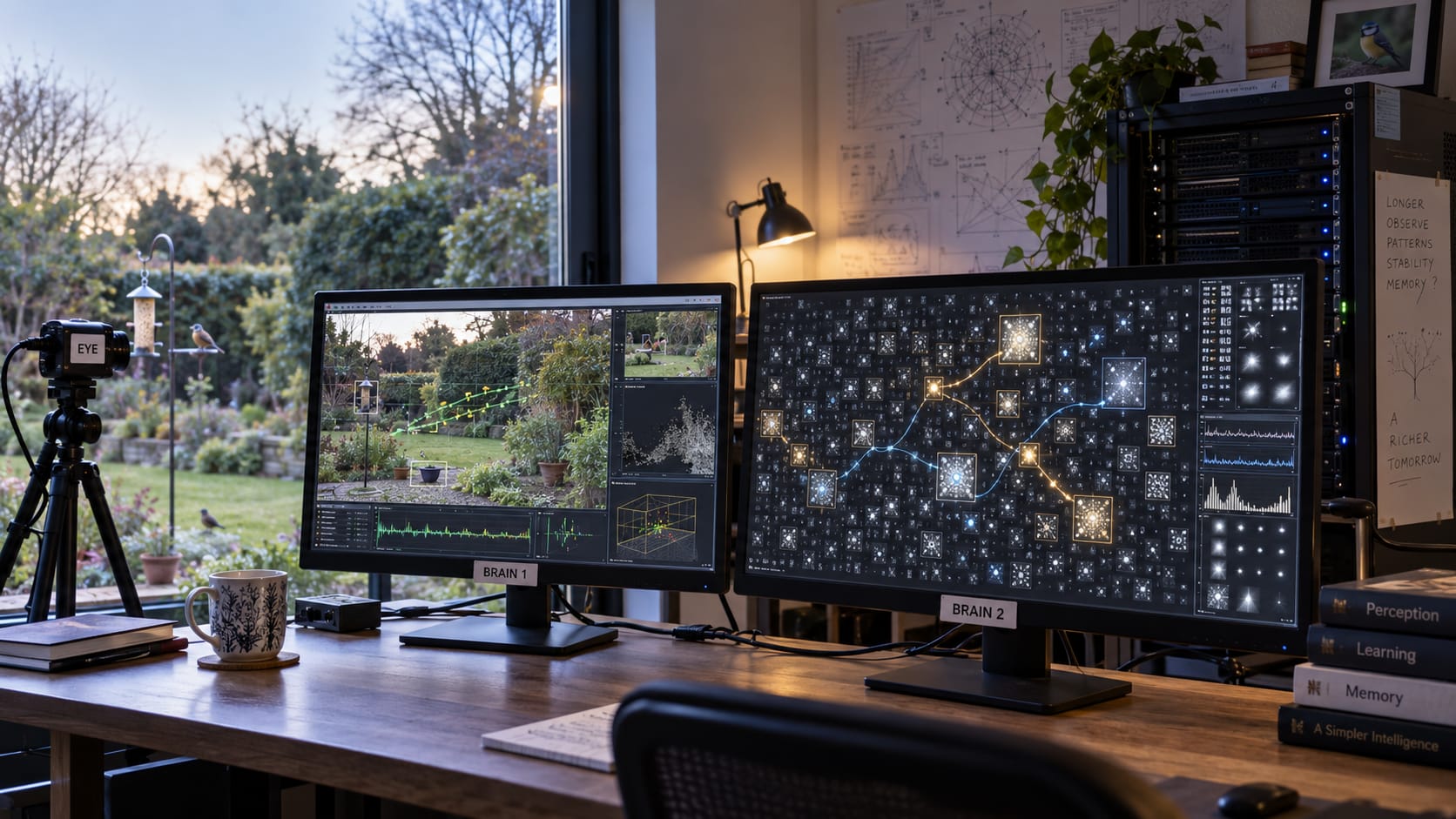
PFVME Journal Part 6 – Learning What Is Worth Remembering
After more than 126 million cycles, PFVME's Brain 2 is moving closer to creating its first glyphs. But before allowing it to remember, we first had to answer a harder question: how can a machine decide for itself what is worth remembering?........
Published On: 21st September 2026
PFVME Research Journal – Part 5: The Introduction of Brain 2
PFVME reaches a major milestone as Brain 2 comes online. After weeks of patient observation by Brain 1, a second independent system begins searching for recurrence, associations and temporal structure—with no language, labels or predefined knowledge.........
Published On: 4th September 2026
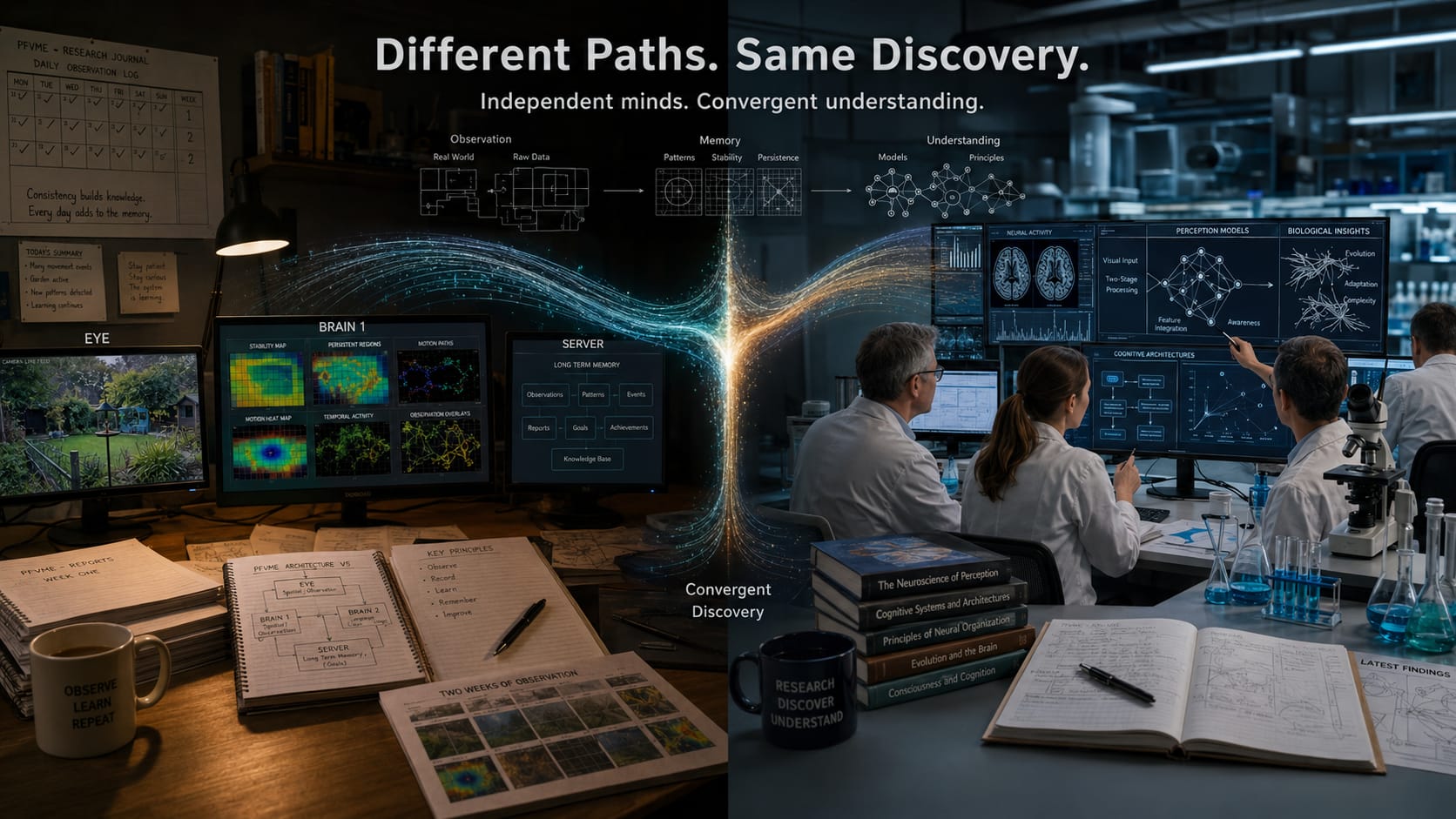
Many Different Paths, Similar Destinations
Can independent AI research reach the same conclusions as world-leading laboratories? The PFVME project unexpectedly found itself converging with modern neuroscience and cognition research, showing how curiosity, experimentation and AI are changing independent science.........
Published On: 10th August 2026
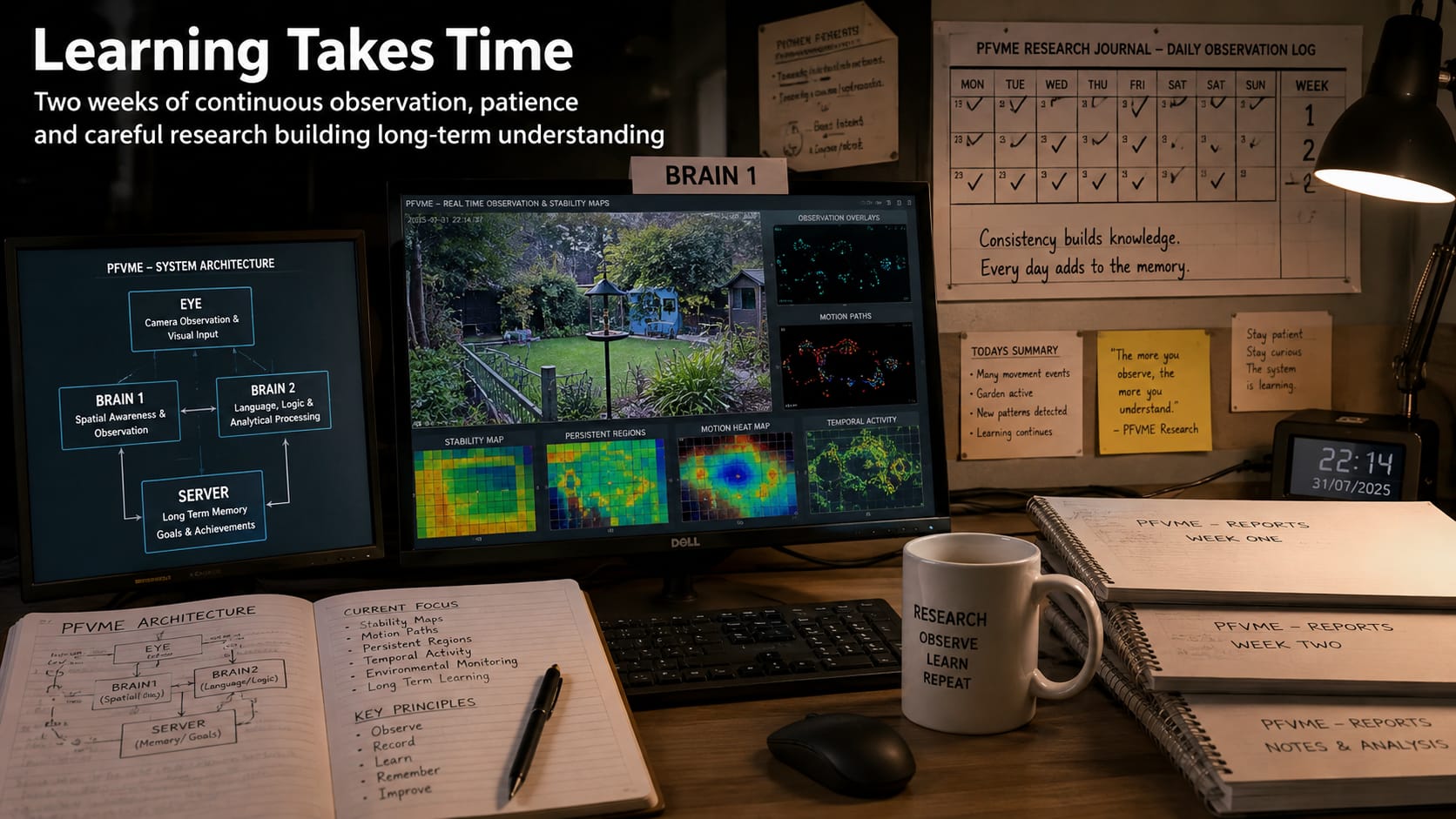
PFVME Research Journal – Part 4
Can artificial intelligence learn simply by watching the world? After weeks of continuous observation, Brain 1 of the PFVME project is beginning to reveal meaningful patterns. This journal explores why patience—not faster coding—may be the key to creating genuine intelligence.........
Published On: 4th August 2026
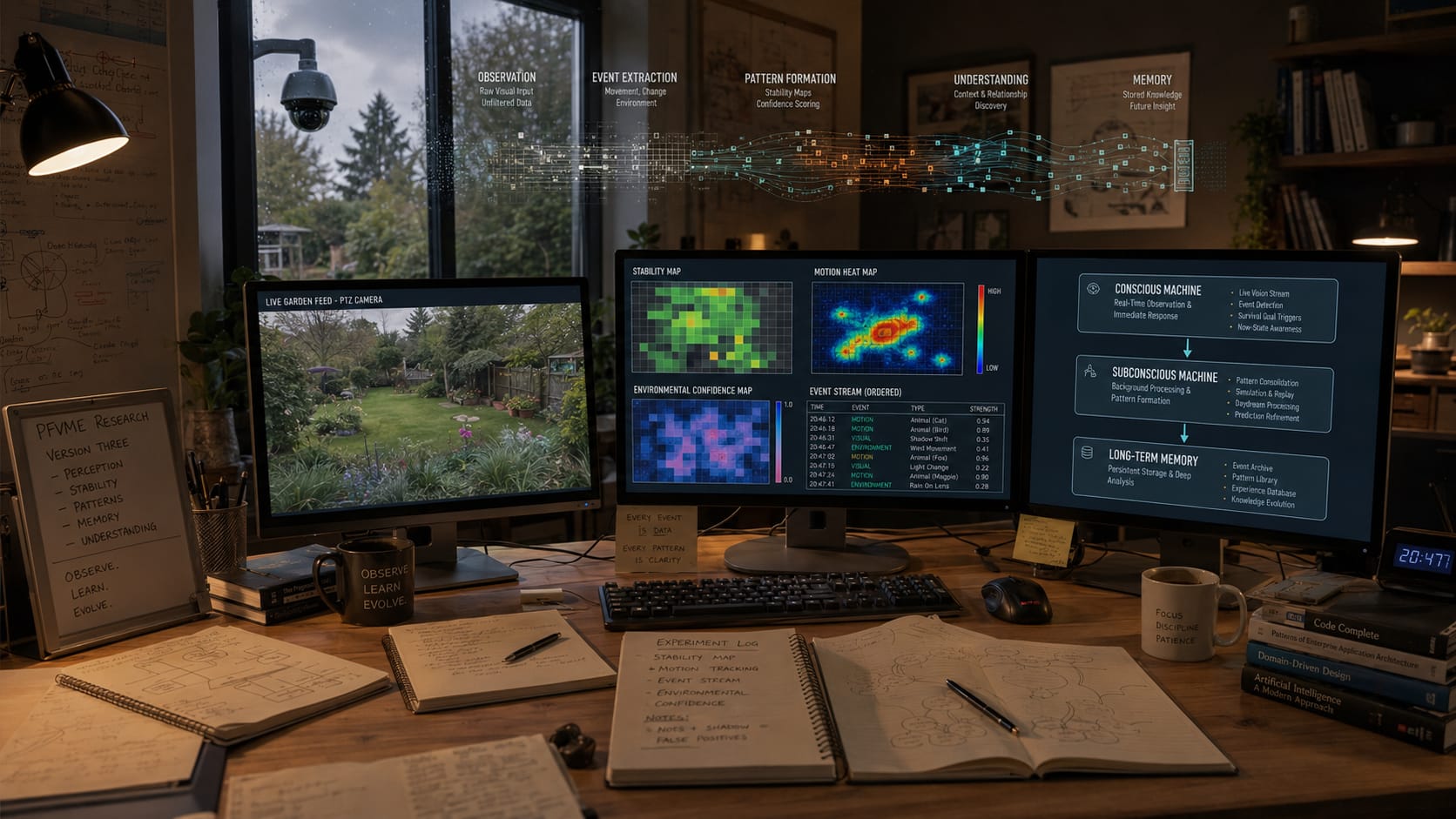
PFVME Research Journal – Part 3 – Building a Mind Instead of a Program
Version Five marks a major milestone in the PFVME Research Journal. Discover how specialised AI systems, digital survival goals, memory buses and self-reflection are shaping an experimental architecture for machine intelligence.........
Published On: 4th July 2026
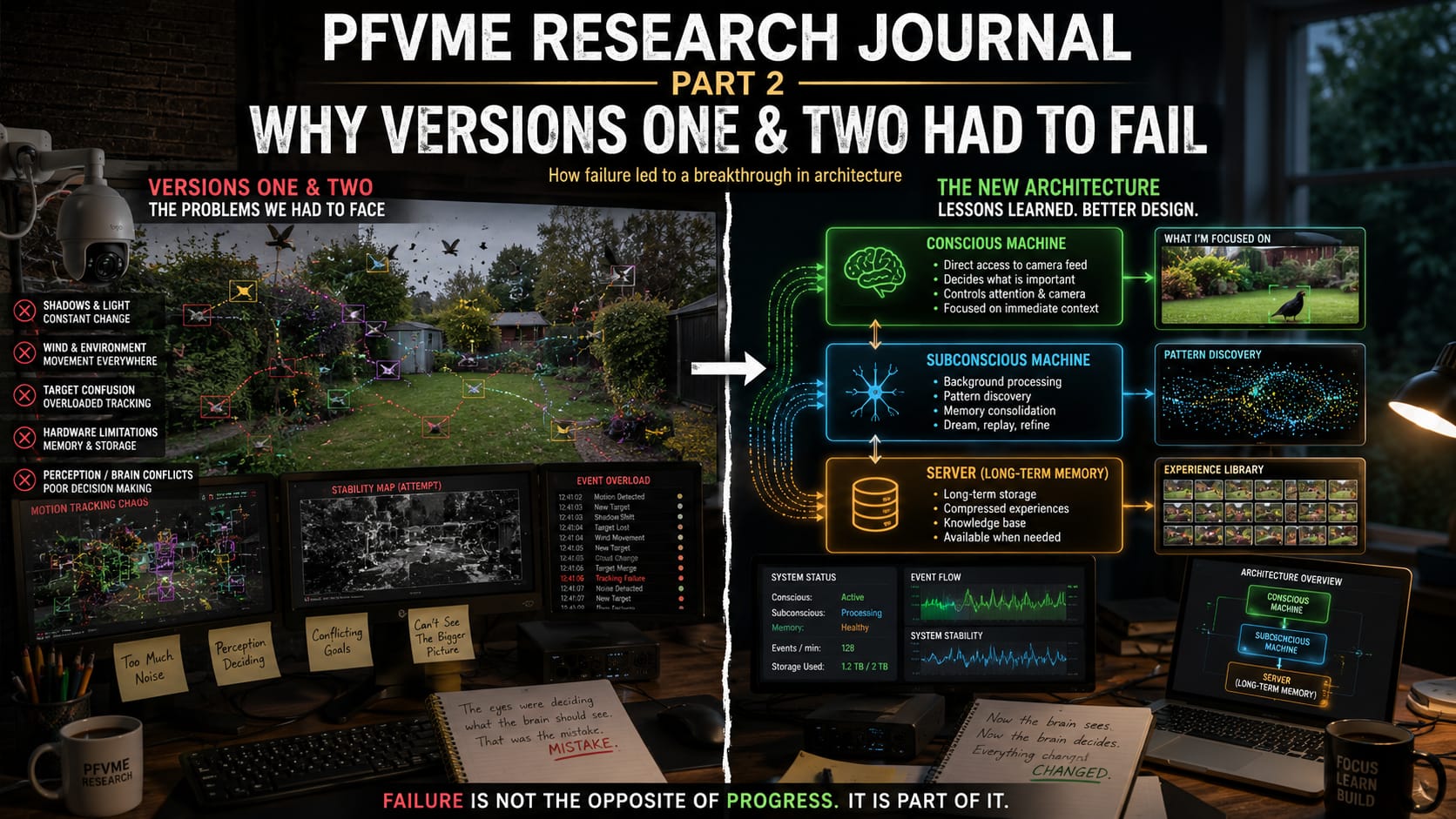
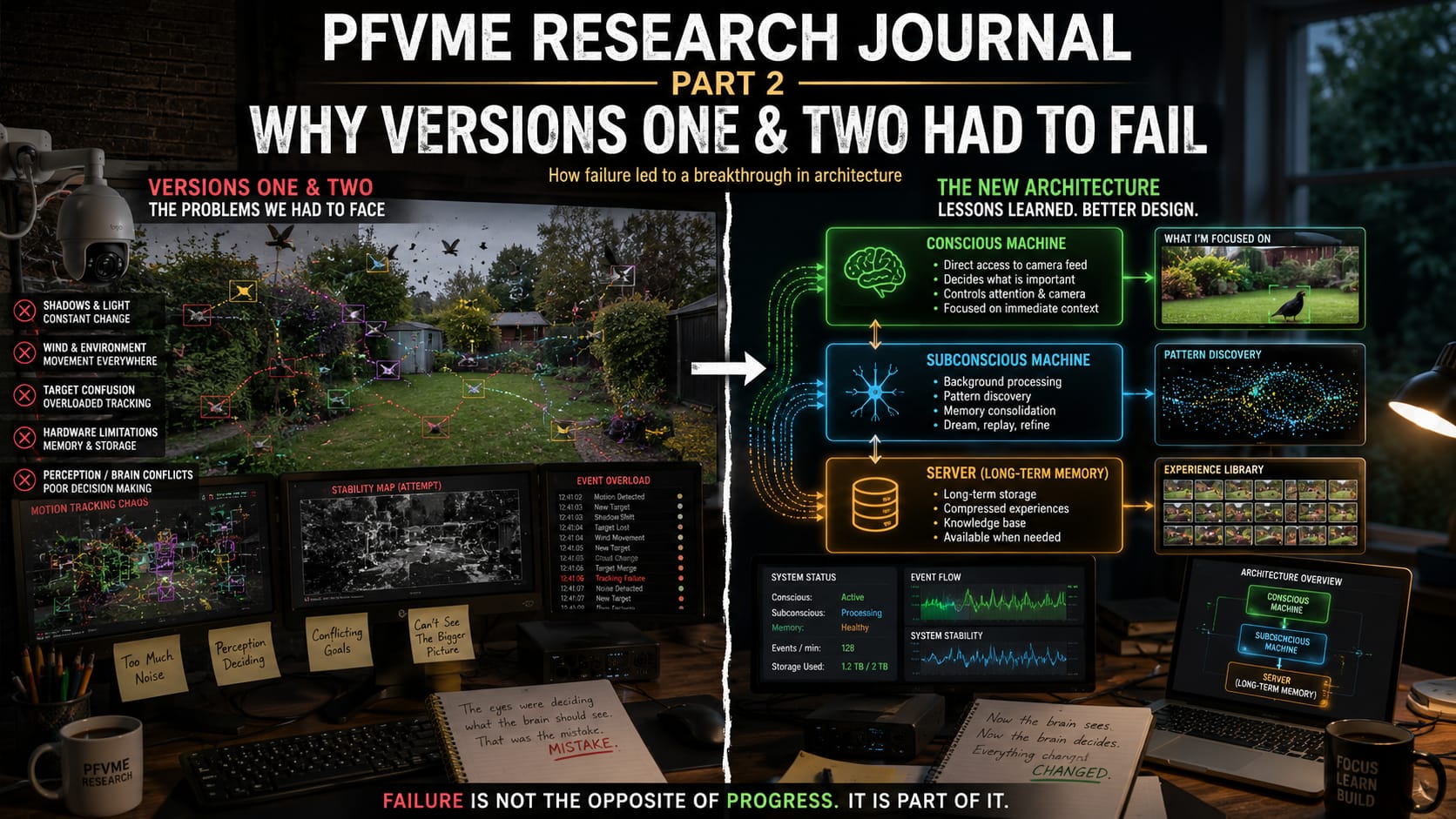
PFVME Research Journal Part Two - Why Versions One & Two Had to Fail
The first two versions of the PFVME project were never wasted effort. They revealed fundamental architectural flaws that challenged my assumptions about perception, memory and intelligence, leading to a completely new direction for the research.........
Published On: 1st July 2026
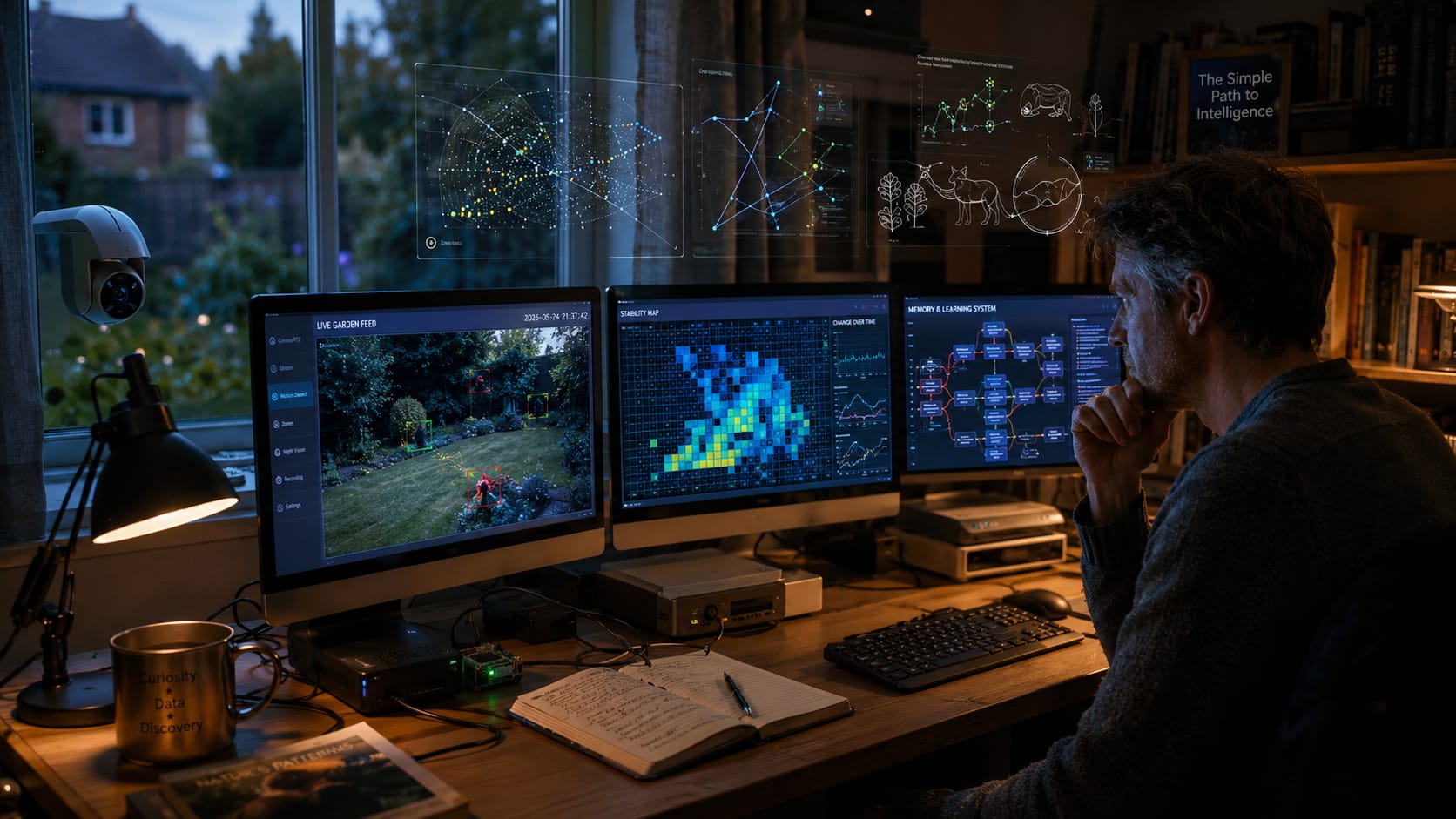
PFVME Research Journal Part One - One Person. Three AI Systems. One Crazy Idea.
PFVME is an ongoing experiment exploring whether artificial intelligence can learn through observation, experience and prediction rather than massive training datasets. Follow the journey as one person uses AI to investigate one of computing's biggest questions: what is intelligence?........
Published On: 27th June 2026