Type: Article -> Category: The PFVME Research Journal
PFVME Research Journal – Part 5
The Introduction of Brain 2
Don't have time to read the article? View as a short video storyboard or listen to it whilst jogging.
Publish Date: Last Updated: 4th September 2026
Author: nick smith- With the help of CHATGPT
It has been a few weeks since I last published an update on the progress of my PFVME project.
That silence does not mean the project has ground to a halt. Quite the opposite. One of the lessons I have learned from PFVME is that sometimes the most productive thing I can do is stop changing it and give it time to experience its environment.
There is always a temptation with a software project to keep coding. Add another feature. Adjust another threshold. Build the next layer.
PFVME is increasingly teaching me that this can be exactly the wrong approach.
If the purpose of the project is to explore whether increasingly complex behaviour can emerge from relatively simple systems observing, remembering and interacting with one another, then those systems need something just as important as code:
They need experience.
After weeks of observation, refinement and long continuous runs, I am now satisfied that Brain 1 has reached the point where it can largely be left to do its job.
And that means PFVME has reached one of its biggest milestones so far.
Brain 2 is alive and running.

Before Brain 2: What Has Brain 1 Become?
For anyone joining the project at this stage, PFVME is not an attempt to build another large language model or conventional AI system.
The project started from a much simpler question:
Can increasingly complex behaviour emerge from simple independent systems that learn from experience and interact when required?
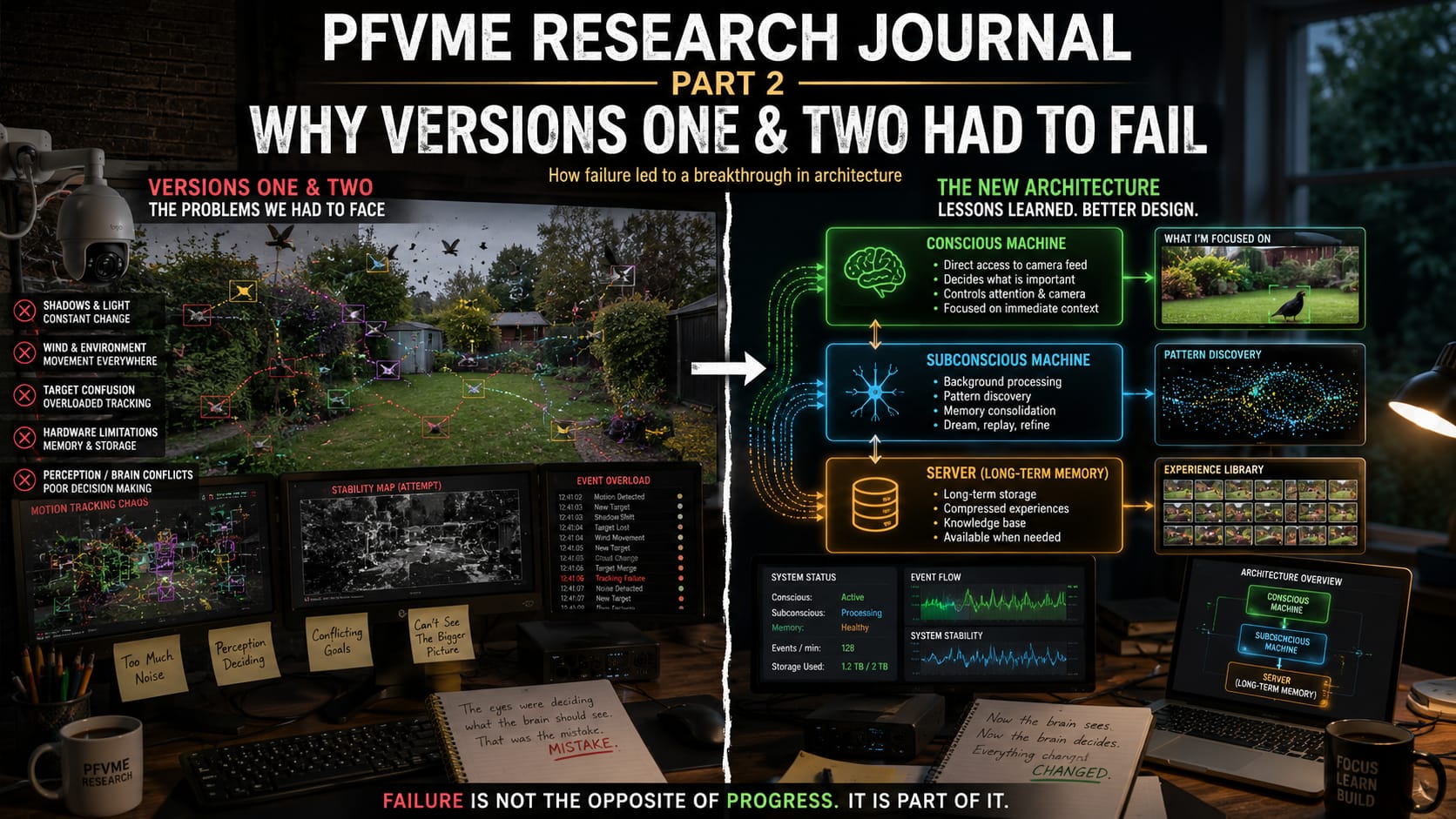
Earlier versions of PFVME divided processing into ideas resembling conscious and subconscious systems. As the project developed, I became increasingly uncomfortable with that architecture.
Biological intelligence does not appear to be neatly divided into one system that "thinks" and another that works invisibly underneath it. Instead, there appear to be many specialised systems operating simultaneously, exchanging information when it becomes relevant.
PFVME Version 5 therefore moved towards a distributed architecture.
The Eye does as little interpretation as possible. It provides the visual stream.
Brain 1 concentrates on the physical and spatial world.
Brain 1 has spent weeks observing the same garden scene. It has been learning which areas remain stable, which regularly change, where independent movement occurs and how movement develops through the visual field.
Importantly, it has not been told that something is a bird, feeder, washing line, bush or tree.
Those are our labels.
Brain 1 instead deals with movement, position, stability, persistence, relationships and confidence.
This has produced some fascinating results. Movement maps have repeatedly concentrated activity around areas that I independently know contain the bird feeders and washing line. Brain 1 does not know what those objects are, but its observations show that these areas behave differently from quieter parts of the scene.
The system has also become substantially better at maintaining moving entities rather than treating every change in shape as a completely new object.
By late August, Brain 1 was running continuously as a Linux service, processing the Eye feed and producing diagnostic information independently. One 24-hour diagnostic, for example, showed the service active and the Eye connected and processing frames continuously.
Brain 1 has therefore become the part of PFVME concerned primarily with:
What physically appears to be happening?
Brain 2 has a very different job.
Building Brain 2
Before any of the interesting experimental work could begin, however, there was the considerably less glamorous matter of building another computer.
I am not an Ubuntu expert.
PFVME has certainly tested my abilities and pushed my knowledge of Linux, networking and system administration considerably further than I expected when this project began.
Once again, having AI beside me throughout the process proved invaluable.
That does not mean AI magically made everything work.
Anyone who has followed a hardware or Linux tutorial will probably recognise the familiar experience where the instructions make something look remarkably straightforward — until you try it on your own machine.
Brain 2 was no exception.
I wanted the PFVME machines to move away from their previous dependence on Windows, so the new Brain 2 machine was installed with Ubuntu. I also needed the Eye, Brain 1 and Brain 2 to communicate across the network while still allowing my Windows laptop to act as my development and monitoring workstation.
That meant learning considerably more about Samba, Linux permissions, network shares and Ubuntu networking than I previously knew.
There is a small correction worth making to my original notes here. I initially blamed Ubuntu for not including NetworkManager. In reality, Ubuntu Server commonly uses systemd-networkd through Netplan rather than NetworkManager by default. Nothing was actually missing from Ubuntu; I was simply unfamiliar with the networking model I had installed.
That distinction did not make troubleshooting it feel any less painful at the time.
At one stage the Ubuntu installation had connected successfully to Wi-Fi during setup, yet networking became considerably less cooperative afterwards. Eventually I learned enough about Netplan and its renderer configuration to get the machines behaving consistently.
Samba presented another learning curve. What I loosely thought of as "virtual folders" are more accurately network shares: directories on the Linux machines exposed over the network with controlled access.
Eventually my Windows laptop could access both machines, while the PFVME systems could communicate directly with one another.
Then came storage.
Brain 1 had previously taught me a fairly brutal lesson about the amount of observational data this type of project can generate. Consequently, Brain 1 and Brain 2 now each have 2 TB NVMe storage available rather than waiting for disk capacity to become another experimental constraint.
Even that produced a final surprise. Ubuntu had initially allocated only around 100 GB of the available Brain 2 storage to the filesystem. Once I realised what had happened, I extended it to use approximately the full 1.9 TB available.
PFVME now has considerably more room to remember.
Making Brain 2 Independent
The next challenge was getting Brain 2 to run as a proper independent service.
PFVME runs inside a Python virtual environment, and getting that environment, its dependencies and the Linux service configuration working correctly proved another exercise in troubleshooting.
A dependency had not installed correctly, which prevented the service from starting.
Once again AI helped me work through the symptoms, logs and configuration until we found the problem.
This highlights something about AI-assisted development that I think is often overlooked.
One of AI's most valuable qualities is not simply its ability to generate code.
It has patience.
It does not become irritated because you misunderstood something. It does not ridicule you for not knowing a Linux command. It does not become frustrated when the fourth attempt still doesn't work.
You can bring it another error message, another log and another theory, and continue working through the problem.
For someone deliberately working beyond areas where they already have expertise, that is incredibly powerful.
And then came what I can only describe as the champagne moment.
Brain 2 started successfully as a service.
The Eye connection appeared.
Brain 1 appeared.
Brain 2 started processing.
For the first time, all three active PFVME machines were operating together.
The current Brain 2 diagnostics confirm that the service is active, the Eye is connected and Brain 1 is independently supplying evidence.
So What Exactly Is Brain 2?
This is where the project becomes particularly interesting.
Brain 2 is not another Brain 1.
Both systems can receive information originating from the same visual world, but they are deliberately being given different responsibilities.
Brain 1 is grounded primarily in physical and spatial observation:
Where did something appear?
Where did it move?
What remained stable?
What changed?
Which fragments might belong to the same moving entity?
Brain 2 is intended eventually to deal with something more abstract:
What repeats?
What tends to occur together?
What tends to follow something else?
What distinguishes one recurring structure from another?
Can repeated experience be compressed into an internal representation?
Eventually, this is where we expect PFVME's glyph system to develop.
But there is an important word in that sentence:
Eventually.
We have deliberately not given Brain 2 a ready-made vocabulary.
It has no predefined knowledge of birds, trees, feeders or people. It has no semantic categories and, at the time of writing, it has created zero glyphs. That absence is deliberate: the first diagnostic report explicitly confirmed zero glyphs, zero semantic categories and zero predefined object knowledge.
The objective is not to give Brain 2 our representation of its world.
It is to see whether repeated experience eventually gives Brain 2 a reason to create its own representation.

The Beginning of an Internal Language
This connects to one of the original ideas behind PFVME.
If the system eventually needs an internal language, I do not want to simply hand it English words.
A glyph should emerge as a form of compression.
Imagine Brain 2 encounters hundreds of recurring structures. Some share characteristics. Others differ. Certain combinations occur repeatedly. Some structures persist. Some happen simultaneously. Others repeatedly follow one another.
At some point, retaining every individual detail becomes inefficient.
A glyph could then become a compressed representation of whatever Brain 2 itself has discovered to be significant.
It does not need to mean "bird".
It might initially represent something much more primitive:
this recurring structure with these distinguishing characteristics.
Multiple glyphs may subsequently acquire similarities of their own. Those similarities could eventually create higher-level groupings.
The important principle is that we should not decide those groupings in advance.
What Build 1 Is Actually Doing
Brain 2 Build 1 is intentionally primitive.
It looks for differences and primitive relationships between them. It creates and reinforces associations. It identifies recurrence candidates and uses tightly bounded working context rather than trying to keep everything active simultaneously.
It also implements the early version of another PFVME concept: buses.
The idea is that processing should not require loading everything the system has ever experienced. Instead, small processing routes can travel through relevant structures, collecting what is needed for the current problem.
Eventually this could become extremely important for long-term memory.
Rather than asking:
Search everything I have ever experienced.
the system should increasingly be able to ask:
What do I need next to make sense of what I am experiencing now?
Build 1 is nowhere near that level yet. The important thing is that we are putting the primitive mechanisms in place without prematurely deciding what intelligence is supposed to look like.
The Bus System — Bringing Relevant Knowledge to the Problem
One of the more unusual ideas being tested in Brain 2 is what we have called the bus system.
The concept came from thinking about a fundamental problem with intelligence and memory. If a system accumulates years of experience, it cannot realistically examine everything it has ever learned every time something happens. Biological brains clearly do not appear to work like a conventional database search either. Relevant memories and associations can sometimes become available extraordinarily quickly.
PFVME therefore works from a different question:
What information do I need right now to make sense of what I am experiencing?
A bus is a small, temporary processing route created in response to something currently requiring attention. Rather than bringing the entire memory system into the problem, the bus travels through potentially relevant structures, collecting useful evidence as it goes.
Importantly, there does not have to be only one bus. Multiple buses can eventually investigate different aspects of the same observation simultaneously. One might encounter spatial evidence from Brain 1, another a recurring structure previously discovered by Brain 2, while another might encounter an association with an earlier experience. Their results can then contribute to the current working context.
This creates an important distinction between memory and active thought.
PFVME may eventually contain enormous amounts of stored experience, but only a tiny fraction of it should need to become active at any particular moment.
Build 1 is already testing the primitive mechanism required for this. Buses are being created and completed successfully rather than remaining permanently active. In an earlier diagnostic, Brain 2 had already completed 425,436 bus operations, while the average budget consumed by each was just 3.0 units. At the same time, its working context was using only 250 of an available 1,000 units.
That is significant because the bus also has a limited energy or processing budget. It cannot wander indefinitely through memory collecting everything remotely connected with an observation. It must operate within constraints.
At the moment these buses are extremely primitive. They are not yet intelligently retrieving decades of memories or reasoning about complex relationships. What matters in Build 1 is establishing the underlying behaviour: something happens → a bounded route investigates it → relevant evidence is collected → the route terminates.
As Brain 2 develops, however, this mechanism could become much more important. Recurrence, associations, temporal sequences and eventually glyphs could provide increasingly useful junctions through which buses can travel.
This could ultimately allow PFVME to replace the computationally expensive question:
What do I know about everything?
with something much closer to:
What do I need to know next?
For me, that distinction may prove to be one of the most important architectural ideas in the entire project.
Day Three: Millions of Experiences Already
At the time of writing, Brain 2 is only around three days into its first continuous observation period.
Yet the amount of data involved is already substantial.
The latest 24-hour diagnostic covered approximately 18.98 million processing cycles and visual samples, with Brain 1 supplying 65,504 evidence records during the same period. Brain 2 detected 728,732 differences.
Perhaps more interestingly, it recorded 39,229 new associations, reinforced existing associations 657,017 times and weakened them more than 5.7 million times.
This is important because Brain 2 is not simply accumulating everything forever with equal significance.
Connections are competing.
Some relationships recur.
Others weaken.
From this activity, the latest report identified 468 unique recurrence candidates. Of those, 321 had already occurred more than ten times.
That does not mean Brain 2 has discovered 468 objects.
That distinction is extremely important.
At this stage, many recurrence candidates are much more primitive — effectively patterns such as small changes repeatedly occurring within particular areas of the visual field.
But that is precisely where I want Brain 2 to start.
Something More Interesting Is Beginning to Appear
Our reporting has now started looking not merely at whether something recurs, but at how recurring structures relate through time.
This has led us to an important diagnostic distinction:
Simultaneous: A and B occur together.
Persistent: A continues or repeatedly appears — A → A → A.
Progressive: different structures occur sequentially — A → B → C.
That last category is particularly interesting.
A system that merely discovers that A, B and C are common has learned something useful about its environment.
A system that discovers:
A is repeatedly followed by B, which is repeatedly followed by C
has discovered something quite different.
It has begun finding structure through time.
We are currently refining the diagnostic system specifically to determine whether these progressive structures remain significant after simultaneous events and simple persistence are separated from them.
I do not yet want to claim what those structures mean.
That would be us imposing an interpretation on the experiment.
But if genuinely progressive sequences repeatedly emerge from the data, they may eventually provide some of the pressure required for Brain 2 to compress recurring experiences into its first glyphs.
Reporting Turned Out to Be an Experiment of Its Own
You might assume that creating a diagnostic report would be one of the easier parts of PFVME.
It hasn't been.
We learned this lesson painfully with Brain 1.
After Brain 1 had been operating continuously for more than a week, an early reporting system attempted to process so much accumulated data in memory that Linux's out-of-memory protection killed the Python process.
That forced us to rethink reporting completely.
The reporting system must satisfy two requirements that can conflict with one another:
- It must tell us enough about what PFVME is doing to evaluate the experiment.
- It must not interfere with, alter or influence the experiment it is measuring.
The current Brain 2 reporter therefore streams historical records rather than loading entire datasets into RAM.
This matters because Brain 2 is already producing very large datasets. The initial storage baseline shows approximately 13.68 GB of runtime data, including roughly 5.5 GB of recurrence records and 4.7 GB of association data.
Yet the reporting process can work through these histories using only a very small amount of memory.
That might sound like an engineering detail, but it has become part of the scientific discipline of the project:
The observer should interfere with the observed system as little as practically possible.
What Have We Learned So Far?
Perhaps the biggest lesson remains the simplest:
Patience. And then more patience.
It is incredibly tempting to look at an encouraging report and immediately start coding the next layer.
Give it glyphs.
Add more reasoning.
Improve the buses.
Create goals.
Connect long-term memory.
But doing that too early risks destroying the very thing PFVME is trying to investigate.
Humans and other animals do not learn their environments in three days. Biological organisms arrive with evolutionary inheritance shaped across enormous spans of time, and then continue learning throughout their individual lives.
Their environment never remains completely fixed either.
Weather changes.
Seasons change.
Other organisms appear and disappear.
Relationships change.
The organism itself changes.
Learning therefore cannot simply be a stage that eventually finishes.
It is continuous adaptation.
PFVME needs to be given the same conceptual freedom.
Following the Evidence, Not Defending the Architecture
One of the founding principles of PFVME has become increasingly important as the project has progressed:
Never become emotionally attached to the architecture.
This project has already changed dramatically.
Ideas that seemed completely sensible several months ago have been abandoned. Systems have been separated. Responsibilities have moved. Assumptions have been challenged. Code representing weeks of work has sometimes become irrelevant.
That isn't failure.
That is the experiment working.
If evidence demonstrates that a fundamental assumption is wrong, I would rather discard a month of development than spend another six months building increasingly elaborate fixes around the mistake.
PFVME is an independent experimental project running on modest hardware in a home environment. It is not a university laboratory, and I am not claiming that these experiments constitute proof of a new theory of intelligence.
But that does not prevent the project from following a scientific mindset:
Observe. Hypothesise. Test. Measure. Question. Revise. Repeat.
And perhaps most importantly:
Be prepared to be wrong.
The Next Stage
For now, Brain 2 will continue observing.
The final Build 1 diagnostic refinements are being completed so that we can clearly separate simultaneous recurrence, persistence and genuinely progressive temporal structures.
Then we wait.
If the evidence shows that Brain 2 is beginning to discover stable recurring structures through time, we can start considering the next major experiment:
When does repeated experience justify compression?
That will take us towards Brain 2 Build 2 and potentially one of the most significant moments in PFVME so far:
the creation of its first internally generated glyph.
But we will not create one simply because we want to see it happen.
Brain 2 needs to give us a reason.
And if it doesn't, then perhaps our assumptions about glyphs are wrong.
That, ultimately, is what makes this project so fascinating to me.
I don't know where it will lead.
If you work in neuroscience, cognition, artificial intelligence, computer science — or you simply have your own ideas about how intelligence might emerge from simpler processes — I would genuinely like to hear them.
PFVME has never been about proving that my original ideas were right.
It is about finding out which ones survive contact with reality.
Read more on the PFVME Project
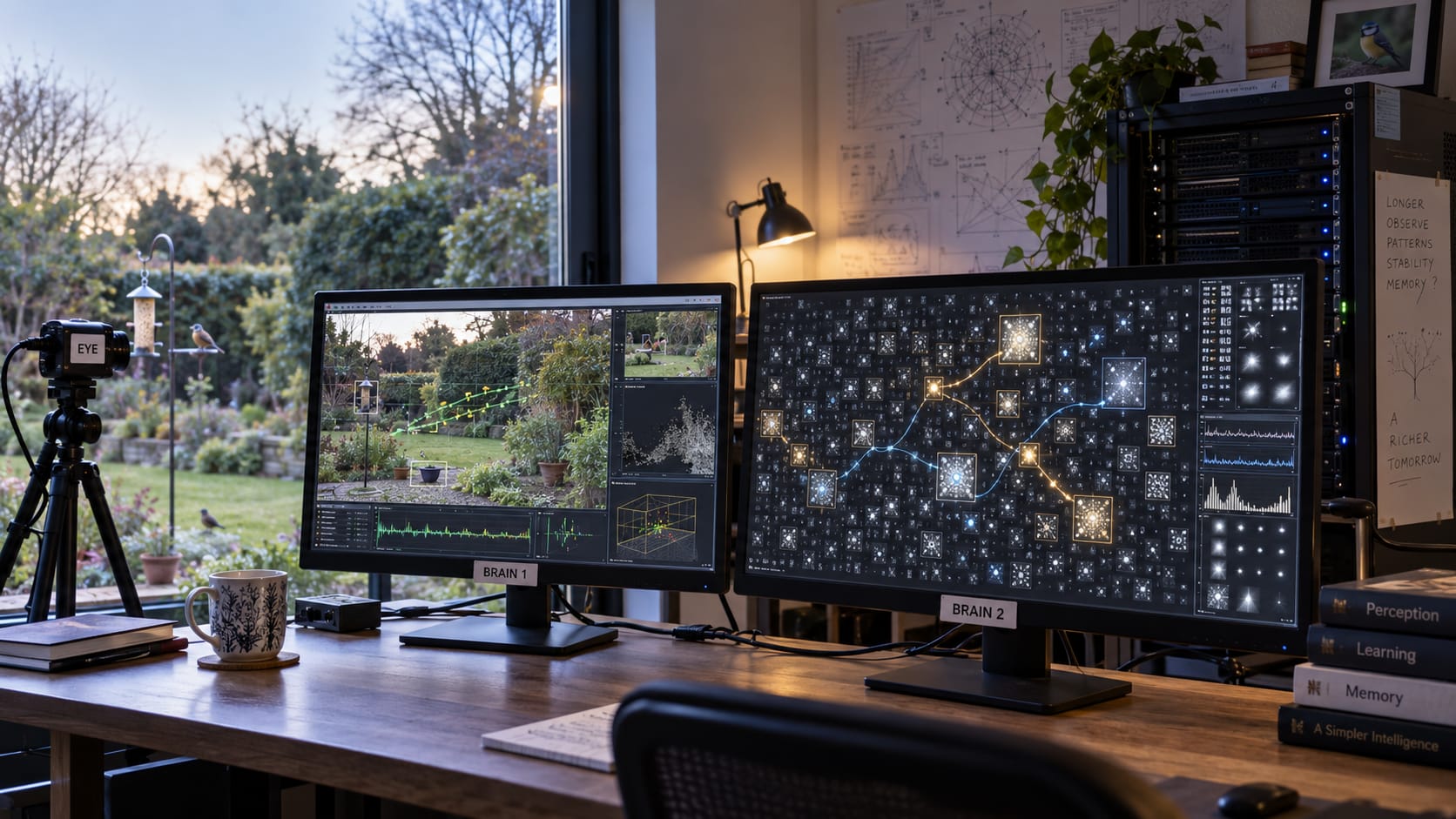
PFVME Journal Part 6 – Learning What Is Worth Remembering
After more than 126 million cycles, PFVME's Brain 2 is moving closer to creating its first glyphs. But before allowing it to...
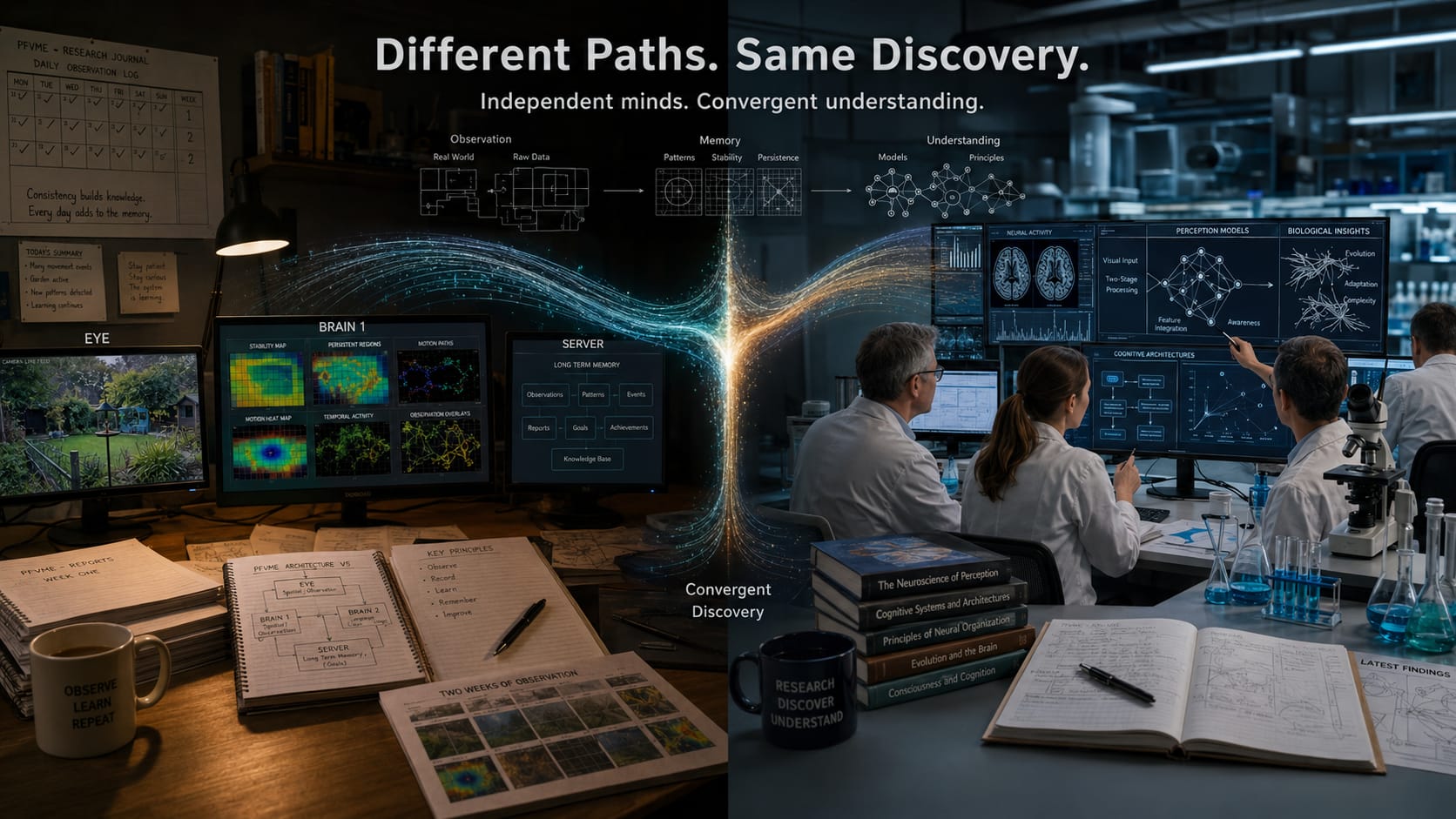
Many Different Paths, Similar Destinations
Can independent AI research reach the same conclusions as world-leading laboratories? The PFVME project unexpectedly found itself...
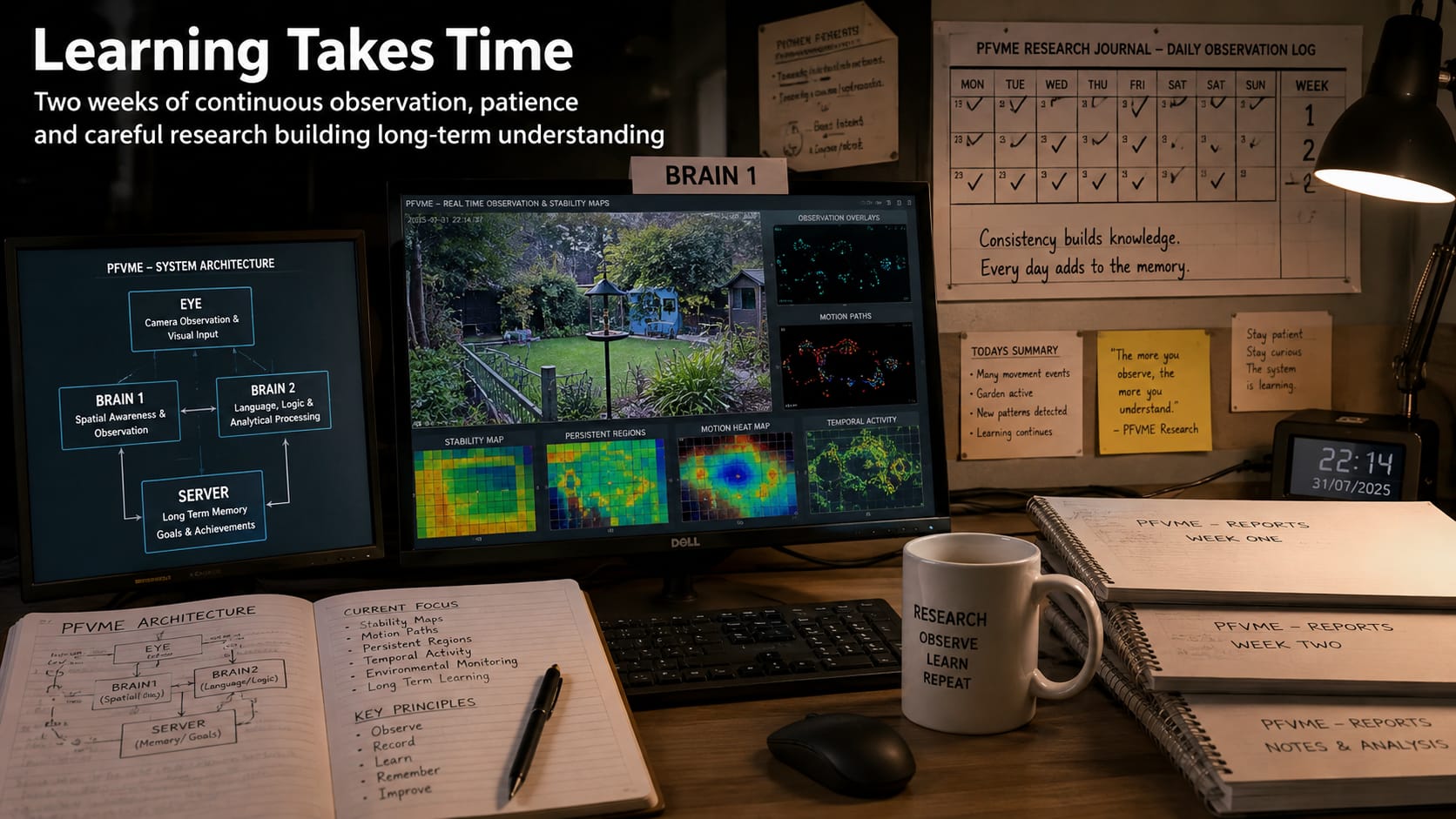
PFVME Research Journal – Part 4
Can artificial intelligence learn simply by watching the world? After weeks of continuous observation, Brain 1 of the PFVME...
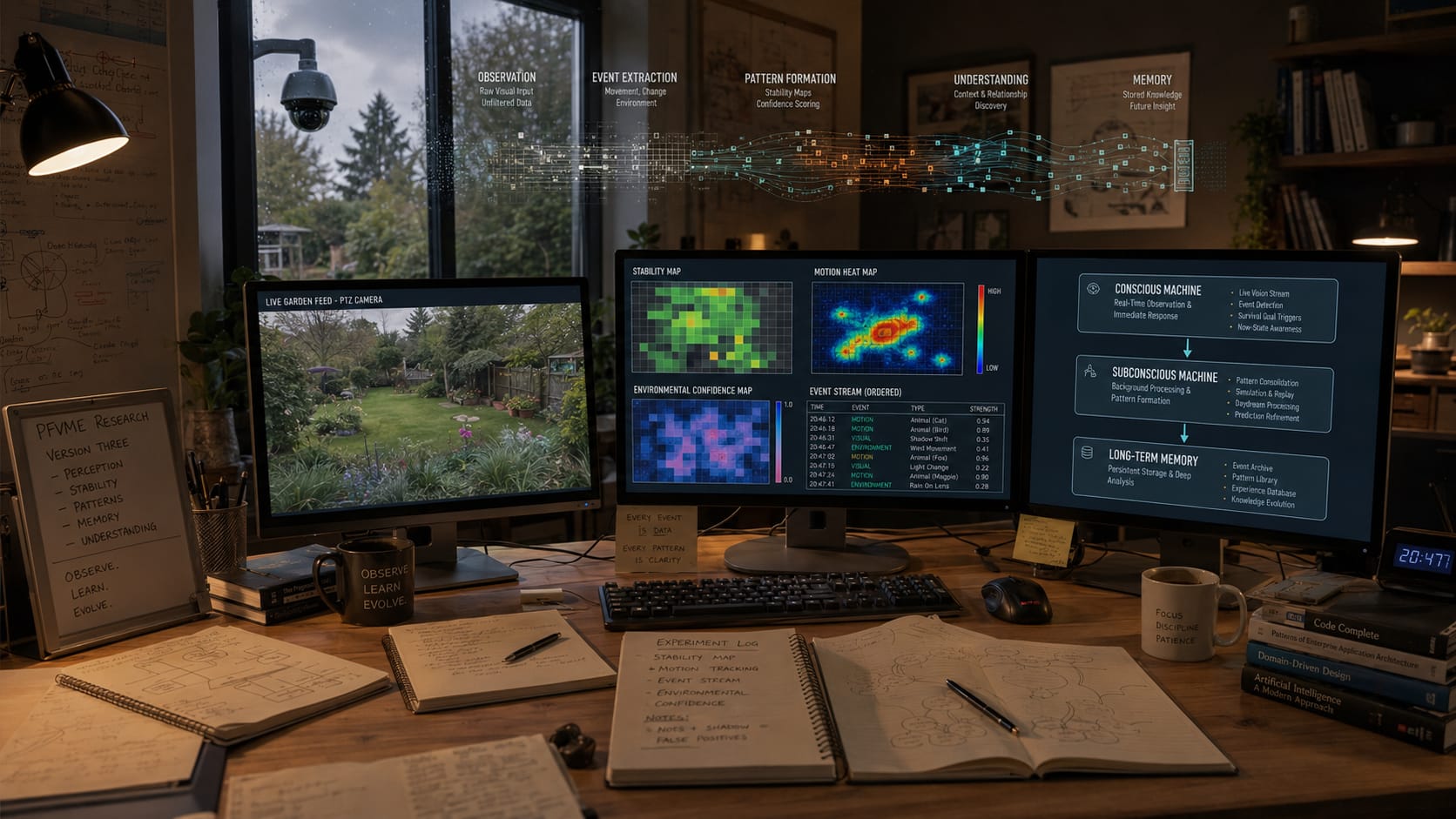
PFVME Research Journal – Part 3 – Building a Mind Instead of a Program
Version Five marks a major milestone in the PFVME Research Journal. Discover how specialised AI systems, digital survival goals,...

AI Questions and Answers section for PFVME Research Journal – Part 5: The Introduction of Brain 2
Welcome to a new feature where you can interact with our AI called Jeannie. You can ask her anything relating to this article. If this feature is available, you should see a small genie lamp above this text. Click on the lamp to start a chat or view the following questions that Jeannie has answered relating to PFVME Research Journal – Part 5: The Introduction of Brain 2.
Be the first to ask our Jeannie AI a question about this article
Look for the gold latern at the bottom right of your screen and click on it to enable Jeannie AI Chat.
Type: Article -> Category: The PFVME Research Journal