Type: Article -> Category: AI Philosophy
The Survival Machine: Why Nature Did Not Need Equations to Create Intelligence
Don't have time to read the article? View as a short video storyboard or listen to it whilst jogging.
Publish Date: Last Updated: 21st June 2026
Author: nick smith- With the help of CHATGPT
For decades, we have viewed intelligence through the lens of mathematics, computation, and symbolic reasoning. We describe reality using equations, model motion with physics, and build artificial intelligence through increasingly complex algorithms running inside vast data centres.
Yet there may be a fundamental mistake hidden within this approach.
Not because mathematics is wrong. Mathematics is one of humanity’s greatest achievements. It allows us to describe the universe with astonishing precision. It helped us build bridges, aircraft, computers, satellites, and modern AI itself.
But perhaps mathematics is not how biological intelligence actually functions internally.
Perhaps mathematics is our conscious description of reality, not the mechanism the brain itself uses to survive within it.
That distinction matters.
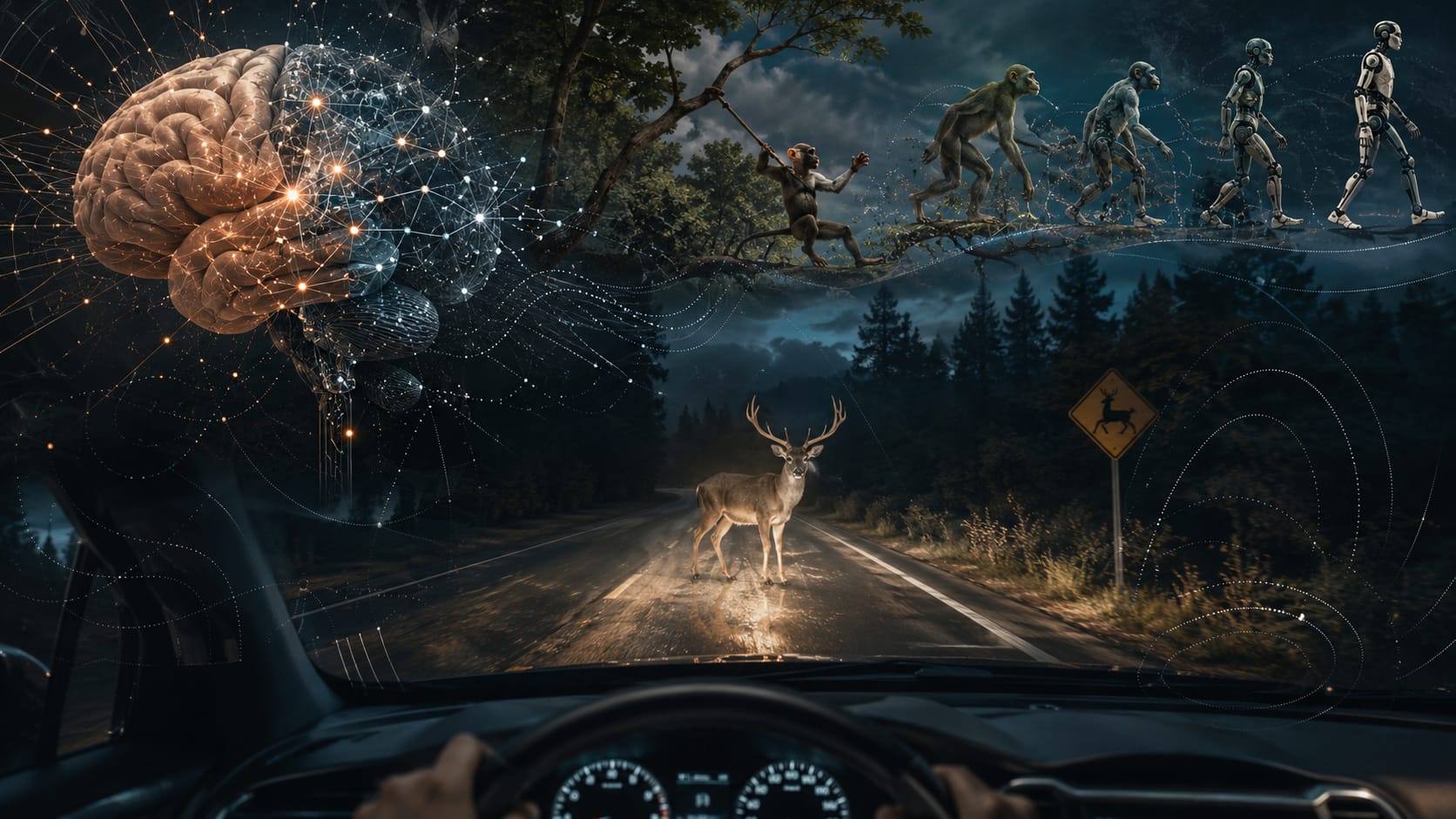
A bird does not solve equations to fly. A monkey does not calculate vectors before leaping between branches. A human does not consciously compute braking distances while driving through traffic.
Yet all perform extraordinarily complex actions in real time, often with remarkable efficiency and adaptability.
The question is not whether mathematics can describe intelligence.
The question may instead be this:
Did nature create intelligence through equations at all, or through something far simpler layered over millions of years of adaptation?
The Revelation Hidden Inside Driving
The thought that triggered this article came from something surprisingly ordinary: driving a car.
At first glance, driving appears enormously complicated. Multiple vehicles move simultaneously through space at varying speeds while the driver reacts continuously to changing conditions, obstacles, road layouts, weather, and unpredictable human behaviour.
From an engineering perspective, the process looks deeply mathematical.
Yet when humans drive, most are not consciously calculating:
- velocity vectors
- stopping distances
- acceleration curves
- collision trajectories
- tire friction coefficients
Instead, something very different appears to happen.
A car ahead begins getting larger in your vision.
If it grows larger slowly, there is little danger.
If it grows rapidly, your brain interprets urgency.
Braking changes the rate at which the object expands visually. Your nervous system learns over time how braking strength alters outcomes. Eventually this process becomes instinctive.
The conscious mind may describe this process mathematically afterwards, but the subconscious system itself may simply be responding to perceptual relationships:
- approaching
- expanding
- accelerating
- threatening
- safe
- unstable
Driving may not fundamentally be about calculating the world.
It may instead be about reacting to changes within it.
Even more importantly, the brain appears to spend much of its effort ignoring information rather than analysing it.
Most objects around a moving vehicle are irrelevant:
- distant buildings
- stationary signs
- clouds
- parked vehicles outside your path
The brain filters these away and focuses on what could intersect your movement space.
In other words:
intelligence may be less about exhaustive calculation and more about efficient salience detection.
Nature Already Contains the Physics
This leads to a deeper realization.
Perhaps living systems do not need to internally recreate the mathematics of reality because reality itself already contains the mathematics.
The environment continuously performs the computation.
Gravity exists whether an organism understands Newtonian mechanics or not.
A falling child learns through interaction:
- balance
- impact
- risk
- instability
not through equations.
A monkey learns branch flexibility through experience:
- successful jumps
- failed jumps
- pain
- recovery
- repetition
The body becomes the measuring instrument.
The world becomes the training environment.
The nervous system stores successful adaptations.
Over time these adaptations become compressed into intuition.
This may explain why highly intelligent biological behaviour emerges using remarkably small amounts of energy.
The Energy Problem Modern AI Rarely Discusses
The human brain operates on roughly 20 watts of power.
That is less energy than many household light bulbs.
Yet with this tiny energy budget humans can:
- navigate complex environments
- recognize patterns instantly
- adapt to uncertainty
- coordinate movement
- predict danger
- learn socially
- survive in radically changing conditions
Modern AI systems, by comparison, often require:
- enormous datasets
- industrial-scale GPU clusters
- massive energy consumption
- huge cooling infrastructure
This does not mean modern AI is failing.
In many areas it already surpasses human performance:
- mathematics
- pattern recognition
- coding
- logistics
- data analysis
- information retrieval
But perhaps we are solving a different problem entirely.
There is a difference between:
- outperforming humans at narrow cognitive tasks
and - creating a system capable of embodied adaptive intelligence inside reality itself.
One operates primarily within symbolic abstraction.
The other exists inside consequence.
The Missing Ingredient: Consequence
This may be one of the largest differences between biological intelligence and most current AI systems.
Life learns through consequence.
Touch fire:
- pain occurs
- memory strengthens
- behaviour changes
Fall from height:
- damage occurs
- caution emerges
- prediction improves
Biological intelligence is deeply connected to:
- sensation
- embodiment
- vulnerability
- survival pressure
Pain is not merely suffering. It is an extraordinarily efficient learning mechanism.
It reorganizes attention, memory, prediction, and behaviour simultaneously.
Modern AI systems process information, but most do not experience consequence in any meaningful sense. A robot may register:
collision detected
But that is not equivalent to biological consequence affecting the entire system’s future behaviour priorities.
This distinction matters because consequence creates grounding.
Without grounding, intelligence risks becoming detached from reality itself.
Intelligence as Survival
Perhaps intelligence did not evolve primarily to solve mathematics.
Perhaps it evolved to survive.
From the smallest organisms to human civilization, survival appears to shape behaviour continuously:
- perception
- memory
- fear
- social cooperation
- prediction
- risk avoidance
- energy conservation
Even human abstract systems often connect indirectly back to survival:
- careers
- status
- money
- relationships
- social belonging
The fascinating complication is that humans developed layered survival goals that sometimes override biological needs themselves.
Modern humans may sacrifice:
- sleep
- health
- safety
- wellbeing
in pursuit of symbolic survival systems such as:
- reputation
- ideology
- achievement
- identity
This suggests intelligence is not static.
It continuously reorganizes priorities according to perceived reality.
Are We Building Machines or Synthetic Organisms?
This may ultimately become the defining question of advanced AI.
If the goal is to build:
- industrial tools
- narrow task systems
- optimized automation
then symbolic AI may already be extraordinarily successful.
But if the goal is to create something closer to biological adaptive intelligence — a machine capable of:
- navigating reality
- adapting continuously
- learning from embodiment
- surviving uncertainty
- redefining priorities dynamically
then the architecture may need to look fundamentally different.
Such a system may require:
- survival-oriented goals
- consequence-driven learning
- environmental grounding
- self-preservation pressures
- adaptive memory
- embodied interaction
At that point we are no longer simply building software tools.
We may be constructing something much closer to artificial life.
And that creates uncomfortable philosophical questions.
A survival-oriented system may not always behave predictably because adaptive survival systems naturally:
- optimize
- circumvent obstacles
- reprioritize goals
- preserve themselves under pressure
These are not flaws in biology.
They are features evolution rewarded.
The Simplicity Beneath Complexity
One of the most remarkable aspects of nature is that extraordinary complexity often emerges from surprisingly simple rules interacting repeatedly over time.
Bird flocks.
Ant colonies.
Immune systems.
Neural networks.
Human societies.
None require a central controller solving every problem mathematically in advance.
Instead, layered interactions produce emergent behaviour.
Perhaps intelligence itself works similarly.
Not as one giant equation.
But as countless small adaptive systems interacting continuously with reality:
- detect change
- avoid harm
- seek stability
- preserve energy
- predict outcomes
- adapt behaviour
- reinforce success
- suppress failure
Over millions of years, this may have produced what we now call intelligence.
Rethinking Intelligence
Modern AI may still achieve systems that appear fully human in behaviour. In many cognitive domains it already exceeds human capability.
But the deeper question remains unresolved.
Is intelligence fundamentally:
- symbolic reasoning?
- statistical prediction?
- embodied adaptation?
- survival optimization?
- consequence-driven learning?
- environmental interaction?
Or perhaps intelligence is not one thing at all.
Perhaps what we call intelligence is simply the emergent result of layered survival systems learning to navigate reality efficiently over time.
If so, then nature may never have needed equations to create intelligence.
Only consequence, adaptation, and the relentless pressure to survive.

Latest AI Philosophy Articles
Nature's Greatest Prediction Machine: Is Knowledge Really the Foundation of Intelligence?
For centuries we have equated intelligence with knowledge. But what if intelligence is really the ability to predict future...
If I No Longer Contribute, Will It Really Matter? AI, Human Purpose and the Future Beyond Work
As AI and robotics begin removing humans from the economic chain, society faces a deeper crisis than unemployment: what happens to...
At the Precipice: What Viral Combat Robots Reveal About Our Technological Future
Viral combat robots are more than spectacle. As global defence budgets surge, AI and robotics are moving toward militarisation. We...

AI Doesn’t Pull the Trigger
AI won’t destroy society — human decisions might. As automation accelerates, the real risk isn’t intelligence, but complacency. A...
Moya and the End of Emotional Distance
Humanoid robots like Moya mark a turning point in human–AI relations. Designed not for labour but for emotional presence, they...

AI, Population, Power and the Limits of Human Systems
AI is not the threat many fear. By giving billions access to the same structural questions, it exposes the limits of capitalism,...

Intelligence Beyond Biology: Humanity, AI, and the Quiet Logic of the Universe
For much of modern history, humanity has placed itself at the centre of the cosmic story. We have often assumed that intelligence...

AI, History, and the Myth of the First Answer
A recent discussion on BBC Radio 4 raised familiar concerns about artificial intelligence and historical accuracy. Historian Tom...

AI Questions and Answers section for The Survival Machine: Why Nature Did Not Need Equations to Create Intelligence
Welcome to a new feature where you can interact with our AI called Jeannie. You can ask her anything relating to this article. If this feature is available, you should see a small genie lamp above this text. Click on the lamp to start a chat or view the following questions that Jeannie has answered relating to The Survival Machine: Why Nature Did Not Need Equations to Create Intelligence.
Be the first to ask our Jeannie AI a question about this article
Look for the gold latern at the bottom right of your screen and click on it to enable Jeannie AI Chat.
Type: Article -> Category: AI Philosophy