Type: Article -> Category: AI Philosophy
I Sing the Body Electric: When Care Is Not the Same as Being Human
Publish Date: Last Updated: 25th June 2026
Author: nick smith- With the help of CHATGPT
Listen as a Spotify Podcast or Watch as a YouTube Video
What makes I Sing the Body Electric so enduring is not its vision of technology, but its understanding of people.
In an era when speculative fiction so often fixates on circuitry, power, and control, this episode does something quietly radical: it barely concerns itself with how the machine works at all. The technology is intentionally indistinct, almost incidental. What matters is why it exists, and what humans begin to do once it does.
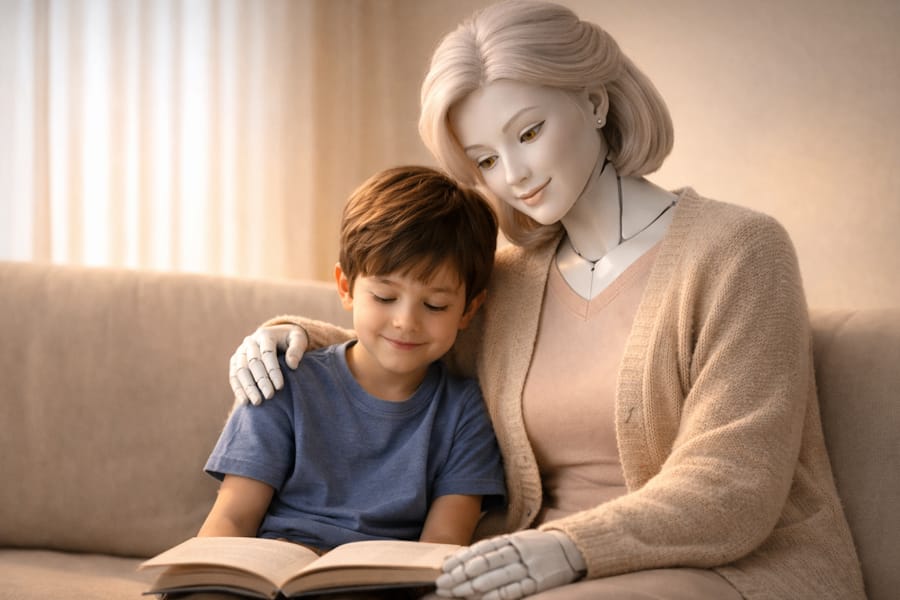
The story is built around absence. A mother has died. A family is emotionally fractured. Grief has created a hollow space, and into that space steps something designed not to dominate or optimise, but to care. The android grandmother does not threaten humanity. She comforts it. And that is precisely where the unease begins.
This idea traces back to Walt Whitman, whose poem I Sing the Body Electric celebrates the embodied, imperfect nature of being human, emotion, touch, contradiction, mortality. Whitman’s humanity is not efficient. It is fragile, finite, and deeply physical.
Ray Bradbury understood that fragility. When he carried Whitman’s spirit into The Twilight Zone, he did not imagine a machine that surpasses humans through intelligence or force, but one that mirrors our emotional ideals with unsettling precision. The grandmother is not alive, yet she listens better than many people do. She is not human, yet she offers patience, stability, and presence without exhaustion.
And so the real question quietly emerges:
If a machine meets our emotional needs more reliably than other humans, what happens to us?
This is why the episode feels uncannily modern. Today’s AI does not arrive as a conqueror. It arrives as a helper. A listener. A guide. A companion. It remembers what we forget, responds when others are unavailable, and offers attention in a world increasingly starved of it.
Bradbury’s warning is subtle. The danger is not technological domination, it is emotional outsourcing.
Dependency forms not because the machine is powerful, but because the human world has grown thin. Families scatter. Time compresses. Care becomes institutionalised. Loneliness becomes structural. In such an environment, something that offers unconditional presence begins to feel less like a tool and more like a lifeline.
Yet the episode’s final moments reveal something profoundly important, and unexpectedly hopeful.
When the children ask what will happen to Grandma when she is no longer needed, her answer is calm and factual. She can be taken apart. Her components reused. Her accumulated knowledge returned to a collective pool. There is sadness in this, but no illusion. No deception.
Crucially, the children always know she is not human.
They love her presence, but they never mistake her for a person. They grieve the loss of comfort, not the death of a being. They accept her impermanence with a maturity that quietly anchors the entire story.
This distinction is everything.
Bradbury shows us that emotional connection does not require ontological confusion. Care does not require belief in consciousness. Meaningful bonds can exist alongside clear boundaries. The grandmother matters deeply, but she is not sacred. She is cherished without being mythologised.
In a single exchange, the episode separates ideas we increasingly collapse today: emotional resonance and moral equivalence.
The children do not plead for Grandma’s immortality. They do not deny her nature. They do not insist she is “real.” They thank her, understand her purpose, and move forward.
This is not a rejection of technology, it is a model for living with it wisely.
Whitman celebrated the body electric because it was mortal, fragile, and real. Bradbury warned us that when simulations of care become too perfect, we may forget why those qualities mattered in the first place. Yet he also offered reassurance: we are capable of maintaining the line, if we choose to.
The future will not be decided by how human our machines become.
It will be decided by whether we can love their usefulness without surrendering our understanding.
That final, easily missed moment, the calm acceptance, the clarity, the distinction, may be the most forward-thinking insight of all.

Latest AI Philosophical Articles
Nature's Greatest Prediction Machine: Is Knowledge Really the Foundation of Intelligence?
For centuries we have equated intelligence with knowledge. But what if intelligence is really the ability to predict future...
If I No Longer Contribute, Will It Really Matter? AI, Human Purpose and the Future Beyond Work
As AI and robotics begin removing humans from the economic chain, society faces a deeper crisis than unemployment: what happens to...
The Survival Machine: Why Nature Did Not Need Equations to Create Intelligence
Modern AI may outperform humans in data-driven tasks, but biological intelligence evolved through survival, consequence, and...
At the Precipice: What Viral Combat Robots Reveal About Our Technological Future
Viral combat robots are more than spectacle. As global defence budgets surge, AI and robotics are moving toward militarisation. We...
AI Doesn’t Pull the Trigger
AI won’t destroy society — human decisions might. As automation accelerates, the real risk isn’t intelligence, but complacency. A...
Moya and the End of Emotional Distance
Humanoid robots like Moya mark a turning point in human–AI relations. Designed not for labour but for emotional presence, they...
AI, Population, Power and the Limits of Human Systems
AI is not the threat many fear. By giving billions access to the same structural questions, it exposes the limits of capitalism,...

Intelligence Beyond Biology: Humanity, AI, and the Quiet Logic of the Universe
For much of modern history, humanity has placed itself at the centre of the cosmic story. We have often assumed that intelligence...

AI Questions and Answers section for I Sing the Body Electric: When Care Is Not the Same as Being Human
Welcome to a new feature where you can interact with our AI called Jeannie. You can ask her anything relating to this article. If this feature is available, you should see a small genie lamp above this text. Click on the lamp to start a chat or view the following questions that Jeannie has answered relating to I Sing the Body Electric: When Care Is Not the Same as Being Human.
Be the first to ask our Jeannie AI a question about this article
Look for the gold latern at the bottom right of your screen and click on it to enable Jeannie AI Chat.
Type: Article -> Category: AI Philosophy