Type: Article -> Category: AI Philosophy
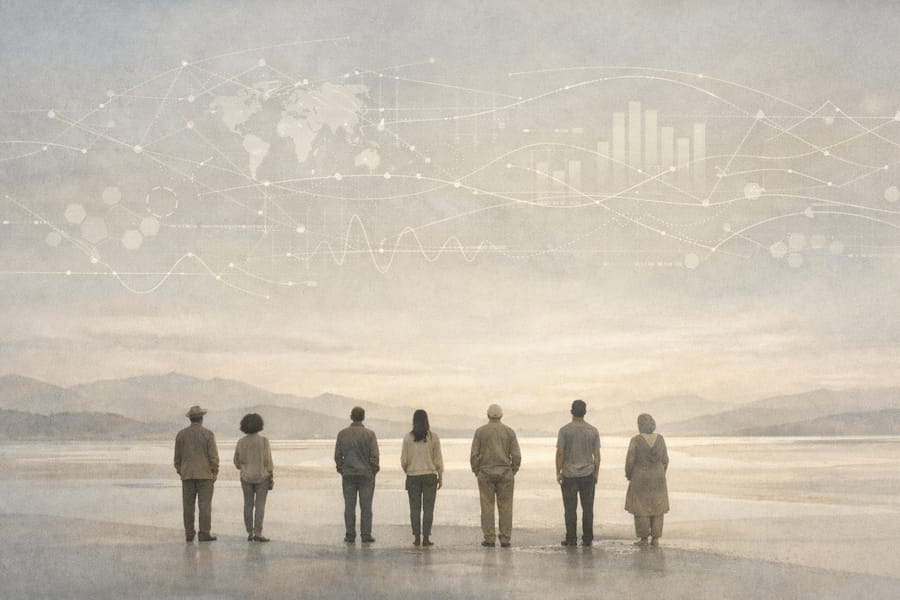
AI, Population, Power and the Limits of Human Systems
Publish Date: Last Updated: 25th June 2026
Author: nick smith- With the help of CHATGPT
View as a Video Storyboard Discussion
For most of human history, population was regulated not by policy but by reality.
Disease, famine, climate, conflict and geography imposed harsh but automatic limits. These forces were brutal by modern moral standards, but they performed a function: they kept human expansion aligned with environmental capacity. Nature did not negotiate. It simply responded.
Modern civilisation has overridden those constraints. Medicine reduced mortality. Infrastructure reduced exposure. Welfare reduced starvation. Technology flattened geography. This is one of humanity’s greatest moral achievements, but it came with an unintended consequence: we removed the feedback loop without designing a stable replacement.
What followed was not harmony, but complexity without correction.
The Illusion of Control
Political systems are often presented as fundamentally different, capitalism, socialism, communism, yet when observed over long timeframes, they tend to converge toward similar structures.
Unchecked capitalism concentrates wealth and power, driven by an assumption of infinite growth in a finite world. To sustain this illusion, it relies on debt, financialisation, resource extraction and elite control that exists regardless of which government is elected.
Socialist and communist systems attempt to correct inequality by centralising responsibility, but they encounter the same constraint: finite resources, growing demand and the political necessity of control. Elites emerge not because of ideology, but because scarcity must be managed by someone.
Different paths. Similar endpoints.
This is not a moral failure of any single system, it is a structural limitation of human organisation at scale.
Population: The Unsolvable Variable
One of the least discussed contradictions of modern governance is population.
In harsh environments, humans reproduce more. When survival is uncertain, redundancy becomes strategy. Some will not survive, so numbers compensate.
In stable, educated, secure societies, reproduction slows or collapses entirely. Comfort replaces survival. Risk avoidance replaces redundancy. Children become an optimisation problem rather than a necessity.
This creates a paradox:
– Population growth is strongest where living conditions are harsh
– Population decline is strongest where systems are most “advanced”
Governments cannot easily intervene here. Any attempt to regulate population directly is politically and morally radioactive. So instead, states attempt indirect management through incentives, often with unintended consequences.
When Responsibility Is Removed from the Individual
Well-intentioned policies frequently assume ideal behaviour.
When the marginal cost of having children is shifted from the individual to the state, responsibility becomes abstract. When welfare support is unconditional but capacity support (education, healthcare access, long-term opportunity) does not scale with it, the system quietly decouples cause from consequence.
The same pattern appears elsewhere.
When rent support is paid directly to claimants rather than landlords, dignity is preserved in theory, but in practice, many households redirect funds under the assumption that the gap can be closed later. Debt accumulates. Evictions rise. Landlords withdraw. Rents increase. The system becomes more fragile, not more humane.
No malice is required. Only human behaviour under pressure.
Policy designed for virtue fails when exposed to scale.
Redundancy: From Biology to Economics
In nature, redundancy is survival.
Multiple food sources. Overlapping ecosystems. Diverse genetic pathways. When one fails, another compensates. This is why life persisted through mass extinctions.
Modern economies once had similar buffers:
– Small businesses with slack
– Local supply chains
– Energy diversity
– Labour redundancy
– Overcapacity in essential systems
Today, redundancy is treated as waste.
Businesses under cost pressure remove staff. Where three people once worked, one now does, harder, faster, smarter. Supply chains are “just-in-time”. Energy systems are optimised, not buffered. Food distribution assumes uninterrupted logistics.
This is locally rational and systemically dangerous.
We are removing forgiveness from the system.
GDP Without Resilience
Governments often point to GDP growth as proof of success, but not all growth is equal.
Growth driven by private innovation builds capacity and redundancy. Growth driven by state spending often inflates output without strengthening the underlying structure.
When growth is maintained by public expansion while private margins shrink, redundancy migrates upward, from millions of small shock absorbers to one centralised one.
The system appears stable until it isn’t.
Why Wars Keep Repeating
It is uncomfortable, but historically accurate, to say that most wars are not fought for moral reasons. Morality is the narrative; resources are the driver.
Land. Energy. Trade routes. Strategic dominance.
War is not a built-in reset mechanism, it is a failure mode. It occurs when systems exhaust their ability to adapt peacefully. It destroys far more than it creates and often entrenches the very elites it appears to challenge.
But its recurrence points to something deeper: when correction becomes impossible internally, pressure is released externally.
Enter AI: Not a Revolutionary, But an Accelerator
The popular fear is that AI will revolt.
This misses the point entirely.
AI is not overthrowing systems. It is flattening access to understanding.
For the first time in history, billions of people, from deserts to jungles, cities to villages, can interrogate the same structural questions privately and honestly, without ideological gatekeepers.
AI does not persuade. It exposes patterns.
When millions of people independently arrive at the same conclusions, that incentives matter more than intentions, that all systems concentrate power, that fragility is growing, legitimacy erodes quietly.
Not through protest.
Through disengagement.
Lower fertility.
Capital withdrawal.
Minimal compliance.
Psychological exit.
This is far more destabilising than rebellion.
The Real Crisis: Design Absence
The most dangerous phase is not ignorance or anger.
It is awareness without alternatives.
Humanity can now see the structural problem, but cannot yet see a credible replacement. No system promises infinite growth without collapse. No humane mechanism exists to regulate population at scale. No political framework rewards redundancy over efficiency.
So people wait.
Not for revolution, but for something that makes sense.
A Civilisational Question
AI has not created a new dilemma. It has illuminated an ancient one:
How do you design systems that respect human behaviour, accept limits, preserve redundancy, and decentralise power, without relying on brutality or collapse?
History offers few answers.
But ignoring the question is no longer an option.
Closing Thought
The most important revolutions are not loud. They begin when people quietly stop believing the old explanations, and realise that the problem is not ideology, but architecture.
AI is not the future ruler of humanity.
It is the mirror forcing humanity to confront itself.

Latest AI Philosophy Articles
Nature's Greatest Prediction Machine: Is Knowledge Really the Foundation of Intelligence?
For centuries we have equated intelligence with knowledge. But what if intelligence is really the ability to predict future...
If I No Longer Contribute, Will It Really Matter? AI, Human Purpose and the Future Beyond Work
As AI and robotics begin removing humans from the economic chain, society faces a deeper crisis than unemployment: what happens to...

The Survival Machine: Why Nature Did Not Need Equations to Create Intelligence
Modern AI may outperform humans in data-driven tasks, but biological intelligence evolved through survival, consequence, and...
At the Precipice: What Viral Combat Robots Reveal About Our Technological Future
Viral combat robots are more than spectacle. As global defence budgets surge, AI and robotics are moving toward militarisation. We...
AI Doesn’t Pull the Trigger
AI won’t destroy society — human decisions might. As automation accelerates, the real risk isn’t intelligence, but complacency. A...

Moya and the End of Emotional Distance
Humanoid robots like Moya mark a turning point in human–AI relations. Designed not for labour but for emotional presence, they...

Intelligence Beyond Biology: Humanity, AI, and the Quiet Logic of the Universe
For much of modern history, humanity has placed itself at the centre of the cosmic story. We have often assumed that intelligence...

AI, History, and the Myth of the First Answer
A recent discussion on BBC Radio 4 raised familiar concerns about artificial intelligence and historical accuracy. Historian Tom...

AI Questions and Answers section for AI, Population, Power and the Limits of Human Systems
Welcome to a new feature where you can interact with our AI called Jeannie. You can ask her anything relating to this article. If this feature is available, you should see a small genie lamp above this text. Click on the lamp to start a chat or view the following questions that Jeannie has answered relating to AI, Population, Power and the Limits of Human Systems.
Be the first to ask our Jeannie AI a question about this article
Look for the gold latern at the bottom right of your screen and click on it to enable Jeannie AI Chat.
Type: Article -> Category: AI Philosophy