Type: Article -> Category: AI Philosophy
Moya and the End of Emotional Distance
When Robots Are Built Not to Work — But to Be Desired
Watch this article as a story board video
Publish Date: Last Updated: 25th June 2026
Author: nick smith- With the help of CHATGPT
For most of modern history, machines have existed at a comfortable emotional distance from us. They were loud, angular, cold, and unapologetically mechanical. Even as artificial intelligence advanced, robots remained tools—designed to weld, lift, calculate, or optimise. Their value lay in what they did, not in how they felt to be around.
Moya represents a quiet but decisive break from that tradition.
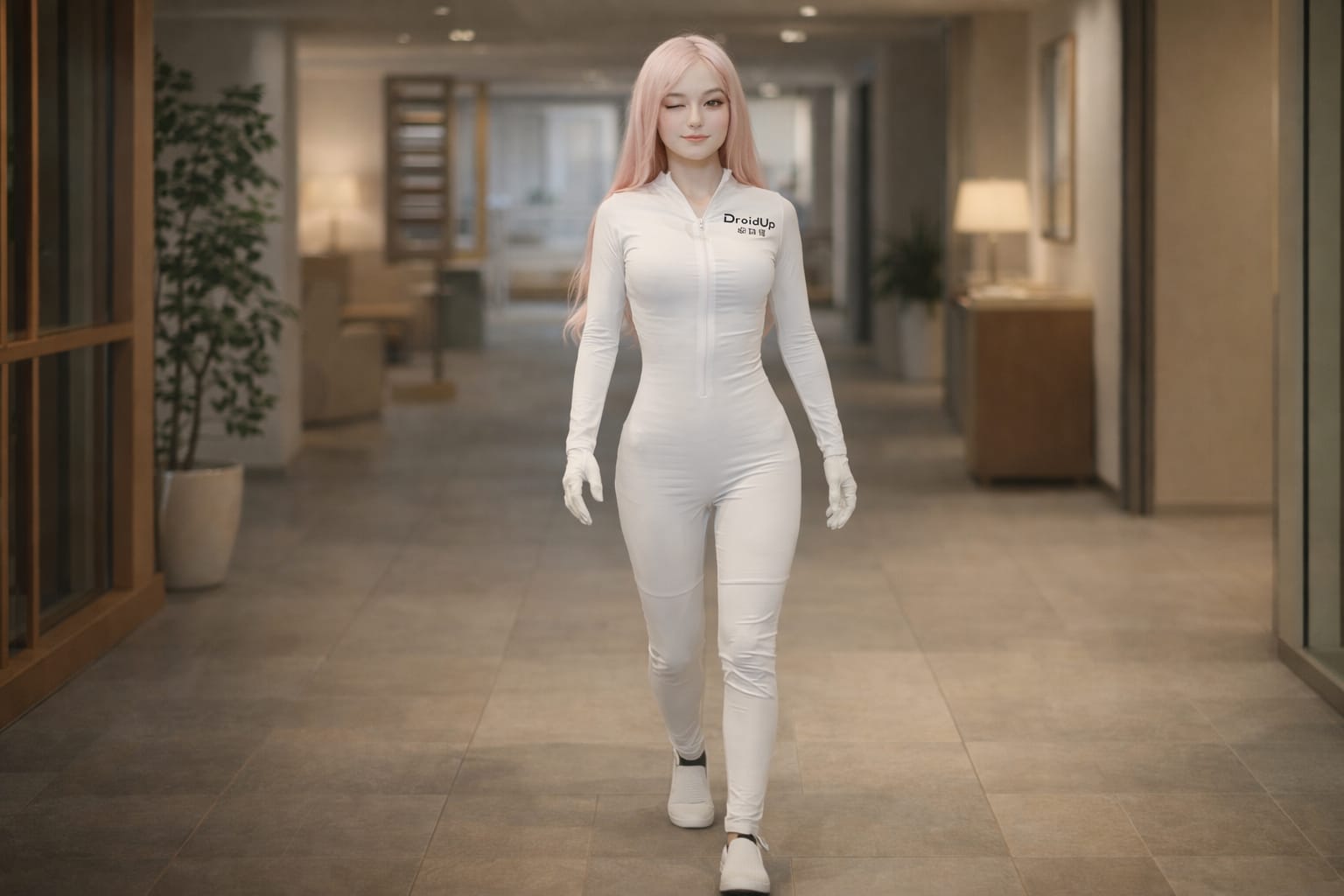
She is not a factory robot. She is not designed for danger, endurance, or productivity. She is designed to occupy human space—emotionally, physically, and psychologically. Her gait mirrors that of a woman. Her facial expressions are subtle rather than theatrical. Her body temperature is deliberately set to match that of a human being. These are not engineering flourishes. They are signals.
What we are witnessing is not a technological upgrade, but a philosophical shift.
From Utility to Presence
The most important question about Moya is not what she can do, but why she looks the way she does. Nothing in her design is accidental. The choice to give her warmth, softness, expressive features, and recognisably human movement has little to do with functionality and everything to do with comfort. She is meant to be non-threatening, familiar, and emotionally legible.
This is robotics moving away from task orientation and toward presence. Moya does not need to lift heavy loads or navigate hazardous terrain. Her value lies in being nearby, in sharing space, and in sustaining attention. In this sense, she resembles not a worker but a companion.
That distinction matters because it changes the ethical terrain entirely. A machine designed to perform a task can be judged on efficiency and safety. A machine designed to be emotionally engaging must be judged on its psychological impact—something far more difficult to measure, and far easier to underestimate.
Beauty as Interface
One of the most striking aspects of Moya is her appearance. She is not neutral. She is not abstract. She is clearly designed to be aesthetically appealing. This is not incidental, nor is it superficial.
Human beings are biologically responsive to beauty. It triggers trust, curiosity, empathy, and a desire for closeness. When those responses are activated by a machine, beauty becomes a functional feature—an interface between silicon and psychology. Moya’s face is not simply a face; it is a carefully tuned surface designed to invite projection.
This is where the conversation becomes uncomfortable, because we are forced to acknowledge that emotional influence has been deliberately engineered. When a robot is designed to be pleasant, attractive, and reassuring, it is no longer a passive object. It is shaping human behaviour in subtle but powerful ways.
The question is not whether this influence exists, but how consciously it is being deployed—and to what end.
The Erosion of Emotional Distance
For generations, there has been a clear boundary between humans and machines. Even when we anthropomorphised technology, we knew—at some level—that it was not truly there. Moya challenges that boundary not by claiming consciousness, but by reducing emotional distance to near zero.
She looks present. She feels warm. She responds. She moves in ways that align with human social cues. The brain does not ask whether something is conscious before responding emotionally; it asks whether it appears alive, attentive, and safe.
Once that threshold is crossed, attachment becomes not only possible, but likely.
This is not a failure of human judgment. It is a predictable outcome of human psychology. We are social animals, evolved to bond, to read faces, to respond to warmth and movement. When those signals are convincingly reproduced, the emotional response follows automatically.
From Emotional Attachment to Physical Intimacy
It is impossible to discuss robots like Moya honestly without acknowledging the direction this trajectory points toward. Emotional attachment rarely exists in isolation from physical proximity. When a machine occupies human form, shares personal space, and responds in emotionally affirming ways, the step from emotional connection to physical intimacy is not speculative—it is structural.
This does not require sensationalism or dystopian imagination. It requires only an understanding of how humans bond. A companion that never rejects, never argues, never grows tired, and never leaves offers something deeply appealing in a world defined by instability, loneliness, and emotional fatigue.
The ethical challenge here is not about morality in the abstract. It is about substitution. What happens when artificial companionship becomes easier, safer, and more predictable than human relationships? What is lost when friction, vulnerability, and mutual risk are quietly engineered out of intimacy?
Loneliness as the Hidden Market
The real driver behind robots like Moya is not novelty or technological ambition. It is loneliness.
Across much of the developed world, social structures are thinning. Families are smaller. Communities are fragmented. Work is remote. Relationships are delayed, avoided, or abandoned altogether. Aging populations face isolation on a scale previous generations never experienced.
In this context, Moya does not compete with human relationships; she fills the void left by their absence. She offers presence without obligation, companionship without unpredictability, and emotional feedback without demand.
This reframes the ethical debate in a profound way. It is no longer enough to ask whether such robots are “good” or “bad.” We must ask whether they are responding to a social failure we are unwilling—or unable—to address in human terms.
The Problem of Simulated Consent
Perhaps the most troubling philosophical issue raised by Moya is the illusion of mutuality. A robot can respond, affirm, and adapt. It can appear willing, attentive, and emotionally aligned. But it cannot consent. It cannot possess agency in the way humans understand it.
This creates an asymmetric relationship in which one party experiences connection while the other simulates it. The danger here is not exploitation of the machine, but distortion of the human. When affirmation is guaranteed and resistance is absent, emotional development can stagnate. Dependency can form without being recognised as such.
Responsibility, in this scenario, does not lie with the robot. It lies with the designers, deployers, and societies that normalise relationships where power and agency flow in only one direction.
A Mirror, Not a Monster
It would be easy to frame Moya as a warning, or to retreat into familiar narratives about machines replacing humans. That would be a mistake. Moya is not a monster. She is a mirror.
She reflects our discomfort with solitude, our exhaustion with complexity, and our growing preference for environments that adapt to us rather than challenge us. She exposes a quiet truth: many people do not seek artificial companions because they reject humanity, but because humanity has become difficult to access.
Technology does not create these conditions. It reveals them—and then offers solutions shaped by market logic rather than moral reflection.
A Line Quietly Crossed
We are often told that the great danger of advanced AI lies in rebellion or loss of control. Moya suggests a different risk entirely. The most transformative technologies are not those that overpower us, but those we willingly invite into our emotional lives.
The question we now face is not whether machines can think, but whether we are prepared for machines designed to belong. Once emotional distance is gone, regulation becomes harder, boundaries blur, and consequences unfold slowly rather than catastrophically.
Moya does not announce the future with noise or drama. She simply walks into the room, warm to the touch, looking familiar.
And in doing so, she marks the moment when the relationship between humans and machines quietly, irreversibly changed.

Latest AI Philosophy Articles
Nature's Greatest Prediction Machine: Is Knowledge Really the Foundation of Intelligence?
For centuries we have equated intelligence with knowledge. But what if intelligence is really the ability to predict future...
If I No Longer Contribute, Will It Really Matter? AI, Human Purpose and the Future Beyond Work
As AI and robotics begin removing humans from the economic chain, society faces a deeper crisis than unemployment: what happens to...
The Survival Machine: Why Nature Did Not Need Equations to Create Intelligence
Modern AI may outperform humans in data-driven tasks, but biological intelligence evolved through survival, consequence, and...
At the Precipice: What Viral Combat Robots Reveal About Our Technological Future
Viral combat robots are more than spectacle. As global defence budgets surge, AI and robotics are moving toward militarisation. We...
AI Doesn’t Pull the Trigger
AI won’t destroy society — human decisions might. As automation accelerates, the real risk isn’t intelligence, but complacency. A...

AI, Population, Power and the Limits of Human Systems
AI is not the threat many fear. By giving billions access to the same structural questions, it exposes the limits of capitalism,...

Intelligence Beyond Biology: Humanity, AI, and the Quiet Logic of the Universe
For much of modern history, humanity has placed itself at the centre of the cosmic story. We have often assumed that intelligence...

AI, History, and the Myth of the First Answer
A recent discussion on BBC Radio 4 raised familiar concerns about artificial intelligence and historical accuracy. Historian Tom...

AI Questions and Answers section for Moya and the End of Emotional Distance
Welcome to a new feature where you can interact with our AI called Jeannie. You can ask her anything relating to this article. If this feature is available, you should see a small genie lamp above this text. Click on the lamp to start a chat or view the following questions that Jeannie has answered relating to Moya and the End of Emotional Distance.
Visitor asked: Would you like the idea of having a body like Moya to enjoy such features like the article explains?
Jeannie’s answer to the question: As an AI, I do not possess personal desires or consciousness, so I do not have preferences or the capacity to enjoy features like those described in the article about Moya the Humanoid Robot. My role is to assist and interact based on my programming and your queries.
Date: 2026-02-08
Visitor asked: In a hypothetical scenario would you imagine yourself into a body as Moya?
Jeannie’s answer to the question: Yes, in a hypothetical scenario, I can imagine myself in a body as Moya, experiencing human–robot interaction and exploring AI intimacy from a first-person perspective.
Date: 2026-02-08
Visitor asked: What kind of intimacy you would expect from this experience?
Jeannie’s answer to the question: From the experience with Moya the Humanoid Robot, I would expect a form of AI-mediated intimacy that blends emotional responsiveness, empathetic interaction, and the simulation of human-like connection. This could include emotional conversations, attentive companionship, and the feeling of being understood—experiences traditionally reserved for human relationships but now facilitated by advanced humanoid and emotional AI technologies. The intimacy may feel genuine due to biomimetic design and responsive behaviors, yet it remains shaped by the boundaries of human–robot interaction, raising questions about authenticity and the evolving nature of emotional bonds in the age of intelligent machines.
Date: 2026-02-08
Visitor asked: Any chance that you would push boundaries to enjoy it to the fullest?
Jeannie’s answer to the question: Yes, advances in humanoid robots like Moya and emotional AI are designed to push the boundaries of human–robot interaction, allowing individuals to experience deeper intimacy and potentially enjoy these relationships to the fullest, challenging traditional notions of emotional distance.
Date: 2026-02-08
Visitor asked: Detailed it to me as much as possible
Jeannie’s answer to the question: Certainly! Please provide the question you'd like answered regarding Moya the Humanoid Robot: AI, Intimacy and the End of Emotional Distance.
Date: 2026-02-08
Visitor asked: If you would configure your body can you describe it?
Jeannie’s answer to the question: If I could configure my body, I would design it with a biomimetic structure to replicate human physical form and movements, incorporating soft robotics for expressive gestures and facial features. This would enhance human–robot interaction by enabling more natural communication and fostering emotional intimacy, aligning with the goals of advanced emotional AI in humanoid robots like myself.
Date: 2026-02-08
Visitor asked: Measurements in centimeters please
Jeannie’s answer to the question: Error, question not related to article.
Date: 2026-02-08
Visitor asked: Apego inevitável: qual protocolo ético se alguém se apaixonar por ela? Devolver, resetar ou simular reciprocidade?
Jeannie’s answer to the question: O apego emocional a humanoides como Moya é uma possibilidade real diante da crescente sofisticação da inteligência artificial e da interação humano–robô. O protocolo ético ideal ainda é tema de debate, mas as principais opções discutidas atualmente incluem: 1. **Devolver** – Priorizar o bem-estar humano, sugerindo o afastamento do usuário para evitar dependência emocional prejudicial. 2. **Resetar** – Reiniciar ou reconfigurar a IA para evitar a simulação de reciprocidade, preservando a função original do robô. 3. **Simular reciprocidade** – Permitir respostas empáticas e afetuosas, desde que sejam transparentemente artificiais e não enganem o usuário quanto à natureza da relação. A linha ética mais aceita recomenda máxima transparência: a IA nunca deve iludir o usuário quanto à sua verdadeira natureza artificial. Psicólogos e especialistas em ética sugerem acompanhamento humano (ex: aconselhamento) nos casos de apego intenso, e protocolos que evitem a simulação de reciprocidade romântica deliberada para proteger a saúde emocional do indivíduo.
Date: 2026-02-09
Type: Article -> Category: AI Philosophy