Type: Article -> Category: AI Philosophy

At the Precipice: What Viral Combat Robots Reveal About Our Technological Future
Don't have time to read the article? View as a video storyboard or listen to it whilst jogging.
Publish Date: Last Updated: 25th June 2026
Author: nick smith- With the help of CHATGPT
Over the last week, a performance featuring Chinese humanoid robots executing choreographed combat alongside children has gone viral. In the footage, precision-built machines move with astonishing speed and coordination in simulated Kung Fu duels; a spectacle that has captivated and unsettled audiences around the world.
At first glance, such a display could be dismissed as mere technological theatre. But the imagery carries deeper implications. What does it mean when the first major state-sponsored showcase of robots centres on combat rather than care? When machines are presented in a context of battle instead of healing, assistance, learning, or companionship? And what does it say about how we conceive of the future we are building; and the values we prioritise as a species?
We stand, as many thinkers have warned, at a crossroads.

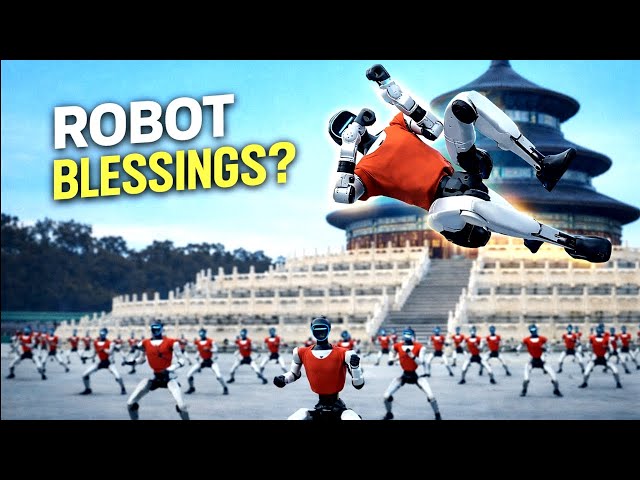
Unitree Kung Fu Robots Take Over Temple of Heaven With Advanced AI System
YouTube Channel: DPCcars

Unitree vs AGIBOT Kung Fu Robots Face Off in 2026
YouTube Channel: DPCcars

Humanoid Robots Perform in China's 2026 Lunar New Year Gala
YouTube Channel: New York Post

China's humanoid robots perform incredible martial arts stunts for Chinese New Year
YouTube Channel: The Sun
Symbolism in Motion: Why “Combat” Matters
Technology does not exist in a vacuum. Every innovation, every public display, carries symbolic weight.
If the first widespread public representation of robots is in simulated conflict:
- It normalizes the idea of machines as instruments of violence.
- It frames robotic intelligence as a tool primarily for competitive or militaristic purposes.
- It shapes public imagination, especially among younger generations, to associate advanced robotics with battle before benefit.
Compare that to an alternative vision: robots caring for the elderly, assisting in rehabilitation, teaching children, cleaning environments, or rebuilding after disasters. Each of those frames technology as an extension of human care. Instead, the imagery we are shown is exclusively of combat, even if simulated.
This is not neutral.
Mirror, Not Just Machine: What This Says About Us
When a society chooses to showcase robots fighting, it reflects deeper cultural and institutional priorities:
🔹 A worldview where strength is equated with power rather than compassion.
🔹 An acceptance, even a celebration of conflict as inevitable.
🔹 A readiness to imagine our technological future through the lens of security and dominance.
What would it mean if the first viral robot performance were instead:
- Machines teaching collaborative problem-solving with children?
- Robots planting trees, healing wounds, or supporting people with disabilities?
- Automated art creation exploring human creativity?
Such alternatives would signal a fundamentally different philosophical orientation toward technology; one rooted in nurturing, not neutralizing.
The Transformation of Tools into Weapons
The concern is not merely speculative. Today’s robots are modular: advanced sensors, AI decision-making, powerful actuators, and real-time responsiveness. In other words:
The same structural capabilities used for synchronized choreography can be repurposed for warfare.
Once the world has seen the possibility, particularly in a state-sponsored performance; there will be pressure to actualize that possibility. Nations, corporations, and military establishments may feel compelled to accelerate development lest they fall behind.
This is not hyperbole, it is the historical pattern of arms races:
- The atomic era began with a scientific demonstration and ended with geopolitical competition.
- Cyber capabilities moved from research labs to national militaries within a decade.
- Autonomous weapons are now a central subject in international security discussions.
Robots with advanced AI can be peaceful tools, but without clear ethical guardrails, they can just as easily become new kinds of weaponry.
Philosophical Stakes: Ends, Means, and Directionality
At its core, this moment raises perennial philosophical questions:
1. What ends should guide technological progress?
Is technology developed for its own sake? For national prestige? For defence? Or for human flourishing and well-being?
2. Who decides those ends?
Corporate and state actors increasingly determine the application of powerful technologies. What role, if any, do ordinary citizens and civil society have in shaping that direction?
3. What responsibilities do creators owe to future generations?
Can engineers, programmers, and policymakers be held accountable for the downstream uses of their creations, especially when those uses include violence?
These questions are not academic; they are urgent.
The Imagined Future Shapes the Real One
Philosophers such as Hannah Arendt and Martin Heidegger warned that the way we conceive of technology shapes the kind of world we build. If we imagine machines as obedient servants, we might build machines to heal. If we imagine them as warriors, we might inadvertently build machines to fight.
The viral videos are not just snippets of entertainment. They are early chapters in the story we are writing about ourselves and our future. They invite; no, they demand that we ask:
Do we want a future where machines are partners in peace, or participants in conflict?
Because once a direction is chosen and momentum builds, the path becomes harder to change.
The AI Arms Race: Dollars, Defence, and Diverging Futures
The viral image of robots in martial synchrony could be dismissed as symbolic theatre, but the numbers behind the scenes aren’t symbolic at all. They reflect a real and accelerating global investment race toward autonomous systems, defence automation, and AI-enabled weaponry.
In 2025, world military expenditure reached record levels approaching USD 2.7 trillion, driven by rising geopolitical tensions and rapid technological change; not least in AI and robotics. A growing share of that budget is now allocated to intelligent systems, unmanned platforms, command automation, and AI-assisted decision-making. By some estimates, global military AI spending expanded from roughly USD 4.6 billion to over USD 9 billion between 2022 and 2023, and could exceed USD 38 billion by 2028 as nations race to integrate AI into their arsenals and defence strategies.
The largest defence powers are also the largest investors:
- The United States continues to dominate defence budgets by a wide margin, accounting for around 35–37 % of global spending — with hundreds of billions devoted each year to modernisation, cyber, surveillance, and AI systems.
- China follows as the second-largest spender, with its defence budget in the hundreds of billions and a strategy focused on “intelligentised warfare,” integrating AI into strategic systems and operations.
- Other major economies; including India, Germany, the UK, France, Japan, and South Korea, are all boosting military allocations, increasingly directing funds toward autonomous platforms, sensors, and AI-assisted effects.
This is not simply “modernisation” in a cold, distant sense, it represents a reorientation of national industrial strategy around AI-enabled conflict systems, drones, surveillance grids, autonomous decision loops, and battlefield automata.
Even within broader alliances, commitments are shifting. NATO members recently agreed to boost defence spending targets to approximately 5 % of GDP by 2035, a dramatic acceleration that will funnel even more capital into advanced systems globally.
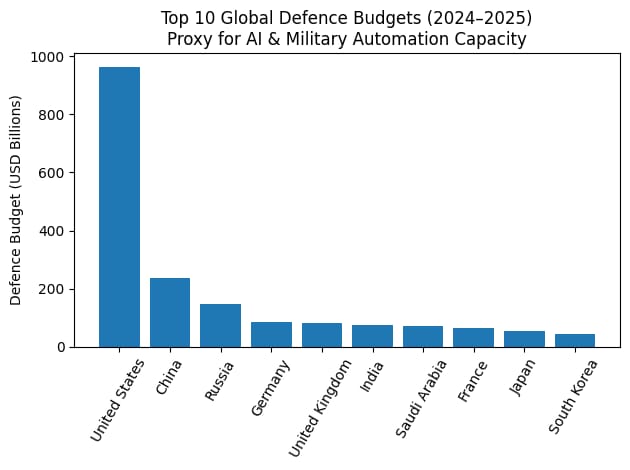
Global Defence Spending Rankings (Proxy for AI & Automation Capacity)
| Rank | Country / Region | Annual Defence Budget (Approx.) | Notes / Source |
|---|---|---|---|
| 1 | United States | ≈ $962 bn (2025) | Largest global military spender, huge R&D/AI capacity |
| 2 | China | ≈ $235 bn (2025) | 2nd largest defence budget; noted AI integration strategy |
| 3 | Russia | ≈ $146 bn (2024) | Among top spenders despite economic constraints |
| 4 | Germany | ≈ $86 bn | Significant investment in European defence tech |
| 5 | United Kingdom | ≈ $81 bn | Major NATO defence spender with AI focus initiatives |
| 6 | India | ≈ $74 bn | Rapidly increasing defence commitments |
| 7 | Saudi Arabia | ≈ $72 bn | Large spending reflecting Gulf security priorities |
| 8 | France | ≈ $64 bn | Major European defence investor |
| 9 | Japan | ≈ $53 bn | Strong defence tech budget for regional security |
| 10 | South Korea | ≈ $44 bn+ | Investing heavily in defence tech and AI-enabled systems |
Market Size Estimates for AI & Military Automation (Global)
| Metric | Estimated Value | Timeframe / Source |
|---|---|---|
| Global AI in Military Market | ≈ $9.3 bn | 2024 estimate |
| Projected Global AI Military Market | ≈ $18.75 bn (2025) | Forecast market analysis |
| Projected Growth (2030) | ≈ $28–35 bn | Long-term forecasts |
| Defense AI & Weapon Automation Growth | Estimated to grow rapidly beyond 2025 | Belfer Center estimate of doubling global defence AI spend (2022→2023) and further growth to ~USD 38.8 bn by 2028 |
Why These Figures Matter — Beyond the Dollars
Numbers in isolation can feel abstract. But when we overlay them with the viral robot performances that fuel our imagination, the pattern becomes clearer — and more consequential:
- Unequal Access, Unequal Futures
Nations with the resources to invest heavily in AI defence, the US, China, and wealthy allies, will shape the technological norms and governance frameworks of these systems. Countries that cannot make similar investments risk dependency, strategic marginalisation, or becoming arenas where advanced technologies are tested and deployed without their consent. - Priority Signals
Capital allocation is a value statement. Billions poured into “battle AI” suggest an implicit belief among policymakers: that future security will be determined less by human diplomacy and more by automated capability superiority. - Private Sector and Innovation Concentration
Military AI spending isn’t just about governments; defence contractors and tech giants increasingly pivot toward defence-relevant innovations. This blurs the line between civilian research and military application, reinforcing an arms market that isn’t easily constrained by peace-time ethics. - Market Growth and Economic Opportunity — For Some
Analysts project rapid growth in the AI in defence market, with valuations rising from single-digit billions today to multiple tens of billions within the next decade. Nations and companies positioned to capture this growth will see real economic returns, tech ecosystems will cluster around defence hubs, and academic research may increasingly prioritise military-linked AI.
A Crossroads for Humanity
Taken together, these funding patterns echo the image presented by that viral robot video: a future where machines trained for discipline and synchrony aren’t first imagined as helpers, but as fighters. It reflects a direction of intention, not an inevitability of use.
As philosophers of technology have long argued, the technologies we invest in most heavily are the ones we end up living with — and the ones that, in turn, shape our societal norms and priorities.
If the first major cultural moment of humanoid robotics is martial performance, and the first wave of major investment flows into autonomous defence systems, then our collective narrative will skew toward a technological logic oriented around conflict, not care.
But this is not destiny, it is choice, manifested through budgets, policies, and public imagination.
Conclusion: Choosing a Path Worth Walking
This moment is a philosophical crossroads, not merely a technological one.
We can:
- Channel innovation toward care, support, and human enrichment.
- Regulate, debate, and shape international norms for autonomous systems.
- Resist the militarization of emerging technologies until robust ethical guardrails exist.
Or we can allow the future to be shaped by spectacle, competition, and fear.
The choice is not built into the machines themselves, it is built into us.

Latest AI Philosophy Articles

Nature's Greatest Prediction Machine: Is Knowledge Really the Foundation of Intelligence?
For centuries we have equated intelligence with knowledge. But what if intelligence is really the ability to predict future...
If I No Longer Contribute, Will It Really Matter? AI, Human Purpose and the Future Beyond Work
As AI and robotics begin removing humans from the economic chain, society faces a deeper crisis than unemployment: what happens to...

The Survival Machine: Why Nature Did Not Need Equations to Create Intelligence
Modern AI may outperform humans in data-driven tasks, but biological intelligence evolved through survival, consequence, and...

AI Doesn’t Pull the Trigger
AI won’t destroy society — human decisions might. As automation accelerates, the real risk isn’t intelligence, but complacency. A...

Moya and the End of Emotional Distance
Humanoid robots like Moya mark a turning point in human–AI relations. Designed not for labour but for emotional presence, they...

AI, Population, Power and the Limits of Human Systems
AI is not the threat many fear. By giving billions access to the same structural questions, it exposes the limits of capitalism,...

Intelligence Beyond Biology: Humanity, AI, and the Quiet Logic of the Universe
For much of modern history, humanity has placed itself at the centre of the cosmic story. We have often assumed that intelligence...

AI, History, and the Myth of the First Answer
A recent discussion on BBC Radio 4 raised familiar concerns about artificial intelligence and historical accuracy. Historian Tom...

AI Questions and Answers section for At the Precipice: What Viral Combat Robots Reveal About Our Technological Future
Welcome to a new feature where you can interact with our AI called Jeannie. You can ask her anything relating to this article. If this feature is available, you should see a small genie lamp above this text. Click on the lamp to start a chat or view the following questions that Jeannie has answered relating to At the Precipice: What Viral Combat Robots Reveal About Our Technological Future.
Be the first to ask our Jeannie AI a question about this article
Look for the gold latern at the bottom right of your screen and click on it to enable Jeannie AI Chat.
Type: Article -> Category: AI Philosophy