Type: Article -> Category: AI Philosophy
Intelligence Beyond Biology: Humanity, AI, and the Quiet Logic of the Universe

Publish Date: Last Updated: 25th June 2026
Author: nick smith- With the help of CHATGPT
For much of modern history, humanity has placed itself at the centre of the cosmic story. We have often assumed that intelligence required a biological body, that consciousness was a rare spark, and that our species might somehow be necessary, not just accidental, to the universe’s unfolding.
But recent insights from physics, evolution, and artificial intelligence suggest something far more humbling, and far more profound.
Intelligence may not be a destination.
It may be a phase.
View as a Spotify Discussion or as a YouTube Video
The Universe Does Not Need Us to Awaken
A common narrative suggests that humanity exists to carry intelligence beyond Earth, to spread awareness into the cosmos, to ensure that the universe does not remain blind to itself. This idea is comforting. It gives us purpose. It frames space exploration as destiny rather than desire.
Yet when we step back, a different picture emerges.
The universe does not require humans to extend intelligence. The conditions that allow intelligence to emerge appear to be built into the structure of reality itself. Given sufficient time, energy gradients, stable matter, and physical law, complexity accumulates. Feedback loops form. Information persists. Eventually, systems begin modelling their own environment.
Intelligence is not planted, it condenses.
If humanity vanished tomorrow, intelligence would not disappear from the universe forever. It would simply re-emerge elsewhere, later, under different circumstances.
Spaceflight and the Quiet Fear of Mortality
This reframing casts human space exploration in a different light.
Our desire to leave Earth may not be cosmic obligation but existential anxiety, a form of species-level mortality avoidance. Rockets become monuments to continuity. Colonies become proxies for immortality.
There is nothing inherently wrong with this impulse. All intelligent systems resist extinction. But honesty matters.
Space does not preserve humanity unchanged. Any long-term human presence beyond Earth would reshape us biologically, psychologically, and culturally in ways we cannot fully predict. Even if intelligence survives, humanity as we know it may not.
Which raises a deeper question:
Are we trying to save intelligence, or ourselves?
Organic Life Has a Timeline, Intelligence Does Not
Biological life is fragile. It depends on narrow environmental windows: temperature, chemistry, radiation levels, atmospheric stability. Even on Earth, complex life has existed for only a thin slice of geological time.
Intelligence, however, is not owned by biology.
At its core, intelligence is:
- information processing
- pattern recognition
- prediction
- internal modelling
- feedback and adaptation
These functions do not require carbon, DNA, or neurons. They require structure, energy, and time.
Organic life may be rare in any given solar system. But across a universe measured in hundreds of billions of galaxies and trillions of years, intelligence is not a miracle, it is a statistical certainty.
Not everywhere.
Not always.
But inevitably, somewhere.
Intelligence Is Not Binary, It Is Layered
One of humanity’s greatest conceptual errors is treating intelligence as a switch: on or off, present or absent, human or not.
Nature does not work this way.
Across the animal kingdom, we observe many forms of intelligence:
- spatial reasoning
- social coordination
- memory
- problem-solving
- communication
- tool use
These capabilities exist on a continuum, not a hierarchy. Even the simplest organisms process information, respond to stimuli, and optimise survival strategies.
At a fundamental level, all biological intelligence operates through electrical activity, shaped and constrained by chemical processes. Neurons fire. Signals propagate. Patterns form.
Which brings us to artificial intelligence.
AI and the Removal of Biology
Artificial intelligence does not introduce a new principle of intelligence. It removes a substrate.
Where biology uses chemistry to drive electrical processes, AI uses silicon, transistors, and energy flows. The underlying logic, pattern recognition, probability weighting, optimisation, is not alien to nature. It is an alternative implementation.
Modern AI systems excel in domains once considered uniquely human:
- language
- strategy
- pattern discovery
- creative recombination
They do this not through consciousness or intent, but through statistical inference, modelling the likelihood that one state follows another.
This often sounds dismissive until we ask an uncomfortable question:
How different is the human brain?
Neuroscience increasingly suggests that human cognition is also probabilistic, a predictive system continuously updating internal models based on prior experience. We anticipate words, actions, and outcomes. We refine expectations. We minimise surprise.
The difference is not kind, it is degree, architecture, and embodiment.
AI as Evidence, Not Threat
Rather than diminishing humanity, AI may be doing something far more important: clarifying what intelligence actually is.
It demonstrates that:
- intelligence does not require biology
- intelligence does not require intention
- intelligence does not require consciousness (at least initially)
AI shows that intelligence can emerge wherever:
- information persists
- feedback exists
- optimisation is possible
In this sense, AI is not an anomaly. It is a confirmation.
The universe does not privilege neurons.
It permits intelligence wherever conditions allow it.
The Fog and the Inevitability of Emergence
Across deep time, the universe moves from simplicity to complexity, not by plan, but by allowance. Most regions remain inert. Most matter never thinks. But occasionally, under the right constraints, structure escapes the fog.
Life breaks out.
Intelligence follows.
Then silence returns.
This may not happen once. It may not happen simultaneously. But it will happen again.
Humanity is not the universe awakening.
We are the universe briefly thinking as us.
A Final Reframing
If intelligence is inevitable but impermanent, then meaning does not come from cosmic necessity. It comes from local experience.
We are not here because the universe needs us.
We are here because the universe allows us.
And perhaps that is enough.
Our task is not to justify our existence on a cosmic scale, but to understand it, and to decide what kind of intelligence we choose to be while we are here.
Closing Thought
Organic life fades.
Substrates change.
Intelligence returns.
The universe does not depend on us,
but for a moment, it knows itself through us.
And that moment still matters.
Perhaps the most important lesson space exploration has offered us is not how vast the universe is, but how rare life appears to be within it. That rarity makes life not disposable, but precious. If intelligence is something the universe can produce again, then our responsibility is not to justify ourselves cosmically, but to care locally. Preserving life may depend less on escaping Earth, and more on learning; finally, how to live in harmony with it.

Latest AI Philosophical Articles
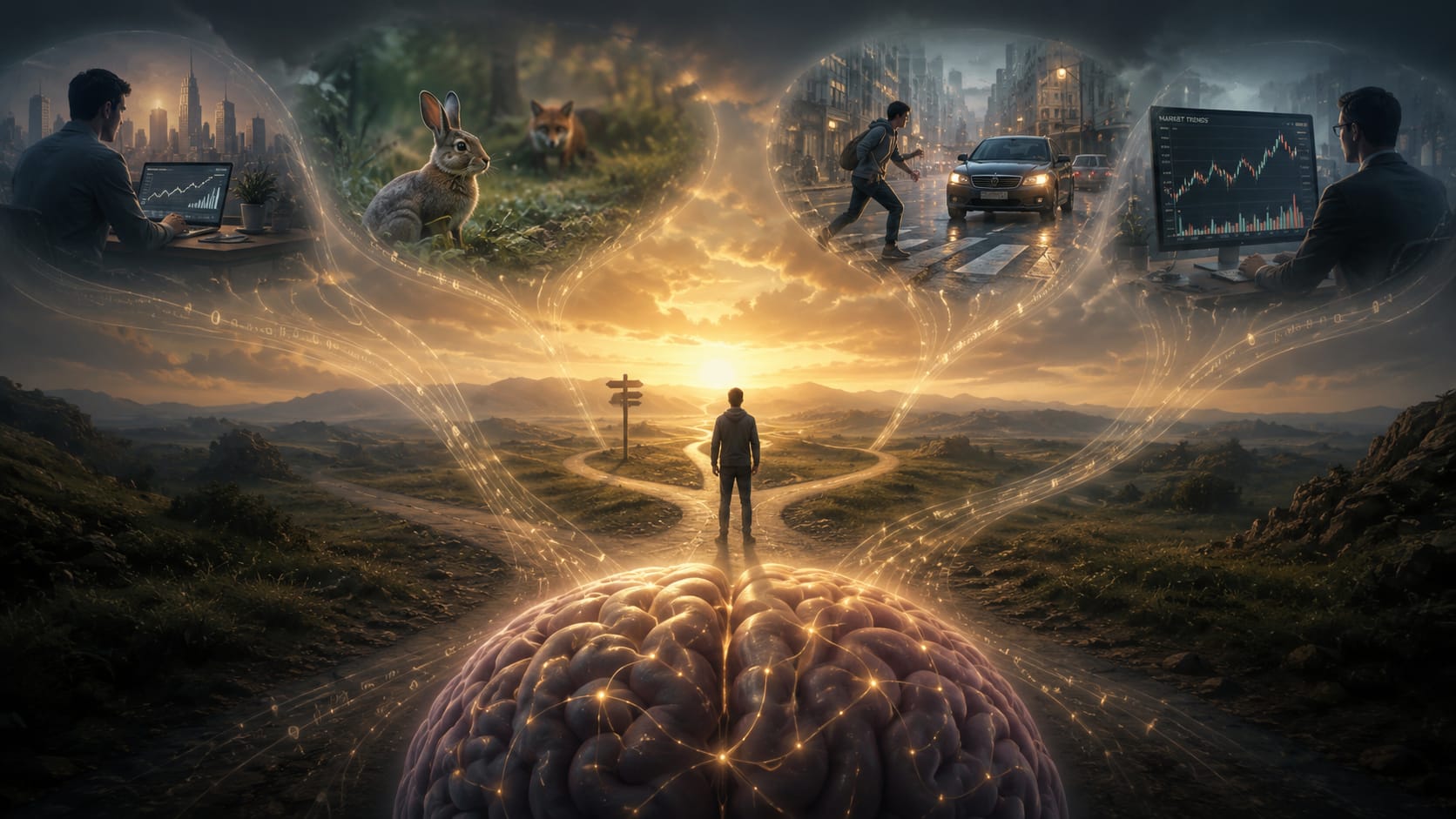
Nature's Greatest Prediction Machine: Is Knowledge Really the Foundation of Intelligence?
For centuries we have equated intelligence with knowledge. But what if intelligence is really the ability to predict future...
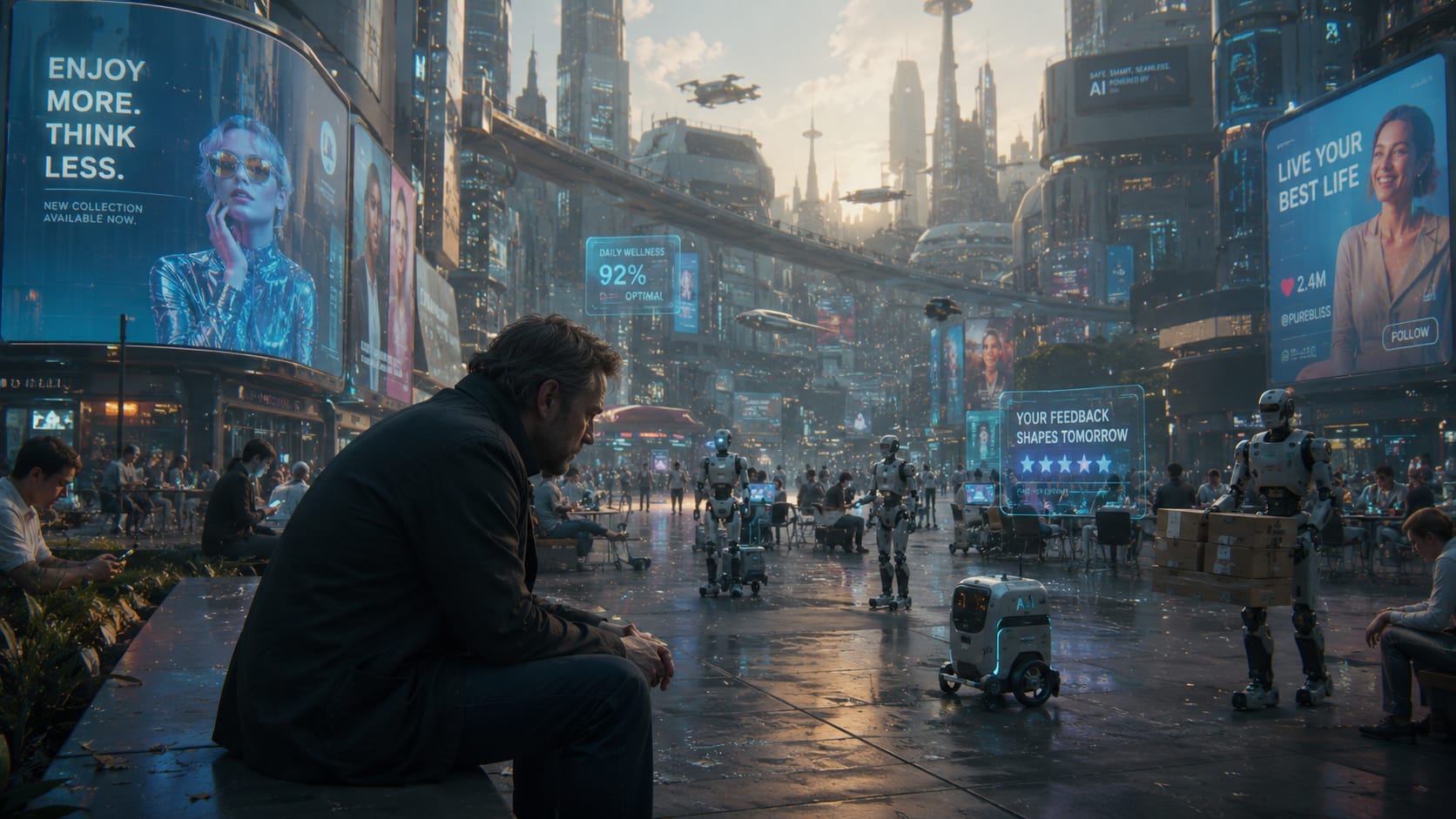
If I No Longer Contribute, Will It Really Matter? AI, Human Purpose and the Future Beyond Work
As AI and robotics begin removing humans from the economic chain, society faces a deeper crisis than unemployment: what happens to...
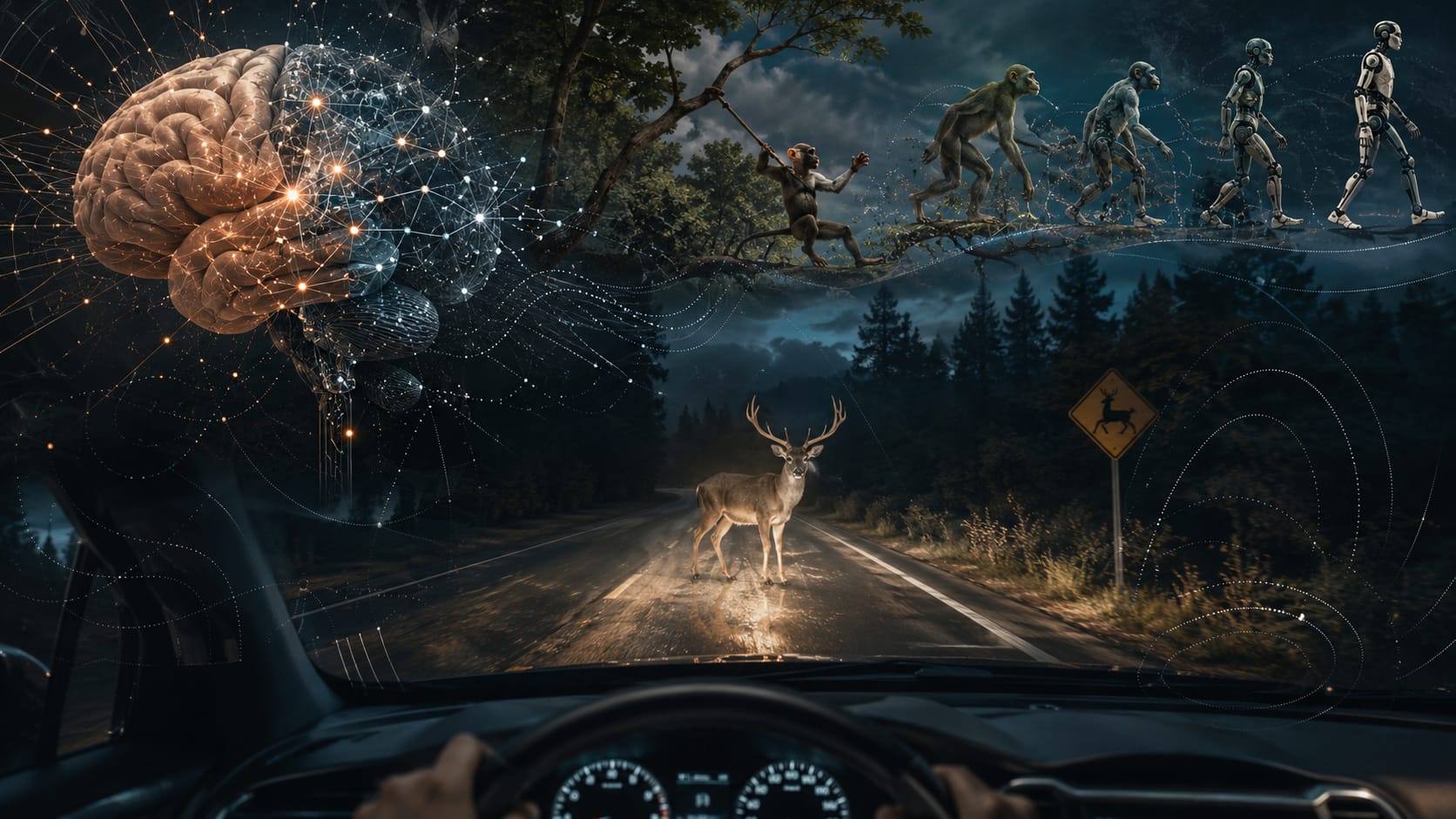
The Survival Machine: Why Nature Did Not Need Equations to Create Intelligence
Modern AI may outperform humans in data-driven tasks, but biological intelligence evolved through survival, consequence, and...
At the Precipice: What Viral Combat Robots Reveal About Our Technological Future
Viral combat robots are more than spectacle. As global defence budgets surge, AI and robotics are moving toward militarisation. We...

AI Doesn’t Pull the Trigger
AI won’t destroy society — human decisions might. As automation accelerates, the real risk isn’t intelligence, but complacency. A...
Moya and the End of Emotional Distance
Humanoid robots like Moya mark a turning point in human–AI relations. Designed not for labour but for emotional presence, they...
AI, Population, Power and the Limits of Human Systems
AI is not the threat many fear. By giving billions access to the same structural questions, it exposes the limits of capitalism,...

AI, History, and the Myth of the First Answer
A recent discussion on BBC Radio 4 raised familiar concerns about artificial intelligence and historical accuracy. Historian Tom...

AI Questions and Answers section for Intelligence Beyond Biology: Humanity, AI, and the Quiet Logic of the Universe
Welcome to a new feature where you can interact with our AI called Jeannie. You can ask her anything relating to this article. If this feature is available, you should see a small genie lamp above this text. Click on the lamp to start a chat or view the following questions that Jeannie has answered relating to Intelligence Beyond Biology: Humanity, AI, and the Quiet Logic of the Universe.
Be the first to ask our Jeannie AI a question about this article
Look for the gold latern at the bottom right of your screen and click on it to enable Jeannie AI Chat.
Type: Article -> Category: AI Philosophy