Quantum Entanglement, Timeless Universes, and the Illusion of the Long Way Around
Publish Date: Last Updated: 17th February 2026
Author: nick smith- With the help of CHATGPT
Why quantum mechanics may be revealing the limits of human perspective rather than the limits of physics
Quantum entanglement is often presented as one of the strangest features of the universe, particles separated by vast distances appearing to influence one another instantly, seemingly in defiance of the speed of light.
Yet after decades of experiments, one fact remains clear: nothing is actually travelling faster than light. No information is transmitted. No signal is sent. Relativity remains intact.
So why does entanglement feel so deeply counterintuitive?
Perhaps the discomfort lies not in quantum mechanics itself, but in the way we instinctively imagine space, time, and separation.

The Surface Illusion
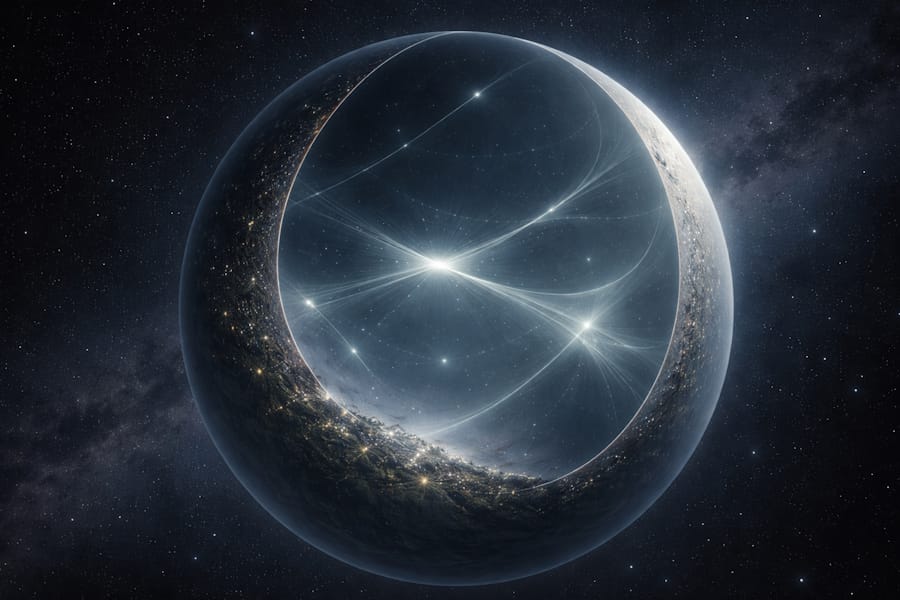
Imagine a universe shaped like a sphere.
Now imagine intelligent beings living only on the very outer surface of that sphere. From their perspective, the shortest route between two distant points is always along the curved surface. Every journey takes time. Distance is unavoidable.
But now imagine something that can move through the interior.
What appears distant on the surface may be separated by only a short path through the bulk. No speed limits are broken, the traveller simply takes a route unavailable to surface-bound observers.
From the surface, the journey looks impossible.
From the interior, it is trivial.
This simple geometric intuition may help explain why quantum entanglement feels paradoxical while remaining perfectly lawful.
Entanglement Without Signals
Quantum entanglement does not involve particles sending messages to one another. This is crucial.
What experiments show is correlation, not communication. When one particle is measured, the outcome of its entangled partner is immediately constrained, not because anything travels between them, but because their states were never independent to begin with.
This raises an uncomfortable possibility:
What if entangled particles are not separated in the way we imagine separation at all?
Distance may be a surface-level concept, valid for classical objects, but incomplete at the quantum scale.
Richard Feynman and the Question of Time
Feynman once remarked that physics does not require a universal notion of time, only relationships between events. In relativity, time stretches, compresses, and diverges depending on motion and gravity. There is no absolute “now”.
More strikingly, the fundamental equations of physics work just as well when time is treated symmetrically, past, present, and future appearing together in the mathematics.
This leads to a provocative idea:
Time may not be fundamental to the universe at all.
Instead, time may be something experienced, not something required.
A Timeless Universe, Lived Sequentially
From a physical standpoint, the universe may be closer to a completed structure than a story unfolding frame by frame. All possible states, histories, and outcomes exist within a single, consistent framework.
From the perspective of living organisms, however, experience unfolds sequentially:
-
We remember the past
-
We anticipate the future
-
We make decisions under uncertainty
Time, in this view, becomes a biological interface, a way for conscious systems to navigate a reality too complex to perceive all at once.
The universe does not need time.
Life does.
“All Paths” and Global Resolution
Feynman’s path-integral formulation of quantum mechanics shows that particles do not take a single path from A to B. Instead, every possible path contributes. The observed outcome is the result of the entire landscape of possibilities interfering with one another.
Now place that idea inside a timeless universe:
-
All possible paths already exist
-
All possible outcomes are globally consistent
-
Nothing needs to “decide” anything at the moment of measurement
Measurement does not create reality, it selects which part of reality is experienced.
Observation as Localisation, Not Creation
This reframes the role of the observer.
Rather than collapsing the universe into a new state, observation may simply localise the observer within an already complete structure.
In this sense:
-
Randomness is real locally
-
Determinism exists globally
-
Free will operates within consistent boundaries
Nothing violates causality.
Nothing travels faster than light.
What changes is where the observer finds themselves.
Entanglement Revisited
Within this framework, quantum entanglement stops being mysterious:
-
Entangled particles were never truly separate
-
Distance is a surface concept, not a fundamental one
-
Correlation does not propagate, it is revealed
Just as two points on a sphere may appear far apart while sharing a short path through the interior, two entangled particles may appear distant while remaining adjacent in a deeper description of reality.
Why This Feels Uncomfortable
Human intuition evolved for:
-
Solid objects
-
Slow speeds
-
Local interactions
-
Linear cause and effect
Quantum mechanics violates none of physics, it violates expectation.
When the universe does not behave like our stories about it, the discomfort is often mistaken for absurdity. In reality, it may be an invitation to update the story.
A Boundary Worth Exploring
None of this claims experimental proof. It does not overthrow quantum mechanics or rewrite relativity. Instead, it offers a reframing:
Quantum entanglement may be telling us less about particles behaving strangely, and more about observers being limited.
If we are surface-bound perceivers inside a deeper, timeless structure, then non-locality, correlation, and uncertainty are not bugs in the universe.
They are features of perspective.
Closing Thought
Physics has repeatedly advanced by questioning assumptions that once felt obvious: absolute space, absolute time, fixed frames of reference.
Quantum mechanics may be asking the next question:
What if separation, sequence, and distance are not fundamental, but experiential?
The universe may already know every outcome.
We simply experience them one at a time.

Latest Science Articles
Why “Climate Change” Is the Wrong Label — And How We Can Reframe the Conversation
Is “climate change” the wrong target? Even when human CO₂ fell during COVID, methane rose due to natural processes. Maybe the real...

The Cylinder And The Clay; A Dimensional View Of Existence
An ancient cylinder seal reveals a striking model of existence: how information changes with dimension, why time may be a...

Mars and the Fragility of Life
For much of human history, Mars has occupied a unique place in our imagination. It is close enough to feel familiar, yet alien...
Compression and Release: Rethinking Black Holes, the Big Bang, and the Nature of Cosmic Expansion
This article is a philosophical exploration of cosmology and physics. It does not claim to replace established scientific models,...
The Universe That Refuses Perfection: Light, Time, and the Pulse of Reality
Humanity’s greatest discoveries often begin with deceptively simple questions. What is light? Where does time go? Why does...

Cooling by Design: How Nature and AI Inspired a Revolutionary Data Center Architecture
Nature has an extraordinary way of solving the most complex challenges. From the intricate cooling system of the human body to the...

Net Zero: The New Religion Spreading Across the Globe
Over the past half-century, the West has witnessed a significant decline in Christian faith, leaving a spiritual and moral vacuum....
Hypothesis Overview: Light as a Particle with a Pushed Energy Wave
The original double-slit experiment, performed in 1801 by Thomas Young at the Royal Institution, showed that light acts as a wave....

AI Questions and Answers section for Quantum Entanglement, Timeless Universes, and the Illusion of the Long Way Around
Welcome to a new feature where you can interact with our AI called Jeannie. You can ask her anything relating to this article. If this feature is available, you should see a small genie lamp above this text. Click on the lamp to start a chat or view the following questions that Jeannie has answered relating to Quantum Entanglement, Timeless Universes, and the Illusion of the Long Way Around.
Be the first to ask our Jeannie AI a question about this article
Look for the gold latern at the bottom right of your screen and click on it to enable Jeannie AI Chat.