Type: Article -> Category: AI Business
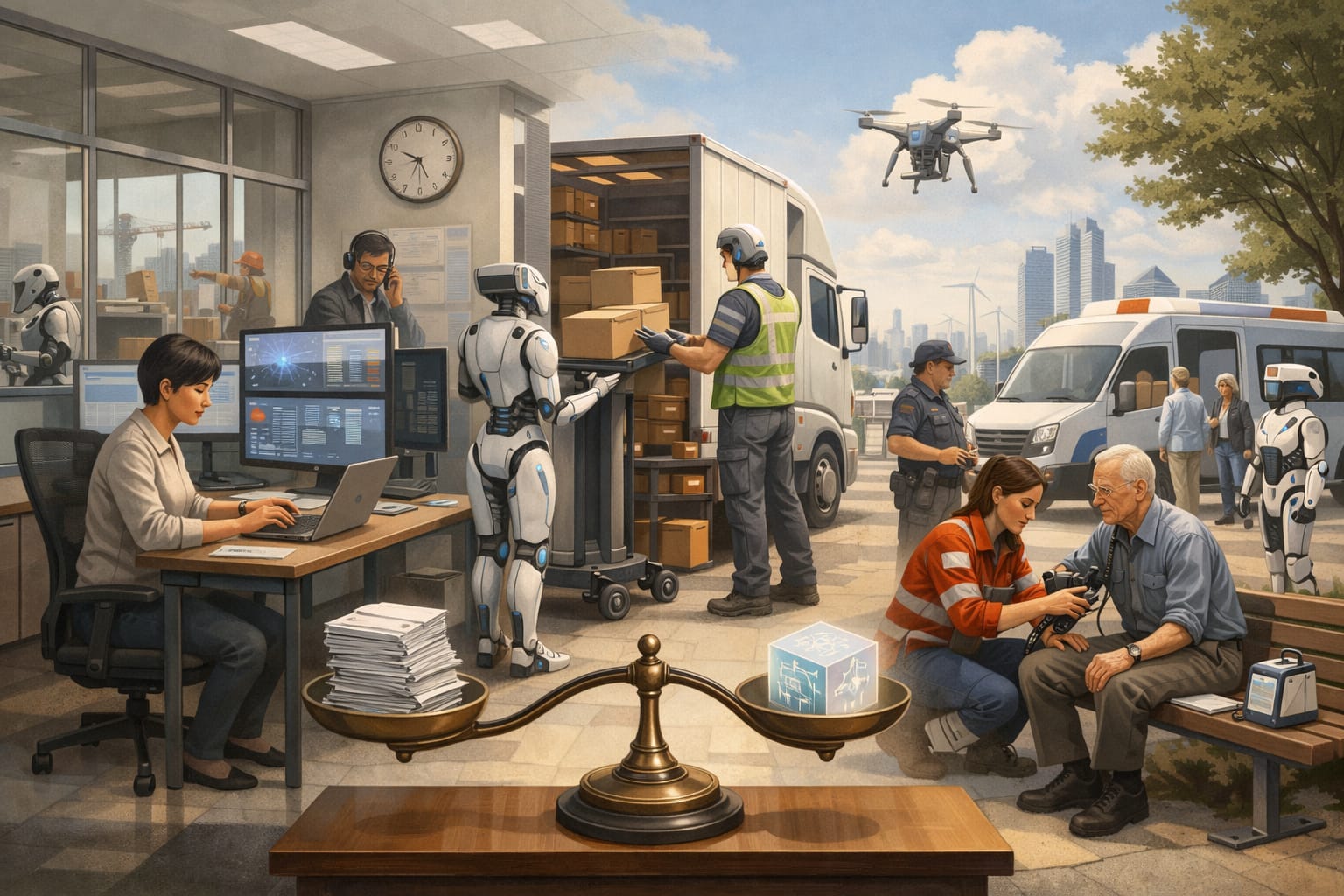
AI, Automation and the Unfunded Shock
Why Universal In come Won’t Save Us, and What Might
Publish Date: Last Updated: 5th February 2026
Author: nick smith- With the help of CHATGPT
Watch as a Storyboard Discussion
Introduction: A Debate Framed Too Narrowly
The rapid rise of artificial intelligence and robotics has reignited a familiar question: what happens when machines do the work?
In response, ideas such as Universal Basic Income (UBI) or Universal Basic Allowance (UBA) are increasingly presented as inevitable. Influential technology figures, including Elon Musk and Sam Altman, have suggested that large-scale automation will make human labour largely redundant, and that income must therefore be decoupled from work.
At first glance, this appears compassionate and forward-thinking. But it rests on assumptions that collapse when confronted with fiscal reality, human behaviour, and the speed at which this technology is being deployed.
This article argues that the greatest risk is not AI itself, but unmanaged rollout combined with exhausted public finances. Universal income is not a solution to this disruption; it is a symptom of having failed to manage it.

1. The Context: Why This Question Is Emerging Now
The current AI and robotics wave differs from previous technological shifts in three critical ways:
- Speed, deployment cycles are measured in months, not decades
- Breadth, white-collar, administrative, and professional roles are now affected
- Capital concentration, productivity gains accrue rapidly to a small number of firms
Unlike mechanisation or early computing, AI systems do not merely enhance productivity; they replace decision-making, coordination, and judgement at scale.
This is why policymakers are now considering income guarantees, not because work has disappeared, but because disruption is outpacing adaptation.
- Task-based automation timelines
- White-collar exposure (legal, finance, admin, HR)
2. The Fiscal Starting Point: No Headroom Left
Office for Budget Responsibility
- UK tax burden as % of GDP (highest sustained level since WWII)
- Long-term fiscal sustainability reports
- Age-related spending projections
A critical fact is often omitted from UBI discussions: Western economies are already over-extended.
In the United Kingdom, taxation is at or near historic highs:
- Frozen income tax thresholds (fiscal drag)
- Higher National Insurance burdens
- Increased corporation tax
- Inflation-driven stealth taxation
Yet public spending still exceeds revenue.
The same structural position exists in:
- France
- Italy
- Spain
These states face:
- Ageing populations
- Rising healthcare and pension costs
- High debt-to-GDP ratios
- Increasing debt-interest servicing
UBI presumes spare fiscal capacity. It does not exist.
A modest universal payment, scaled nationally, would exceed current welfare budgets without replacing existing obligations, particularly healthcare and pensions.

3. The Unpriced Cost of Automation
Automation is often described as “productivity enhancing.” That framing hides a crucial asymmetry:
Productivity gains are private.
Transition costs are public.
AI and robotics impose costs that are rarely priced into adoption decisions:
- Lost income tax and National Insurance receipts
- Regional unemployment clustering
- Retraining and reskilling at scale
- Increased demand for mental health and social services
- Reduced consumer spending in affected communities
These costs unfold over decades, not quarters, while automation savings are realised immediately.
This creates an unfunded liability that governments did not budget for, at a time when fiscal systems are already strained.
4. Market Speed vs Social Adaptation
Left entirely to open markets, AI deployment follows a predictable logic:
- Fastest adoption wins
- Labour displacement is treated as an externality
- Communities are expected to adapt after the fact
Markets optimise for efficiency, not stability.
A company that replaces hundreds of roles with automation:
- Does not retrain the local workforce
- Does not replace lost local tax revenue
- Does not rebuild the surrounding economy
The consequences fall on municipalities, social services, and national governments.
This creates what can be described as a temporal mismatch:
- Technology moves at machine speed
- Human adaptation operates at social speed
Universal income attempts to paper over this mismatch, but does not resolve it.
5. Why Universal Income Fails at National Scale
UBI is attractive because it is simple, visible, and politically communicable. But at scale, it encounters four structural failures:
Fiscal Failure
National-scale UBI requires sustained funding far beyond current welfare systems.
- Cash transfer programme outcomes
- Long-term dependency effects
Finland Government UBI Experiment
- UBI trial results
- Employment and wellbeing impacts
Demographic Feedback
When income is guaranteed independent of contribution, dependency ratios rise and population pressures increase, a well-understood dynamic in both human and natural systems.
Psychological Cost
Work provides:
- Structure
- Purpose
- Status
- Social integration
Large populations detached from contribution experience higher rates of depression, substance abuse, and political radicalisation.
Political Fragility
UBI transforms citizens into dependents of the state, while concentrating productive power in a narrow technical elite, a form of soft feudalism rather than empowerment.
UBI does not prevent social breakdown; it manages decline once disruption is already entrenched.
6. The Corporate Tax Illusion
- Digital services tax impact assessments
- Corporate tax competition analysis
- Corporate profit shifting estimates
- Lost public revenue calculations
A common rebuttal is: “We’ll just tax the AI companies.”
This underestimates three realities:
- Capital is mobile
- Intellectual property is relocatable
- Global tax coordination remains weak
AI firms can shift profits, restructure ownership, and negotiate regulatory arbitrage far faster than states can legislate.
As automation reduces employment, governments become more dependent on the very corporations they are attempting to tax, weakening leverage precisely when it is most needed.
7. The Early-Days Danger
We are still at the beginning of this transition, and that is what makes it dangerous.
Early automation:
UK Office for National Statistics
- Sectoral employment trends
- Productivity vs employment divergence
- Hits low-friction roles first
- Produces visible productivity gains
- Creates political complacency
Later waves will affect:
- Professional services
- Public administration
- Knowledge work, including the state itself
This means governments risk losing both revenue and administrative capacity at the same time.
By the time universal income becomes unavoidable, it will also be unaffordable.
8. What Can Be Done Instead
Rejecting UBI does not mean rejecting progress. It means managing it deliberately.
- Policy sequencing and transition management research
A. Pace Automation, Don’t Ban It
- Sector-specific rollout thresholds
- Mandatory impact assessments (similar to environmental reviews)
- Human-in-the-loop requirements during transition periods
B. Localised Transition Buffers
- Regional adaptation funds
- Targeted retraining tied to real local demand
- Temporary wage-top-ups instead of permanent income guarantees
C. Incentivise Augmentation Over Replacement
- Tax incentives for human-AI collaboration
- Higher levies on large-scale displacement without retraining commitments
D. Redefine Economic Contribution
Prioritise sectors where human presence matters:
- Care
- Education
- Infrastructure
- Environmental restoration
- Local services
This reframes humans not as a cost to be supported, but as participants to be empowered.
Conclusion: The Real Choice Ahead
The AI and robotics revolution is real, powerful, and irreversible.
But the idea that universal income will painlessly absorb its consequences is a dangerous illusion, especially in high-tax, high-debt societies already struggling to fund existing commitments.
The choice is not between progress and protection.
It is between:
- Unmanaged acceleration followed by permanent dependency, or
- Paced innovation that keeps humans economically and socially relevant
AI should fund the future, not become another unfunded shock that society is forced to absorb.
The danger is not that machines become intelligent.
The danger is that we decide humans no longer need to be economically necessary.

Latest AI Business Articles

The AI Advertising Paradox
AI search gives us answers without requiring us to visit the websites that created them. That's convenient for users, but...
Coding with Local AI vs Cloud AI
Cloud AI transformed the way I write software, but growing projects also brought growing concerns over usage limits. After a week...
If You Wanted to Start a Business in the UK Today… Were We Right?
Two years ago, we predicted the best businesses to start in the UK. Now it's time to hold those predictions accountable. Discover...

AI Range Anxiety: Will Rising AI Costs Slow Innovation?
Artificial intelligence has transformed the way developers, researchers and creators work. But as AI becomes an essential tool, a...

Are You in Charge of Your AI – Or Is AI in Charge of You?
Artificial Intelligence can improve efficiency and reduce costs, but are you still making the decisions? Discover how businesses...

AI Can Transform Your Business – But What Happens When It Fails?
Artificial Intelligence can transform productivity, efficiency and customer service, but over-reliance creates new business risks....

The Invisible Battlefield: How AI Trading Bots Could Turn Geopolitical Conflict into Financial Shockwaves
AI trading bots now react to global news in milliseconds. During geopolitical crises, these automated systems can amplify market...

From Digital Currency to Volatility Engine: What Crypto Became in the Age of AI
Crypto began as a decentralised currency experiment. Today it functions as a high-volatility speculative market, now accelerated...

AI Questions and Answers section for AI, Automation and the Unfunded Shock
Welcome to a new feature where you can interact with our AI called Jeannie. You can ask her anything relating to this article. If this feature is available, you should see a small genie lamp above this text. Click on the lamp to start a chat or view the following questions that Jeannie has answered relating to AI, Automation and the Unfunded Shock.
Be the first to ask our Jeannie AI a question about this article
Look for the gold latern at the bottom right of your screen and click on it to enable Jeannie AI Chat.
Type: Article -> Category: AI Business