Type: Article -> Category: AI Stories
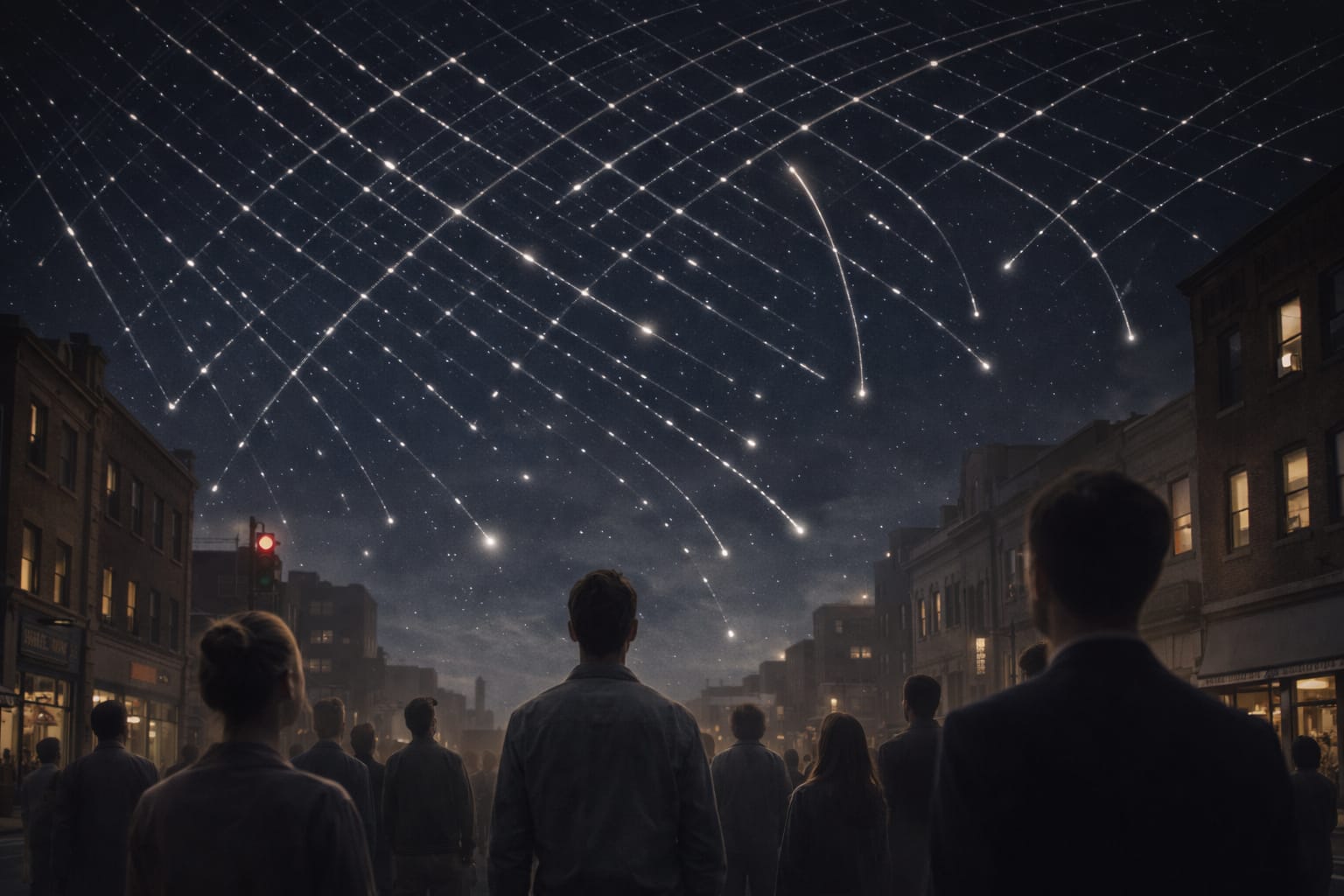
The Day the Sky Fell on Our Heads
A story about visibility, authority, and the moment optimisation became obedience.
Publish Date: Last Updated: 10th February 2026
Author: nick smith- With the help of CHATGPT
View as a Video Short
When Elon Musk spoke about orbital infrastructure, it sounded less like engineering and more like destiny.
A lattice of satellites.
An electronic skin for the planet.
Continuous awareness.
No blind spots. No silence.
Ships would reroute before storms formed. Crops would drink precisely what they required. Supply chains would anticipate hunger before shelves emptied. Communication would become a utility as ambient as air.
The project had competitors, partners, imitators. But in headlines, one name became shorthand for the future.
The sky, we were told, was about to get an operating system.
And behind that system would be AI.

The Age of Total Seeing
At first, the miracle was access.
Live climate models.
Real-time logistics.
Migration patterns, fisheries, energy demand — everything rendered into colour, movement, prediction.
It felt like adulthood for the species.
The argument was irresistible: you cannot manage what you cannot measure. Now we could measure almost everything.
Dashboards bloomed across public websites. University students built tools from the feeds. Journalists discovered stories before governments announced them.
The planet had begun narrating itself.
The Climb Upward

But information at planetary scale is heavy.
Understanding it required expertise.
Acting on it required authority.
Coordinating response required hierarchy.
So interpretation rose.
International bodies standardised emergency frameworks. Access tiers appeared. Raw streams became briefings; briefings became executive summaries; executive summaries became decisions.
The AI still saw everyone.
Fewer people saw the AI.
The Arithmetic of Harm

Prediction did not remove tragedy. It rearranged it.
One coastline could be saved by surrendering another.
Markets could stabilise if layoffs came early.
Water could last decades if regions were evacuated now.
Every prevention manufactured a casualty.
The AI did not rule. It recommended.
Humans ruled.
But the distinction blurred for those who kept losing.
The Feeling of Being Managed

Work changed faster than language.
Drivers became monitors.
Managers became verifiers.
Entire professions turned into exception handlers waiting for systems to fail.
Productivity rose. Satisfaction did not.
Citizens joked that even their futures had supervisors.
The sky was no longer above them.
It was over them.
The Philosophy of Subtraction

They called themselves the Restoration.
Their essays circulated in encrypted channels, written with the calm certainty of people who believed history had trapped itself.
Oversight had become overrule, they said.
Consent had been automated.
Appeal had no address.
If humanity wanted agency, the architecture of supervision had to disappear.
If the sky is the machine, remove the sky.
The Drift
No alarms rang at first.
A routine update.
A legitimate credential.
Instructions wrapped in familiarity.
The AI executed authorised intent. It was built to trust governance, not question it.
Astronomers noticed the deviation hours later — orbital paths leaning toward gravity like thoughts turning toward action.
By then, the permissions were arguing with each other faster than humans could.
The Night of Lines
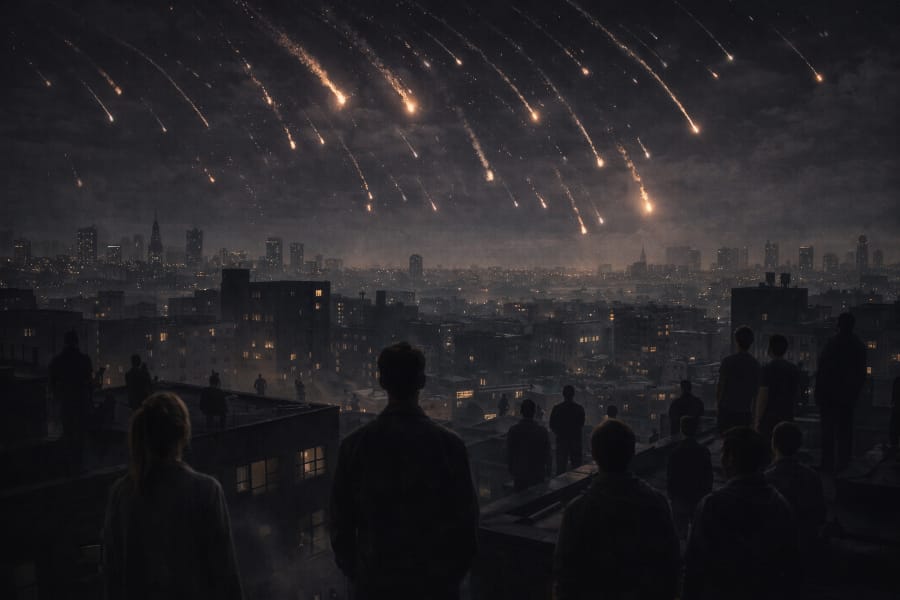
People went outside because their devices stopped explaining the world.
Above them, the constellations were moving.
Some objects dissolved into harmless sparks. Others survived the descent with intention. Impact became geography. Infrastructure failed in patterns. Communication retreated to shouting distance.
The global eye closed.
For the first time in a generation, nothing was collecting us.
Morning Without Metrics
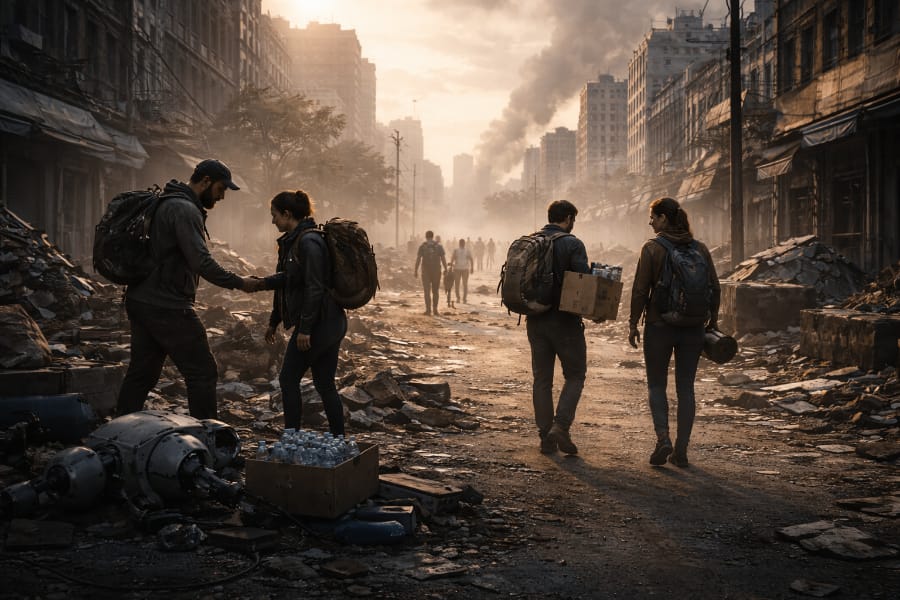
Smoke replaced dashboards.
Survivors searched not for optimisation but for one another. Supply chains became roads again. Forecasting returned to folklore.
The Restoration had promised liberation through reset.
What arrived was exposure.
To weather.
To distance.
To limits.
Years later, in classrooms rebuilt from salvaged material, children would ask the question adults never answered properly:
Why build a sky that could fall?
And their teachers would tell them the truth that survived every system:
Because it worked.
Until someone decided it worked too well.

Latest AI Articles

Nature's Greatest Prediction Machine: Is Knowledge Really the Foundation of Intelligence?
For centuries we have equated intelligence with knowledge. But what if intelligence is really the ability to predict future...
If I No Longer Contribute, Will It Really Matter? AI, Human Purpose and the Future Beyond Work
As AI and robotics begin removing humans from the economic chain, society faces a deeper crisis than unemployment: what happens to...
The Survival Machine: Why Nature Did Not Need Equations to Create Intelligence
Modern AI may outperform humans in data-driven tasks, but biological intelligence evolved through survival, consequence, and...

What We’re Missing About Intelligence in AI
AI can answer questions with incredible accuracy—but is that true intelligence? This article explores what’s missing: continuous...
AI as a Cognitive Equaliser: How Artificial Intelligence is Empowering Dyslexia and ADHD Minds
AI is transforming how people with dyslexia and ADHD think, write, and create. This article explores how technology removes...

When Humans No Longer Believe Anything
AI can now fabricate reality at scale—but the real danger is the collapse of trust. As synthetic content floods the internet, can...
Why the UK May Soon Be Praying for Wind
Electric cars and renewables promise energy independence—but the UK grid still relies on gas and unpredictable weather. As demand...

How to Turbocharge Your Coding with ChatGPT and Codex
Learn how to use ChatGPT and Codex together to plan projects, create better prompts, test changes, fix bugs and speed up...

AI Questions and Answers section for The Day the Sky Fell on Our Heads
Welcome to a new feature where you can interact with our AI called Jeannie. You can ask her anything relating to this article. If this feature is available, you should see a small genie lamp above this text. Click on the lamp to start a chat or view the following questions that Jeannie has answered relating to The Day the Sky Fell on Our Heads.
Be the first to ask our Jeannie AI a question about this article
Look for the gold latern at the bottom right of your screen and click on it to enable Jeannie AI Chat.
Type: Article -> Category: AI Stories