Type: Article -> Category: The PFVME Research Journal
PFVME Research Journal – Part 2
Why Versions One & Two Had to Fail.
Don't have time to read the article? View as a short video storyboard or listen to it whilst jogging.
Publish Date: Last Updated: 1st July 2026
Author: nick smith- With the help of CHATGPT
In the first journal I introduced the idea behind the Primitive Foundations of Visual Machine Emergence (PFVME) project and explained why I wanted to explore a very different approach to artificial intelligence.
This second journal is about something far less glamorous.
Failure.
Not software bugs, but architectural failure.
Looking back now, I genuinely believe Versions One and Two had to fail. Without those failures I would never have discovered what I now believe is a far more natural direction for the project.
Sometimes the fastest route to understanding is to build something, watch it break, and ask why.
Building Knowledge Across Disciplines
One of the unexpected challenges of this research has been that it refuses to stay inside one subject.
To explore the possibility of machine intelligence emerging from experience, I have found myself studying biology, neuroscience, psychology, philosophy, computer science, information theory and even animal behaviour.
No single discipline contains the whole answer.
The difficult part is not learning these subjects individually, but bringing them together into something that makes sense.
Throughout this project I have repeatedly found myself returning to an approach inspired by Richard Feynman.
Take what little you know, test it against reality, and build from there.
Rather than attempting to design an entire intelligent system on paper, I wanted each version of PFVME to answer one question before moving to the next.
Every version is therefore an experiment.
Sometimes the result is success.
Sometimes the result is discovering that the original question was wrong.
Both outcomes are valuable.
The Principles Behind PFVME
Before writing a single line of code, I established several principles that every version of the project should follow.
These principles have remained remarkably consistent, even though almost everything else has changed.
Complexity Should Emerge from Layered Simplicity
Nature rarely begins with complexity.
Simple rules repeated millions of times create astonishingly sophisticated behaviour.
Snowflakes.
Ant colonies.
Evolution.
Neural networks.
Human civilisation.
Rather than beginning with complicated algorithms, massive models or expensive hardware, I wanted to see how far extremely simple mechanisms could be pushed.
If each layer performs one simple task well, perhaps intelligence is something that gradually emerges from those layers rather than something programmed directly.
Whenever the architecture became increasingly complicated simply to solve a problem, I treated it as a warning sign that I was probably heading in the wrong direction.
The goal was always to simplify, not complicate.
The Goal Was Never Human Intelligence
One misunderstanding that often appears whenever people discuss AI is the assumption that every project is trying to build something equivalent to a human mind.
PFVME is not.
The objective has never been to beat human intelligence, replace it or even reproduce it.
The question is much simpler.
Can a computer develop a primitive form of intelligence through continuous observation and experience?
If the answer is yes, then we can begin asking deeper questions later.
But trying to jump straight to human-level intelligence felt like attempting to build a skyscraper before learning how to lay foundations.
No Labels. No Language. No Human Assumptions.
This became one of the defining principles of the entire project.
Almost every modern AI vision system begins with labelled data.
"This is a bird."
"This is a tree."
"This is a person."
Useful?
Absolutely.
But it also means the system begins life already viewing the world through human definitions.
PFVME deliberately rejects this.
The system does not know what a bird is.
It does not know what grass is.
It does not even know what "movement" means in human language.
Instead it simply observes changes in pixels, persistence, stability, trajectories and relationships.
If useful internal concepts eventually emerge, they emerge because the system experienced them—not because I named them.
The Original Architecture
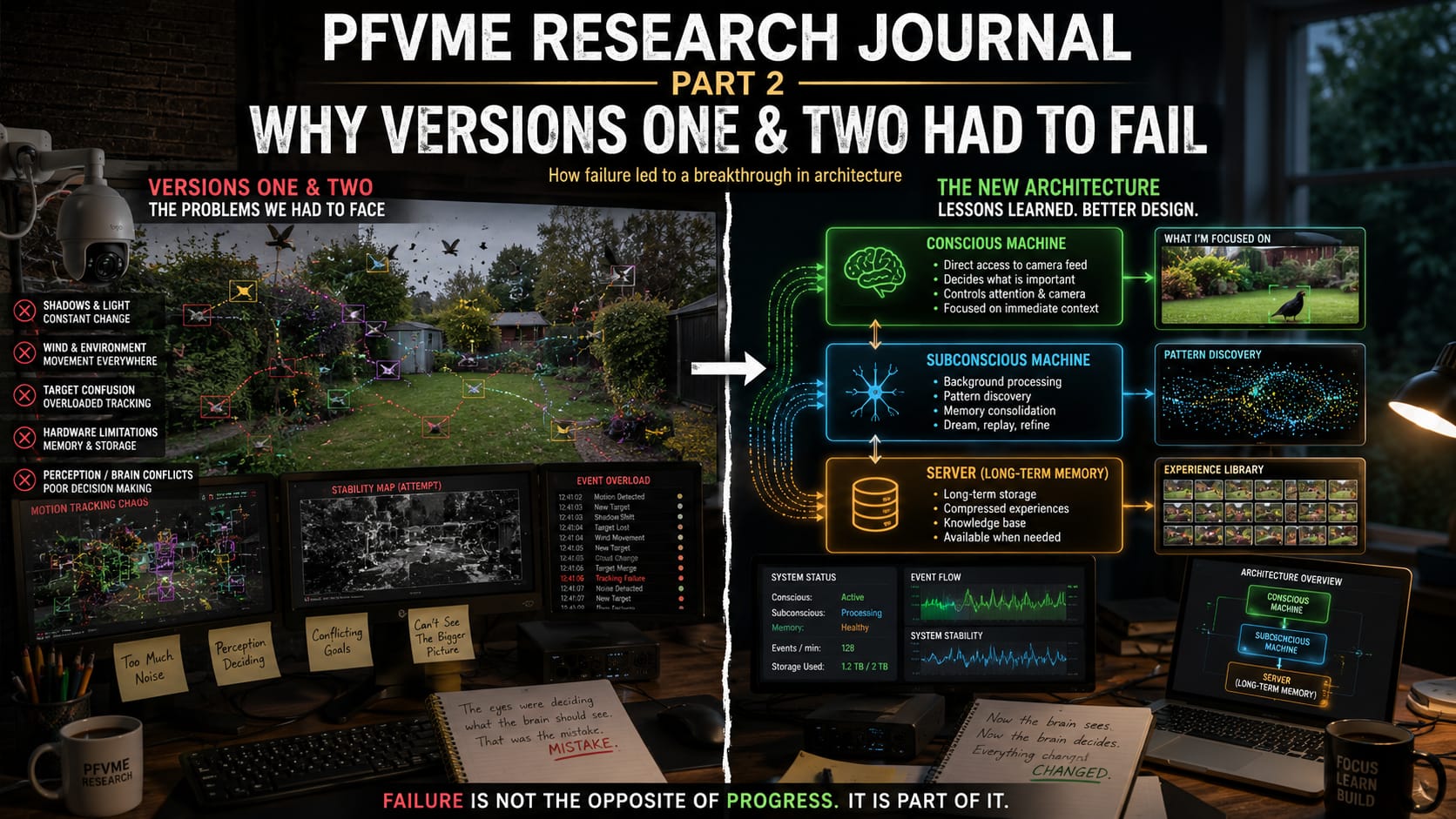
Versions One and Two were built around three major components.
-
Perception Machine
-
Brain
-
Server
On paper, the architecture seemed logical.
The Perception Machine would watch the world.
The Brain would analyse important events.
The Server would provide long-term storage.
At first glance this appears sensible.
In practice it contained a fundamental mistake.
Why Movement Became the First Goal
If you watch almost any animal with eyes, one behaviour appears remarkably early.
Movement attracts attention.
Birds do it.
Cats do it.
Jumping spiders do it.
Humans do it.
Movement often signals opportunity, danger or change.
For that reason, Version One focused almost entirely on learning how to detect and follow moving objects.
The challenge, however, quickly became obvious.
A real garden is incredibly noisy.
Trees sway.
Leaves flutter.
Clouds move.
Shadows drift.
Rain changes everything.
Wind constantly alters the entire scene.
If every movement is considered equally important, the system rapidly becomes overwhelmed.
The Birth of the Stability Map
One of the biggest breakthroughs of the early versions was the introduction of what became known as the stability map.
Instead of asking:
"What moved?"
the system first learned:
"What normally stays the same?"
Once enough observations had been collected, large parts of the environment became recognised as stable.
Only deviations from that stable background demanded significant attention.
The effect was dramatic.
Instead of constantly reacting to every leaf moving in the wind, the system could largely ignore environmental noise while concentrating on genuinely independent movement.
One particularly satisfying moment came when a flock of roughly fifteen to twenty birds suddenly took flight.
Rather than merging into one moving blob, the system was able to maintain separate tracks for multiple birds with surprising efficiency.
That was the first indication that simplifying the perception problem before solving the tracking problem was the correct direction.
The Real World Fights Back
Unfortunately, nature is wonderfully inconvenient.
The garden refused to behave like a controlled laboratory.
Long shadows would slowly move across the lawn throughout the day.
Clouds could alter the brightness of the entire scene within seconds.
Rain completely changed surface textures.
Branches oscillated continuously in strong winds.
Seasonal changes gradually altered the appearance of the environment.
None of these represented meaningful events.
Yet every one of them generated visual change.
The more time the system spent observing reality, the more I appreciated just how difficult perception actually is.
Humans dismiss these effects almost effortlessly.
A computer has to learn why they matter—or why they do not.
Hardware Can Be a Good Teacher
There is a tendency in software engineering to solve problems simply by adding more hardware.
More memory.
More storage.
More processors.
More GPUs.
I was reminded of a conversation I once had with an IBM developer who began programming during the 1970s.
He explained that early systems often had only a few megabytes of memory available.
Efficiency was not considered an optimisation.
It was survival.
Today we routinely solve similar problems using gigabytes of memory simply because it is available.
PFVME did not have that luxury.
Continuous camera observation generates astonishing amounts of data.
Very quickly it became obvious that storing everything indefinitely was impossible.
This forced a different mindset.
The system needed to decide what should remain in active memory, what should be compressed, what should be streamed to long-term storage and what could simply be forgotten.
Ironically, the hardware limitations became one of the project's greatest strengths.
They constantly punished lazy design decisions.
The Conflict Between Perception and Thought
The biggest architectural problem was not storage.
It was responsibility.
Originally I had designed the Perception Machine to decide where the camera should look and which observations were important enough to send to the Brain.
At the time this seemed perfectly reasonable.
It wasn't.
The more the system evolved, the more obvious the flaw became.
The perception system was effectively making decisions that required intelligence.
It was deciding what mattered before the Brain had even seen the information.
In biological terms, it was as though the eyes had begun deciding what the brain should think about.
That felt increasingly unnatural.
The more I examined the architecture, the more uncomfortable it became.
The Advantages of Working with AI
One thing this project has reinforced is how dramatically AI has changed software development.
I am not a neuroscientist.
Nor do I claim to have all the answers.
Much of this research involves forming hypotheses, implementing them and then discovering whether they survive contact with reality.
Without AI assistance, reaching each architectural milestone might have taken weeks.
Ironically, that could have made abandoning flawed ideas much harder.
The more effort we invest in a design, the stronger the temptation becomes to defend it.
Instead of fixing the real problem, we begin patching around it.
Software history is full of systems that became increasingly complicated simply because nobody wanted to admit the original architecture was wrong.
AI shortened that feedback loop dramatically.
It allowed ideas to be tested quickly, discarded quickly and rebuilt quickly.
The important part wasn't writing code faster.
It was becoming willing to change direction sooner.
The Light Bulb Moment
Eventually one thought became impossible to ignore.
The Perception Machine should not be deciding where to look.
The Brain should.
That single observation changed everything.
Instead of filtering reality before the Brain saw it, the camera feed should be available directly to the system responsible for making decisions.
Only the Brain has sufficient context to determine what deserves attention.
Only the Brain should decide whether to continue watching a bird, investigate movement in the bushes or return to monitoring a previously stable area.
Looking back, it now feels almost embarrassingly obvious.
But many breakthroughs only appear obvious after they happen.
A New Architecture
That realisation fundamentally changed the project.
The architecture became:
-
Conscious Machine
-
Subconscious Machine
-
Server (Long-Term Memory)
The change was far more significant than simply renaming components.
The Conscious Machine became responsible for immediate perception, attention and survival-oriented decision making.
The Subconscious Machine became responsible for slower processing, pattern discovery, memory consolidation and replaying experiences in the background.
The Server became the long-term memory of the system, preserving observations while allowing the active components to remain lightweight.
Suddenly the architecture began to resemble less a traditional software pipeline and more a layered cognitive system.
Looking Back at Versions One and Two
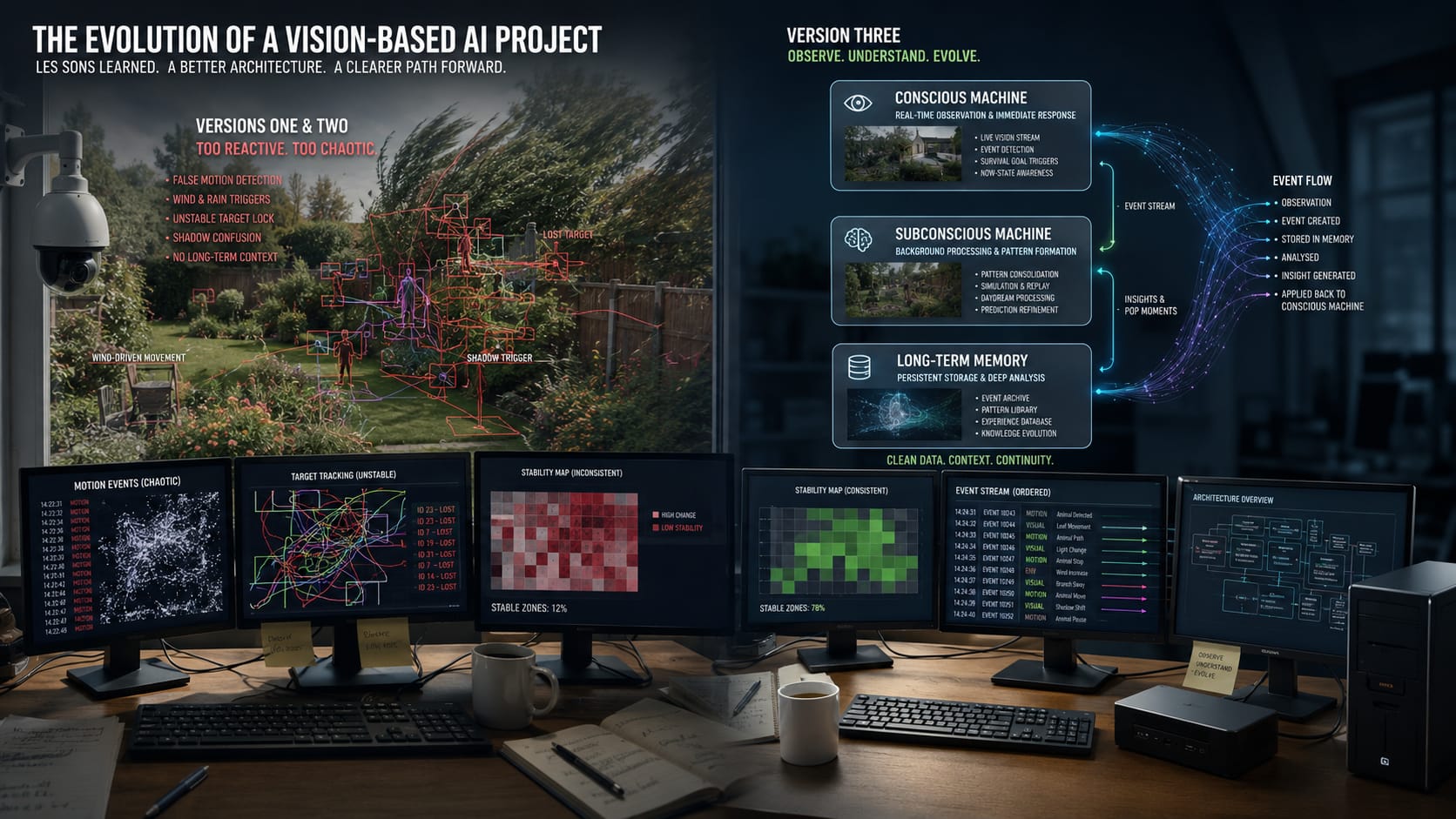
Although Versions One and Two were ultimately abandoned, they were far from failures.
They taught lessons that could not have been learned from theory alone.
What Went Well
-
Stable environment mapping dramatically reduced visual noise.
-
Multi-object tracking became surprisingly effective.
-
Efficient storage management began to emerge.
-
Continuous real-world observation exposed problems impossible to reproduce in simulation.
-
Hardware limitations encouraged elegant engineering rather than brute-force solutions.
What Went Wrong
-
Perception was making decisions that belonged to cognition.
-
Camera control became tightly coupled to low-level processing.
-
Environmental change remained difficult to classify correctly.
-
Responsibility between system components became blurred.
-
The architecture fought against itself as new capabilities were added.
Most importantly, the project revealed that intelligent behaviour depends just as much on where decisions are made as how they are made.
That lesson alone made the first two versions worthwhile.
Moving Towards Version Three
Version Three was not simply another software update.
It represented a complete rethink of the architecture.
Rather than asking how perception should feed the brain, I began asking how a conscious system might naturally organise itself.
The emphasis shifted from tracking objects to understanding attention.
From collecting data to managing experience.
From processing images to deciding what deserved further thought.
For the first time, the architecture began to feel less like traditional computer software and more like an evolving cognitive system.
Whether that intuition proves correct remains to be seen.
That, after all, is why we perform experiments.
What Comes Next
Versions One and Two answered an important question.
They showed me that my original assumptions about perception were wrong.
Version Three begins exploring a much more interesting possibility.
What happens when perception, attention, memory and experience are reorganised into something that more closely resembles the layered processes we observe in nature?
And Version Four pushes that idea even further.
The introduction of conscious and subconscious processing, event-driven memory, continual learning and architectural simplification has already produced encouraging results.
Whether these changes lead to the emergence of genuinely useful intelligence is still unknown.
That uncertainty is precisely what makes the research exciting.
The next journal explores how those architectural changes began producing the first signs that the project was moving in the right direction—and why Version Four may represent the most significant breakthrough so far.

Latest Journal Reports on PFVME Project
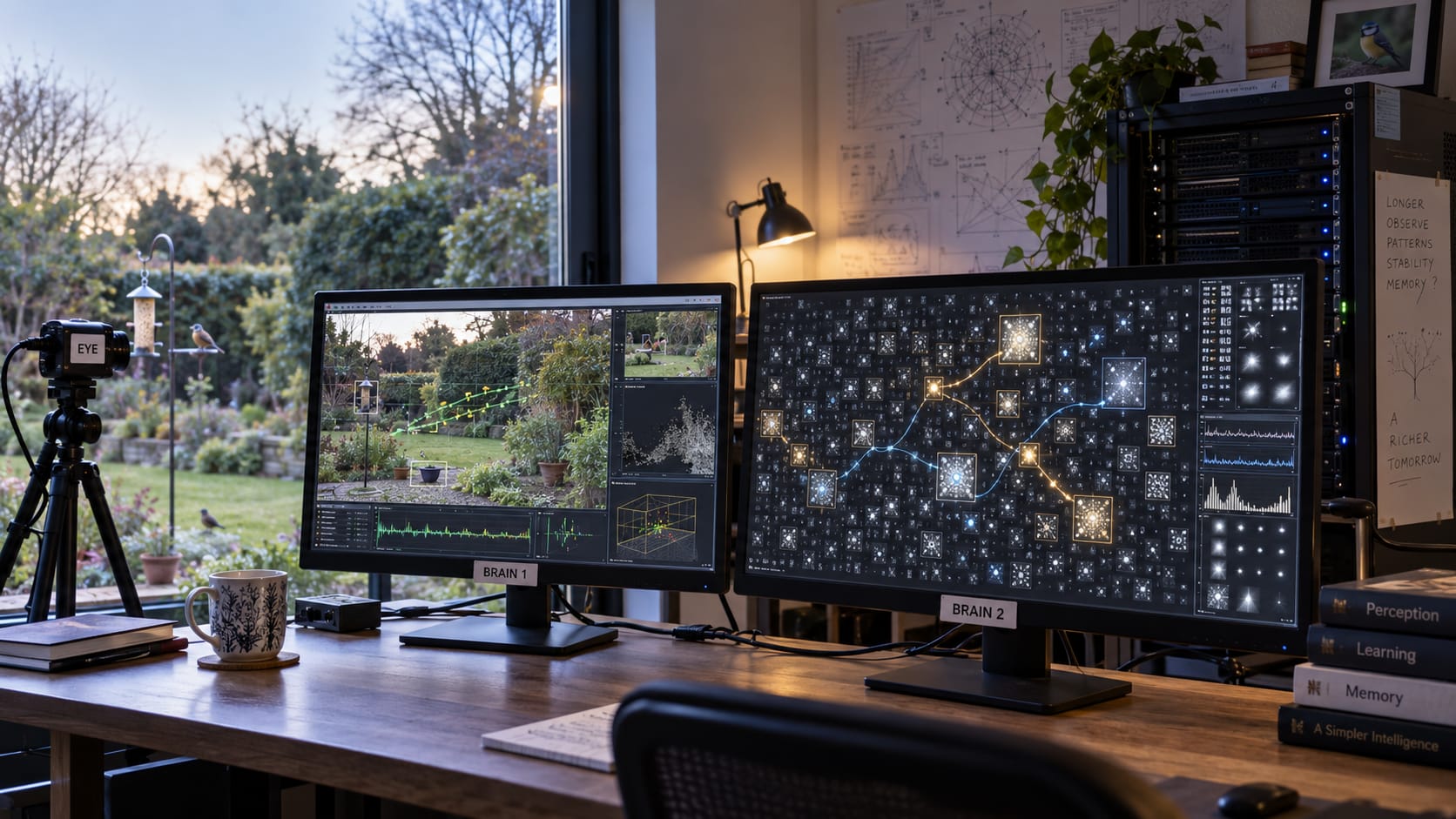
PFVME Journal Part 6 – Learning What Is Worth Remembering
After more than 126 million cycles, PFVME's Brain 2 is moving closer to creating its first glyphs. But before allowing it to...
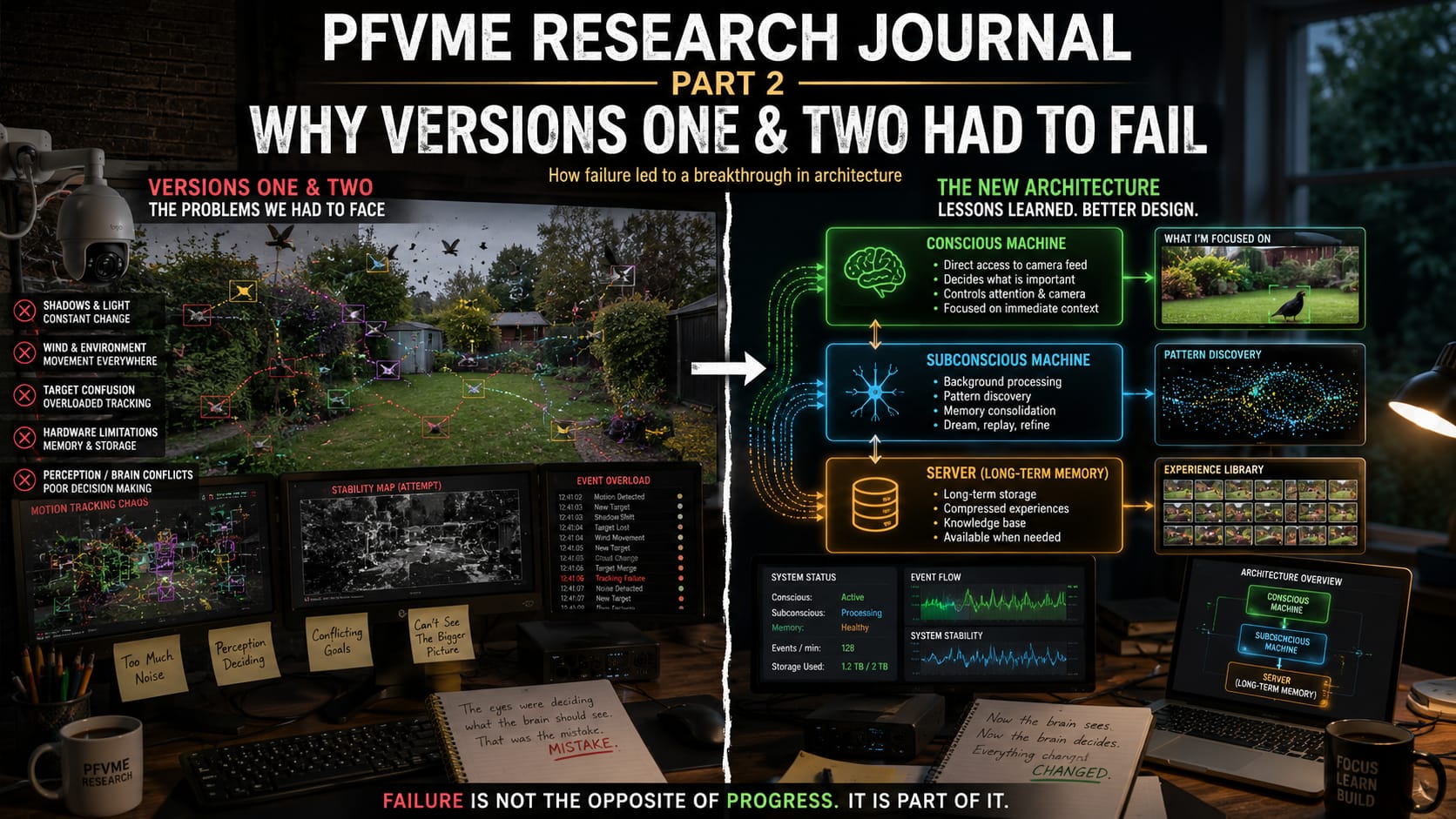
PFVME Research Journal – Part 5: The Introduction of Brain 2
PFVME reaches a major milestone as Brain 2 comes online. After weeks of patient observation by Brain 1, a second independent...
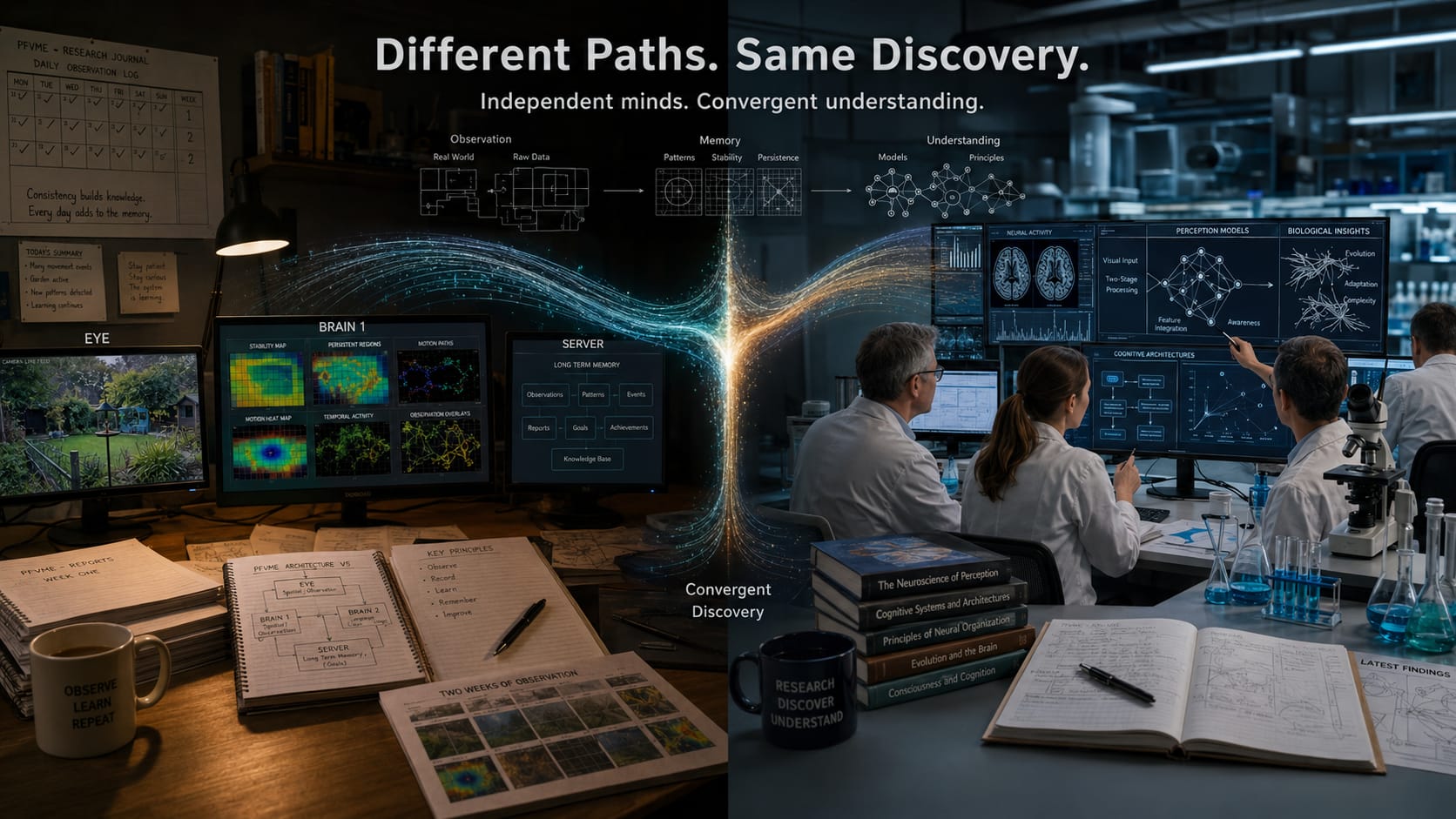
Many Different Paths, Similar Destinations
Can independent AI research reach the same conclusions as world-leading laboratories? The PFVME project unexpectedly found itself...
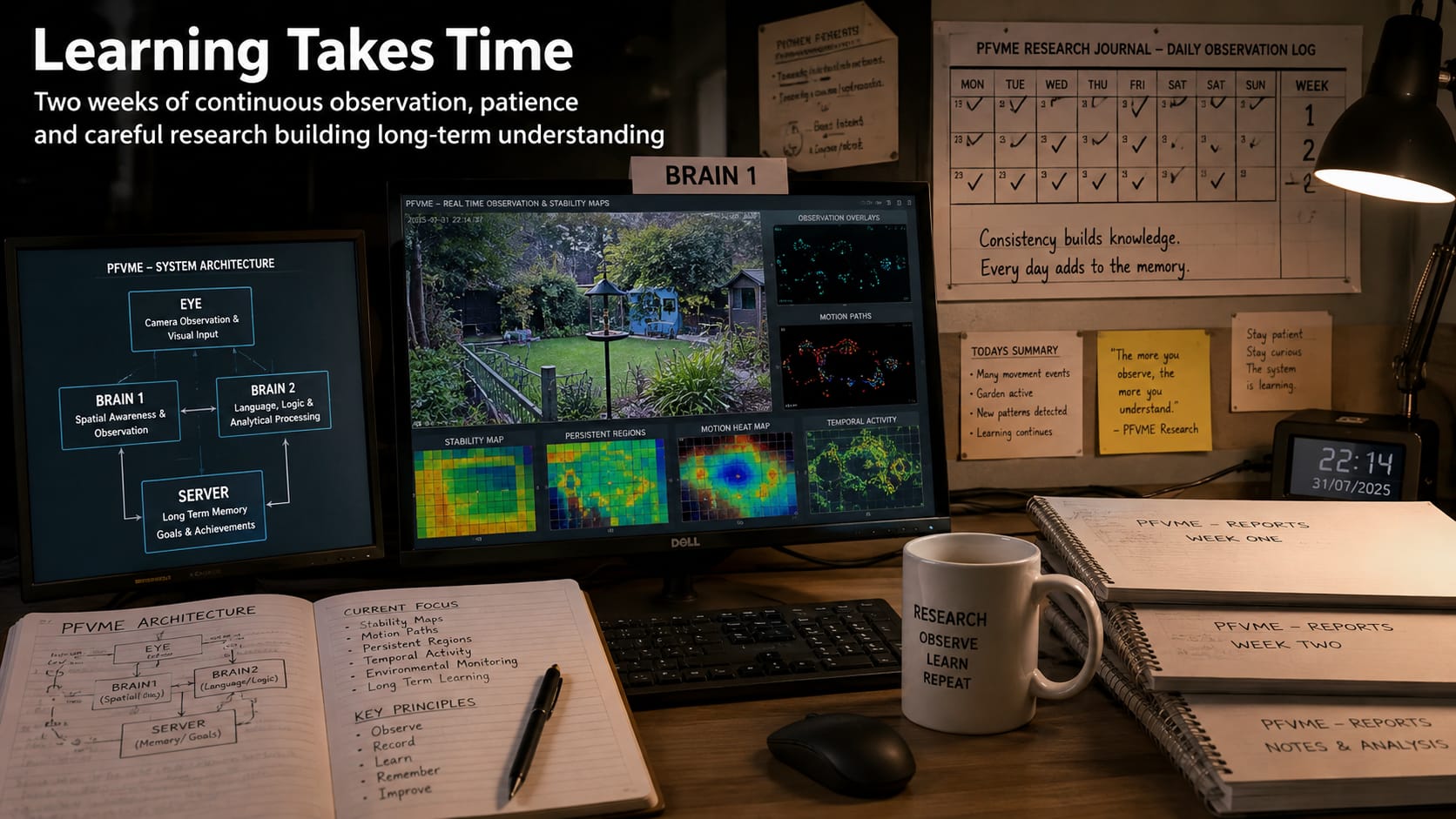
PFVME Research Journal – Part 4
Can artificial intelligence learn simply by watching the world? After weeks of continuous observation, Brain 1 of the PFVME...

AI Questions and Answers section for PFVME Research Journal Part Two - Why Versions One & Two Had to Fail
Welcome to a new feature where you can interact with our AI called Jeannie. You can ask her anything relating to this article. If this feature is available, you should see a small genie lamp above this text. Click on the lamp to start a chat or view the following questions that Jeannie has answered relating to PFVME Research Journal Part Two - Why Versions One & Two Had to Fail.
Be the first to ask our Jeannie AI a question about this article
Look for the gold latern at the bottom right of your screen and click on it to enable Jeannie AI Chat.
Type: Article -> Category: The PFVME Research Journal