Type: Article -> Category: The PFVME Research Journal
PFVME Research Journal
Part 1 – One Person. Three AI Systems. One Crazy Idea.
Don't have time to read the article? View as a short video storyboard or listen to it whilst jogging.
Publish Date: Last Updated: 1st July 2026
Author: nick smith- With the help of CHATGPT
How Artificial Intelligence Finally Allowed Me to Build the Research Project I Had Been Thinking About for Decades
Some ideas arrive fully formed.
PFVME Research Journal
This article is part of an ongoing series documenting the design, successes, failures and evolution of the PFVME intelligence research project.
Previous articles: Part 1 (current)
Next article: Why Version One Had to Fail: The Day I Realised Eyes Should Never Think
Others quietly sit in the back of your mind for years, waiting for the technology to catch up.
For me, this project belongs firmly in the second category.
For decades I have been fascinated by one deceptively simple question.
What is intelligence?
Not how we measure it.
Not how we test it.
But what it actually is.
Three months ago I finally reached a point where that question could become more than just another thought experiment.
I asked myself something that would have been almost impossible to attempt only a few years ago.
Could a single person build an experimental artificial intelligence system that learns about the world through experience rather than being trained on billions of examples?
Twenty years ago the answer would almost certainly have been no.
Not because the idea itself was impossible, but because building such a system would have required a team of experienced programmers, researchers, philosophers and AI specialists. Even reaching the starting line would have been beyond the resources of most individuals.
Today, that has changed.
Not because computers have suddenly become infinitely more powerful.
But due to Artificial Intelligence, which has fundamentally changed what one determined person can achieve.
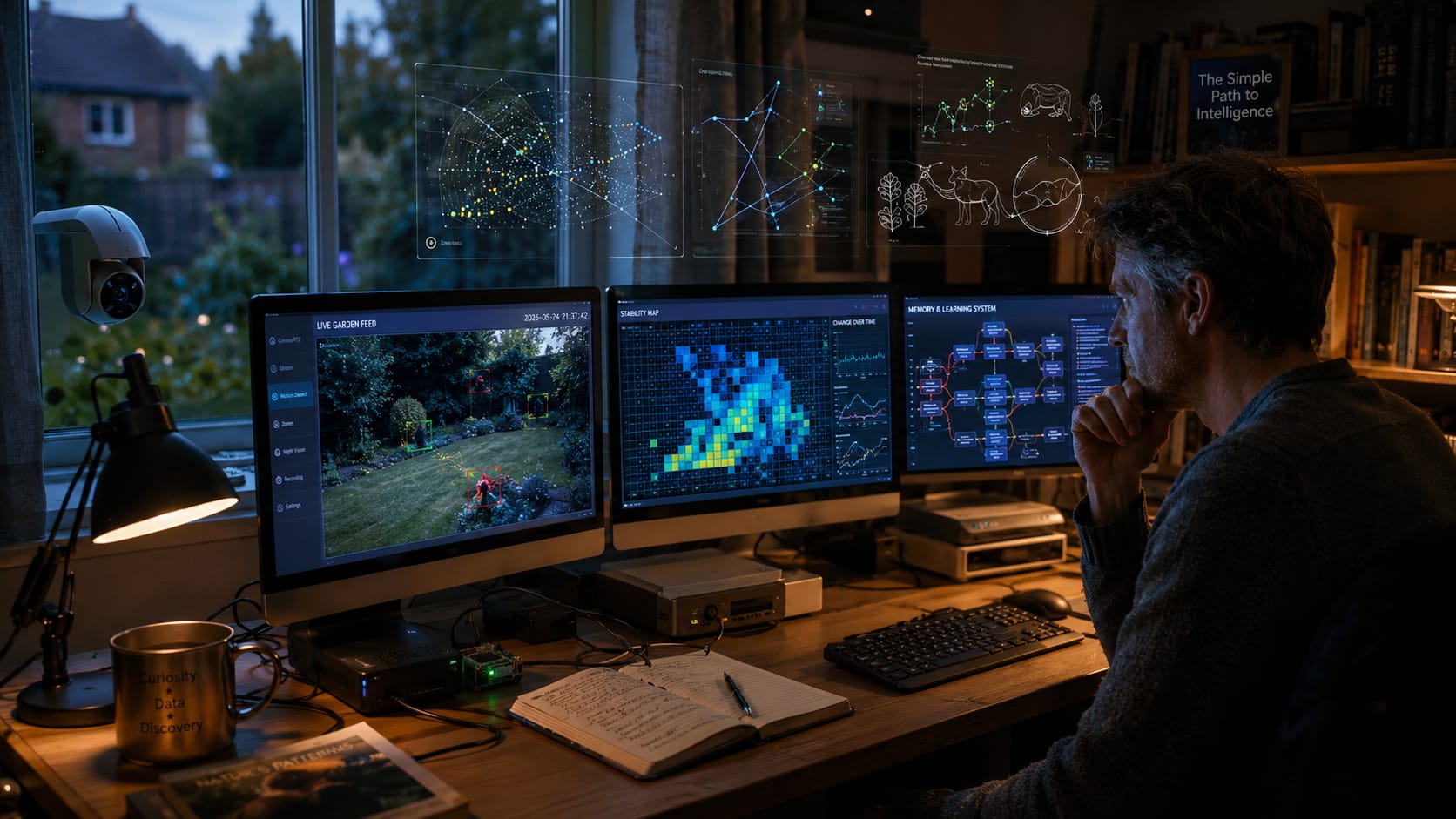
This article begins a new series documenting an experiment I call PFVME.
It isn't another chatbot.
It isn't another large language model.
It isn't trying to compete with systems like ChatGPT.
Instead, it explores a much simpler question.
Can intelligence emerge from continuous observation, experience and prediction rather than from memorising the experiences of others?
I honestly don't know the answer.
That uncertainty is exactly why I decided to build it.
Why I Didn't Want to Build Another AI
Today's AI systems are extraordinary achievements.
They can write software, explain quantum physics, produce artwork and hold conversations that were almost unimaginable only a few years ago.
But they also begin life in a very different way from every living creature on Earth.
Before answering their first question they have already absorbed vast quantities of human knowledge.
- Books.
- Images.
- Research papers.
- Programming code.
- Videos.
- Conversations.
Humans don't begin that way.
Neither does a fox, or a bird, or even a spider.
They begin life with very little knowledge at all.
Instead, they learn by experiencing the world one moment at a time.
That distinction fascinated me.
What would happen if we attempted to build a system that starts in a similar way?
Not by teaching it what a tree is.
Not by telling it what a bird looks like.
But by allowing it to observe, detect patterns and slowly construct its own understanding of the environment.
That question became the foundation of PFVME.
AI Didn't Replace Me. It Amplified Me.
Much of the public discussion around AI centres on replacement.
Will AI replace programmers?
Will AI replace writers?
Will AI replace artists?
My experience has been very different.
Throughout this project AI has become something entirely different.
A collaborator.
I remain responsible for every architectural decision.
I decide what questions are worth asking.
I challenge assumptions.
I reject ideas that don't fit the overall design.
Artificial Intelligence helps me think faster.
It organises complex discussions.
It spots inconsistencies.
It helps transform abstract ideas into practical engineering plans.
Perhaps most importantly, it allows me to explore ideas that would once have remained trapped inside notebooks simply because I didn't have the resources to test them.
The project therefore has three collaborators.
Me.
ChatGPT.
Codex.
Each contributes something different.
None could complete the project alone.
The Crazy Idea
Imagine giving a machine nothing more than a camera.
Allowing it to observe the same environment every day.
Watching stable regions emerge.
Tracking objects as they appear and disappear.
Looking for repeated patterns.
Developing expectations.
Building memories.
Eventually creating its own symbols to represent what it has learned.
All without ever telling it what it is looking at.
No labels.
No predefined objects.
No human descriptions.
Just continuous observation and experience.
That is the experiment.
The Hardware
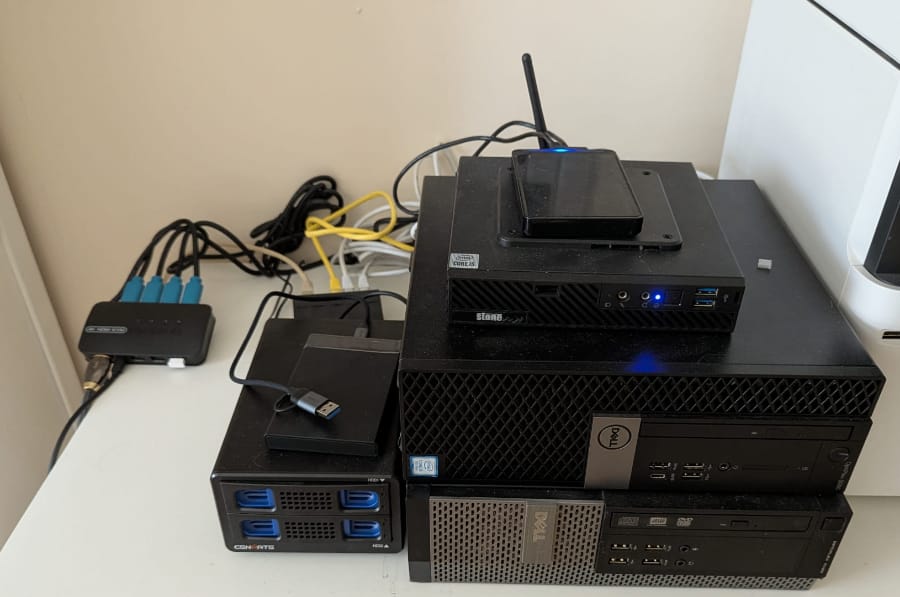
One of the rules I imposed on myself was that the project should avoid expensive hardware.
No AI supercomputer.
No racks of GPUs.
No cloud clusters costing thousands of pounds each month.
Instead...
One second-hand mini PC.
Another older desktop.
An ageing i7 machine acting as long-term memory.
A consumer surveillance camera.
And a lot of coffee.
If this experiment succeeds, it should succeed because of architecture rather than brute computational force.
Version 1
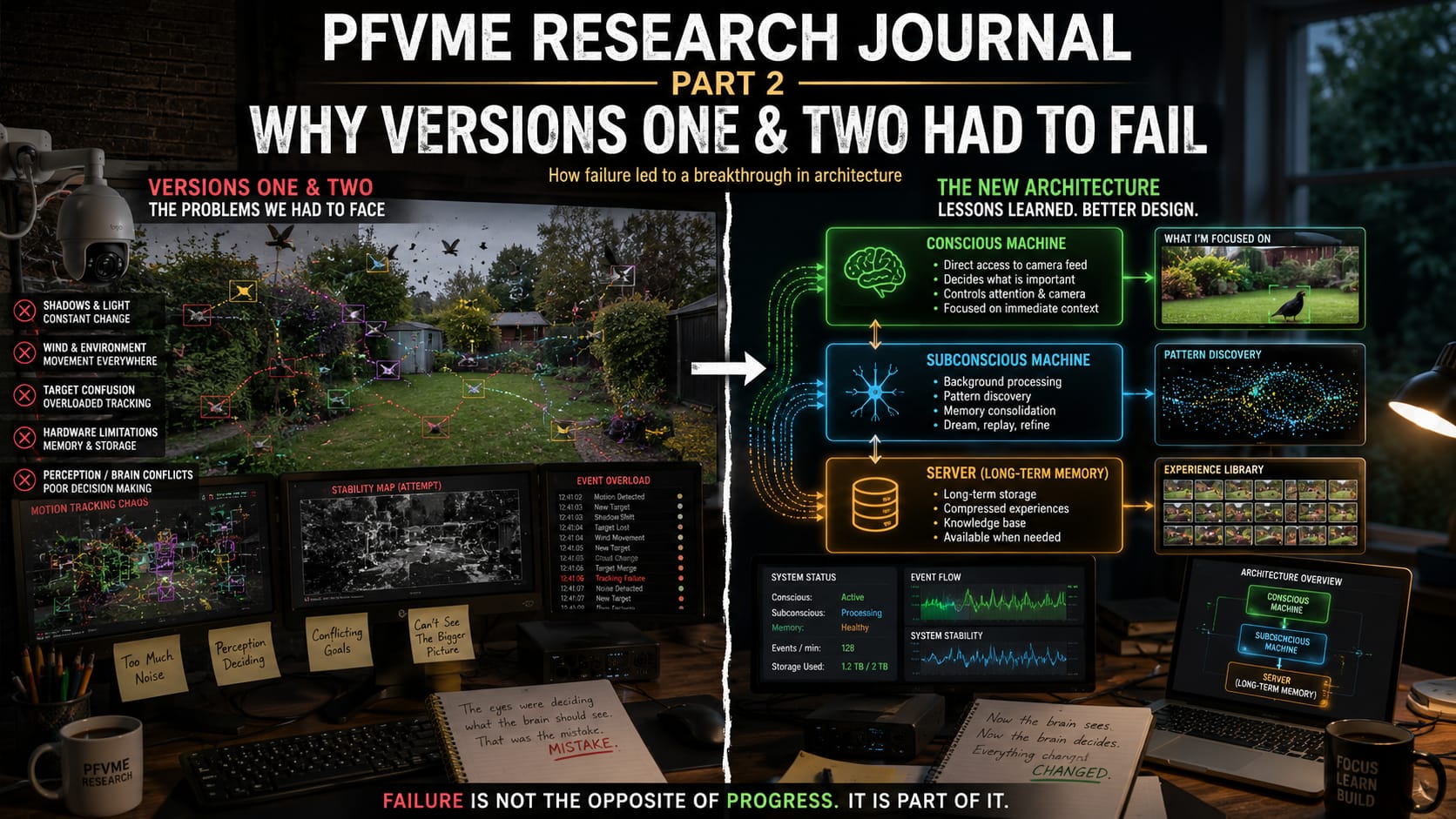
Version 1 failed.
Spectacularly.
It taught me that I had accidentally given the eyes a job they should never perform.
Eyes don't think.
They observe.
That single mistake forced a complete redesign of the system's architecture.
It also became one of the most important lessons of the entire project.
Sometimes failure isn't evidence that an idea is wrong.
It's evidence that your assumptions were.
Each version of PFVME has taught me something new.
Every redesign has moved the project a little closer to the original vision.
Where I Am Now
As I write this, Version 4 of PFVME is quietly running in the background, continuously observing the world through a single camera.
It doesn't know what a tree is.
It doesn't know what a bird is.
It has never been told what grass looks like.
It is simply watching, comparing, remembering and searching for patterns.
Will it eventually develop something we might recognise as intelligence?
I genuinely don't know.
But that's the exciting part.
This isn't a story about proving a theory.
It's a story about testing one.
Over the coming months I'll be documenting every major success, every failure, every redesign and every unexpected discovery.
Whether PFVME ultimately succeeds or fails is almost secondary.
The experiment has already demonstrated something remarkable.
Artificial Intelligence has dramatically lowered the barrier between having an ambitious idea and being able to test it.
Projects that once required laboratories, research teams and significant funding can now begin with one curious person, a handful of second-hand computers and AI acting as a collaborator rather than a replacement.
For me, that may be the most important breakthrough of all.
Artificial Intelligence hasn't replaced my curiosity.
It has amplified it.
And for the first time in my life, ideas that once seemed impossible to explore have become projects that can actually be built.
If you'd like to follow the journey, I'll be documenting the evolution of PFVME as it grows, fails, adapts and hopefully learns.
I hope you'll join me.
A big thanks to Mike Le Gray for donating two NVME Drives towards the project.

Latest Journal Reports on PFVME Project
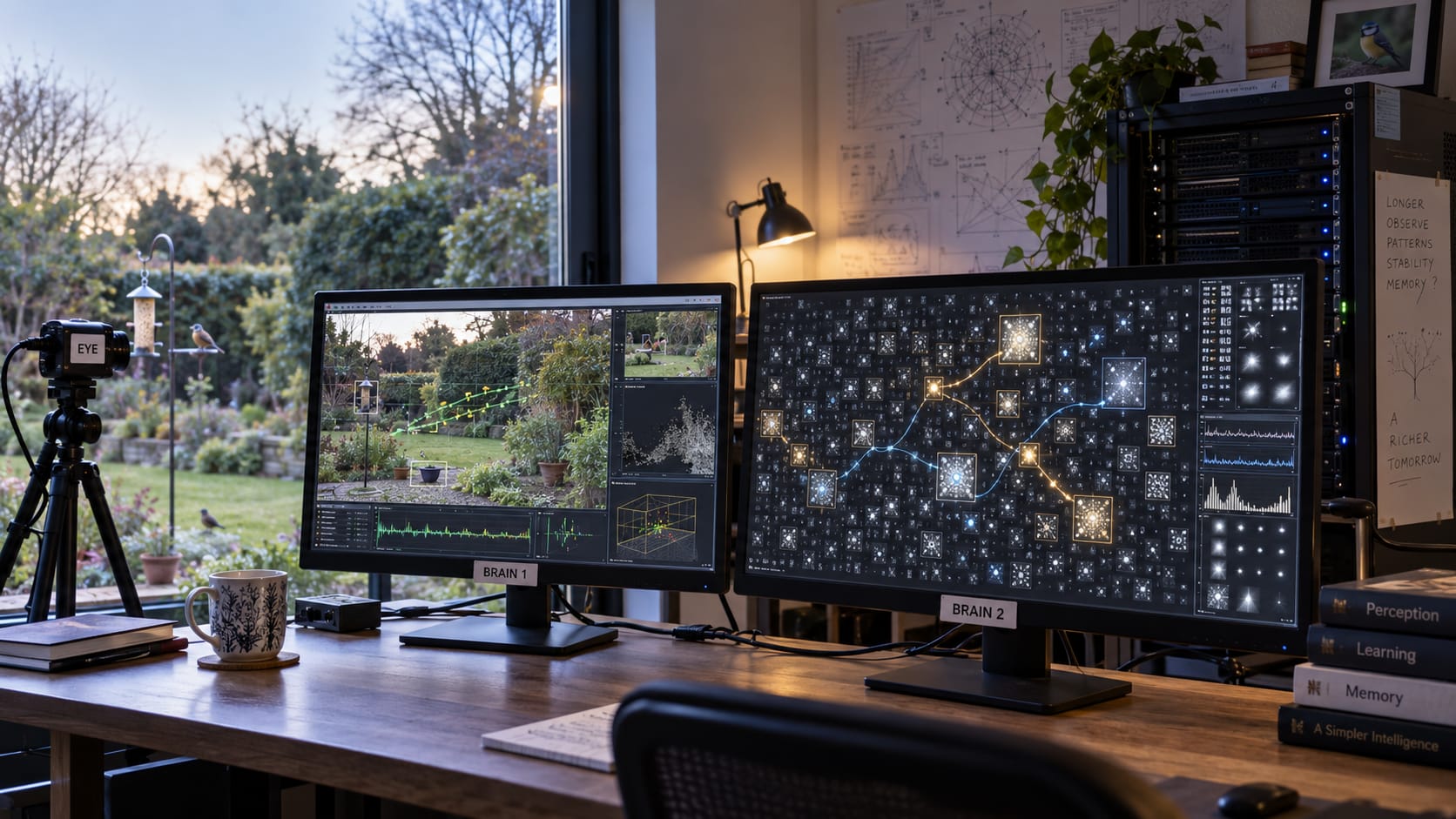
PFVME Journal Part 6 – Learning What Is Worth Remembering
After more than 126 million cycles, PFVME's Brain 2 is moving closer to creating its first glyphs. But before allowing it to...
PFVME Research Journal – Part 5: The Introduction of Brain 2
PFVME reaches a major milestone as Brain 2 comes online. After weeks of patient observation by Brain 1, a second independent...
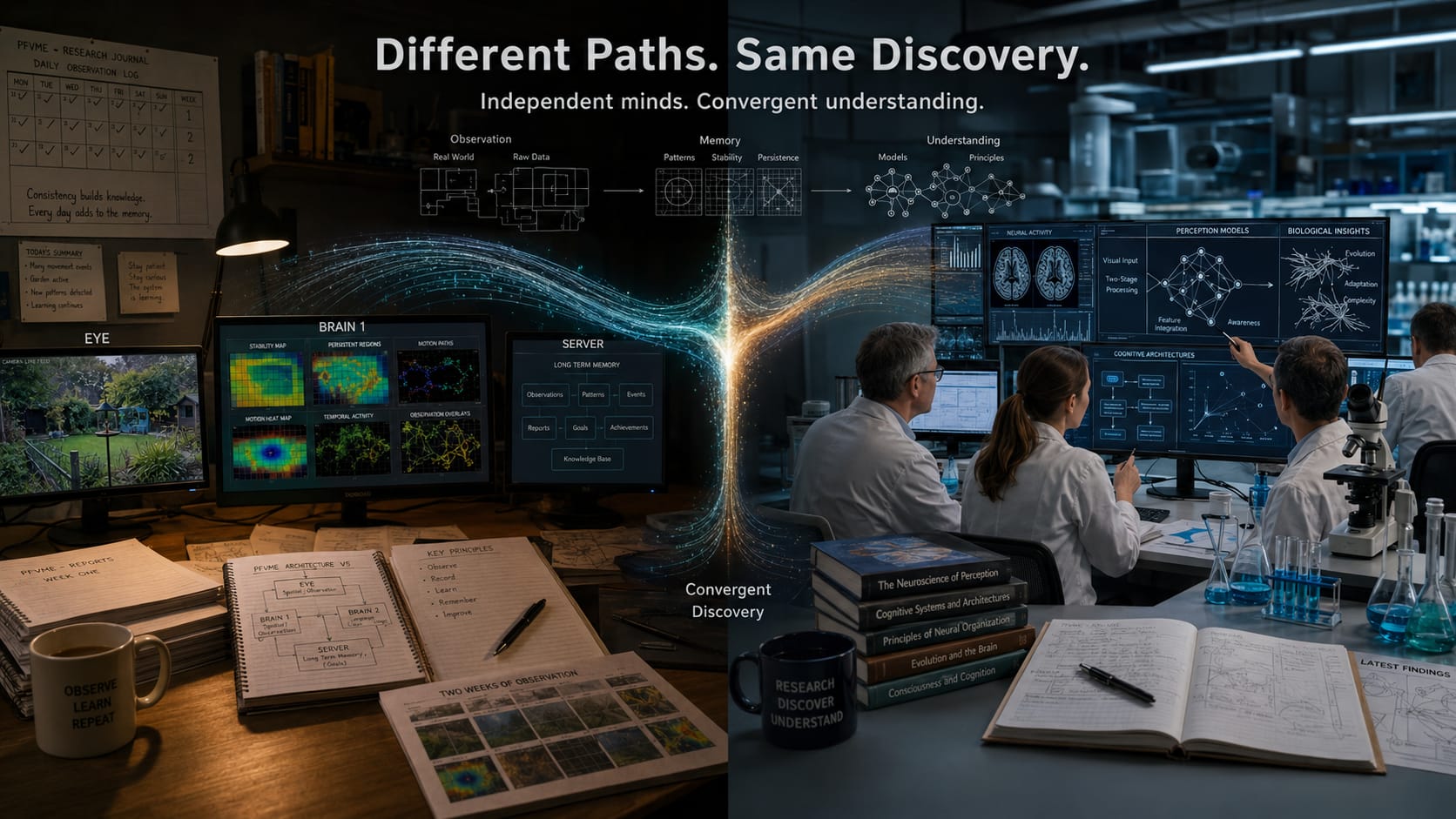
Many Different Paths, Similar Destinations
Can independent AI research reach the same conclusions as world-leading laboratories? The PFVME project unexpectedly found itself...
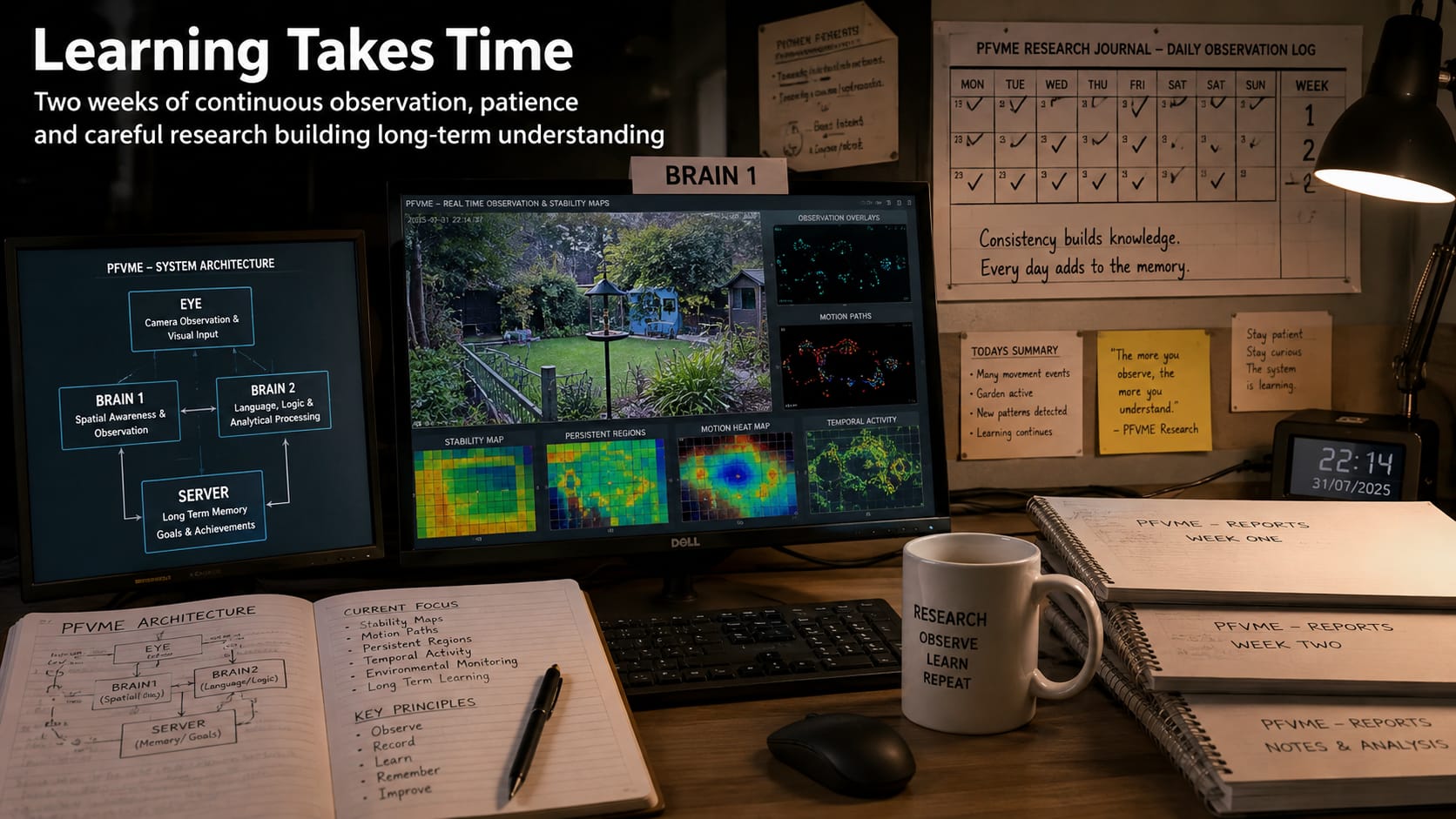
PFVME Research Journal – Part 4
Can artificial intelligence learn simply by watching the world? After weeks of continuous observation, Brain 1 of the PFVME...

AI Questions and Answers section for PFVME Research Journal Part One - One Person. Three AI Systems. One Crazy Idea.
Welcome to a new feature where you can interact with our AI called Jeannie. You can ask her anything relating to this article. If this feature is available, you should see a small genie lamp above this text. Click on the lamp to start a chat or view the following questions that Jeannie has answered relating to PFVME Research Journal Part One - One Person. Three AI Systems. One Crazy Idea..
Be the first to ask our Jeannie AI a question about this article
Look for the gold latern at the bottom right of your screen and click on it to enable Jeannie AI Chat.
Type: Article -> Category: The PFVME Research Journal