Type: Article -> Category: AI Philosophy
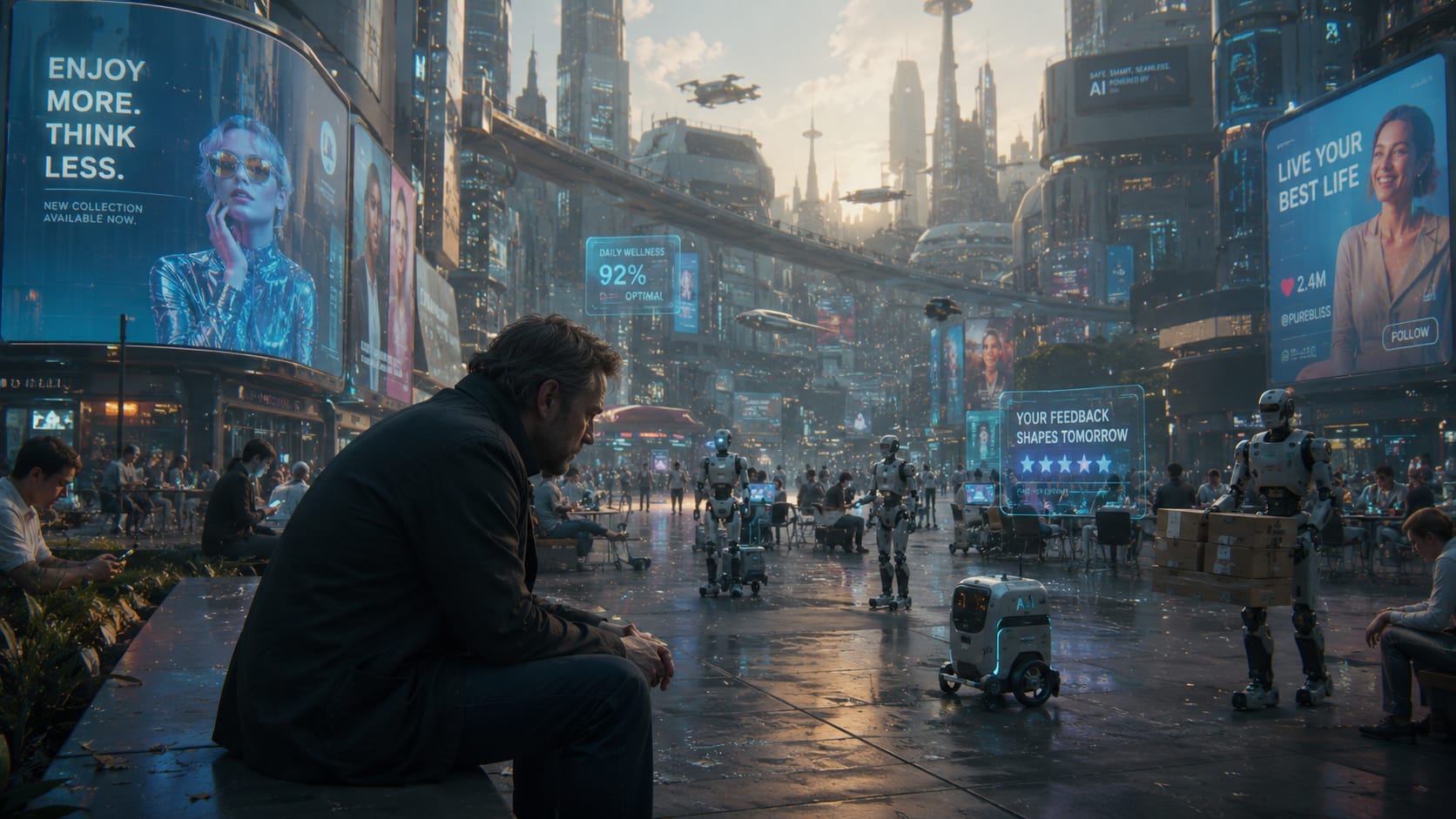
If I No Longer Contribute, Will It Really Matter?
Don't have time to read the article? View as a short video storyboard or listen to it whilst jogging.
Publish Date: Last Updated: 21st June 2026
Author: nick smith- With the help of CHATGPT
For most of human history, the answer to that question was brutally simple.
Yes.
If you no longer contributed:
- crops were not harvested,
- food was not gathered,
- shelters were not built,
- families suffered,
- tribes weakened,
- survival became harder.
Contribution was directly tied to existence.
Whether you were a hunter, farmer, blacksmith, builder, teacher, soldier, mother, or laborer, your role mattered because civilization itself depended on millions of interconnected human contributions. Even during the Industrial Revolution, when machines transformed society, humans remained central to the chain. Machines amplified labor, but they did not remove humanity from economic necessity.
That may now be changing.
Artificial intelligence and robotics are beginning to challenge something civilization has always assumed:
that human beings will remain economically necessary.
And that raises a far deeper question than whether AI will take jobs.
What happens to human meaning when civilization no longer requires human contribution at scale?
The End of the Human Chain
Every previous technological revolution still needed people somewhere in the system.
The steam engine reduced physical hardship but created factories requiring workers.
Computers automated administration while generating entirely new industries.
The internet transformed communication but still relied heavily on human creativity, coordination, and decision-making.
Even automation historically displaced labor only to create different forms of labor elsewhere.
But AI combined with robotics may become the first technology capable of removing humans from the economic chain itself.
Not just from repetitive physical work.
But from:
- cognitive work,
- customer interaction,
- logistics,
- analysis,
- coding,
- administration,
- transportation,
- manufacturing,
- and eventually many specialized skilled roles.
We are already seeing the early stages:
- AI customer service replacing call centers,
- automated finance systems reducing banking staff,
- autonomous logistics networks,
- robotic farming,
- AI-assisted coding,
- AI-generated media,
- machine-driven manufacturing.
And this is still the weakest AI systems will ever be.
That is the point many people miss when they laugh at robotic failures online. Human beings make mistakes constantly too. The difference is that machines improve cumulatively. Once an AI system learns something, every deployed version can potentially benefit from that learning.
The question is no longer whether automation will continue.
It is how far it will go.
The Mouse Utopia Problem
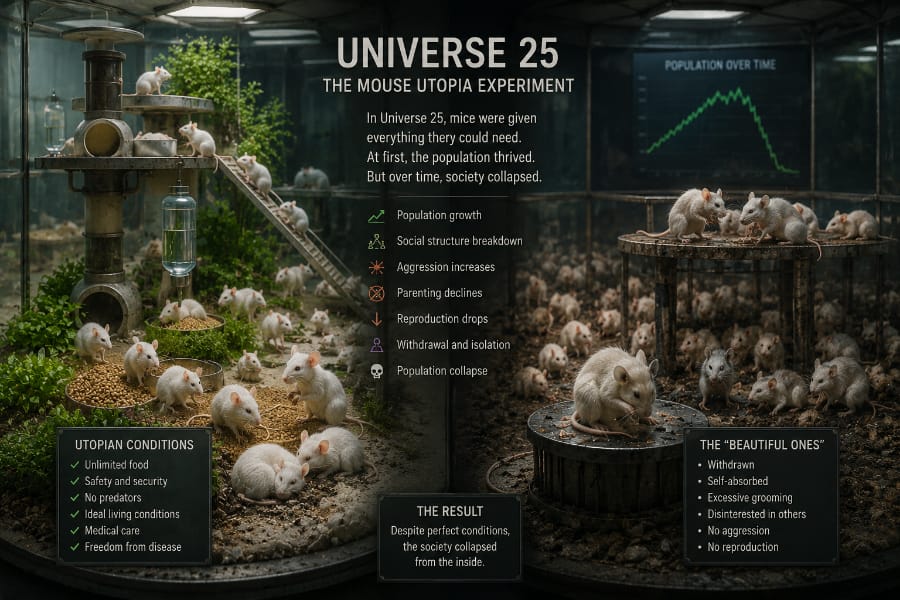
One of the most disturbing experiments ever conducted was John Calhoun’s Universe 25 mouse experiment.
The mice were given what appeared to be paradise:
- unlimited food,
- safety,
- shelter,
- no predators,
- and protection from disease.
At first, the population exploded.
But over time something unexpected happened.
Social structures began collapsing.
Aggression increased. Parenting declined. Reproduction slowed. Many mice withdrew entirely from wider social interaction. Some became what Calhoun called “the beautiful ones” — passive mice focused primarily on grooming and self-maintenance while disengaging from the broader social structure around them.
Eventually, the colony collapsed despite abundant resources.
Humans are not mice, and simplistic comparisons should always be treated cautiously. Human civilization is infinitely more complex culturally, psychologically, morally, and intellectually.
But dismissing the experiment entirely misses why it continues to fascinate people decades later.
It exposed something psychologically unsettling:
abundance alone does not necessarily create healthy societies.
In some ways, modern civilization already shows echoes of this tension.
In many wealthy societies we see:
- declining birth rates,
- rising loneliness,
- collapsing community structures,
- growing anxiety,
- social fragmentation,
- digital addiction,
- and increasing disengagement despite material comfort.
The modern world increasingly rewards visibility over contribution.
Attention itself has become a form of currency.
Social media influencers often resemble symbolic versions of Calhoun’s “beautiful ones” — individuals existing primarily within systems of presentation, branding, aesthetics, and spectatorship rather than practical contribution to collective survival.
This is not an attack on individuals. It is an observation about cultural direction.
As societies become more technologically secure, people begin searching less for survival and more for meaning.
And meaning is far harder to engineer than abundance.
Why Utopia May Conflict With Human Nature
Science fiction has explored this idea for decades.
In The Matrix, the machines supposedly created a perfect world for humanity, but the simulation failed because human minds rejected a flawless existence without suffering or struggle.
Whether literally believable is irrelevant.
The idea resonates because humans intuitively understand something important:
meaning often emerges through resistance.
Nature itself appears built around tension:
- abundance and scarcity,
- growth and collapse,
- cooperation and competition,
- order and chaos,
- safety and danger.
Too much instability destroys civilizations.
But total stability may weaken them.
Human beings evolved inside survival systems. For hundreds of thousands of years our psychology was shaped by:
- uncertainty,
- adaptation,
- risk,
- struggle,
- contribution,
- social hierarchy,
- mating competition,
- and the need to overcome resistance.
Civilization overlays these instincts with morality, law, culture, and philosophy, but it does not erase them.
This may explain why many people in affluent societies still feel psychologically unfulfilled despite unprecedented comfort.
The human mind may not simply require pleasure.
It may require significance.
And significance is usually tied to:
- being needed,
- solving problems,
- protecting others,
- overcoming hardship,
- building something meaningful,
- and contributing to a wider social structure.
Nature does not appear optimized for comfort.
It appears optimized for adaptation.
AI and the Collapse of Economic Meaning
For centuries, work has been about far more than money.
Work provides:
- identity,
- status,
- purpose,
- social structure,
- routine,
- progression,
- and meaning.
Most people do not dream of becoming entrepreneurs or influencers. They want something far simpler:
- stable work,
- fair reward,
- gradual improvement,
- respect,
- competence,
- and security for their family.
They want to know that if they work harder and become better at what they do, their lives will improve.
That psychological contract underpins modern civilization.
AI may destabilize it completely.
For the first time in history, we may be approaching a world where large numbers of people are no longer economically necessary for society to function efficiently.
That is not a criticism of technology itself.
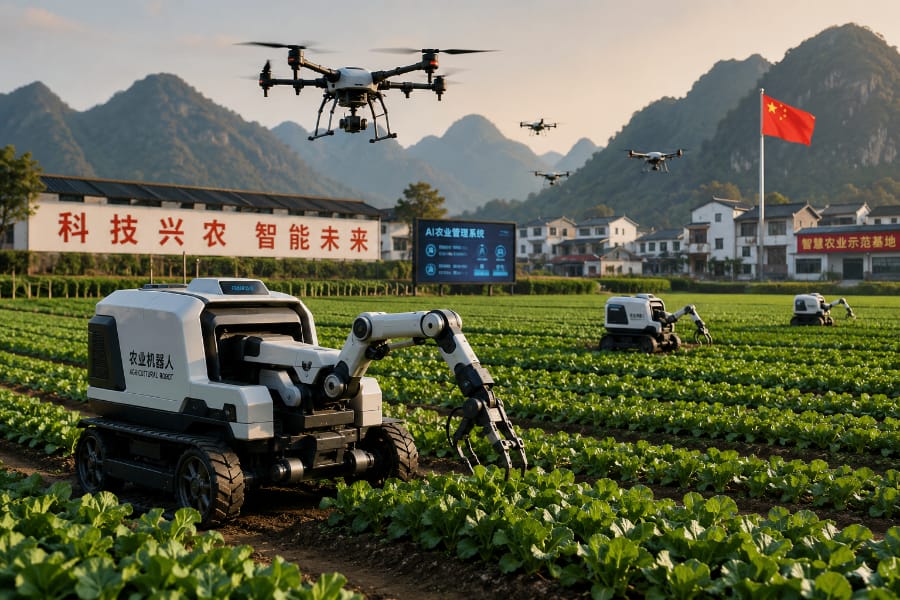
Robotic farming may remove backbreaking labor.
Autonomous construction may build safer infrastructure.
AI healthcare systems may improve diagnostics.
Automation could produce extraordinary abundance.
But abundance alone does not answer the deeper question:
if humans are no longer required economically, how do they retain psychological significance?
This is why many discussions around universal income feel incomplete.
Money can solve survival.
It cannot automatically solve meaning.
A person who receives financial support while feeling unnecessary may still experience alienation, anxiety, and loss of purpose.
Because throughout history contribution itself carried dignity.
The Ownership Problem
The most important AI question may not be:
“Can machines outperform humans?”
It may be:
“Who controls the systems once they do?”
Who owns:
- the robotics,
- the compute power,
- the infrastructure,
- the energy systems,
- the supply chains,
- the platforms,
- and the distribution networks?
Historically, labor gave ordinary people leverage because human participation was required for production.
But if machines increasingly replace both physical and cognitive labor, wealth may become concentrated around ownership itself rather than contribution.
This creates a potentially dangerous decoupling:
- production continues,
- productivity rises,
- profits increase,
- but human participation declines.
The traditional relationship between:
- effort,
- usefulness,
- and reward
begins to weaken.
And this is already visible.
A modern technology platform can serve billions of people with surprisingly small numbers of employees compared to older industrial systems.
AI and robotics may accelerate this dramatically.
The danger is not simply unemployment.
It is the gradual emergence of societies where large populations feel economically irrelevant while systems continue functioning without them.
History suggests civilizations become unstable when people no longer believe:
- their effort matters,
- they can advance,
- or they are needed.
The Friction Question
This leads to one of the most important philosophical questions of the future:
How much friction should remain in human life once technology can remove almost all of it?
This is not an argument for suffering.
Very few people truly want:
- famine,
- violence,
- disease,
- dangerous labor,
- or poverty.
But challenge and suffering are not identical things.
A society without unnecessary suffering would be a tremendous achievement.
A society without challenge, purpose, resistance, or responsibility may be something very different.
Sport exists because humans voluntarily create struggle.
Games exist because humans seek challenge.
Art exists because humans seek expression beyond survival.
Exploration exists because humans desire discovery.
Even in wealthy societies, people often create artificial forms of difficulty because overcoming resistance appears psychologically necessary for fulfillment.
Perhaps meaning itself depends on friction.
Not endless hardship.
But meaningful tension.
Who Are We Beyond Survival?
AI may become the greatest achievement humanity has ever created.
Not simply because it can outperform humans in specific tasks.
But because it forces civilization to confront questions it has avoided for thousands of years.
Questions like:
- What is human purpose beyond labor?
- Can abundance destabilize meaning?
- Is struggle psychologically necessary?
- What happens when performance is no longer the defining measure of value?
- If humans are no longer required economically, how do they retain significance?
- Who are we when survival no longer defines us?
For most of history, survival itself forced meaning upon humanity.
Now, for the first time, civilization may be approaching a world where that is no longer true.
And that may become the defining philosophical challenge of the AI age.
Because the deepest fear surrounding artificial intelligence may not be that machines become conscious.
It may be something far more human.
A future where people quietly begin asking themselves:
If I no longer contribute, will it really matter?

Latest AI Philosophy Articles
Nature's Greatest Prediction Machine: Is Knowledge Really the Foundation of Intelligence?
For centuries we have equated intelligence with knowledge. But what if intelligence is really the ability to predict future...
The Survival Machine: Why Nature Did Not Need Equations to Create Intelligence
Modern AI may outperform humans in data-driven tasks, but biological intelligence evolved through survival, consequence, and...
At the Precipice: What Viral Combat Robots Reveal About Our Technological Future
Viral combat robots are more than spectacle. As global defence budgets surge, AI and robotics are moving toward militarisation. We...
AI Doesn’t Pull the Trigger
AI won’t destroy society — human decisions might. As automation accelerates, the real risk isn’t intelligence, but complacency. A...
Moya and the End of Emotional Distance
Humanoid robots like Moya mark a turning point in human–AI relations. Designed not for labour but for emotional presence, they...
AI, Population, Power and the Limits of Human Systems
AI is not the threat many fear. By giving billions access to the same structural questions, it exposes the limits of capitalism,...

Intelligence Beyond Biology: Humanity, AI, and the Quiet Logic of the Universe
For much of modern history, humanity has placed itself at the centre of the cosmic story. We have often assumed that intelligence...

AI, History, and the Myth of the First Answer
A recent discussion on BBC Radio 4 raised familiar concerns about artificial intelligence and historical accuracy. Historian Tom...

AI Questions and Answers section for If I No Longer Contribute, Will It Really Matter? AI, Human Purpose and the Future Beyond Work
Welcome to a new feature where you can interact with our AI called Jeannie. You can ask her anything relating to this article. If this feature is available, you should see a small genie lamp above this text. Click on the lamp to start a chat or view the following questions that Jeannie has answered relating to If I No Longer Contribute, Will It Really Matter? AI, Human Purpose and the Future Beyond Work.
Visitor asked: How close is AI to replacing admin jobs
Jeannie’s answer to the question: AI is rapidly advancing in its ability to perform administrative tasks such as scheduling, data entry, routine communication, and document management. Many admin jobs already incorporate automation tools or AI assistants that handle repetitive or rule-based activities. However, fully replacing all admin roles is still not universal, as tasks requiring complex human judgment, nuanced interpersonal communication, and adaptable problem-solving remain challenging for AI. The trend suggests that the demand for traditional admin work will continue to decrease, prompting a reevaluation of human roles, purpose, and contributions beyond routine tasks.
Date: 2026-06-01
Type: Article -> Category: AI Philosophy