Compression and Release: Rethinking Black Holes, the Big Bang, and the Nature of Cosmic Expansion
Publish Date: Last Updated: 17th February 2026
Author: nick smith- With the help of CHATGPT
Editor’s Note
This article is a philosophical exploration of cosmology and physics. It does not claim to replace established scientific models, but instead examines whether certain assumptions about beginnings and endings may be conceptually inverted. Where speculation is used, it is clearly framed as such.
Listen as a Spotify Discussion or view as a YouTube Video
Introduction
Modern cosmology is built around a powerful but rarely questioned narrative: the universe began with a singular explosive event, while black holes represent the final collapse of matter and energy. These two ideas sit at opposite ends of cosmic time, one a beginning, the other an end.
Yet both share an uncomfortable similarity. At their extremes, our current physical theories fail.

This raises a simple but profound question:
What if these two apparent limits are not opposites at all, but phases of the same process?
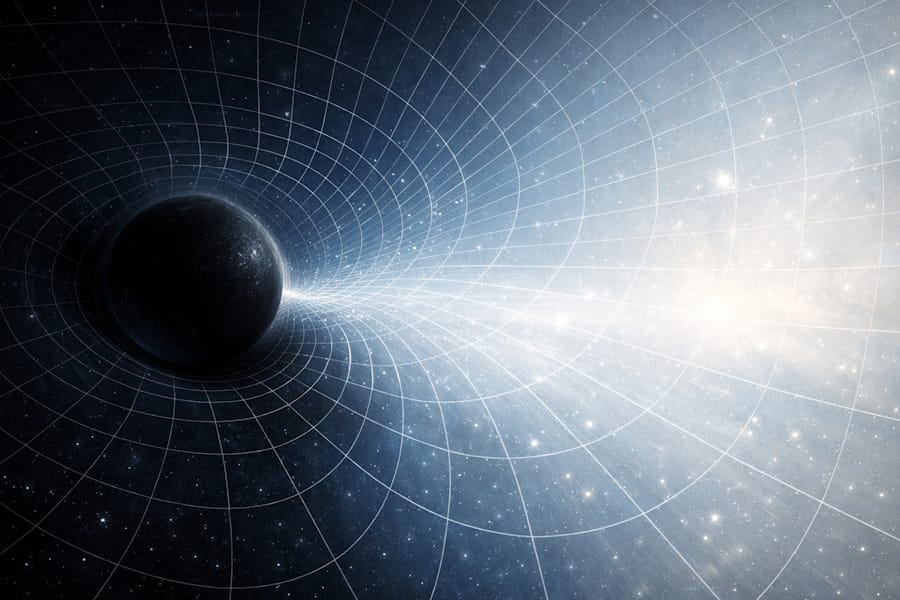
This article explores the possibility that extreme gravitational collapse and cosmic expansion are not contradictory phenomena, but sequential expressions of compression and release, and that what we call the Big Bang may be better understood not as an explosion, but as a prolonged decompression from a maximally constrained state.
1. The Problem with Endpoints
In physics, singularities are not objects we understand; they are places where our equations stop working. Both the Big Bang and the core of a black hole fall into this category.
Despite this, they are commonly treated as fundamentally different:
- One creates spacetime
- The other destroys it
This distinction may say more about the limits of our models than about reality itself.
When two boundaries of knowledge appear at opposite ends of a system, it is reasonable to ask whether they are truly separate, or whether they represent the same phenomenon viewed from different sides.
2. Inverting the Assumption
Rather than assuming the Big Bang was a one-time creation event, we can ask a different question:
What if the Big Bang was not a beginning, but a release?
In this framing:
- A black hole represents a phase of extreme compression
- The Big Bang represents the relaxation of that compression
- Expansion is not residual momentum, but an ongoing process
This removes the need for a single, instantaneous origin and replaces it with a transition.
3. Compression and Release as a Physical Process
The model proposed here is intentionally simple:
- Matter and energy collapse under gravity
- Compression approaches an extreme limit
- Classical descriptions fail
- A transition occurs rather than termination
- Spacetime begins to expand from that state
Importantly, this expansion does not need to occur all at once.
A compressed system typically releases energy rapidly at first, then more slowly as equilibrium is approached. Applied cosmologically, this would naturally explain early rapid expansion followed by continued, but gentler, cosmic growth.
4. Why Expansion Has Not Ended
A quiet difficulty in standard cosmology is the persistence of expansion.
If all energy were released at a single moment, gravitational attraction should eventually dominate and slow expansion to a halt. Instead, the universe continues to expand, with evidence of distinct phases of acceleration.
Within a compression–release framework, this is not unexpected.
The expansion continues because the system has not yet fully relaxed. The universe is not coasting on an initial impulse; it is still unfolding.
5. Are We Inside a Black Hole?
Taken from the following article: https://www.iflscience.com/why-some-physicists-think-we-are-living-inside-a-black-hole-82039
If our universe were literally inside a classical black hole, certain consequences would be unavoidable:
- We would not observe uniform expansion
- All trajectories would converge inward
- Large-scale structure would collapse rather than persist
None of these match observation.
This model therefore does not propose that we live inside a black hole.
Instead, the black hole is causally prior, not spatially enclosing. Its role is to define an initial boundary condition from which spacetime emerges, not a container in which it resides.
6. No Centre, No Edge, No Wall
One strength of this reframing is what it avoids.
There is:
- No cosmic wall
- No central point of expansion
- No requirement for space outside the universe
Expansion occurs within spacetime itself, consistent with relativistic descriptions and observational evidence.
This also removes the misleading image of matter exploding into empty space, a metaphor that has caused persistent confusion.
7. Time as a Consequence of Release
In this framework, time itself acquires a natural explanation.
Compression represents maximum constraint. Release represents irreversibility. Time emerges as the gradient between the two.
The arrow of time is therefore not imposed externally but arises from the structure of the process itself, explaining why time flows in one direction at large scales despite time-symmetric fundamental laws.
8. Rethinking Black Holes
Seen this way, black holes are not cosmic dead ends.
They are transitions.
Rather than destroying information, they may reorganise it in forms beyond current description. Rather than ending processes, they may initiate new ones at scales inaccessible from within the parent system.
This reframing does not resolve existing paradoxes, but it places them within a coherent narrative rather than isolating them as anomalies.
9. Implications and Open Questions
If collapse and expansion are phases of a single process, several implications follow:
- Singularities may not exist as physical objects
- Universes may be sequential rather than unique
- Expansion may end in equilibrium rather than heat death
- Creation and destruction become contextual, not absolute
These ideas remain speculative, but they are internally consistent and aligned with the known limits of current theory.
Conclusion
Scientific progress often begins by questioning whether familiar labels have led us astray.
By treating black holes as compression thresholds and cosmic expansion as a prolonged release, we gain a framework that unifies two of cosmology’s most troubling limits without adding unnecessary assumptions.
Whether ultimately correct or not, this inversion highlights an important possibility:
The universe may not have begun with a bang, but with a release.

More Science Articles
Why “Climate Change” Is the Wrong Label — And How We Can Reframe the Conversation
Is “climate change” the wrong target? Even when human CO₂ fell during COVID, methane rose due to natural processes. Maybe the real...

The Cylinder And The Clay; A Dimensional View Of Existence
An ancient cylinder seal reveals a striking model of existence: how information changes with dimension, why time may be a...

Mars and the Fragility of Life
For much of human history, Mars has occupied a unique place in our imagination. It is close enough to feel familiar, yet alien...
Quantum Entanglement, Timeless Universes, and the Illusion of the Long Way Around
Quantum entanglement is often presented as one of the strangest features of the universe, particles separated by vast distances...
The Universe That Refuses Perfection: Light, Time, and the Pulse of Reality
Humanity’s greatest discoveries often begin with deceptively simple questions. What is light? Where does time go? Why does...

Cooling by Design: How Nature and AI Inspired a Revolutionary Data Center Architecture
Nature has an extraordinary way of solving the most complex challenges. From the intricate cooling system of the human body to the...

Net Zero: The New Religion Spreading Across the Globe
Over the past half-century, the West has witnessed a significant decline in Christian faith, leaving a spiritual and moral vacuum....
Hypothesis Overview: Light as a Particle with a Pushed Energy Wave
The original double-slit experiment, performed in 1801 by Thomas Young at the Royal Institution, showed that light acts as a wave....

AI Questions and Answers section for Compression and Release: Rethinking Black Holes, the Big Bang, and the Nature of Cosmic Expansion
Welcome to a new feature where you can interact with our AI called Jeannie. You can ask her anything relating to this article. If this feature is available, you should see a small genie lamp above this text. Click on the lamp to start a chat or view the following questions that Jeannie has answered relating to Compression and Release: Rethinking Black Holes, the Big Bang, and the Nature of Cosmic Expansion.
Be the first to ask our Jeannie AI a question about this article
Look for the gold latern at the bottom right of your screen and click on it to enable Jeannie AI Chat.