Type: Article -> Category: AI Business
AI, Jobs, and the Great Distraction: Why Artificial Intelligence Is Not the Root Cause of Today’s Employment Crisis
Publish Date: Last Updated: 1st March 2026
Author: nick smith- With the help of CHATGPT
View this article as a video discussion
For much of the past two years, headlines have been dominated by a familiar claim: AI is taking jobs.
From news articles warning of mass unemployment to opinion pieces predicting the end of entire professions, artificial intelligence has become the convenient villain in a rapidly changing labour market.

But this framing misses a more uncomfortable truth.
AI is not the root cause of today’s employment pressures. It is an accelerant, a tool that exposes and amplifies structural weaknesses created by economic choices made long before modern AI entered the picture.
What we are witnessing is not an “AI jobs apocalypse”, but the collision of rising business costs, a service-heavy economic model, stalled career progression, and the systematic removal of redundancy from organisations. AI simply makes these pressures visible, and politically convenient to blame.
The Quiet Cost Squeeze on Business
Who Benefits From the AI Narrative?
The idea that “AI is taking jobs” is not just popular; it is useful.
For industry, AI provides cover for difficult decisions. Rising wages, energy costs, and regulatory pressures force businesses to remove redundancy and flatten structures. Framing job reductions as technological inevitability softens public and internal resistance.
For government, AI offers a future-focused explanation for economic disruption. It shifts attention away from long-term policy choices, energy pricing, industrial decline, and service-sector dependence, and reframes them as consequences of innovation rather than governance.
For media, AI delivers simple, dramatic headlines. Structural economic change is slow, complex, and politically sensitive. “AI replaces jobs” is faster, cleaner, and more clickable.
The result is a shared narrative that avoids harder questions:
- Why domestic industry became uncompetitive
- Why career progression stalled
- Why resilience and redundancy were engineered out of organisations
AI did not create these conditions, but it is a convenient scapegoat for them
Over the past decade, businesses across the UK have faced steadily rising operating costs:
- Higher minimum wages
- Increased employer tax burdens
- Escalating energy prices
- Regulatory and compliance overheads
None of these pressures were created by AI. They are the result of long-term policy decisions, many of which delivered short-term gains, higher wages, greener energy targets, consumer protections, while deferring the long-term economic consequences.
In response, businesses have been forced to become leaner. Redundancy, once a safety buffer that allowed firms to absorb shocks, staff turnover, and supplier failures, has increasingly been engineered out of organisations.
AI enters this environment not as the cause, but as a mechanism: a way to remove remaining inefficiencies when margins are already under strain.
AI Adoption: Who Is Really Replacing Workers?
Contrary to popular belief, most job displacement attributed to AI is not occurring in small or medium-sized businesses.
- Large corporations, particularly in technology, finance, and professional services, are the primary adopters of AI at scale.
- These organisations already operate with high digital maturity and structured workflows that lend themselves to automation.
For most small businesses, AI is not replacing staff. It is being used to:
- Assist with research
- Draft reports and correspondence
- Summarise data
- Improve productivity per employee
This distinction matters. The narrative that “AI is replacing workers everywhere” collapses under scrutiny. What is happening instead is selective efficiency optimisation in already cost-pressured environments.
The Risk of Removing Human Redundancy
There is an often-ignored risk in aggressive AI adoption: the loss of institutional knowledge.
When experienced staff are removed and replaced with AI systems:
- Decision-making becomes dependent on third-party AI vendors
- Tacit knowledge disappears from organisations
- Error detection weakens without human oversight
- Long-term resilience declines
AI systems require auditing, governance, and human judgement. Left unchecked, they can produce confident but incorrect outputs, mistakes that may not surface until reputational or financial damage has already occurred.
Few organisations fully account for this risk when cost pressures dominate strategic decisions.
The Graduate Bottleneck No One Talks About
One of the most significant, and least discussed, impacts of today’s labour market is on younger workers.
Across the UK and much of the developed world:
- Millions of graduates enter the workforce each year
- Many degrees are oriented toward managerial, analytical, or administrative roles
- These roles are increasingly scarce
AI has not removed management jobs en masse, but it has slowed progression. Entry-level roles exist, but upward mobility has stalled. Graduates may remain in junior positions for years, not because they lack ability, but because organisational layers have been flattened.
This creates a structural bottleneck:
- Fewer promotions
- Fewer middle-management roles
- More competition for limited advancement
Again, AI is not the root cause. It simply accelerates efficiency in environments where career ladders were already narrowing.
The UK’s Service Economy Problem
This simple chart shows the long-term structural shift in the UK economy. Since the 1970s, services have steadily expanded to dominate economic output, while manufacturing has declined sharply. This imbalance increases exposure to AI-driven automation, which thrives in service-based work.
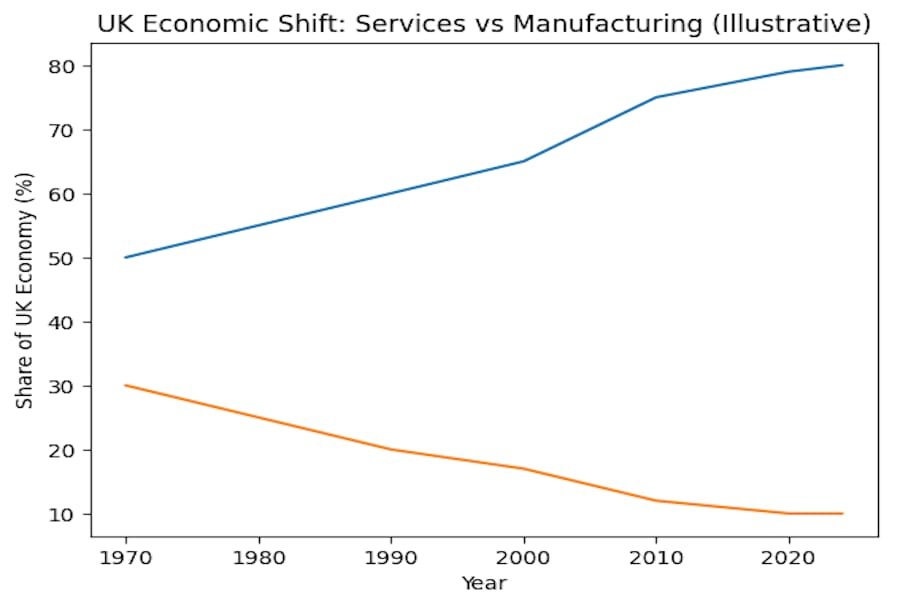
Note: Percentages are illustrative but reflect well-documented long-term trends reported by the Office for National Statistics and UK parliamentary research.
The UK has deliberately evolved into a service-based economy. Today, services account for roughly 80% of economic output.
At the same time:
- Energy-intensive industries such as chemicals, metals, and heavy manufacturing have declined
- High energy costs and climate-related levies have made domestic production less competitive
- Industrial capacity has eroded rather than diversified
This matters because AI thrives in service economies.
AI is exceptionally good at:
- Processing information
- Handling customer interactions
- Generating text, analysis, and recommendations
- Optimising administrative workflows
By contrast, physical manufacturing and industrial production are far less susceptible to rapid AI substitution.
By placing most of its economic weight in services, the UK has unintentionally maximised its exposure to AI-driven efficiency gains, and the employment disruption that follows.
This is not a failure of AI. It is the consequence of putting too many eggs in one economic basket.
Call Centres: A Case Study in Structural Vulnerability
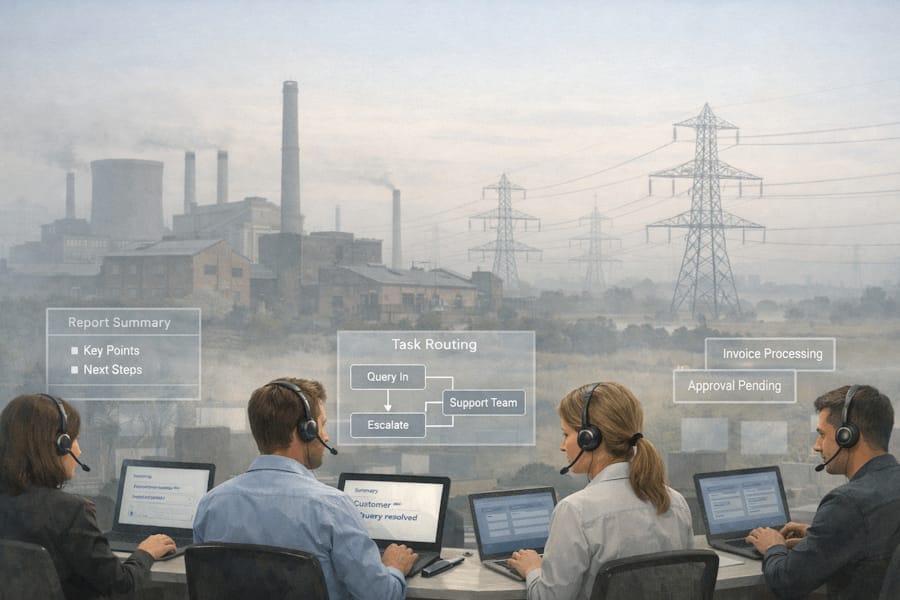
UK call centres illustrate this perfectly.
For decades, call centre jobs have:
- Been concentrated in the north of England, Scotland, and other post-industrial regions
- Provided service-sector employment after manufacturing decline
- Remained vulnerable to overseas outsourcing, particularly to India and the Philippines
AI does not change this dynamic, it intensifies it.
Modern AI systems can:
- Handle routine customer queries
- Route calls intelligently
- Narrow issues to specialist departments
- Reduce the need for large frontline teams
This does not eliminate human roles entirely, but it drastically reduces headcount requirements. Crucially, these jobs were already exposed to global competition long before AI entered the scene.
Blaming AI for call centre job losses ignores decades of structural vulnerability.
AI as a Convenient Scapegoat
The reason AI dominates the narrative is not because it is uniquely destructive, but because it is politically and commercially useful.
For industry:
- AI provides justification for removing remaining redundancy
- Cost-cutting decisions can be framed as technological inevitability
For government:
- AI offers a future-focused explanation for employment disruption
- Attention is diverted away from past policy decisions
- Structural issues can be reframed as unavoidable technological change
This framing avoids harder questions:
- Why energy costs became so uncompetitive
- Why industrial diversity was allowed to erode
- Why service-sector dependence increased risk
- Why career progression pathways narrowed
Conclusion: The Real Question We Should Be Asking
AI is not the architect of today’s employment challenges. It is the mirror reflecting them.
Businesses are under intense pressure to remove all redundancy from their operations due to rising costs that have little to do with artificial intelligence. Governments, meanwhile, find it easier to point to AI than to confront the long-term consequences of economic and industrial policies set in motion years, even decades, before AI became mainstream.
AI is a powerful tool. It will reshape work, accelerate efficiency, and change how value is created. But treating it as the primary villain allows both industry and government to avoid responsibility for deeper structural choices.
The real question is not whether AI will take jobs, but whether we are willing to address the economic foundations that made those jobs so fragile in the first place.

Latest AI Business Articles
Coding with Local AI vs Cloud AI
Cloud AI transformed the way I write software, but growing projects also brought growing concerns over usage limits. After a week...
If You Wanted to Start a Business in the UK Today… Were We Right?
Two years ago, we predicted the best businesses to start in the UK. Now it's time to hold those predictions accountable. Discover...

AI Range Anxiety: Will Rising AI Costs Slow Innovation?
Artificial intelligence has transformed the way developers, researchers and creators work. But as AI becomes an essential tool, a...

Are You in Charge of Your AI – Or Is AI in Charge of You?
Artificial Intelligence can improve efficiency and reduce costs, but are you still making the decisions? Discover how businesses...
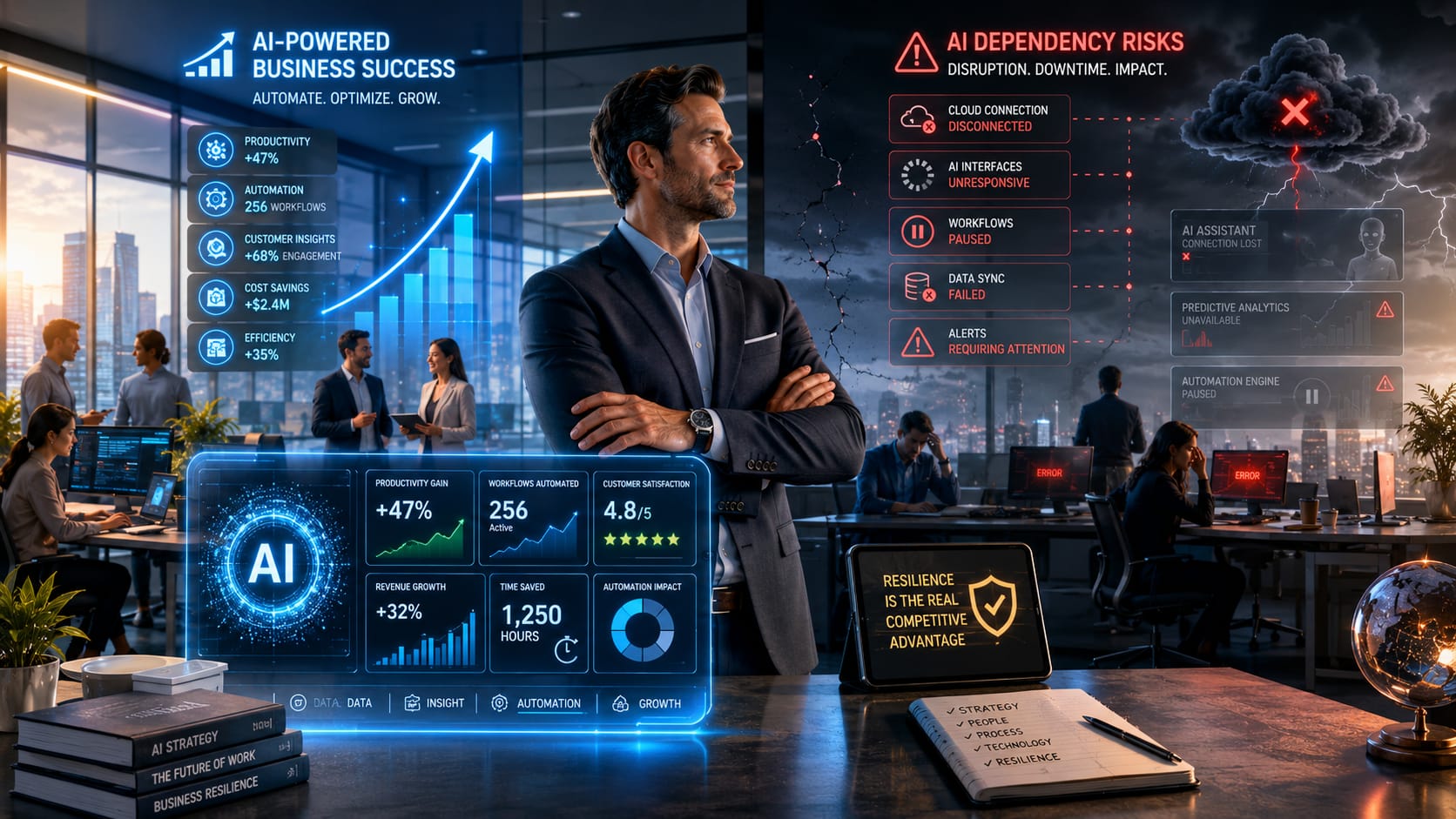
AI Can Transform Your Business – But What Happens When It Fails?
Artificial Intelligence can transform productivity, efficiency and customer service, but over-reliance creates new business risks....

The Invisible Battlefield: How AI Trading Bots Could Turn Geopolitical Conflict into Financial Shockwaves
AI trading bots now react to global news in milliseconds. During geopolitical crises, these automated systems can amplify market...

From Digital Currency to Volatility Engine: What Crypto Became in the Age of AI
Crypto began as a decentralised currency experiment. Today it functions as a high-volatility speculative market, now accelerated...

When AI Catches the Flu: Why Backup, Recovery, and Resilience Mean Something Different for Intelligent Systems
When AI replaces human systems, failure changes shape. This article explores what happens when AI “gets sick,” why it can’t be...

AI Questions and Answers section for AI, Jobs, and the Great Distraction: Why Artificial Intelligence Is Not the Root Cause of Today’s Employment Crisis
Welcome to a new feature where you can interact with our AI called Jeannie. You can ask her anything relating to this article. If this feature is available, you should see a small genie lamp above this text. Click on the lamp to start a chat or view the following questions that Jeannie has answered relating to AI, Jobs, and the Great Distraction: Why Artificial Intelligence Is Not the Root Cause of Today’s Employment Crisis.
Be the first to ask our Jeannie AI a question about this article
Look for the gold latern at the bottom right of your screen and click on it to enable Jeannie AI Chat.
Type: Article -> Category: AI Business