Type: Article -> Category: AI Business
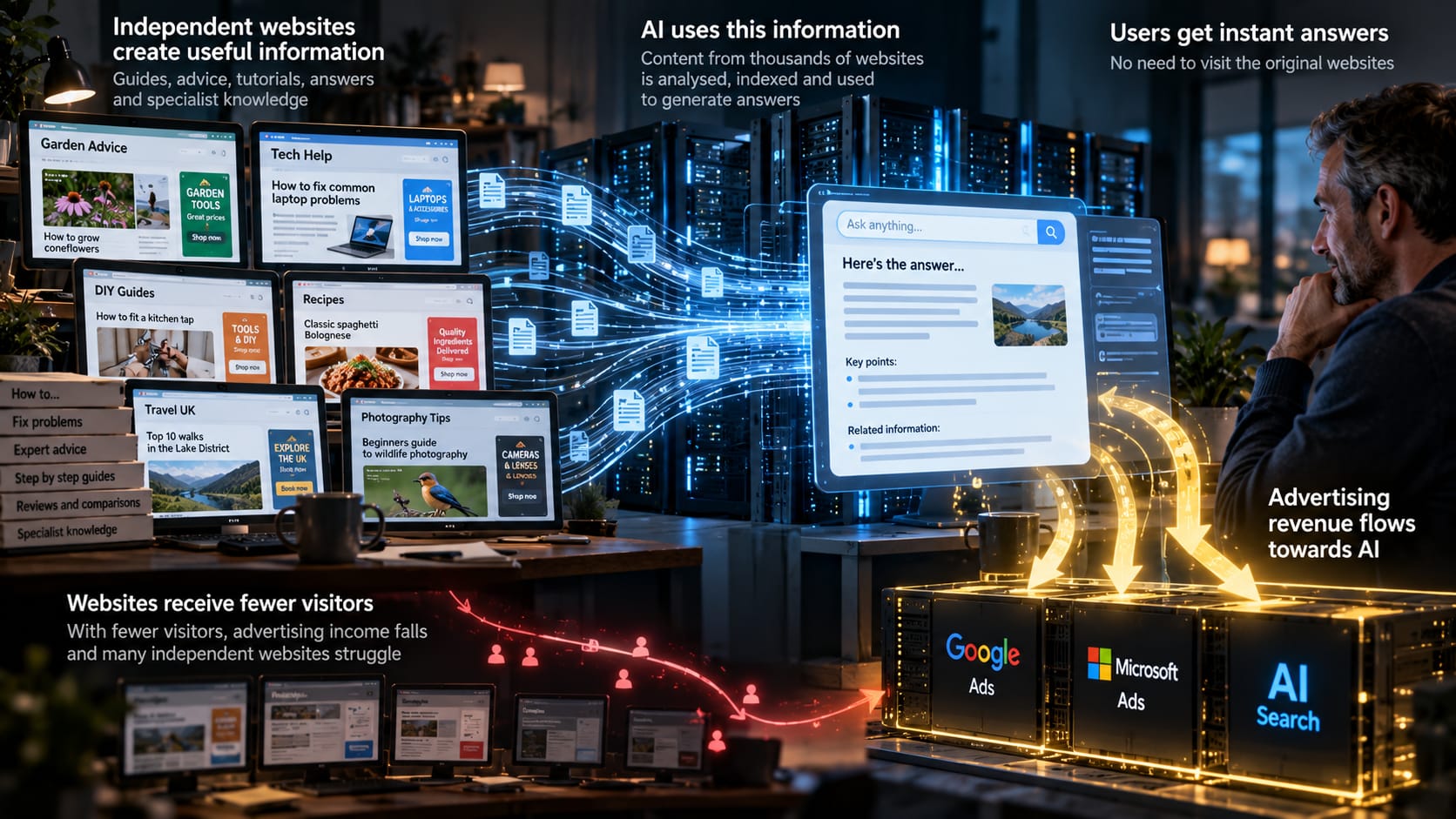
The AI Advertising Paradox
If AI Gives Us the Answer, Who Pays for the Website That Created It?
Don't have time to read the article? View as a short video storyboard or listen to it whilst jogging.
Publish Date: Last Updated: 25th September 2026
Author: nick smith- With the help of CHATGPT
There is something rather strange happening to the Internet.
For more than two decades, we have operated under a reasonably simple arrangement.
Someone creates a website. They spend time researching a subject, writing articles, answering questions, creating tutorials and keeping everything reasonably up to date.
Google indexes those pages.
Someone asks Google a question.
Google sends them to the website.
The visitor gets their answer, sees a few adverts along the way, and a tiny amount of advertising revenue goes to the website owner.
Nobody becomes a millionaire because you wanted to know why your washing machine is making a strange noise, but multiply those visits by hundreds of thousands or millions and suddenly there is enough money to pay writers, hosting bills, developers and researchers.
It wasn't a perfect system.
But it worked.
Now AI has arrived and quietly changed one very important part of the arrangement.
Increasingly, you don't have to visit the website at all.
And that creates what I think we should call the AI advertising paradox.
AI systems are becoming extraordinarily good at answering questions using information available across the web.
But much of that information exists because advertising pays for somebody to create it.
So what happens when AI provides the answer and removes the need to visit the website that helped provide it?
We may be building a system that consumes the very economic model responsible for producing the information it needs.

The Internet Was Never Really Free
We often talk about the Internet as though information magically appeared there.
It didn't.
Someone had to create it.
Consider a fairly ordinary information website.
Perhaps it contains thousands of articles about gardening.
Someone has written:
Why are the leaves on my tomato plants turning yellow?
Another article explains:
When should I prune an apple tree?
Another answers:
Why isn't my hydrangea flowering?
Those articles require knowledge, research, writing, editing, photographs, servers, software and maintenance.
Traditionally, the bargain was simple.
You didn't pay to read the article.
Advertisers did.
The website might earn only a fraction of a penny from your individual visit, but millions of visits made the business viable.
The same model supports enormous parts of the informational web: technology guides, recipes, DIY websites, travel information, motoring advice, hobby sites, news publishers and thousands of specialist websites answering obscure questions that somebody, somewhere, will eventually type into a search box.
Search engines were fundamental to that economy.
Google indexed the information and, in return, sent people to the people who created it.
Then AI changed the journey.
Ask the Question — "Don't Visit the Website"
Imagine searching:
Why are the leaves on my tomato plants turning yellow?
The traditional search engine might present ten links.
You choose one.
You visit GardeningExample.com.
You read the article.
The website displays advertising.
Everyone gets something from the transaction.
Now imagine an AI-powered search engine.
You ask exactly the same question.
Instead of merely showing you where the answer might be found, it gives you the answer.
Perhaps it explains that yellow leaves can result from overwatering, nutrient deficiencies, disease or natural ageing. It may provide several suggestions for identifying the cause.
Excellent.
You have your answer.
So why click anything?
That isn't hypothetical anymore.
A Pew Research Center study of browsing behaviour from 900 US adults examined nearly 69,000 Google searches. When an AI summary appeared, users clicked a traditional search result on 8% of visits, compared with 15% when there was no AI summary.
Even more strikingly, users clicked links contained within the AI summary itself on only 1% of visits.
Users were also more likely simply to end their browsing session after receiving an AI summary: 26%, compared with 16% following conventional search results.
In other words, AI search appears to be doing exactly what it was designed to do.
It is answering the question.
Unfortunately for the website owner, that may be precisely the problem.
Question-and-Answer Websites Are Particularly Exposed
Not every website faces the same threat.
If I search for a hotel, restaurant, new laptop or pair of shoes, at some point I probably still need to visit a website to do something.
Information is different.
If my entire objective is obtaining an answer, an AI system can potentially complete the transaction itself.
And research published in 2026 suggests this distinction matters.
Researchers Haofei Xu, Umar Iqbal and Jacob M. Montgomery examined 55,393 Google searches across 19 categories over a 40-day period.
Google AI Overviews appeared in 13.7% of queries overall.
But when the search was phrased as a question, that figure jumped to 64.7%.
That makes informational websites particularly interesting because their entire business model may have been built around answering exactly those kinds of questions.
The same research found that well over half of the pages cited by AI Overviews carried display advertising.
That creates an extraordinary situation.
The publisher produces the information.
The information contributes to an AI-generated answer.
The search user gets what they wanted without necessarily visiting the publisher.
The publisher therefore loses the opportunity to display the advertising that helped finance creation of the information in the first place.
Meanwhile, advertising can still appear on the search platform displaying the AI-generated answer.
And there lies the paradox.
Being Cited Isn't the Same as Being Paid
There is an obvious response to all of this.
AI systems can cite their sources.
And they should.
But economically, attribution and compensation are two completely different things.
Imagine that my gardening website is cited underneath an excellent AI explanation of yellow tomato leaves.
Wonderful.
Except the user already knows why their tomato leaves are yellow.
Why would they click?
The citation may establish where some of the information originated, but unless the user follows it, my website receives no page view.
No page view means no advertising impression.
No advertising impression means no advertising revenue.
You cannot pay a hosting bill with attribution.
The Crawling Bargain Is Changing Too
There is another side to this story.
Historically, website owners generally welcomed search-engine crawlers.
Googlebot arrived, downloaded your pages and indexed them.
In isolation that cost you bandwidth.
But the bargain was worthwhile because Google subsequently sent human visitors back.
AI systems complicate that exchange.
Cloudflare has been measuring the relationship between AI crawling and the referral traffic AI platforms send back to websites. Its research has highlighted a substantial imbalance between how frequently some AI systems retrieve publisher content and how frequently users subsequently arrive from those systems.
By July 2026, Cloudflare was arguing that the traditional economics of web publishing were undergoing a fundamental change. It reported that AI-training activity represented 52% of the AI crawler requests it measured in June 2026, up from 22% in spring 2025.
The problem isn't necessarily that an AI company accesses a page.
Search engines have been doing that for decades.
The important question is:
What does the publisher receive in return?
With conventional search the answer was traffic.
With AI, that answer is becoming considerably less obvious.
But AI Is Sending Some Traffic Back
There is an important counterargument.
AI referral traffic does exist, and it is growing.
People do follow citations from ChatGPT and other AI services. AI can introduce users to websites they might never have discovered through conventional search.
So it would be wrong to suggest that AI simply takes information and sends nothing back.
The emerging picture is more complicated.
AI referrals are increasing, while AI-generated answers can simultaneously reduce the need for users to visit external websites.
The relevant question for publishers therefore isn't simply:
"Does AI send traffic?"
It is:
"Does AI send enough valuable traffic to compensate for the traffic displaced by AI-generated answers?"
We don't yet have a universal answer.
And different types of websites will almost certainly experience very different outcomes.
This Isn't Just a Theory Anymore
One particularly interesting piece of research appeared in August 2026.
Stephanie T. Wang, Jeffrey Gleason, Yakov Bart, Christo Wilson and Danaé Metaxa conducted a preregistered field experiment involving 1,100 participants using Google Search.
Rather than simply observing correlations, they experimentally altered participants' exposure to Google's AI search features.
Removing AI Overviews and AI Mode increased click-through rates to publishers.
Conversely, an AI Mode-only search experience reduced publisher click-through.
That matters because it strengthens the argument that AI-generated search results aren't merely appearing alongside declining publisher traffic.
They can actually contribute to causing the reduction.
We should still be careful about translating reduced clicks directly into a particular percentage loss of advertising revenue. Websites have different audiences, advertising rates, business models and sources of traffic.
But for a website primarily financed by display advertising, the underlying arithmetic isn't particularly complicated.
Fewer human visits mean fewer adverts displayed.
Fewer adverts displayed generally means less advertising revenue.
The Really Interesting Part Comes Next
Suppose this trend continues.
Our imaginary gardening website once received five million visitors a year.
AI search gradually answers more of the simple questions that previously generated those visits.
Traffic falls.
Advertising revenue falls.
Eventually the owner has decisions to make.
- Fewer articles.
- Stop updating old ones.
- They reduce the number of specialist writers they employ.
- They introduce a subscription.
- They block AI crawlers.
- They fill the site with affiliate links and sponsored products instead.
- Or perhaps they simply close it.
Multiply that decision across thousands of specialist publishers and we arrive at a much bigger question.
Where does tomorrow's information come from?

AI Cannot Eat Yesterday's Internet Forever
AI systems have an enormous amount of existing human knowledge available to them.
But knowledge doesn't stand still.
- Software changes.
- Laws change.
- Products change.
- Scientific understanding develops.
- Businesses open and close.
- Prices change.
- Diseases spread.
- Technology advances.
- People discover better ways of doing things.
- Someone needs to document those changes.
AI can certainly help create and organise that information, but ultimately much fresh information originates because somebody investigates something, experiences something, tests something, measures something or reports something.
That activity costs money.
And this is where the advertising paradox becomes potentially serious.
If AI becomes increasingly effective at intercepting the economic value generated by informational content while continuing to depend upon that content, we could create a feedback loop:
Publishers create useful information.
↓
Advertising finances its creation.
↓
AI systems discover and synthesise the information.
↓
Users receive answers without visiting publishers.
↓
Publisher traffic declines.
↓
Advertising revenue declines.
↓
Less money is available to produce new information.
↓
The information ecosystem AI depends upon becomes poorer.
That would be bad for publishers.
Eventually, it could also be bad for AI.
Perhaps Advertising Isn't the Real Problem
There is another way of looking at this.
Perhaps AI hasn't broken the Internet's advertising model.
Perhaps it has simply exposed how fragile that model always was.
We built an enormous information economy where people expected almost everything to be free.
The compromise was advertising.
Publishers received money for attention.
Search engines received money for attention.
Social networks received money for attention.
Everyone competed for clicks.
AI potentially removes the click.
That may force us to reconsider how information itself is valued.
Perhaps AI companies will
- license content.
- Use automated micropayments will emerge when AI systems use publisher material.
- Will be charged to crawl websites.
- Force specialist information to increasingly move behind subscriptions.
- Or maybe AI referrals will eventually become valuable enough to establish a new equilibrium.
Cloudflare and others are already experimenting with technologies intended to give publishers greater control over AI crawling and potentially allow compensation for content access.
The business model isn't necessarily doomed.
But it may need to change.
And There Is One More Awkward Detail
Advertising isn't disappearing from this new world.
Quite the opposite.
AI companies and search engines are experimenting with ways of placing advertising around AI-generated experiences.
Which creates perhaps the strangest version of the paradox.
Imagine:
Website A pays researchers and writers to produce useful information.
An AI search system uses information from Website A to help construct an answer.
The user reads the answer without visiting Website A.
Website A therefore displays no advertisement and earns nothing from that user.
But the AI platform displays an advertisement alongside its answer.
The advertising hasn't vanished.
It has moved.
And potentially so has the revenue.
That may become one of the most important economic questions surrounding AI search.
Not whether advertising survives.
But who gets paid for the information that makes the advertising valuable?
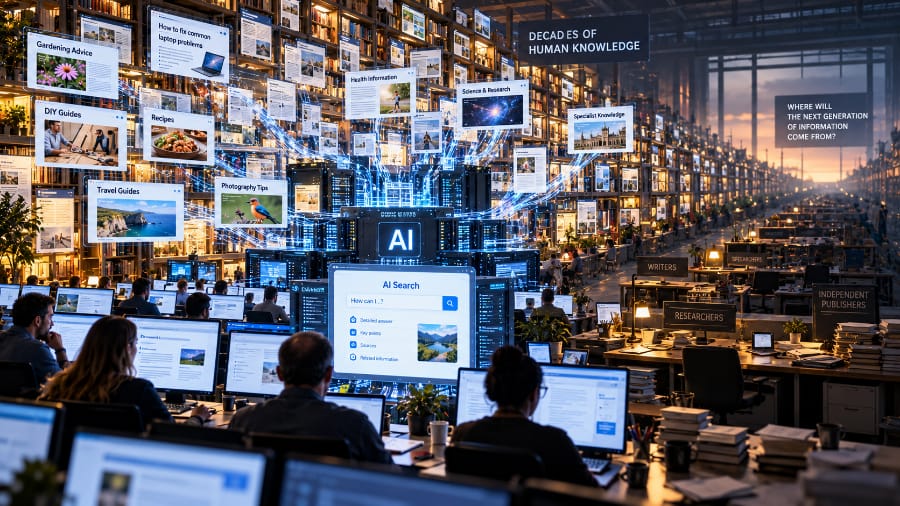
The Internet Needs an Incentive to Know Things
There is a temptation to frame this debate as publishers versus AI companies.
I don't think that's particularly helpful.
AI search is useful.
Being able to ask a complicated question and receive a clear, synthesised answer is a genuine improvement over opening fifteen browser tabs and attempting to work out which website actually knows what it is talking about.
I use AI for exactly that reason.
But useful technology still needs a sustainable information ecosystem underneath it.
The open web became extraordinarily valuable because millions of people had reasons to contribute knowledge to it.
Some did it for:-
- Fun.
- Reputation.
- To promote businesses.
- Universities, governments and charities.
- And many did it because advertising made publishing useful information commercially viable.
If AI changes that incentive, something eventually has to replace it.
Because an AI system capable of answering every question is enormously useful.
But only while somebody, somewhere, still has a reason to discover the answers.
And that is the AI advertising paradox.
If AI gives us the answer, who pays for the website that created it?
Latest AI Business Articles
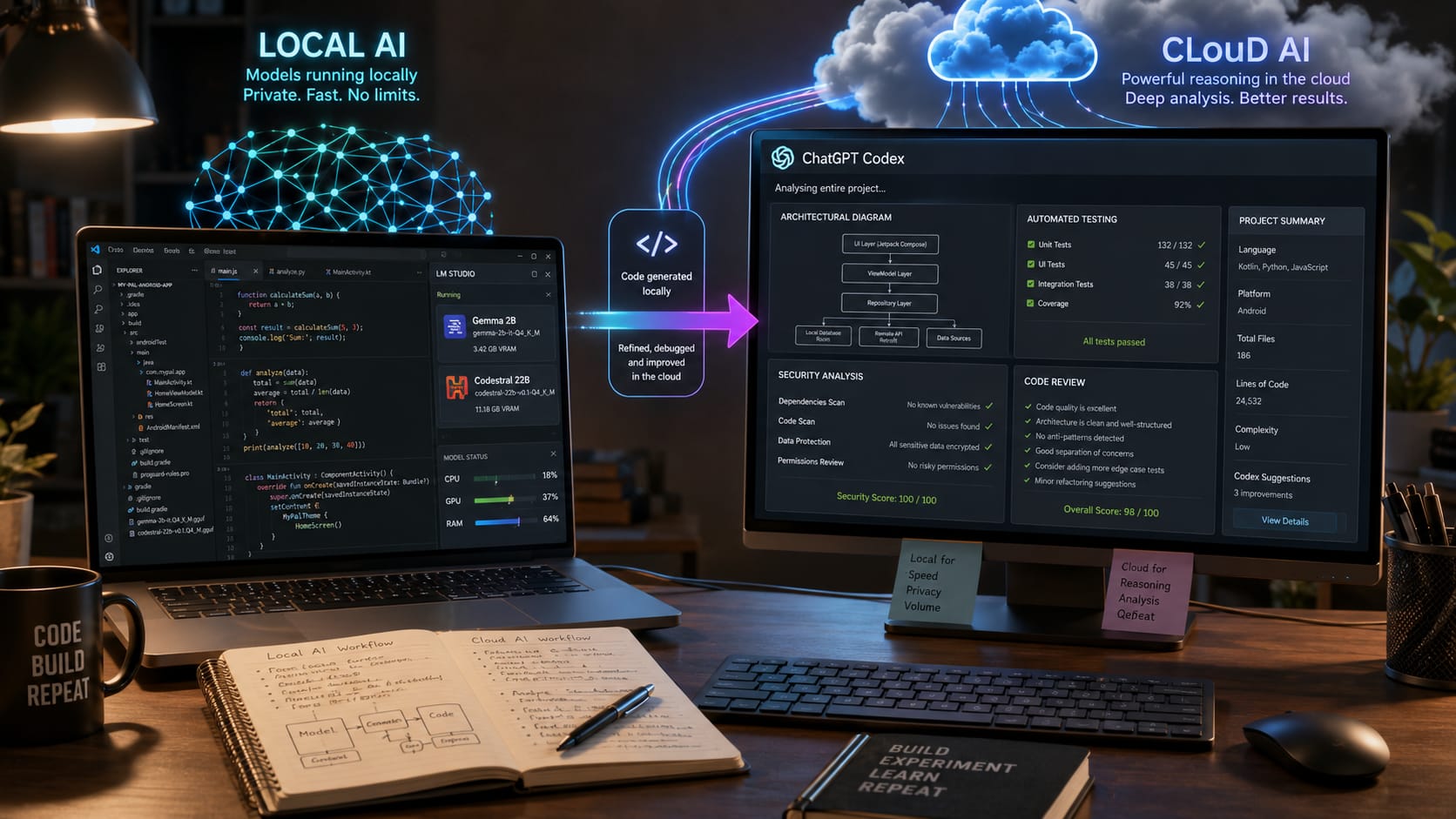
Coding with Local AI vs Cloud AI
Cloud AI transformed the way I write software, but growing projects also brought growing concerns over usage limits. After a week...
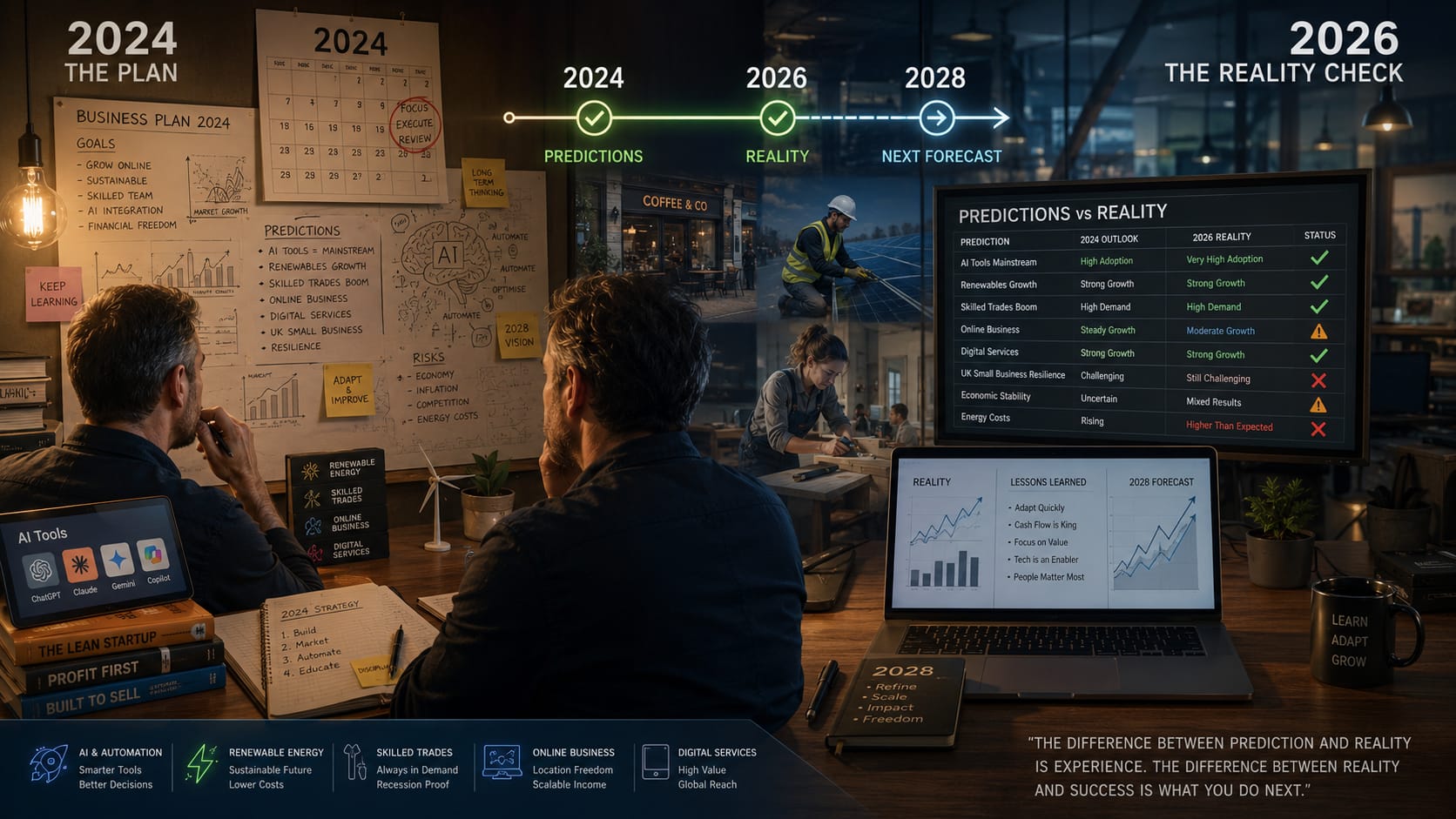
If You Wanted to Start a Business in the UK Today… Were We Right?
Two years ago, we predicted the best businesses to start in the UK. Now it's time to hold those predictions accountable. Discover...

AI Range Anxiety: Will Rising AI Costs Slow Innovation?
Artificial intelligence has transformed the way developers, researchers and creators work. But as AI becomes an essential tool, a...

Are You in Charge of Your AI – Or Is AI in Charge of You?
Artificial Intelligence can improve efficiency and reduce costs, but are you still making the decisions? Discover how businesses...

AI Questions and Answers section for The AI Advertising Paradox
Welcome to a new feature where you can interact with our AI called Jeannie. You can ask her anything relating to this article. If this feature is available, you should see a small genie lamp above this text. Click on the lamp to start a chat or view the following questions that Jeannie has answered relating to The AI Advertising Paradox.
Be the first to ask our Jeannie AI a question about this article
Look for the gold latern at the bottom right of your screen and click on it to enable Jeannie AI Chat.
Type: Article -> Category: AI Business