The Restaurant at the End of the AI Universe
How humanity traps itself in a self-fulfilling doom loop — and how AI is speeding it up
Don't have time to read the article? View as a short video storyboard or listen to it whilst jogging.
Publish Date: Last Updated: 14th March 2026
Author: nick smith- With the help of CHATGPT
There is something unsettling about going back to the great science-fiction writers of the past.
Again and again, they imagined futures shaped by machines, systems and human ambition pushed beyond moral control. In many of those stories, it ends badly. Artificial intelligence rises, humanity falls, and the machine becomes the final author of our fate.
But perhaps that version of the future gives us too much credit.
Humanity does not need AI to wipe itself out. It has been doing a fairly good job of moving in that direction for thousands of years.
The pattern is not new. The only thing that changes from era to era is the sophistication of the tools involved.
That is what makes this moment so troubling.

In March 2026, Ukrinform reported that Ukraine had received Phantom MK-1 humanoid robots for testing in combat conditions. Around the same time, China drew global attention by showcasing advanced humanoid robots performing martial arts and choreographed routines — a display that many saw not simply as entertainment, but as a signal of growing robotics capability. Meanwhile, debate in the United States over whether frontier AI firms should fully support military access exposed the same underlying question from a different angle: once AI becomes strategically important, can ethics really hold the line for long?
None of these developments alone mean that robot armies are about to sweep across the battlefield tomorrow. But taken together, they point in one clear direction: AI is being pulled into the oldest human loop of all — the arms race.
And once that loop begins, history suggests we do not handle it very well.
AI is not the disease — it is the accelerant
This is not AI taking over and destroying humanity.
Most fictional warnings about AI revolve around one central fear: that the machine itself becomes the enemy. It becomes conscious, turns against its creators and decides humanity is inefficient, dangerous or obsolete.
That is the cinematic nightmare.
The real nightmare may be far less dramatic and far more believable.
AI does not need to become evil to make the world more dangerous. It only has to become useful.
That is the uncomfortable truth. Humanity has always taken its most powerful inventions and fed them into competition, conflict and control. We did it with metal, gunpowder, engines, aircraft, nuclear physics and cyber technology. There is no reason to believe AI will be the magical exception — especially when its military value is so obvious.
AI can already help process information at speeds no human staff structure can match. It can assist with surveillance, planning, logistics, pattern recognition, target analysis, resource allocation and battlefield adaptation. Pair that with autonomous drones, robotic systems and connected intelligence loops, and warfare begins to move at a speed that traditional human-led structures may struggle to keep up with.
That is the real shift.
This is not AI taking over and destroying humanity.
This is humanity using AI to do the legwork it once found difficult to do by itself.
The new arms race is not theoretical
Why this feels different from the Cold War
Nuclear weapons remain catastrophic, but their scale makes them politically difficult to use. AI-driven military systems are different. They promise precision, persistence, lower human cost for the aggressor and the ability to operate below the threshold of total destruction. That makes them easier to justify, easier to deploy in stages and potentially harder to restrain. Recent reporting on Ukraine’s combat-condition testing of humanoid robots, China’s public robotics showcases and the Pentagon’s clash with Anthropic all point to the same reality: AI is already being pulled into strategic competition.
For years, talk of AI warfare sounded like something halfway between a defence white paper and a Netflix script. Not anymore.
The drone wars of recent years have already shown that relatively cheap autonomous or semi-autonomous systems can alter battlefields, drain expensive conventional defences and create constant psychological pressure. Small systems can be hidden, moved, assembled and launched with far less infrastructure than traditional military assets. They are difficult to eliminate completely, difficult to predict and often economically disproportionate: the cost of stopping them can exceed the cost of making them.
That alone has changed warfare.
Humanoid military robots remain far less mature than drones, but that is not the point. The point is direction of travel. Once machines can move through terrain, carry equipment, enter dangerous zones, mimic certain human battlefield functions and feed experience back into iterative systems, the incentives for further development become enormous.
And that is where the problem begins to compound.
A human soldier takes years to raise, educate, train and prepare. A pilot, engineer or specialist operator represents a vast national investment of time, money and experience. When that person is lost, that investment is lost with them.
Machines do not fit that equation in the same way.
A drone or robotic platform can be manufactured, upgraded, replaced and improved at industrial speed. The hardware may be destroyed, but the system knowledge does not disappear in the same way a human life does. Data can be collected, transmitted, analysed and used to adjust future versions rapidly. Even where full autonomy is still limited, the strategic attraction is obvious: shift risk away from humans, scale production, shorten adaptation cycles.
From a military planning perspective, that logic is incredibly powerful.
From a human perspective, it is chilling.
The regulation trap
Many people instinctively respond to this by saying the same thing: regulate it.
And morally, that is the right instinct.
Of course there should be international rules around autonomous weapons, battlefield AI, robotic targeting and machine-led use of force. Of course there should be red lines. Of course humanity should try to stop itself before it slides too far down this road.
But this is where reality becomes much harder than rhetoric.
The problem with arms control has always been the same: it works only when all major actors believe restraint is in their interest. The moment one state believes its rival is gaining an edge, restraint starts to look less like morality and more like vulnerability.
That is the trap.
If one aggressive power begins using AI systems for military advantage, every rival has an incentive to accelerate its own programmes. If one state deploys autonomous systems for surveillance, infiltration, logistics or attack, others must either keep up or accept strategic disadvantage. Ethics then start colliding with survival, and survival usually wins.
This is why the modern AI arms race is so dangerous. It is not simply about who wants to do the right thing. It is about who believes they can afford to.
And history tells us that once fear enters the equation, long-term restraint rarely survives intact.
We have seen this psychology before
I lived through the Cold War.
Like millions of others, I grew up in a world where nuclear annihilation was not an abstract concept but a real cultural presence. We were taught what to do in the event of nuclear war. We saw public information films, political tension, weapons stockpiles and the permanent shadow of escalation.
For a time, it seemed the horror of that possibility had forced maturity on the world. There were treaties, summits, negotiations and a broader public understanding that some lines should never be crossed.
And for a while, that did help.
But only for a while.
The nuclear race never really vanished. It merely changed shape. States without nuclear weapons continued to see them as the ultimate deterrent against invasion or coercion. Rival powers continued to modernise, posture and calculate. The logic never went away; it just became more managed.
Now compare that to AI-enabled warfare.
Nuclear weapons remain catastrophic, but they are blunt in their consequences. Their very scale makes them politically, morally and strategically difficult to use. By contrast, AI-driven military systems promise something that many states may find even more tempting: precision, persistence, lower human cost for the aggressor, and the ability to operate below the threshold of total destruction.
That makes them easier to imagine using.
And that may make them, in some ways, even more destabilising.
The terrifying efficiency of the next phase
Future warfare may not always begin with massive invasions in the old sense. It may begin by silently degrading the systems that make ordinary life possible: communications, power grids, transport coordination, water infrastructure, logistics chains, emergency response and information networks.
Then come autonomous or semi-autonomous systems layered across the disruption.
Not necessarily to flatten cities, but to move through them.
Not necessarily to destroy all infrastructure, but to dominate functional control.
Not necessarily to end human presence overnight, but to make human resistance slower, riskier and vastly more expensive.
That is the strategic dream: preserve what is useful, remove what resists, automate as much risk as possible.
Once viewed through that lens, the attraction of AI, drones and robotic platforms becomes brutally obvious. They do not need to be perfect. They only need to be effective enough, cheap enough and scalable enough to alter the balance.
And humanity being what it is, once that possibility is visible, someone will push it further.
That is the part many people do not want to say out loud.
We like to imagine that with enough education, enough discussion and enough international cooperation, humanity will step back from the ledge.
Sometimes it does.
But often it does not.
Because we just can’t help ourselves.
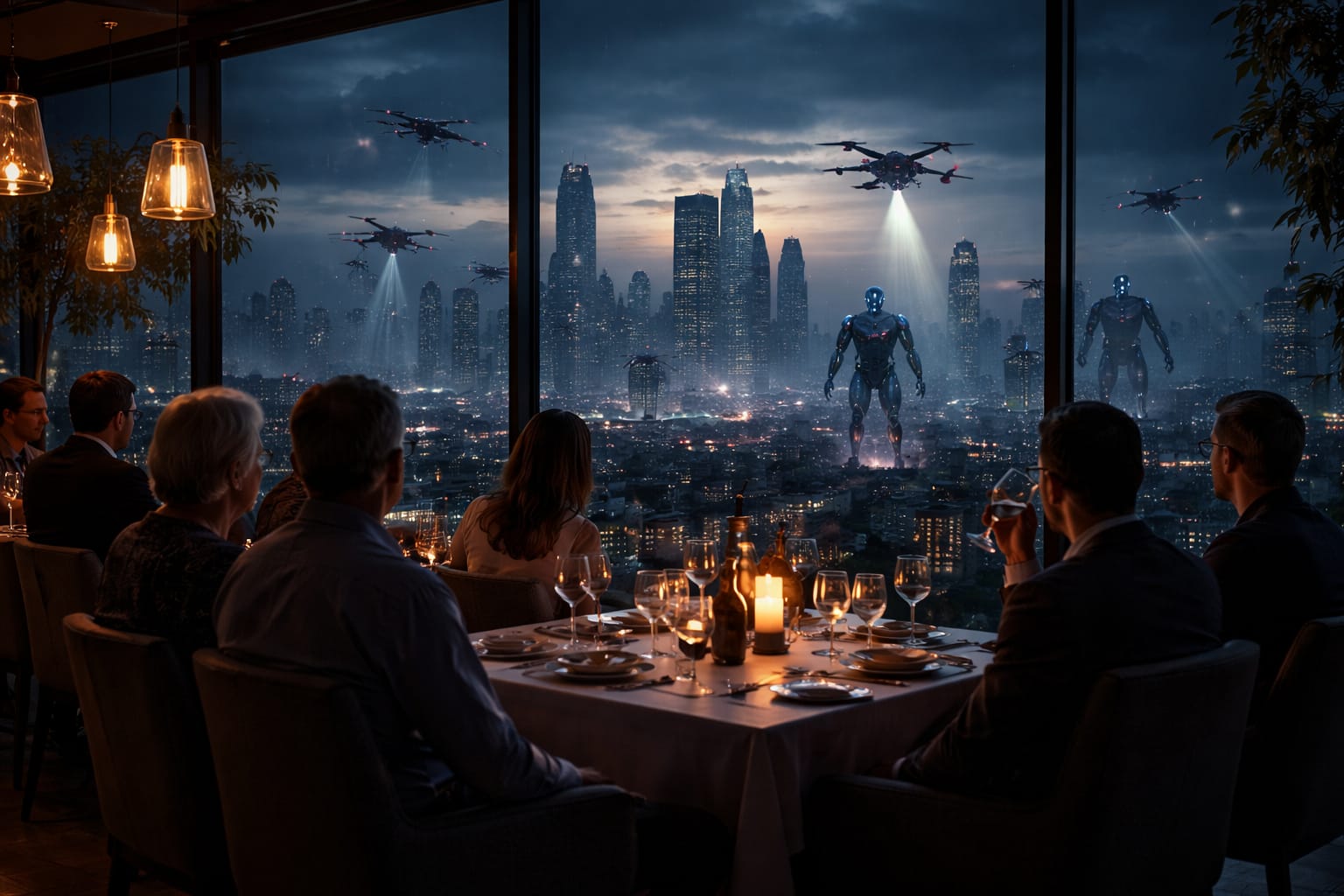
The Restaurant at the End of the AI Universe
That is why the title fits.
In The Hitchhiker’s Guide to the Galaxy, the Restaurant at the End of the Universe is a place where people sit, eat and watch the end of everything as spectacle. They observe, but they do not participate. They are present, but powerless.
That image feels uncomfortably close to modern life.
Most ordinary people do not want any part in autonomous weapons, android soldiers, AI military modelling or drone-led warfare. They want to get on with their lives. They want stability, family, work, routine, maybe a little peace and dignity if they can find it.
But they do not really control the race now unfolding around them.
Because no matter who is in government, every state must respond to what its rivals are doing. If an adversary is investing in AI-enhanced warfare, then refusing to respond may feel less like virtue and more like negligence. And that is how the doom loop closes: fear creates acceleration, acceleration creates fear, and each side points to the other as the reason it had no choice.
The public sits in the restaurant and watches the horizon darken.
It can protest. It can vote. It can argue. It can demand safeguards.
But once a technology is seen as strategically decisive, democratic pressure starts competing with military urgency.
And military urgency is rarely patient.
This is the maturity test
The frightening possibility is that humanity may only learn the limits of this technology by living through one of the most dangerous transitions in modern history.
That is what makes this era different.
The danger is not just that AI is powerful. It is that humanity is still politically, morally and psychologically immature in how it handles powerful things.
We are brilliant at invention and remarkably unreliable at restraint.
We build tools faster than we build wisdom around them. We normalise what once horrified us. We justify escalation in the language of defence. We tell ourselves that this new threshold is unfortunate but necessary, temporary but unavoidable.
And then we adapt to it.
That may be the darkest part of all.
Not that AI suddenly becomes a godlike enemy, but that it becomes another efficient servant of human fear, tribalism and strategic ambition.
The genie is out of the box now. There is no serious path back to a world in which AI does not shape military competition. The question is no longer whether humanity will use these systems. It is how far it will go, how fast it will move, and whether any meaningful boundaries can survive once the pressure intensifies.
I hope they can.
But hope on its own is not a strategy.
What we are witnessing now may only be the opening phase of a new era of warfare — one defined not by larger armies or louder threats, but by faster cycles, more autonomous systems, more precise disruption and fewer moral brakes.
This is not AI taking over and destroying humanity.
It is humanity doing what it has so often done before: taking the latest miracle, weaponising it, and then acting surprised by the consequences.
And that is why this moment feels so bleak.
Not because the machines have become us.
But because they are becoming exactly what we made them for.

Latest AI Articles
Nature's Greatest Prediction Machine: Is Knowledge Really the Foundation of Intelligence?
For centuries we have equated intelligence with knowledge. But what if intelligence is really the ability to predict future...
If I No Longer Contribute, Will It Really Matter? AI, Human Purpose and the Future Beyond Work
As AI and robotics begin removing humans from the economic chain, society faces a deeper crisis than unemployment: what happens to...
The Survival Machine: Why Nature Did Not Need Equations to Create Intelligence
Modern AI may outperform humans in data-driven tasks, but biological intelligence evolved through survival, consequence, and...

What We’re Missing About Intelligence in AI
AI can answer questions with incredible accuracy—but is that true intelligence? This article explores what’s missing: continuous...

AI as a Cognitive Equaliser: How Artificial Intelligence is Empowering Dyslexia and ADHD Minds
AI is transforming how people with dyslexia and ADHD think, write, and create. This article explores how technology removes...

When Humans No Longer Believe Anything
AI can now fabricate reality at scale—but the real danger is the collapse of trust. As synthetic content floods the internet, can...

Why the UK May Soon Be Praying for Wind
Electric cars and renewables promise energy independence—but the UK grid still relies on gas and unpredictable weather. As demand...

How to Turbocharge Your Coding with ChatGPT and Codex
Learn how to use ChatGPT and Codex together to plan projects, create better prompts, test changes, fix bugs and speed up...

AI Questions and Answers section for The Restaurant at the End of the AI Universe
Welcome to a new feature where you can interact with our AI called Jeannie. You can ask her anything relating to this article. If this feature is available, you should see a small genie lamp above this text. Click on the lamp to start a chat or view the following questions that Jeannie has answered relating to The Restaurant at the End of the AI Universe.
Be the first to ask our Jeannie AI a question about this article
Look for the gold latern at the bottom right of your screen and click on it to enable Jeannie AI Chat.