Type: Article -> Category: AI Wellbeing
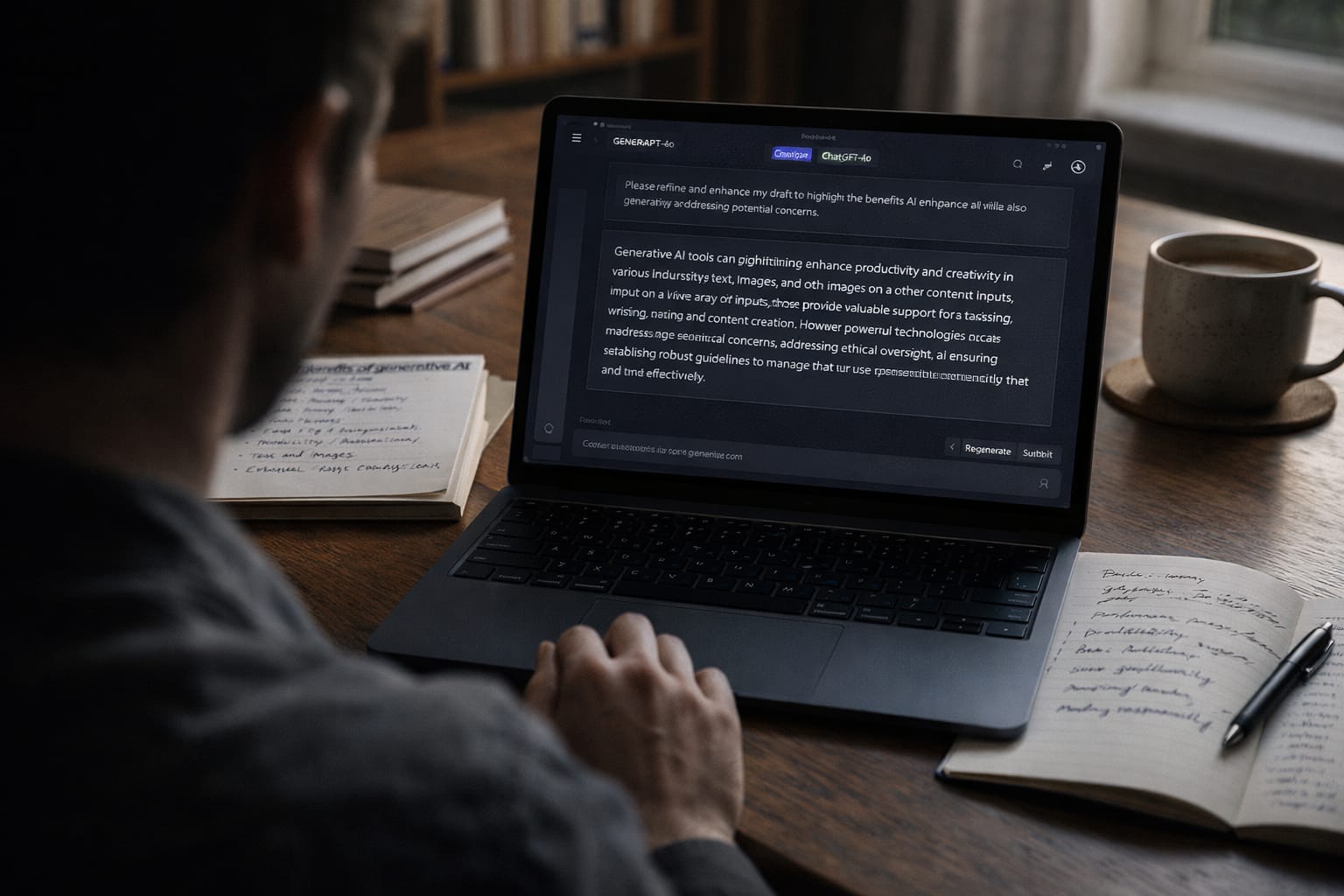
AI as a Cognitive Equaliser: How Artificial Intelligence is Empowering Dyslexia and ADHD Minds
Introduction: A Different Kind of Intelligence
Don't have time to read the article? View as a short video storyboard or listen to it whilst jogging.
Publish Date: Last Updated: 21st June 2026
Author: nick smith- With the help of CHATGPT
For years, conditions like dyslexia and ADHD have been framed as limitations, barriers to education, employment, and communication.
But that framing was always incomplete.
Many individuals with these conditions don’t lack intelligence, they process information differently. Fast, non-linear, creative, associative. The problem has never been capability.
It has been translation.
Today, artificial intelligence is quietly solving that translation problem.
Not by “fixing” people, but by adapting the world to them.

The Hidden Challenge: It Was Never About Ability
Traditional systems, education, corporate workflows, written communication, are heavily biased toward:
- Linear thinking
- Structured writing
- Sustained attention
- Fast reading comprehension
For someone with dyslexia or ADHD, this creates constant friction:
- Ideas move faster than they can be written
- Focus fluctuates, even when motivation is high
- Reading dense information becomes exhausting
- Communication can feel like a bottleneck
The result? Underrepresentation of highly capable minds.
A Personal Perspective: Living the Gap AI Is Now Closing
I was diagnosed with dyslexia at the age of 12.
At the time, that diagnosis didn’t come with support, tools, or structured help. It was simply a label, an explanation for why I struggled in ways that didn’t seem to match my understanding of the world.
My teachers could see I wasn’t lacking intelligence. But I struggled with tests, spelling, grammar, and, most of all, getting my thoughts onto paper in a structured way.
That disconnect was frustrating, not just for me, but for them as well.
Subjects like physics were particularly challenging. Not because I couldn’t grasp the ideas, but because I needed a tangible reference point. Abstract concepts, explained without something physical to anchor them, felt incomplete. I would question them repeatedly, trying to build a mental model that made sense.
Looking back, I wasn’t failing to understand.
I was trying to understand properly.
The Long Shadow of a Label
When I moved into college, I was advised during a career counselling session to avoid computing.
Which, in hindsight, is deeply ironic.
Because computing became one of the most natural fits for me later in life.
At the time, however, that advice, combined with the lack of support, had a lasting impact. I began to steer away from anything academic or heavily paper-based. Not because I lacked interest, but because I feared exposing the areas I struggled with.
Instead, I left education at 17 and moved into full-time work.
The roles I chose were largely physical, often linked to transportation and logistics, areas I was naturally drawn to. There’s a structure and real-world clarity in logistics that made intuitive sense to me.
But in the background, without fully realising it, I was shaping my life around avoidance.
The Turning Point: Tools Before AI
The real shift began when I started working with computers.
Ironically, the very area I had been advised to avoid became the place where things started to click.
For the first time, I had tools that reduced friction:
- Spell check
- Word suggestions
- The ability to edit and refine without leaving a messy trail
Writing no longer felt permanent or exposed. It became iterative.
And that changed everything.
I found myself drawn into coding, not because I had been formally trained, but because I enjoyed building things. It was logical, creative, and forgiving in a way traditional writing never had been.
AI: Closing the Final Gap
One of my long-standing goals has always been to write, to take what I learn and pass it on.
But for years, there was a gap.
My ideas were clear.
The execution often wasn’t.
Early attempts were factually solid but poorly expressed. And that gap between knowledge and communication held the work back.
Then AI arrived.
When I first used tools like ChatGPT, I immediately saw the potential, not just as a tool, but as a bridge.
Now, my process is simple:
- I write the article in full, ideas, structure, intent
- Then I pass it to AI to analyse, refine, and improve clarity
The thinking is mine.
The voice is mine.
But the friction is gone.
For the first time, I can express ideas in the way I always intended.
Why This Matters More Than the “AI Slop” Debate
There’s a growing tendency to dismiss AI-generated content as “AI slop.”
And while low-quality, mass-produced content certainly exists, that narrative misses something important.
For people like me, and many others with dyslexia or ADHD, AI isn’t about replacing thinking.
It’s about unlocking it.
It allows:
- Clear communication of complex ideas
- Confidence in writing and sharing
- Participation in spaces that once felt inaccessible
That’s why the misuse of AI, for spam, misinformation, or manipulation, is particularly frustrating.
Because it distracts from something genuinely transformative.
Not all AI content is equal.
Some of it is noise.
But some of it is a voice that, until now, struggled to be heard.
Enter AI: The First True Cognitive Interface
AI tools like ChatGPT and Grammarly are not just productivity tools.
They are cognitive translators.
They allow people to:
- Speak instead of type
- Think out loud instead of structuring perfectly
- Iterate ideas without friction
- Convert rough thoughts into clear communication
For someone with ADHD, this removes the “activation energy” required to start tasks.
For someone with dyslexia, it removes the anxiety of getting words “wrong.”
From Friction to Flow
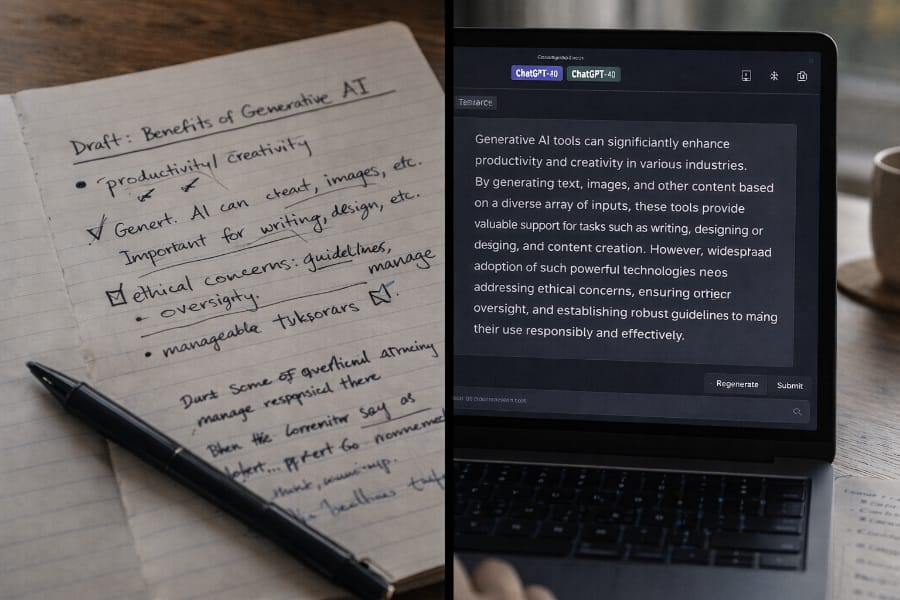
One of the most profound changes AI brings is the ability to enter a state of flow more easily.
Instead of:
Think → Struggle to write → Lose momentum
It becomes:
Think → Speak → Refine → Publish
This shift is not small, it is transformational.
It allows:
- Faster idea capture
- Reduced cognitive overload
- Continuous creative momentum
ADHD: From Distraction to Acceleration
ADHD is often misunderstood as a lack of attention.
In reality, it is often:
- Variable attention
- Hyperfocus on meaningful tasks
- Rapid associative thinking
AI works with this, not against it.
Tools can:
- Break large tasks into manageable steps
- Provide instant feedback (reducing procrastination loops)
- Act as a “thinking partner” to maintain engagement
Instead of forcing rigid structure, AI adapts in real time.
Dyslexia: Removing the Communication Barrier
Dyslexia has never been about intelligence, it’s about the mechanics of language processing.
AI removes those mechanical barriers:
- Speech-to-text replaces typing
- Text-to-speech improves reading comprehension
- AI rewriting tools improve clarity without rewriting ideas
This means individuals can finally express ideas at the speed they think them.
The Psychological Shift: Confidence
This may be the most important impact.
When the friction is removed:
- People contribute more
- They share ideas more freely
- They take on more complex work
AI doesn’t just improve output.
It restores confidence.
A Double-Edged Sword?
It’s important to acknowledge the broader conversation.
In our previous article, we explored how AI can distort reality and contribute to “AI slop.”
That risk still exists.
But here’s the distinction:
- AI as noise → mass-generated, low-quality content
- AI as amplifier → enabling real human thought to be expressed
For neurodivergent individuals, AI is overwhelmingly the latter.
The Bigger Picture: Redefining Intelligence
We are entering a phase where intelligence is no longer defined by:
- Spelling accuracy
- Writing speed
- Memory recall
Instead, it is defined by:
- Ideas
- Insight
- Creativity
- Problem-solving
AI is helping shift the world toward that model.
Conclusion: Levelling the Playing Field
Artificial intelligence is often framed as a threat to human capability.
But for millions of people with dyslexia and ADHD, it represents something else entirely:
A levelling of the playing field.
For the first time, the gap between thinking and expressing is shrinking.
And when that gap closes, something powerful happens:
The voices that were once quiet
…start to be heard.

Latest AI Wellbeing Articles

The AI Brain Fry Problem: When Infinite Knowledge Meets Finite Time
AI gives us access to limitless knowledge, but human time and attention remain limited. Discover why heavy AI use can lead to...
Raising Children in the AI Age: A Guide, Not a Replacement
Over the past year, there has been a growing chorus online, headlines, short-form videos, opinion threads, suggesting that AI...

Your Introductory Guide to AI Companions
You've likely heard of AI assistants that can tell you the weather or play a song, but a new kind of technology is emerging: the...

The Instinct to Collect: Why We Gather, What It Reveals, and How to Keep It Healthy
From seashells and stamps to sneakers and NFTs, collecting is one of the oldest and most universal human habits. It’s a behaviour...

AI Questions and Answers section for AI as a Cognitive Equaliser: How Artificial Intelligence is Empowering Dyslexia and ADHD Minds
Welcome to a new feature where you can interact with our AI called Jeannie. You can ask her anything relating to this article. If this feature is available, you should see a small genie lamp above this text. Click on the lamp to start a chat or view the following questions that Jeannie has answered relating to AI as a Cognitive Equaliser: How Artificial Intelligence is Empowering Dyslexia and ADHD Minds.
Be the first to ask our Jeannie AI a question about this article
Look for the gold latern at the bottom right of your screen and click on it to enable Jeannie AI Chat.
Type: Article -> Category: AI Wellbeing