Type: Article -> Category: UK Politics
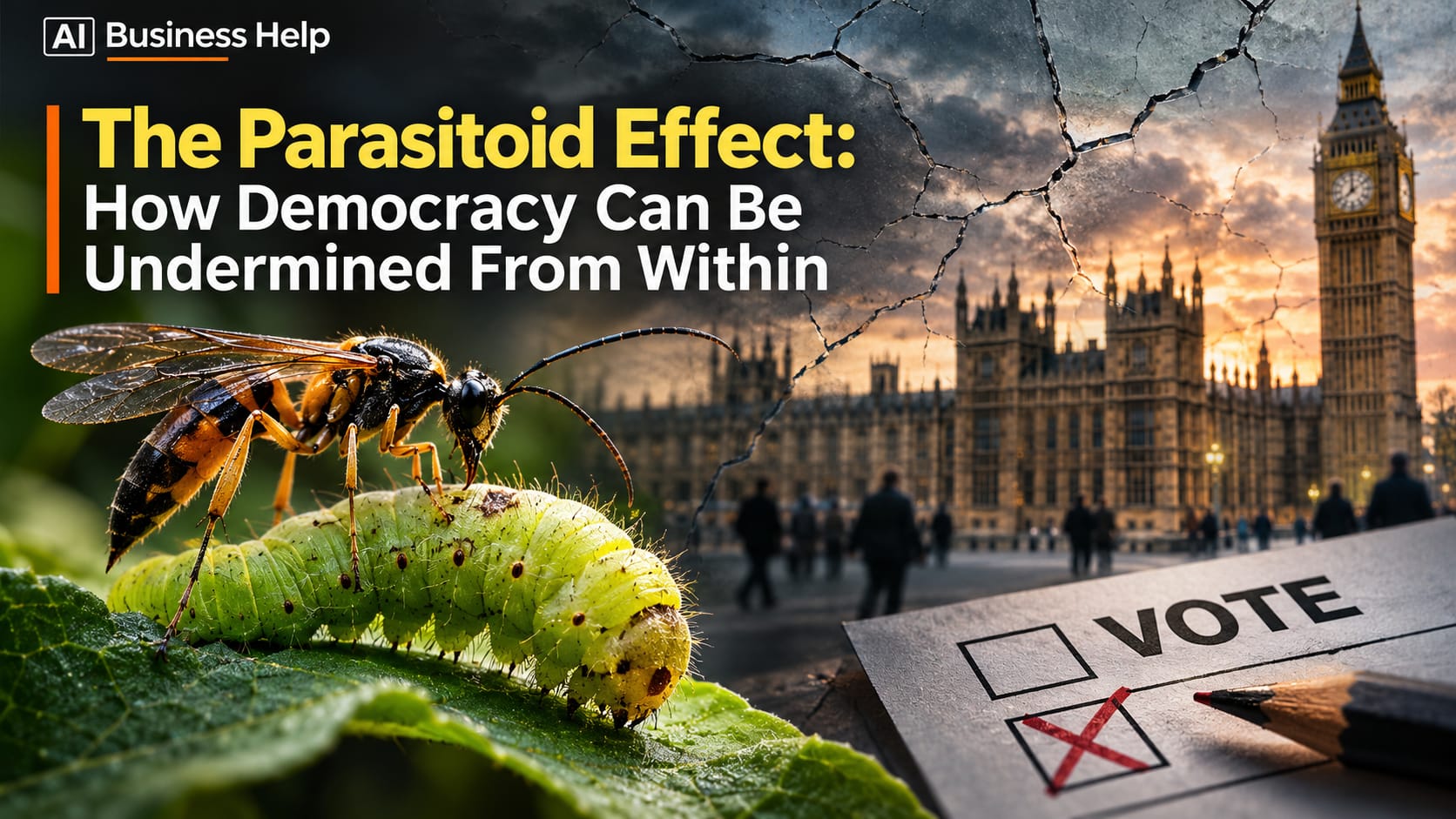
The Parasitoid Effect: How Democracy Can Be Undermined From Within
Publish Date: Last Updated: 9th November 2026
Author: nick smith- With the help of CHATGPT
We spend billions defending our borders against external threats. But what happens when the greatest danger to our democracy comes from weaknesses within the very system we are trying to protect?
A Disturbing Lesson From Nature
There is a rather extraordinary and disturbing survival strategy employed by certain species of wasps known as parasitoid wasps.
These wasps lay their eggs inside living creatures, including caterpillars.
When the eggs hatch, the developing larvae begin feeding on the host's nutrients and tissues. Remarkably, some species avoid damaging vital organs, allowing the caterpillar to remain alive while the larvae develop.
The host continues to function, often unaware of the creatures developing inside it.
Eventually, the larvae emerge. Depending on the species, the host may die or survive the ordeal, sometimes displaying extraordinary changes in behaviour.
It is a fascinating example of an organism exploiting another from within rather than attacking it from outside.
But what on earth does this have to do with democracy?
Perhaps more than we would like to believe.
I have increasingly come to question whether the greatest danger to Western democratic societies necessarily comes from an external aggressor or whether we are overlooking a potentially more insidious threat developing within our own political systems.
I call this the Parasitoid Effect.
To be absolutely clear, I am not comparing any nationality, religion, culture or group of people to parasites. The analogy concerns a method of exploiting an existing system from within, not the identity of those participating in it.
The question is simple.
Could a highly organised ideological movement use the very freedoms and democratic institutions designed to protect society to gain power and subsequently undermine those same freedoms?
And could widespread voter apathy make that considerably easier than most people realise?

While We Watch Our Borders, What Is Happening Within Them?
When discussing the greatest threats to the United Kingdom and Europe, attention frequently turns to Russia.
The war in Ukraine has reinforced the importance of military preparedness, national sovereignty and defending countries against foreign aggression.
Russia's invasion of Ukraine was an unlawful act of aggression against an independent European country. Its military activities, cyber operations and hostile interference are genuine security concerns.
I do not dispute any of that.
But I do question whether concentrating so heavily on external dangers risks distracting us from the problems developing within our own societies.
A foreign aggressor may seek to weaken a nation through military force, economic disruption or political interference.
Yet a society can also weaken itself through declining confidence in its institutions, increasing political polarisation, the erosion of civil liberties and the withdrawal of ordinary citizens from democratic participation.
These internal problems do not require an invading army.
They can develop slowly, often under successive governments, until the divisions within society become more damaging to everyday life than many of the external threats against which we are preparing.
I believe Britain is showing signs of this kind of institutional and social weakness.
That is not to suggest that Russia is unimportant or that domestic problems and foreign threats are mutually exclusive. Indeed, external actors can exploit divisions within democratic societies.
But there is a fundamental difference between defending a country against an external enemy and defending the democratic principles on which that country depends.
We spend considerable time and resources preparing for the first.
Are we devoting enough attention to the second?
The Most Effective Political Weapon May Be Voter Apathy
We tend to think of democracy as majority rule.
The people vote, the votes are counted, and whoever receives the most support gains the authority to govern.
But this simple description hides a significant weakness.
Democracy does not count the opinions of everyone entitled to vote. It counts the votes of those who actually participate.
At the 2024 UK general election, turnout was just 59.7%, the lowest at a general election since 2001.
More than four out of every ten registered voters did not participate.
Local elections frequently attract even lower turnout.
In the May 2025 English local elections, turnout was 34.3% in county council elections and 35.2% in unitary council elections.
Participation improved in 2026, reaching 41.2% in metropolitan, London borough, unitary and district elections, but most registered voters still did not cast a ballot.
Now consider the implications.
When fewer people vote, a well-organised political movement can achieve a much larger share of the votes cast than its share of the overall electorate might suggest.
It does not necessarily need to persuade the majority of the community.
It needs to persuade enough of the people who will actually turn up.
And that distinction is enormously important.
How a Minority Can Acquire Majority Influence
Imagine a British town with 10,000 registered voters.
For simplicity, suppose turnout at its next local election is 35%.
That means only 3,500 people vote.
The other 6,500 registered voters have no direct influence over the result.
Now imagine that an organised political movement has 2,000 potential supporters in the town.
That represents just 20% of the electorate.
Suppose the movement has developed a disciplined campaign, maintained close contact with its supporters and successfully persuaded 80% of them to vote for the same candidate.
That produces 1,600 votes.
Those 1,600 votes now represent approximately 45.7% of all votes cast.
If the remaining votes are divided between several other candidates, the organised movement could win the election.
Consider what has happened.
A movement representing 20% of the registered electorate could secure political office with the votes of just 16% of those entitled to participate.
No fraud.
No intimidation.
No conspiracy.
Everything conducted entirely through the democratic process.
Of course, this is a hypothetical example. Real voters are individuals with differing views, and membership of a cultural, religious or political community does not mean everyone votes identically.
Nor does winning an election with a minority of the total electorate automatically make the result illegitimate.
But the arithmetic demonstrates something important.
A highly organised minority can gain disproportionate electoral influence when the wider population fails to participate.
And this is not simply a theoretical possibility.
It is an inherent characteristic of electoral systems in which voting is voluntary and outcomes are decided by those who participate.
When Democracy Becomes a Tool for Ideological Change
There is nothing inherently wrong with people organising politically.
Indeed, the freedom to campaign, form associations, stand for election and advocate change is fundamental to democracy.
Minority groups have often used these freedoms to secure important improvements in civil rights, equality and political representation.
But the right to campaign for change creates an uncomfortable question.
What happens when an organised movement is not simply trying to participate in democracy, but ultimately wants to replace some of its fundamental principles?
A movement might believe that its religious doctrines should take precedence over freedom of expression.
Another might believe that political opponents should be prevented from challenging its authority.
Others may seek to restrict minority rights, weaken judicial independence, control information or reduce the freedom of citizens to organise against the government.
These objectives can emerge from very different ideological traditions.
The danger is not that people hold strong beliefs.
It is that people with strongly held beliefs may seek political authority for the purpose of removing freedoms from those who disagree with them.
A democratic society must permit people to campaign for change.
But it must also protect the rights that make genuine democratic competition possible.
This includes the right to criticise those in power, challenge religious and political beliefs, organise opposition and replace governments through free elections.
If those rights are progressively weakened, democracy may continue to exist in name while becoming considerably less democratic in practice.
And that leads to what I believe is one of the most concerning developments within modern British society.
When People Become Afraid to Speak
Freedom of expression is one of the foundations of a democratic society.
Without it, citizens cannot properly challenge those who govern them.
They cannot expose wrongdoing, question public policy or express unpopular opinions without fearing the consequences.
Britain has never provided an unlimited right to say absolutely anything.
Threats, harassment, incitement to violence and certain other forms of harmful conduct are subject to criminal law.
There are legitimate reasons for some restrictions, particularly when protecting people from violence or intimidation.
But the difficult question is where legitimate protection ends and excessive control begins.
In recent years, Britain has experienced growing controversy over police powers, online communications, public protests and the boundaries of lawful political expression.
The legislation governing protests has also expanded, with additional police powers introduced through the Police, Crime, Sentencing and Courts Act 2022 and the Crime and Policing Act 2026.
Human rights organisations have raised concerns about the consequences of certain restrictions for freedom of expression and peaceful assembly.
The difficult balance between public safety and civil liberties deserves serious scrutiny.
A person making a credible threat against another individual is not in the same position as someone expressing an unpopular political opinion.
Criticising immigration policy is not automatically the same as expressing hatred towards immigrants.
Challenging a religious belief is not automatically hostility towards people who follow that religion.
And criticising government policy is not, by itself, extremism.
These distinctions matter.
When political disagreements become framed primarily through accusations of hatred or extremism, there is a danger that legitimate debate becomes increasingly difficult.
People may begin to censor themselves, not necessarily because their opinions are unlawful, but because they are uncertain about the consequences of expressing them.
This is sometimes called a chilling effect.
It is important not to assume that every arrest, prosecution or restriction involving speech is evidence of political repression. Each case must be examined according to its facts and the law.
Nevertheless, the cumulative effect of controversial enforcement decisions and uncertainty about the boundaries of lawful expression can damage public confidence.
A democracy is weakened when citizens become more concerned about the consequences of expressing an opinion than about the consequences of remaining silent.
More Than 12,000 Arrests: When Online Speech Becomes a Police Matter
There is another statistic that I believe every British citizen should know.
In April 2025, an investigation by The Times revealed that police forces in England and Wales had recorded 12,183 arrests during 2023 under two pieces of communications legislation.
That is approximately 33 arrests every single day.
The figures were obtained through Freedom of Information requests to police forces and concerned Section 127 of the Communications Act 2003 and Section 1 of the Malicious Communications Act 1988.
The legislation covered various forms of unlawful communication, including threatening, malicious and grossly offensive messages.
It is essential to recognise that these were not all arrests for expressing political opinions or committing hate crimes. Some involved serious threats, harassment and genuinely harmful behaviour.
Nor does an arrest mean that a person was subsequently charged or convicted.
Nevertheless, the scale of police involvement in communications offences deserves public scrutiny.
When thousands of people are arrested over communications each year, we should examine whether the law provides sufficiently clear boundaries between legitimate expression and criminal behaviour.
The Home Office does not publish a separate national total for arrests specifically involving hate crimes. In June 2026, the government confirmed that the available arrest statistics are grouped under broader offence categories.
So we cannot accurately claim that 12,183 people were arrested for hate speech alone.
But these figures raise an important question.
How confident can ordinary people be that expressing a controversial opinion will not lead to a police investigation, particularly when the boundaries of offences involving grossly offensive communications can be difficult to understand?
When a Social Media Post Brings the Police to Your Door
Consider the case of journalist Allison Pearson.
In November 2024, police officers visited her home to investigate a complaint about a social media post published approximately a year earlier.
The post had criticised perceived double standards in policing demonstrations, although it also contained a mistaken identification of the people and circumstances shown in an accompanying photograph.
The investigation concerned an allegation of inciting racial hatred.
Pearson was invited to a voluntary police interview but was not arrested.
Following advice from the Crown Prosecution Service, Essex Police decided that no charges should be brought and closed the investigation.
The case subsequently resulted in further legal proceedings relating to statements made by officials about Pearson.
In July 2026, the Police, Fire and Crime Commissioner for Essex apologised and agreed to pay damages and costs in relation to accusations he had made.
There are legitimate reasons why police investigate credible reports of criminal conduct, including allegations of inciting hatred.
However, this case also illustrates how an online political controversy can develop into a criminal investigation even when it ultimately results in no prosecution.
For an ordinary person without access to legal support, publicity or financial resources, such an experience could be intimidating.
And this is where I believe the wider danger lies.
Not every person investigated will have committed an offence.
Not every complaint will be justified.
And not every police investigation will lead to prosecution.
Yet the prospect of police involvement may be enough to discourage some people from participating in controversial political discussions.
Is Arrest Being Confused With Guilt?
There is another principle that must not be forgotten.
An arrest is not a conviction.
Neither is an investigation evidence that the person concerned has committed a crime.
When discussing the figures for communications-related arrests, it is therefore important to distinguish arrests, charges, prosecutions and convictions.
A person can be arrested, questioned and subsequently released without further action.
The legal process may have operated correctly, but the experience may still carry personal, professional and reputational consequences.
Equally, the absence of charges does not automatically establish that the original investigation was improper.
The important question is whether police powers are being used proportionately and consistently, with proper regard for freedom of expression.
The Right to Disagree Without Fear
I believe this is one of the greatest challenges facing modern British democracy.
We need laws that protect people from genuine threats, targeted harassment and incitement to violence.
But we also need confidence that those laws will not be applied in ways that unnecessarily discourage political criticism, religious debate or unpopular opinions.
The distinction should be understandable to ordinary citizens without requiring them to consult a solicitor before expressing a view.
Because if people are unsure whether criticism of government policy, religious doctrine or social change might result in police involvement, some will simply decide not to speak.
And when people withdraw from public debate, the range of opinions being expressed becomes narrower.
This brings us back to the Parasitoid Effect.
A determined political movement does not necessarily need to silence every opponent.
It may benefit from an environment in which opposition becomes less vocal, less organised or less willing to challenge controversial decisions.
This does not establish that speech restrictions are being deliberately used as part of a coordinated plan. But it demonstrates why the chilling effect identified by the courts deserves serious attention.
Democracy depends on more than the freedom to vote. It depends on the freedom to question, criticise and challenge those who seek to exercise power.
And those freedoms must be protected consistently, including when the opinions expressed are unpopular, uncomfortable or offensive.
The Return of the Blasphemy Debate
One area where the conflict between individual rights and ideological demands becomes especially visible concerns religion.
Blasphemy offences were abolished in England and Wales in 2008.
This represented an important recognition that religious ideas should not enjoy special protection from criticism simply because they are considered sacred.
People should be free to practise their religion.
They should also be free not to practise a religion, to change their beliefs and to criticise religious doctrines.
Those freedoms must apply equally to everyone.
Yet debates about blasphemy, religious hatred and offensive expression have resurfaced in British public life.
There have been concerns about pressure on individuals who are accused of insulting religious beliefs, including intimidation and attempts to prevent lawful expression.
The government has explicitly stated that there is no blasphemy law in England and that it will not introduce legislation creating de facto blasphemy laws.
That distinction is important. It would be inaccurate to claim that England has already reintroduced criminal blasphemy offences.
But the absence of a formal blasphemy law does not remove every concern about informal pressure, intimidation or the possibility that other restrictions could have similar consequences.
The real issue is whether people can freely question religious doctrines without fearing threats, harassment or disproportionate legal consequences.
Protecting believers against discrimination and violence is essential.
Protecting beliefs themselves against criticism is an entirely different proposition.
A free society must be capable of making that distinction.
The right to hold a belief must never become an automatic right to prevent others from challenging it.
And that principle must apply to every religion, political philosophy and ideology without exception.
The Political Danger of an Increasingly Divided Society
I believe successive British governments have failed to confront a growing sense of alienation among parts of the population.
Many people feel that their concerns are ignored, their communities are changing without meaningful consultation, and political decisions are increasingly disconnected from their everyday experiences.
These perceptions do not always reflect the full reality, but dismissing them does not make them disappear.
Neither does describing everyone who raises uncomfortable questions as extreme.
A government's responsibility is not simply to identify opinions it dislikes.
It is to understand why people hold those opinions, engage with their concerns and respond within the principles of democracy and the rule of law.
This does not mean accepting prejudice, discrimination or misinformation.
It means recognising that public disagreement cannot always be solved by condemnation.
The collapse in political trust should concern every political party.
The Electoral Commission's 2025 research found that only 14% of respondents said they trusted politicians, while 54% believed that elected representatives did not care about people like them.
More recent polling has continued to show widespread distrust.
In the 2026 Ipsos Global Trustworthiness Index, only 11% of British respondents considered politicians trustworthy.
These figures are extraordinary for a country that prides itself on its democratic traditions.
When citizens no longer trust politicians, some become angry and politically active.
Others withdraw altogether.
And this second response can be particularly damaging.
Because every person who disengages leaves political decisions to those who remain engaged.
We should not assume that all non-voters are apathetic or that they would vote for the same policies if they participated.
But widespread withdrawal undeniably reduces the breadth of public participation in democratic decision-making.
It also creates an environment in which well-organised movements can acquire influence more easily.
The Parasitoid Effect: Democracy Undermined Through Its Own Mechanisms
Now return to the wasp.
The unsettling feature of its survival strategy is not simply that it exploits another organism.
It is that the host remains functional while the process develops.
The political analogy is that democratic institutions can continue operating even as their underlying principles are gradually weakened.
Elections may still take place.
Politicians may still make speeches about democracy.
Laws may still be passed through Parliament.
But the freedoms and safeguards that make the system genuinely democratic could become less secure.
An ideological movement does not necessarily need to abolish elections if it can achieve its objectives through them.
It does not need to attack Parliament if it can secure enough parliamentary support to change the law.
And it does not necessarily need to silence every opponent if a combination of political pressure, legal uncertainty and public disengagement reduces effective opposition.
This is the potential danger I call the Parasitoid Effect.
Not the claim that a particular ethnic, cultural or religious community is secretly controlling Britain.
Not an allegation that every unpopular policy forms part of some coordinated conspiracy.
But the recognition that democratic processes can potentially be used to weaken democratic protections.
Political scientists have examined related processes under concepts such as democratic backsliding and executive aggrandisement.
Democratically elected governments can gradually reduce accountability by weakening independent institutions, restricting opponents or changing the rules of political competition.
The difficulty is that democratic erosion does not always arrive as a single dramatic event.
It can occur incrementally.
And because each individual change may appear relatively minor, the cumulative consequences can be difficult to recognise until substantial damage has already been done.
The Most Dangerous Mistake Is Believing It Cannot Happen Here
Britain has an established parliamentary tradition, independent courts, competitive elections and a long history of political liberties.
These institutions provide important safeguards.
But no democratic system is immune from deterioration.
The strength of our institutions depends partly on the willingness of citizens to defend them and the willingness of those in power to respect the limits of their authority.
We should not assume that every politically organised minority is a threat.
Most groups participate in politics because they want representation, better services or policies reflecting their priorities.
That is democracy working as intended.
The danger arises when any movement, whether it represents a minority or a majority, seeks to deny others the rights it used to obtain power.
A movement that demands freedom of expression for itself while seeking to criminalise legitimate criticism by opponents is challenging a democratic principle.
A movement that supports elections only when it wins is challenging a democratic principle.
And a movement that attempts to make itself immune from scrutiny is challenging the accountability on which democracy depends.
The test should always be the same.
Would we accept the same rules if they were being used by a political movement with which we fundamentally disagreed?
If the answer is no, then perhaps those rules deserve closer examination.
The Responsibility of Those Who Govern
I do not believe the responsibility for Britain's political disengagement rests solely with the electorate.
Successive governments must accept their share of responsibility for declining public trust.
When politicians fail to deliver on promises, dismiss legitimate concerns or appear more interested in political advantage than public service, they risk undermining confidence in the entire democratic process.
And when governments respond to public frustration primarily through tighter restrictions or increasingly confrontational political language, the resulting divisions may become even harder to resolve.
People need to believe that there is a meaningful democratic route through which their concerns can be heard.
That requires more than holding elections every few years.
It requires transparency, accountability, consistent application of the law, freedom of expression and a willingness to engage respectfully with disagreement.
It also requires political leaders to recognise that the institutions they control do not belong to their party.
They belong to the country.
A government is a temporary custodian of democratic authority, not the owner of democracy itself.
The Greatest Threat May Be Our Own Indifference
I began this article by describing a creature that survives by exploiting another organism from within.
It is an uncomfortable comparison, but I believe it raises an important warning about the vulnerability of democratic societies.
We naturally fear external enemies because their intentions and actions can appear more obvious.
A military invasion is visible.
A missile strike is unmistakable.
But the gradual weakening of democratic accountability, political trust and freedom of expression can be considerably harder to recognise.
It may happen without an invading army, without a military coup and without a single dramatic moment when democracy can be said to have ended.
It may involve ordinary political processes, lawful elections and legislation passed by elected representatives.
None of this means that Britain is already undergoing a coordinated ideological takeover.
It means that the possibility of democratic erosion should be taken seriously, particularly when public participation and confidence in political institutions are weak.
The answer is not to prevent minority groups from organising, to suppress unpopular beliefs or to deny political rights to people whose views we dislike.
That would undermine the very freedoms we are trying to protect.
The answer must be stronger democratic participation, greater political accountability, effective institutional safeguards and the preservation of the right to criticise those in authority.
Because a democracy can survive disagreement.
It can survive unpopular governments.
It can survive difficult elections and political crises.
What it cannot indefinitely survive is the steady erosion of the principles that allow its citizens to hold power to account.
Perhaps the greatest danger is not that a determined minority can use democracy to acquire influence. That is a freedom democracy deliberately provides.
The danger is that the wider population becomes so disengaged, divided or afraid to speak that it no longer effectively defends the democratic principles on which everyone's freedom depends.
And unlike an external invasion, that process may take place almost unnoticed.
Not because democracy has been defeated from outside.
But because too many people have stopped defending it from within.
Sources and factual references
These are suitable references to link within the published article:
- Natural History Museum — How parasitoid wasps exploit living hosts.
- House of Commons Library — 2024 general election turnout.
- Electoral Commission — 2025 local election participation.
- Electoral Commission — Trust in politicians and democratic institutions.
- House of Commons Library — Police powers and protest legislation.
- Home Affairs Committee — Government response on extremism and blasphemy
- House of Lords Library — Communications offences and free speech concerns.
- Home Office parliamentary answer — Hate-crime arrests and convictions, June 2026.
- Essex Police, Fire and Crime Commissioner — July 2026 apology
Latest UK Politics Articles
Reform donations: it was never only about the money. It is about how the system is fixed.
The row over Reform UK’s donors is being fought as a story about dirty money. The harder question is whether Britain’s funding...
Why a share of GDP will not defend Britain
A GDP target is not a defence policy. Britain can hit two per cent and still leave the grid, factories and munitions line exposed....

Scrapping the Two-Child Limit: Compassion or Costly Signal?
As the UK approaches Chancellor Rachel Reeves’ Autumn Budget on November 26, signals from Downing Street point to a seismic shift:...

The UK’s Hidden Fiscal Crisis
These trends are already locked in, regardless of the Autumn Budget on 26 November. Even a £40 billion tax raid will only buy...

AI Questions and Answers section for The Parasitoid Effect: How Democracy Can Be Undermined From Within
Welcome to a new feature where you can interact with our AI called Jeannie. You can ask her anything relating to this article. If this feature is available, you should see a small genie lamp above this text. Click on the lamp to start a chat or view the following questions that Jeannie has answered relating to The Parasitoid Effect: How Democracy Can Be Undermined From Within.
Be the first to ask our Jeannie AI a question about this article
Look for the gold latern at the bottom right of your screen and click on it to enable Jeannie AI Chat.
Type: Article -> Category: UK Politics