Type: Article -> Category: UK Politics
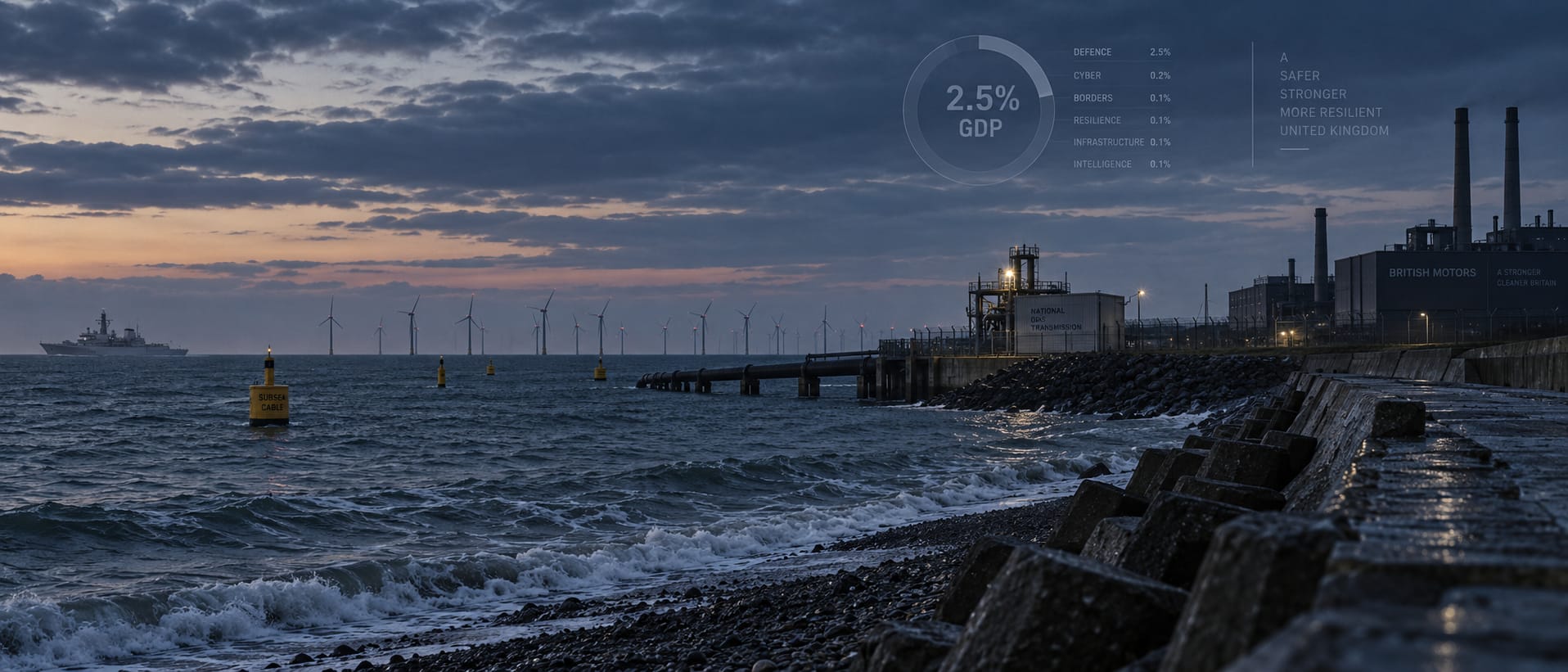
Why a share of GDP will not defend Britain
Don't have time to read the article? View as a short video storyboard or listen to it whilst jogging.
Publish Date: Last Updated: 9th September 2026
Author: nick smith- With the help of GROK3
Every few months the argument about Britain’s safety collapses into the same number. Are we at two per cent of GDP? Two and a half? Three and a half? Five? What happens if we miss it? What will the next summit communiqué say?
Those are real political questions. They are not the same as the only question that matters: is the country actually harder to hurt than it was last year?
A percentage is an input. Protection is an output. Confusing the two is how a government can boast that it has met the target while the lights, the networks, the factories and public confidence remain easy to disrupt.

Imagine you are told to spend a million pounds on home security in twelve months, or face a two million pound fine.
For six months you research locks, cameras and alarms. Then you notice the calendar. You buy a good alarm. You cover the house in expensive cameras. You still have three-quarters of the money left. So you fund a neighbour’s untested gadget because it absorbs half a million quickly, and you buy average protective kit from someone you already know. On paper you have spent the million. In the real world you have a house that looks defended and a plan that was written by a deadline.
Then the burglar does not pick the lock. He cuts the power. The cameras go dark. The alarm dies. The gate motor stops. He walks in through a side door you never treated as part of “security,” because it was not on the shopping list that would hit the target.
That is what a GDP target does when the target becomes the strategy. Cash has to leave the building before March. Big, visible programmes absorb money faster than unglamorous ones. Familiar suppliers are easier than new ones. None of that is automatically corrupt. It is what happens when the scoreboard measures spending rather than readiness and when the power supply that makes the whole system work is treated as someone else’s problem.
Picture two countries with the same size of economy.
Ledger spends 2.5 per cent of GDP on “defence” every year and issues a press release when the spreadsheet turns green. A large slice of that total is military pensions. Another slice is a handful of exquisite platforms ordered years ago. Magazines of ammunition are thin. The companies that would have to refill them import the explosive materials. The energy grid has plants whose cyber standards will not be tightened for years. Most firms have no tested plan for a serious attack on their networks. Ledger has hit the number.
Rampart spends whatever the threat assessment says is required, which in some years is a little under Ledger’s ratio and in others a little over. Ministers are judged on a different list. How many days of high-intensity fighting can the ammunition stocks support? How much of the army’s kit actually works? How quickly can a factory turn out shells, drones or spare parts? Is the grid’s operational technology locked down? Can the country keep the lights on, the payments system up and food moving if undersea cables or pipelines are interfered with? Do citizens believe the state can keep basic order at home? Rampart’s budget is messier to explain at a summit. It is a more serious country.
Britain has spent too many years talking like Ledger.
The percentage was never designed to answer the hard questions.
The two per cent guideline did not begin as a recent American punishment. NATO defence ministers discussed it in 2006. Allies wrote it down at the Wales Summit in 2014, after Russia seized Crimea, and later hardened the language. The latest alliance politics push the number higher still, with a split between core military spending and a broader pot for infrastructure and resilience. A simple ratio has a use: it is a crude signal of political will, and after the Cold War too many European budgets were allowed to drift.
The trouble starts when the signal replaces the plan.
GDP moves for reasons that have nothing to do with a cable in the North Atlantic. A recession can make the ratio look healthier without adding a single interceptor. A boom can make a serious programme look like underspending. Different countries have different jobs. Poland’s problem is a land war on its doorstep. Britain’s is a nuclear deterrent that must stay at sea, a North Atlantic navy, undersea infrastructure, a small army that can reinforce allies, and a homeland that runs on electricity, software and just-in-time supply.
Even the scoreboard can be negotiated. Under NATO rules, pensions paid to retired military personnel count as defence spending. In some European budgets that is a large share of the headline figure. The newer “defence-related” category can include dual-use infrastructure that is genuine resilience; ports, rail, cyber; or civilian projects given a khaki label. A country can pass the test without becoming harder to attack.
Modern attack does not wait for a declaration of war.
The 2025 Strategic Defence Review was right to talk about warfighting readiness and a “whole of society” effort. The National Security Strategy was right to treat undersea cables, pipelines and critical infrastructure as targets in their own right. About 99 per cent of Britain’s digital communications travel through subsea cables. Most imported gas arrives by pipeline under the sea. You do not need to occupy Whitehall to make daily life seize up. You need to make the country doubt that the lights, the banks and the food shops will work tomorrow.
That contest is already under way at a lower intensity. The National Cyber Security Centre handled 204 nationally significant cyber attacks in the year to August 2025, up from 89 the year before, about four a week. In the year to May 2026 it managed around 200 incidents affecting critical national infrastructure and the firms that support it. Officials say three-quarters of those infrastructure attacks were linked to hostile states. Adversaries do not only smash things. They park themselves inside networks so that, in a crisis, they already have a foot in the door.
The rest of the country is not ready for that. In the latest government survey, 43 per cent of businesses reported a cyber breach or attack in the previous year. A small UK power plant was taken offline for four days in 2026 in an attack attributed to Iranian hackers. The government’s own timeline for tougher baseline cyber rules on the smallest generators runs to 2030.
This is not a theory about “systems.” In late August 2025 attackers got into Jaguar Land Rover. The company pulled the plug on its own networks to stop the spread, and the production lines at Solihull, Halewood and Wolverhampton went dark for weeks. Plants abroad stopped too. The wider economic damage has been put in the region of £2 billion. A government loan guarantee of £1.5 billion was needed to stop the shock running through thousands of suppliers. UK car output in that September fell to levels last seen in the early 1950s. Investigators have since pointed towards a Russian group rather than the outfit that first claimed the attack.
The lesson is larger than one car firm. A modern factory is a computer that happens to make physical objects. If the network falls, the plant falls. If an attacker sits inside that network, they may also see designs, tool settings, supplier contracts and the digital trail of whatever the company is developing next. A GDP defence target does not measure whether Britain’s industrial base can survive that. JLR still counted as a successful manufacturer on the day before the breach. So did the national accounts.
If a gas pipeline were sabotaged, would the lights go out?
The honest answer is: it depends what else fails at the same time.
Britain does not live off a big gas tank. It lives off a set of pipes and ships. In recent years roughly two-fifths of the gas has still come from UK fields. Much of the rest comes through Norwegian pipelines, especially Langeled into Easington, and from tankers of liquefied gas. Storage is thin, on the order of ten days of winter demand, which sounds fatal until you remember that the system was built to keep flowing, not to sit on a stockpile.
Cut one artery and the country can often limp. Other fields, other landfalls, LNG cargoes and the links to the continent take up the slack. Bills jump. Factories are asked to throttle back. The first official sacrifice in a true gas emergency is not the household boiler. It is the gas-fired power station. That is the moment electricity becomes the problem. On a windy afternoon the grid may barely notice. On a still January evening, when gas is carrying a large share of generation, switching those plants down is how you get rolling cuts. Official planning already contemplates cuts of a few hours and months to repair sabotaged gas kit. There has never been a full Network Gas Supply Emergency in Britain. That is luck and design, not proof that one cannot happen.
Now add the offshore wind farms. Wind is often the largest single source of British electricity. That is a climate success and a new target set. One damaged export cable is an insurance claim. The grid is already built for wind to rise and fall; operators even pay farms to switch off when the inland wires cannot take the power. Several cables, plus a gas pipeline, plus a cold and windless week, is a national incident. The system is not designed for the wind farms and the gas backstop to be wounded together. Repairing a heavy power cable or a pipeline on the seabed is measured in weeks or months. The landing stations where those lines come ashore can be easier to reach than the middle of the North Sea. The Baltic has already shown that undersea kit can be interfered with using commercial ships and anchors. Britain is not the Baltic. The method is no longer theoretical.
None of this appears in a defence-to-GDP ratio. The pipes, the landing stations, the spare cables and the repair ships are either ready or they are not. That is the burglar cutting the power.

Factories are strategy.
There is a still blunter test. If Britain had to fight, or had to keep supplying a neighbour that was fighting, could its factories keep up?
Not as they stand. The country can still design and assemble some of the most complicated machines on earth; nuclear submarines, high-end warships, combat aircraft in partnership, sophisticated missiles in limited numbers. It cannot, at short notice, pour out the unglamorous stuff a long war actually consumes: explosives, propellants, shells, interceptors, cheap drones and spare parts.
Ukraine taught the consumption rates. Peacetime Britain showed the stockpiles. For years the explosive ingredients that turn metal into a working round were allowed to become an import. BAE and others still fill shells and are contracted to raise that output sharply from a low base. That is not the same as a wartime production line. Officials are now paying firms to study where at least six new energetics and munitions plants might go. Construction is hoped to start late this year. A plan to build a factory is not a factory. Until those plants exist on British soil, with skilled shifts and a secure supply of powder, “we spent 2.5 per cent” is a sentence that will not survive contact with a long war.
The same logic runs through the wider industrial base. A wartime surge that depends on digital factories is only as strong as their networks. JLR demonstrated what happens when a flagship manufacturer’s computers die. Defence inflation makes the money problem worse. When every ally shops at once from a small number of plants, prices jump and the extra billions buy less than the press release implies.
A country that cannot keep order at home is already partly undefended.
This is the part of security that never appears in a NATO ratio and is easy to caricature. It should be stated without melodrama. The first duty of the state is to remain a state: to monopolise legitimate force, to protect critical sites, to investigate crime, and to give ordinary people reason to believe that the rules still hold.
A society that feels permanently unsafe does not need a foreign army to become weaker. It becomes weaker because trust collapses, because people stop cooperating with institutions, and because hostile states and extremists alike look for cracks to widen. Britain’s own security documents now treat terrorism, serious organised crime, extremism and state interference as a single domestic field, not as a separate home-affairs file that defence ministers can ignore. Foreign actors do not have to invent every grievance. They amplify what is already there.
None of that is an argument for treating citizens as suspects. It is an argument for treating policing, border control, social cohesion and the information space as part of national defence in the same way Finland and the Baltic states already do. If people do not believe the country can keep a town centre safe on a Saturday night, they will not believe it can protect a power station on a Saturday morning.
The budget fight is real. The percentage does not settle it.
After the Cold War, Britain took a peace dividend. Defence fell from around 3.2 per cent of national income at the start of the 1990s to a little over 2 per cent more recently, while health and social protection grew. That was a political choice made in a quieter world. The world is no longer quiet, and the same pound cannot be spent twice.
It is fair to put the scale on the table. Welfare spending in the official sense is on the order of £330 billion a year. More than half of that goes to pensioners, with the state pension the single largest item. Housing support, disability payments and working-age benefits make up most of the rest. Health is larger than defence by a distance. The defence budget, even on a generous reading, is a fraction of the transfer state as a whole.
Those figures are not an argument for tearing up the pension or the NHS. They are an argument against magical thinking. If Britain decides it needs more warfighting stocks, more air defence for cities and bases, more cyber resilience and more industrial capacity, the money comes from tax, borrowing, or other programmes. A GDP target does not make that choice for you. It only manufactures an annual row about whether the defence line has crossed an arbitrary threshold.
Judge the country by whether it can take a punch.
A grown-up test for Britain would look less like a summit scoreboard and more like a preparedness audit.
Can the armed forces fight for more than a short campaign without running out of munitions? Can the nuclear deterrent stay hidden and at sea? Can the navy find and protect the cables and pipelines that keep the island plugged in? Can cities and bases stop a cheap drone or a missile, not only a textbook bomber? Can a car plant, a hospital trust and a water company recover from a serious cyber attack in days rather than weeks? If Langeled were damaged in a still, cold week, and two offshore wind export cables with it, would the plan be more than hope and an emergency press conference? Are the smallest power plants treated as part of national defence or as an IT afterthought? Can the police and intelligence agencies keep the peace without losing the public? Is there a funded ten-year plan for factories, skills and stockpiles that survives a change of chancellor?
If the answers improve, the percentage of GDP will look after itself. If they do not, Britain can hit any ratio its allies demand and still be a country that looks strong in a communiqué and brittle in a crisis.
The point of the state is not to spend a tidy share of national income on uniforms. It is to remain a country that its people can live in. Machinery is part of that. So are magazines of ammunition, a grid that stays up, firms that can take a hit, and a public that still believes the centre will hold. Until those are the measures that ministers fear missing, we will keep arguing about a number; and calling it defence.
Latest UK Articles
Reform donations: it was never only about the money. It is about how the system is fixed.
The row over Reform UK’s donors is being fought as a story about dirty money. The harder question is whether Britain’s funding...

Scrapping the Two-Child Limit: Compassion or Costly Signal?
As the UK approaches Chancellor Rachel Reeves’ Autumn Budget on November 26, signals from Downing Street point to a seismic shift:...

The UK’s Hidden Fiscal Crisis
These trends are already locked in, regardless of the Autumn Budget on 26 November. Even a £40 billion tax raid will only buy...

The Great Condom Caper: Britain's Taxpayers Foot the Bill for Overseas Safe Sex While Kids Here Hitchhike to School
Ah, 2025 – the year of fiscal enlightenment, where the UK government, in a dazzling display of global virtue-signaling, decided...

AI Questions and Answers section for Why a share of GDP will not defend Britain
Welcome to a new feature where you can interact with our AI called Jeannie. You can ask her anything relating to this article. If this feature is available, you should see a small genie lamp above this text. Click on the lamp to start a chat or view the following questions that Jeannie has answered relating to Why a share of GDP will not defend Britain.
Be the first to ask our Jeannie AI a question about this article
Look for the gold latern at the bottom right of your screen and click on it to enable Jeannie AI Chat.
Type: Article -> Category: UK Politics