Type: Article -> Category: UK Politics
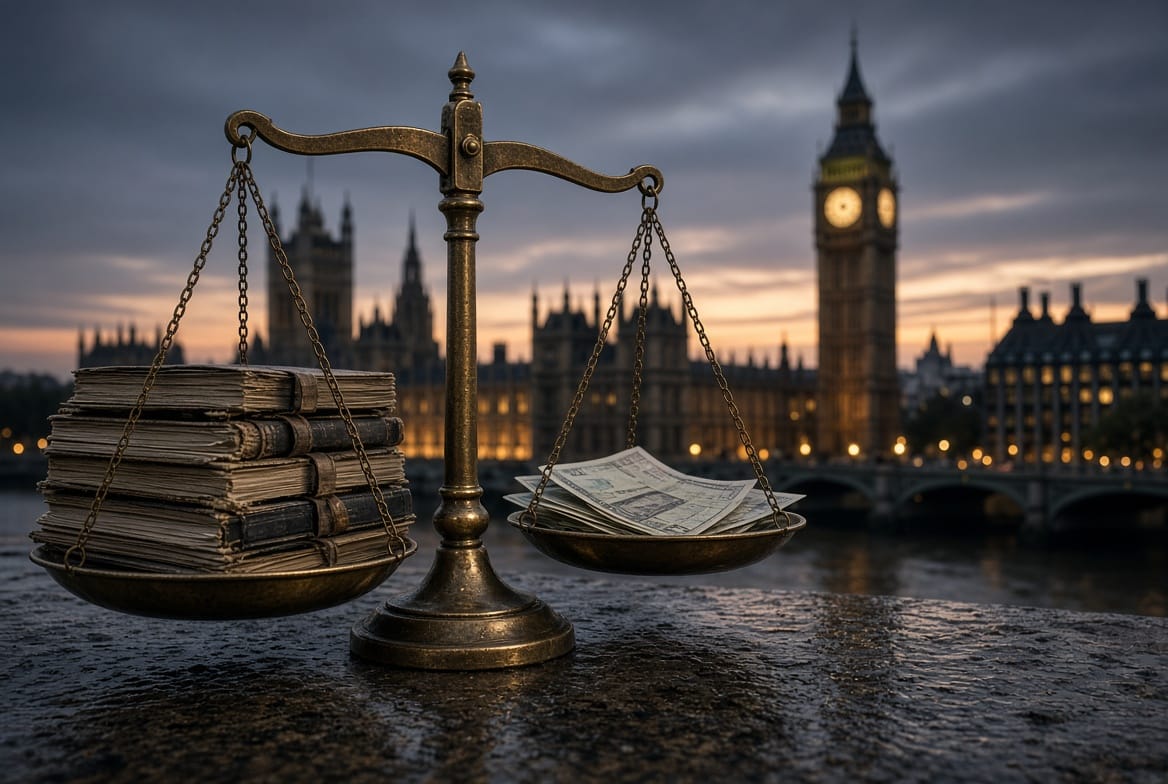
Reform donations: it was never only about the money. It is about how the system is fixed.
Don't have time to read the article? View as a short video storyboard or listen to it whilst jogging.
Publish Date: Last Updated: 14th September 2026
Author: nick smith- With the help of GROK3
The row over who funds Reform UK is being fought as a morality play. The more important question is whether the rules of British political finance apply evenly; and whether anyone outside Labour or the Conservatives is ever meant to govern.
The public conversation about Reform UK’s finances has been reduced to a simple story: large sums, controversial donors, and the suggestion that something improper is being bought. That story is easy to tell. It is not the whole story.
Large donations always raise legitimate questions. Parties should have to show that money comes from permissible sources, that it is declared on time, and that no one is using a third party to hide the real donor. Those rules exist for a reason. They should be enforced without fear or favour. What they should not become is a one-sided weapon: fierce when pointed at a rising challenger, muted when pointed at the funding models that have sustained the two main parties for decades.
This is not a defence of Reform UK. It is not an argument that the party should win, or that its programme would succeed if it did. I set out in August 2025 why I thought a Reform victory would not, by itself, deliver the changes many voters expect, because the machinery of government, the courts, the Lords, international obligations and the first-past-the-post arithmetic all constrain any incoming party that lacks a commanding majority. That remains my view. The point here is different. The point is that the present row is being used to talk about character, when the underlying issue is design.

What is actually on the record
In 2024, according to reporting first published by The Guardian, Nigel Farage received a £5 million personal gift from Christopher Harborne, a British cryptocurrency investor based in Thailand and a major Reform donor. Farage has given more than one account of the gift: that it was for lifetime security, that it was a reward for campaigning for Brexit, and that it was a private matter. The Parliamentary Commissioner for Standards is investigating whether the gift should have been declared under the MPs’ code of conduct. Farage has denied wrongdoing and says the money was not a party donation. Those are the facts as they stand: an investigation, not a finding.
Separately, George Cottrell — a former UKIP official and associate of Farage, pleaded guilty in the United States to wire fraud and served a prison sentence. Reporting in 2026 has examined financial links between Cottrell, his mother Fiona Cottrell, Reform deputy leader Richard Tice, and donations to the party and related organisations. The Metropolitan Police have interviewed people under caution in connection with some of those donations. No charges have been announced. Tice has described the coverage as a politically motivated smear. That, again, is allegation and investigation, not a completed case.
In September 2026, Channel 4 News broadcast undercover footage, filmed by Verbatim Investigations, in which two Reform aides appeared to discuss ways a foreign donor might support the party, including by paying for opinion polling. The party said it had been the target of a hoax by foreign-funded activists, called the remarks “loose pub talk”, and said the proposed donation was never made. Two advisers stepped down. Labour and the Liberal Democrats referred the matter to
the police. The Metropolitan Police have since said they are conducting a criminal investigation into allegations relating to foreign funding. Reform denies breaking the law.
Then came the two £36 million gifts, from Ben Delo and Christopher Harborne, announced within days of each other in September 2026 — together £72 million, larger than the combined general-election spend of the main parties in 2024. Delo was convicted in the United States in 2022 for failing to put adequate anti-money-laundering controls in place at his firm; he was later pardoned by Donald Trump. Both men are British citizens who have lived overseas. Reform says the gifts are lawful. The government is, at the same time, legislating to cap donations from overseas electors.
None of that should be waved away. If the law was broken, it should be applied. If declarations were missed, they should be corrected and sanctioned. Voters are entitled to know who is paying, and why. The question is whether the same standard is applied to every large source of political money in Britain — or only to the source that currently threatens the existing order.
Labour’s union money is not a moral free pass
Labour politicians have been among the loudest in calling Reform’s money tainted. That is their right. It does not exempt their own funding from the same scrutiny.
Trade unions remain a structural pillar of Labour’s finances: affiliation fees, donations to the central party, and support for individual MPs and constituency parties. In the first quarter of 2025 alone, Unite, Unison and the GMB were among Labour’s largest organisational donors. Over the longer run the sums are measured in tens of millions. Union leaders themselves describe this as “the cleanest money in British politics” because it is pooled from members and declared. That is a serious argument. It is not a complete one.
In June 2025 the BBC reported that auditors at BDO had concluded there was a “pervasive fraud environment” at Unite in the 2021 financial year, linked in part to the union’s Birmingham hotel and conference centre. The project was budgeted at tens of millions and ended up costing around £112 million, with later valuations a fraction of that figure. Sharon Graham, who became general secretary in 2021, commissioned inquiries. The Serious Fraud Office has investigated the hotel project. South Wales Police and HMRC have investigated related historical allegations of fraud, bribery and money laundering. Unite’s London headquarters was raided in 2022. As of the BBC’s reporting, those were investigations and auditor findings, not criminal convictions of the union as a donor to Labour.
That distinction is important. It would be reckless, and unfair, to say that money given by Unite to Labour was the proceeds of crime. There is no public finding that it was. The honest question is narrower, and it cuts both ways: if a party is told it must treat a donor’s past conviction, or an organisation’s unresolved fraud investigation, as a reason to return money or refuse it, does that rule apply only to Reform? Or does it apply to every large institutional donor whose books have been the subject of police and auditor concern?
There is a second, structural question. Should any private organisation; a union, a company, a think tank, a billionaire, a foreign-linked foundation; be able to write cheques large enough to change the competitive balance of a general election? Unions are membership bodies with a historic link to Labour. Wealthy individuals are not. Both, however, are organised interests. Both want policy outcomes. The difference is not that one has an agenda and the other does not. The difference is that one agenda has been normalised inside the system and the other has not.
A cap that caps one side
The government’s present answer is a cap. Under amendments to the Representation of the People Bill, donations and regulated loans from overseas electors would be limited to £100,000 a year, with retrospective effect from 25 March 2026, plus a residency period after someone returns to the UK during which the same cap would still apply. Cryptocurrency donations are to be banned until regulators are satisfied the source can be traced. Those proposals sit in a bill that peers are now debating.
On their own terms, some of those measures are defensible. Foreign influence is a real risk. Untraceable crypto is a real risk. A democracy is entitled to insist that the people who fund its parties have a genuine stake in the country.
The problem is the shape of the rule. A £100,000 cap that bites hardest on British citizens living abroad, and on the two mega-donors now bankrolling Reform, is not the same thing as a cap on all large political money. Labour’s union funding is not an “overseas elector” donation. A single union can still move sums well above £100,000 in a year. If Parliament later extends a hard cap to every UK-based individual, but leaves affiliation fees and union donations in a separate category, the effect is easy to predict: the challenger party built on a handful of very large gifts is constrained; the incumbent party built on institutional relationships is not.
That may be good policy. It may be bad policy. What it is not is a level playing field. If the principle is that no single source should be able to dominate a party’s finances, the principle has to include unions, companies and wealthy residents as well as expats. If the principle is only that Reform should not be allowed to out-raise Labour and the Conservatives, then say so. Do not dress a competitive manoeuvre up as constitutional hygiene.
A system that almost never lets anyone else in
Look at the last hundred years of actual power, not at the rhetoric of openness. Since 1918, British government has been a Conservative or Labour monopoly interrupted only by coalitions. David Lloyd George led a wartime and post-war coalition from 1916 to 1922; his Liberals did not govern alone. The Liberal Democrats entered office in 2010 as the junior partner to David Cameron’s Conservatives and left in 2015. There has been no third party with a Commons majority in modern times. That is not a conspiracy theory. It is the arithmetic of first-past-the-post, plus the cost of a national campaign, plus the inherited machinery of two parties that already hold the seats, the donors, the unions, the safe constituencies and the benefit of the doubt from much of the broadcast media.
Even a party that “wins” without a large majority discovers the second lock. The Commons can block. The Lords can delay. The civil service can slow. The courts can review. International treaties and human-rights obligations can constrain. I made that argument about Reform specifically last year, and it applies to any insurgent. Winning the election is not the same as winning the right to change the country. Without a commanding majority, the manifesto becomes a list of aspirations that Parliament can sand down to nothing.
That is why the intensity of the present campaign against Reform’s money should be read politically as well as legally. In June 2026 Keir Starmer resigned as prime minister after losing the confidence of his own party. John Healey’s resignation as defence secretary was widely reported as one of the blows that made Starmer’s position impossible. Andy Burnham, having returned to the Commons, became Labour leader and prime minister within weeks. Those are ordinary, if brutal, facts of party management. They are also a reminder that power inside the existing system is
rearranged far more easily than it is opened to someone outside it.
Some commentators have reached for foreign analogies, the sudden elevation of a more palatable figure; the legal pressure on a disruptive opponent in another country in the run-up to an election. Analogies are not evidence. France is not Britain. A conviction abroad is not a template for Westminster. What can be said, without theatrics, is this: the closer Reform has come to looking like a plausible competitor, the more its funding has been treated not as one funding model among others, but as a moral emergency. Timing is not proof of orchestration. It is, however, a pattern voters can see.
Unrest is not only the work of “bad actors”
Ministers of every recent government have had a standard reply to street protest and public anger: a minority of bad actors is stirring division. Sometimes that is true. It is not an explanation of the last decade.
On immigration, housing, law and order and the cost of living, the complaint from a large part of the public has been consistent. Successive governments have announced plans, targets, bills and “cracksdowns”. Delivery has not matched the language. Record net migration after the Brexit vote was not what many Leave voters thought they had been offered. Housebuilding has not kept pace with household formation. The criminal justice system is backlogged. Real incomes were squeezed for years. When politicians then describe the resulting anger as a pathology imported by extremists, they insult the people who have been raising the same issues in the ordinary language of work, rent and safety.
A closed political market makes that worse. If voters believe that only two parties are allowed to win, and that both have failed on the same files, they will look for a vehicle that appears to be being punished for existing. That does not make the vehicle wise. It makes the punishment counter-productive. The harder the established parties lean on process, police referrals and donor morality while leaving their own funding structures intact, the easier it is for Reform to say the game is rigged. Multimedia makes that argument harder to smother than it was in 1992 or 2001. Every investigation is now a clip; every clip is a recruitment poster for someone who already suspects the rules are written by the incumbents.
The test that would make this honest
If Parliament is serious about clean politics, the test is simple and uncomfortable.
Apply the same due-diligence standard to every large donor, whether the donor is a crypto billionaire, a property developer, a union with an unresolved fraud investigation, or a company bidding for public contracts.
If there is to be a cap, cap the source, not the brand. A union, a company and an individual should face the same annual limit, or Parliament should explain why they should not.
Complete the investigations that already exist; the standards inquiry into the Harborne gift, the Metropolitan Police work on Reform’s funding, the long-running inquiries into Unite’s hotel project; and publish outcomes. An investigation that never ends is not accountability. It is a cloud.
Do not pretend that returning one controversial cheque, while leaving institutional funding untouched, restores public trust. It does not. It tells the public that morality is a tool.
I am not asking anyone to vote for Reform. I have already said why I doubt that party, in office, would be able to do what its voters want. I am asking something more basic. A country that has been governed by two parties for a century, that is now living through a funding row timed to a challenger’s rise, and that is rewriting donation law in the middle of that rise, should be honest about what it is protecting.
It may be protecting democracy from foreign money and from the vanity of the rich. That is a respectable aim. It may also be protecting a duopoly from the first opponent in a generation with the cash to fight it on something like equal terms. Those two things can be true at once. The public can tell the difference between a rule that applies to everyone and a rule that happens to arrive when the wrong people learned how to raise money.
The donations were never only about the money. The money is the evidence. The system is the point.
Notes on sources and wording
This is comment, not a news report. Statements about investigations, gifts, auditor findings and proposed legislation are drawn from contemporaneous reporting by the BBC, The Guardian, the Financial Times, Channel 4 News, the Electoral Commission and government publications. Where a matter is before the police, the Parliamentary Commissioner for Standards, the Serious Fraud Office or the courts, it is described as an allegation or an investigation. No finding of guilt should be inferred. Union donations to Labour are a matter of public Electoral Commission records; they are not evidence that any particular donation was the proceeds of crime.
Earlier related comment: “Why a Reform Party Victory Would Not Deliver the Changes the UK Public Is Expecting”, August 2025, aibusinesshelp.co.uk.
Latest UK Politics Articles

Why a share of GDP will not defend Britain
A GDP target is not a defence policy. Britain can hit two per cent and still leave the grid, factories and munitions line exposed....

Scrapping the Two-Child Limit: Compassion or Costly Signal?
As the UK approaches Chancellor Rachel Reeves’ Autumn Budget on November 26, signals from Downing Street point to a seismic shift:...

The UK’s Hidden Fiscal Crisis
These trends are already locked in, regardless of the Autumn Budget on 26 November. Even a £40 billion tax raid will only buy...

The Great Condom Caper: Britain's Taxpayers Foot the Bill for Overseas Safe Sex While Kids Here Hitchhike to School
Ah, 2025 – the year of fiscal enlightenment, where the UK government, in a dazzling display of global virtue-signaling, decided...

AI Questions and Answers section for Reform donations: it was never only about the money. It is about how the system is fixed.
Welcome to a new feature where you can interact with our AI called Jeannie. You can ask her anything relating to this article. If this feature is available, you should see a small genie lamp above this text. Click on the lamp to start a chat or view the following questions that Jeannie has answered relating to Reform donations: it was never only about the money. It is about how the system is fixed..
Be the first to ask our Jeannie AI a question about this article
Look for the gold latern at the bottom right of your screen and click on it to enable Jeannie AI Chat.
Type: Article -> Category: UK Politics