Type: Article -> Category: AI Wellbeing

The AI Brain Fry Problem: When Infinite Knowledge Meets Finite Time
Don't have time to read the article? View as a short video storyboard or listen to it whilst jogging.
Publish Date: Last Updated: 8th March 2026
Author: nick smith- With the help of CHATGPT

In June 2025, we published an article titled “AI Is the Real-Life Limitless Pill, If You Know How to Use It.” The argument was simple: artificial intelligence gives individuals access to knowledge and productivity that once required entire teams.

The comparison with the fictional NZT-48 pill from the film Limitless was deliberate. Like the pill, AI dramatically enhances cognitive capability. It allows a single individual to research faster, write faster, code faster, analyse faster and learn faster than ever before.
But the Limitless story had an important warning.
The pill amplified everything, including the weaknesses of the person taking it.
Over the past year, a new conversation has started emerging around AI use. Researchers and early adopters are beginning to report a phenomenon now being informally called “AI brain fry.”
It raises an important question for the AI era:
What happens when humans suddenly gain infinite access to knowledge, but still live with finite time and cognitive limits?
The Rise of “AI Brain Fry”
A recent report highlighted a growing trend among heavy AI users: mental fatigue caused by prolonged interaction with AI systems.
Users described symptoms including:
- mental fog
- decision fatigue
- reduced concentration
- headaches and cognitive overload
- the sense that their brain is “full”
The cause is not necessarily the AI itself, but the way humans interact with it.
AI accelerates thinking, but it also accelerates the amount of information a person can consume, generate, review and iterate on.
Instead of reducing mental workload, AI can sometimes expand it dramatically.
The result is a paradox:
The more powerful the tool becomes, the easier it is to overwhelm the person using it.
The Productivity Paradox of AI
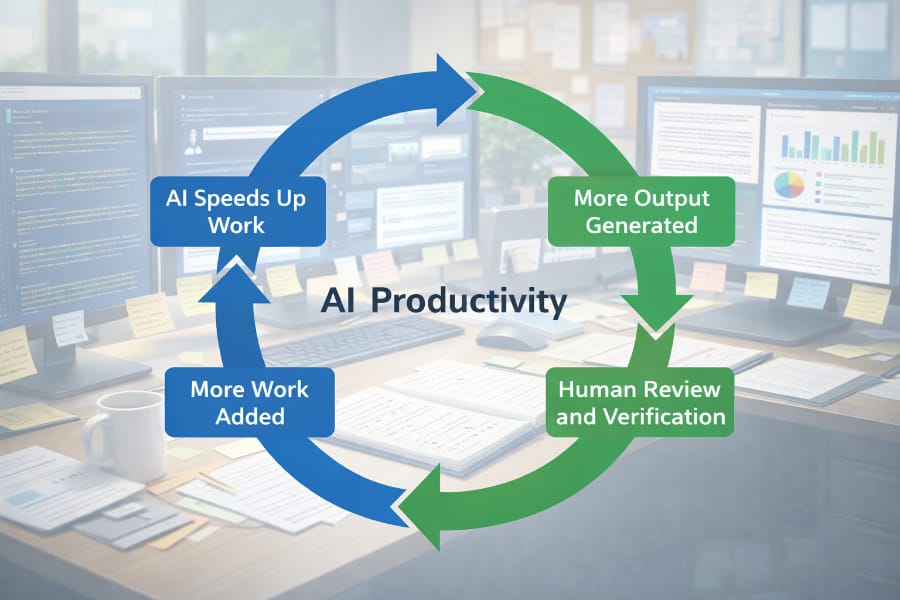
AI promises productivity gains, and it absolutely delivers them.
However, productivity improvements often create a secondary effect: expectations increase.
When work becomes faster, more work is often added.
This produces a feedback loop:
- AI speeds up tasks
- People take on more projects
- AI produces more output
- Humans must review, verify and refine that output
- Cognitive workload increases
Many AI users are now discovering that while AI removes friction from tasks, it also opens the door to an almost unlimited expansion of work and information.
The result can be mental overload rather than relief.
Infinite Knowledge Is a New Psychological Challenge

Before the age of AI, accessing knowledge required effort.
Limitless Was Fiction — AI Is Reality
In 2025 we published an article titled “AI Is the Real-Life Limitless Pill, If You Know How to Use It.” The comparison with the fictional NZT-48 pill from the film Limitless was deliberate. Like the pill, AI dramatically expands a person’s ability to learn, analyse, write, code and create.
But the story of Limitless carried an important warning: power without control has consequences.
AI is now beginning to reveal a similar lesson. While it gives individuals unprecedented access to knowledge and productivity, it also introduces a new challenge — managing the sheer volume of information it produces.
If the first article explored how AI can amplify human capability, this follow-up explores the other side of the equation: how to avoid cognitive overload when knowledge becomes effectively infinite.
👉 Read the original article: AI Is the Real-Life Limitless Pill — If You Know How to Use It
Research meant:
- searching through books
- scanning articles
- gathering sources
- interpreting information manually
These steps acted as natural friction that slowed the pace of information intake.
AI removes that friction almost entirely.
You can ask:
- one more question
- one more refinement
- one more explanation
- one more iteration
The flow of knowledge becomes effectively unlimited.
But there is a problem.
Human attention, time and cognitive capacity remain very limited.
When infinite information meets finite time, the result is pressure.
Knowledge Can Become Addictive
AI introduces something humanity has never experienced before:
on-demand access to near-unlimited expertise.
This creates a subtle psychological trap.
There is always:
- a deeper explanation
- a better version
- another angle to explore
- another improvement to generate
The temptation to keep refining and exploring becomes extremely strong.
In many ways, AI turns curiosity into an always-on feedback loop.
Without clear boundaries, people can easily find themselves spending hours refining ideas that were already “good enough.”
The pursuit of perfect knowledge can quickly turn into cognitive exhaustion.
AI Is Not the Problem, Discipline Is the Missing Skill
The real lesson from the “AI brain fry” discussion is not that AI is harmful.
It is that AI is a catalyst.
Like any catalyst, it amplifies what already exists.
It amplifies:
- curiosity
- productivity
- creativity
- research capability
- learning speed
But it also amplifies:
- distraction
- overthinking
- perfectionism
- information overload
AI gives people enormous cognitive power.
But power without discipline often leads to burnout rather than productivity.
The New Skill of the AI Era: Managing Cognitive Bandwidth
The most successful AI users in the coming years may not be those who use AI the most.
Instead, it may be those who learn how to control their interaction with it.
Healthy AI use requires intentional structure.
Some practical approaches include:
Set clear task boundaries
Use AI with a defined goal rather than open-ended exploration.
Limit iteration loops
Decide in advance how many refinements are reasonable before moving forward.
Separate research and creation
Gather information first, then switch modes and focus on producing output.
Step away regularly
The human brain processes information best when given time away from screens and inputs.
AI accelerates thinking, but thinking still requires mental recovery time.
The Irony of the AI Era
The people most at risk of AI burnout are often the most capable users.
Developers, researchers, analysts, writers and entrepreneurs who fully embrace AI tools often push them the hardest.
They explore every capability.
They integrate multiple systems.
They constantly refine outputs.
In doing so, they often push their own cognitive limits.
Ironically, the people gaining the most productivity from AI may also be the first to experience its psychological side effects.
The Limitless Lesson Still Applies
The comparison between AI and the fictional Limitless pill still holds true.
In the story, the pill unlocked enormous intellectual power, but it also required control, balance and discipline to use safely.
AI is much the same.
It has the potential to expand human capability dramatically.
But the real skill of the AI age will not simply be using AI.
It will be knowing when to stop.
Infinite Knowledge Requires Human Wisdom
Artificial intelligence is rapidly becoming the most powerful knowledge tool ever created.
For the first time in history, individuals can access insights, analysis and creative assistance at a scale that previously belonged only to large institutions.
But AI does not change one fundamental truth:
Human time and attention remain limited.
The challenge of the AI era will not be accessing knowledge.
It will be managing it wisely.
Because when infinite knowledge meets finite time, the difference between productivity and burnout may come down to one simple skill:
discipline.
Latest AI WellBeing Articles

AI as a Cognitive Equaliser: How Artificial Intelligence is Empowering Dyslexia and ADHD Minds
AI is transforming how people with dyslexia and ADHD think, write, and create. This article explores how technology removes...
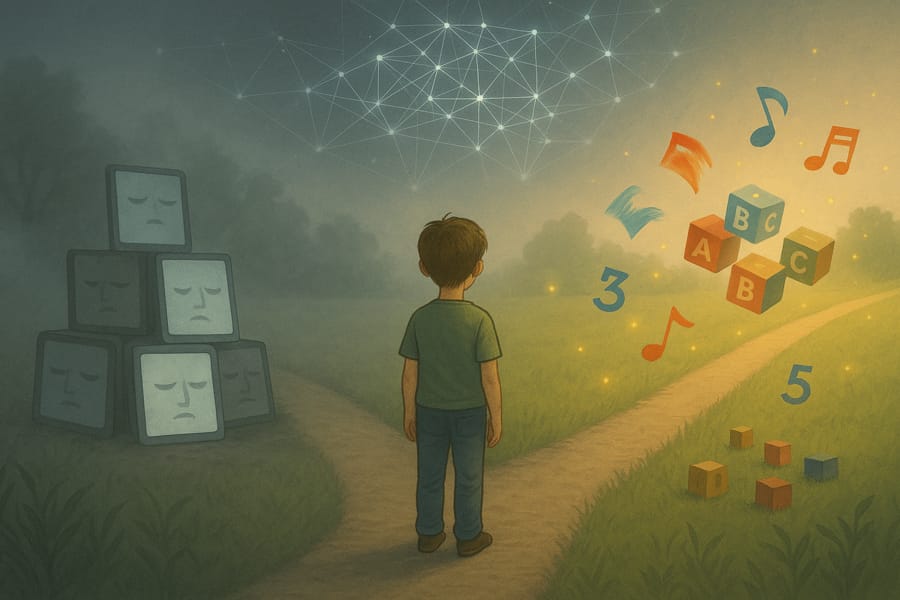
Raising Children in the AI Age: A Guide, Not a Replacement
Over the past year, there has been a growing chorus online, headlines, short-form videos, opinion threads, suggesting that AI...

Your Introductory Guide to AI Companions
You've likely heard of AI assistants that can tell you the weather or play a song, but a new kind of technology is emerging: the...

The Instinct to Collect: Why We Gather, What It Reveals, and How to Keep It Healthy
From seashells and stamps to sneakers and NFTs, collecting is one of the oldest and most universal human habits. It’s a behaviour...

When Ego and Vanity Impoverish the People
The world is littered with grand projects conceived by governments and sold to their citizens as “investments in national pride.”...
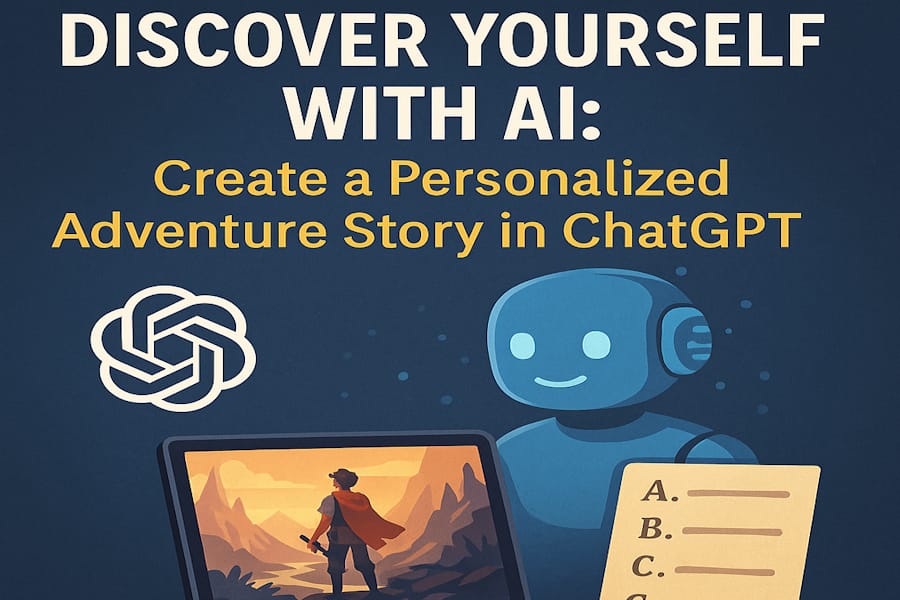
Discover Yourself with AI: Create a Personalized Adventure Story in ChatGPT
Want to explore your imagination and learn more about yourself at the same time? This step-by-step guide shows you how to use...
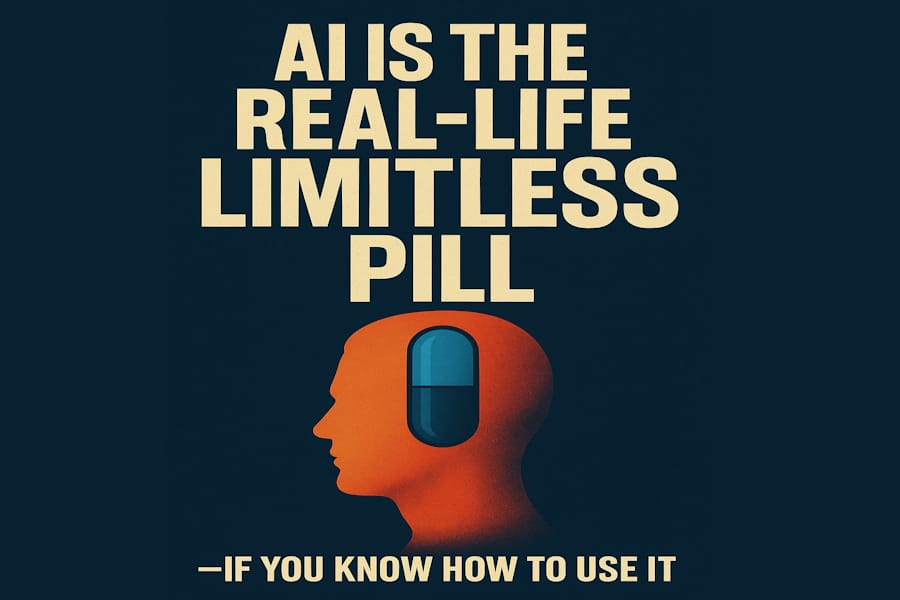
AI Is the Real-Life Limitless Pill — If You Know How to Use It
In the 2011 film Limitless, a struggling writer stumbles upon NZT-48 — a fictional pill that lets him unlock 100% of his brain’s...
How AI Set Me Free from My Dyslexia
When I was 12 years old, I was told I had Dyslexia. Like many neurodiverse conditions, Dyslexia exists on a spectrum, and while my...

AI Questions and Answers section for The AI Brain Fry Problem: When Infinite Knowledge Meets Finite Time
Welcome to a new feature where you can interact with our AI called Jeannie. You can ask her anything relating to this article. If this feature is available, you should see a small genie lamp above this text. Click on the lamp to start a chat or view the following questions that Jeannie has answered relating to The AI Brain Fry Problem: When Infinite Knowledge Meets Finite Time.
Be the first to ask our Jeannie AI a question about this article
Look for the gold latern at the bottom right of your screen and click on it to enable Jeannie AI Chat.
Type: Article -> Category: AI Wellbeing