Type: Article -> Category: AI Wellbeing
Raising Children in the AI Age: A Guide, Not a Replacement
Publish Date: Last Updated: 17th February 2026
Author: nick smith- With the help of CHATGPT
View as a YouTube video or listen as a podcast on Spotify
Over the past year, there has been a growing chorus online, headlines, short-form videos, opinion threads, suggesting that AI is dumbing people down.
The idea is not without reason. Every time humanity invents a tool that makes life easier, a trade-off appears: less effort, less learning, less physical strain.
Calculators reduced the need for mental arithmetic. Cars weakened our reliance on endurance. Map apps replaced the skill of navigation.
And yes, AI too could make us passive if we only consume with it.
But that is just one possibility.
Because while tools can weaken us when used lazily, they can also strengthen us when used deliberately.
There will always be people who misuse technology, as distraction, as escape, as automation for thinking. Yet there is another group, growing quietly, who are using AI to learn faster, to reflect deeper, to build skills they never thought possible. AI is, in many ways, the most powerful self-development tool humanity has ever created. Never in our history has so much knowledge been so immediately accessible.
Whether AI becomes dangerous or transformative depends entirely on one factor:
How we choose to use it.
If we use AI as a shortcut for thinking, we decline.
If we use AI as a partner for growth, we evolve.
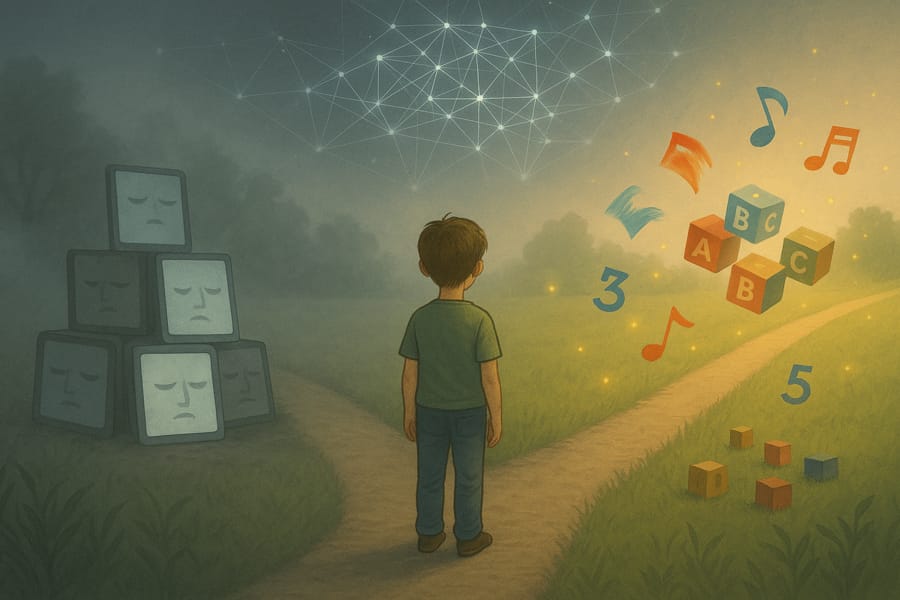
And nowhere is this choice more important than in the way we raise the next generation.
Parenting does not come with a handbook.
For generations, new parents have navigated learning curves through instinct, family influence, trial-and-error and, increasingly, screens used as entertainment or distraction.
While television and tablets can keep children calm or occupied, the majority of screen time today remains passive. A child watches, but is not seen. They consume, but rarely engage.
AI has the potential to change that.
Rather than replacing parental influence, AI could enhance it, becoming a personalised learning companion that identifies a child’s interests, helps them explore their natural strengths, gently addresses weaknesses, and provides feedback that parents can use to better connect with their child. Imagine a future where screen time becomes growth time.
From Passive Viewing → Interactive Enrichment
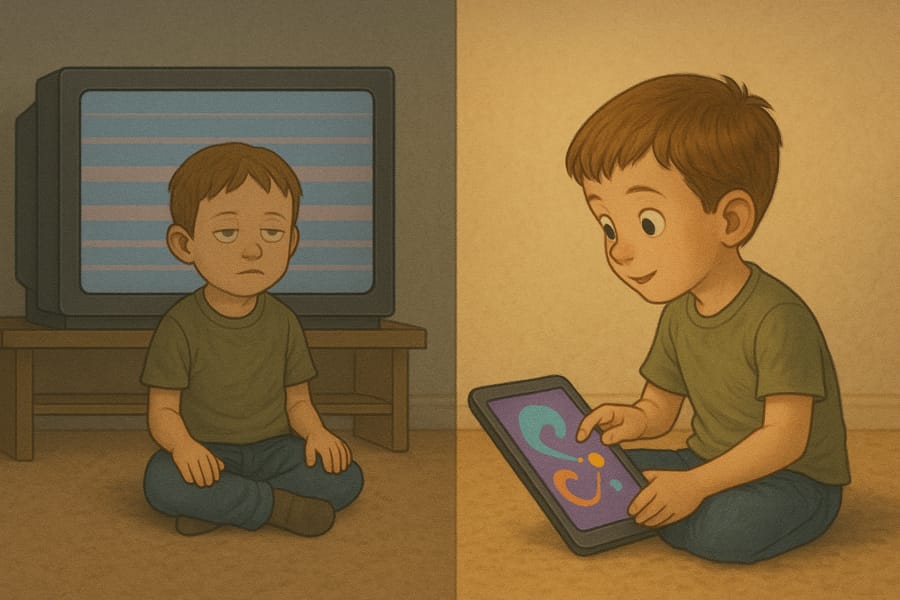
A popular modern parenting compromise is simple:
The child is occupied, the parent gets breathing space.
But traditional digital content does not respond to the child, whether they are bored, confused, excited, or curious.
AI-assisted learning goes further.
- It can notice what captures attention, colours, shapes, music, stories, building blocks, numbers.
- It can adapt dynamic content, puzzles for problem-solvers, stories for imaginative thinkers, videos that pause and ask questions.
- It can adjust complexity instantly, keeping children stimulated without overwhelming them.
Instead of a screen becoming a placeholder parent, it becomes a tool for discovery.
Finding Strengths Early, And Nurturing Them
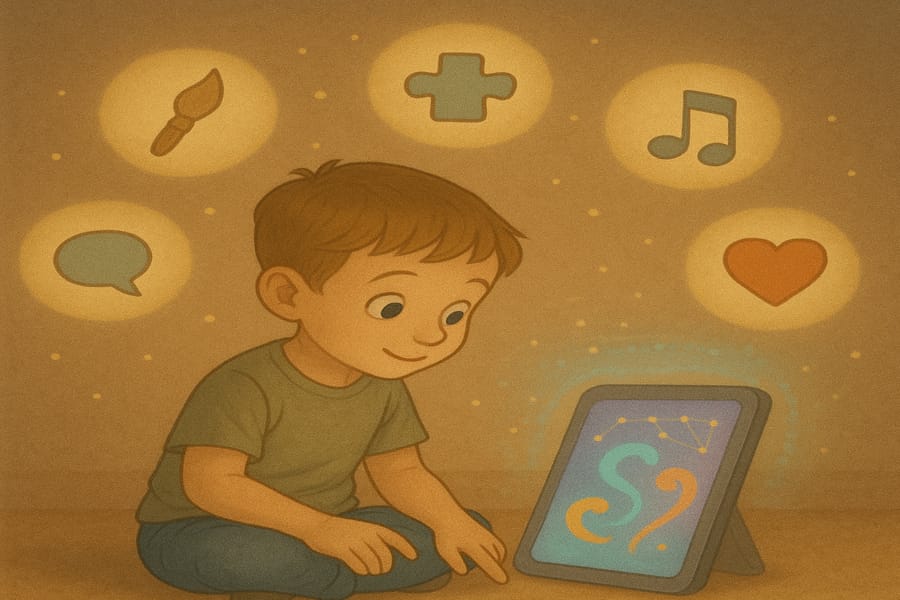
Every child is uniquely wired. Some are natural tinkerers, some observant, some deeply empathetic, others analytical.
AI could help spot these attributes earlier than traditional schooling, not to label a child, but to empower development while curiosity is still fresh.

Possible insights AI could track:
| Potential Strength | How AI Learns It | How It Can Help Develop It |
|---|---|---|
| Logical thinking | Puzzle completion, sequencing tasks | More advanced logic games & STEM exploration |
| Creativity | Drawing, imaginative responses, story creation | Art prompts, collaborative storytelling |
| Musical affinity | Reaction to sounds, rhythm games | Personalised music lessons & instruments to try |
| Language learning | Vocabulary growth, pronunciation improvements | Gentle multi-language exposure |
| Emotional intelligence | Response to characters and scenarios | Guided empathy activities & reflection questions |
Instead of generic education, we move toward precision childhood development.
Detecting Struggles Early, With Compassion
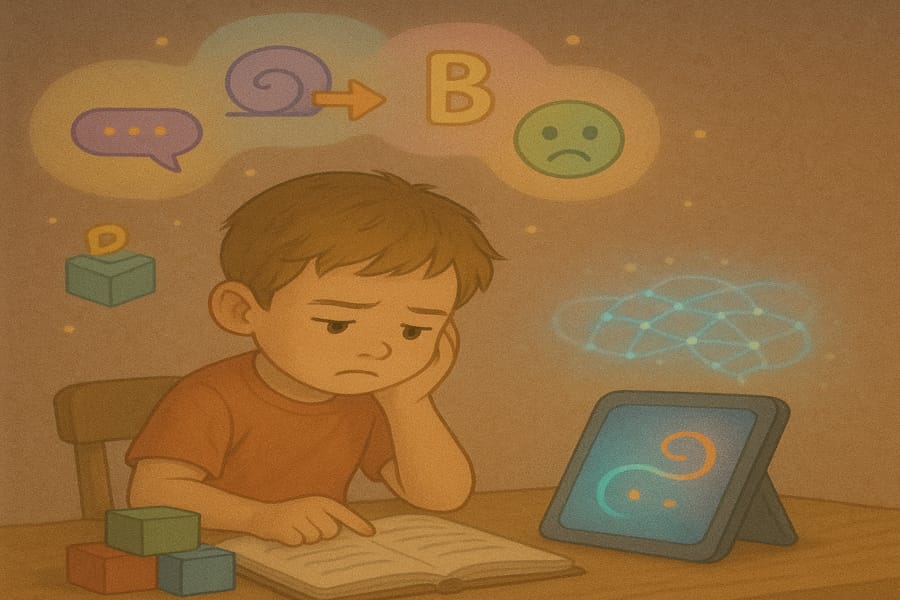
Equally important is identifying where a child needs more support.
AI could privately monitor areas of difficulty such as:
- Speech delays
- Numeracy challenges
- Reading hesitation
- Emotional regulation
- Difficulty focusing
- Motor skill development
Rather than waiting for a classroom to highlight a problem years later, AI could act as an early whisper to parents, offering activities to practice, and even recommending when professional assessment might help.
This is not about judgement, it is about opportunity.
Early support changes lives.
A Nightly Report That Helps Parents Parent Better
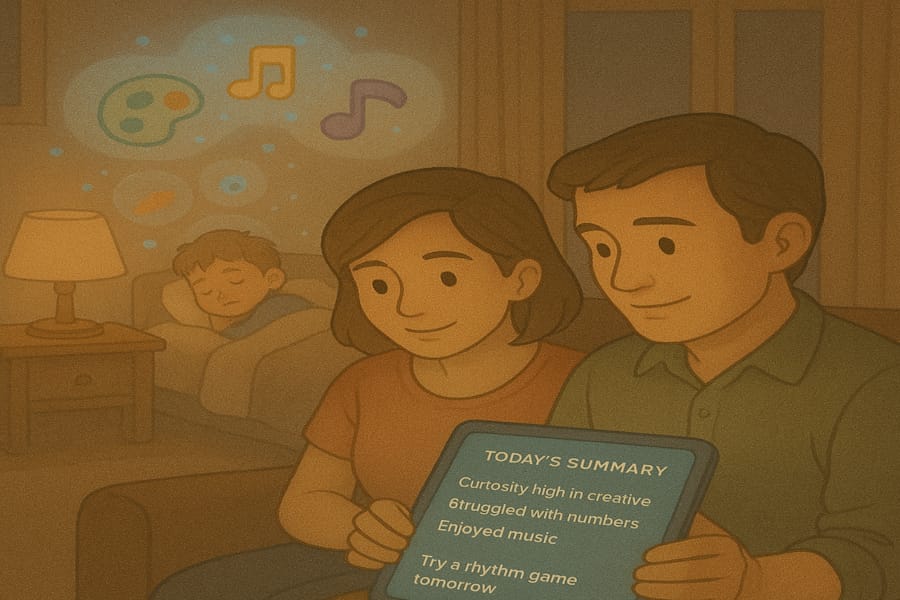
At the end of each day, an AI companion could produce a summary for parents:
- What the child reacted positively to
- What frustrated them
- Skills emerging naturally
- Skills requiring reinforcement
- Suggested activities for tomorrow (with the parent, not instead of them)
For the first time, parents would receive a window into cognitive patterns usually invisible until school age.
Simple insight can reduce stress, strengthen relationships, and help parents feel empowered rather than overwhelmed.
Parent + AI Together, Not Parent vs AI
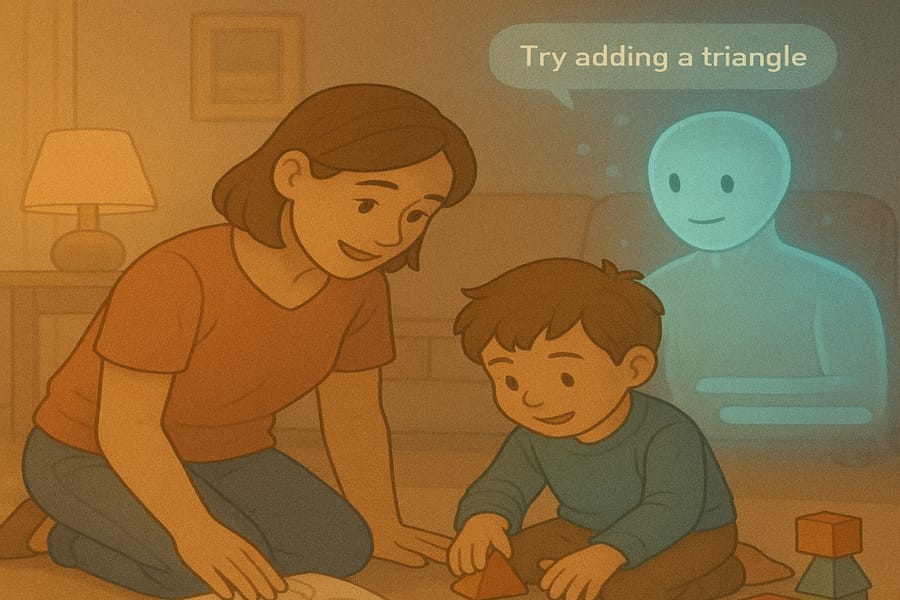
The most important message:
AI should never replace parenting, only guide it.
Screens cannot hug, comfort after a nightmare, or teach empathy through lived example.
AI cannot know a child like a loving parent can. But it can support parents:
- A patient tutor when a child struggles
- A curious companion when parents need a moment
- An insight engine revealing unseen learning patterns
- A structure for first-time parents learning as they go
AI is not the destination, it is the tool that helps families get there.
In a world where technology will shape the future of every child, the goal is not to push them toward machines, but to use machines to help them flourish as humans.
Conclusion: A Smarter Way to Grow Up
If we reshape screen time into interactive growth time, the next generation could become more confident, curious, emotionally aware, and intellectually prepared. Not because AI replaces parents, but because it helps parents raise their children with more insight than any generation before.
AI can’t love a child.
But it can help them discover who they are meant to become.

Latest AI Wellbeing Articles
AI as a Cognitive Equaliser: How Artificial Intelligence is Empowering Dyslexia and ADHD Minds
AI is transforming how people with dyslexia and ADHD think, write, and create. This article explores how technology removes...

The AI Brain Fry Problem: When Infinite Knowledge Meets Finite Time
AI gives us access to limitless knowledge, but human time and attention remain limited. Discover why heavy AI use can lead to...

Your Introductory Guide to AI Companions
You've likely heard of AI assistants that can tell you the weather or play a song, but a new kind of technology is emerging: the...

The Instinct to Collect: Why We Gather, What It Reveals, and How to Keep It Healthy
From seashells and stamps to sneakers and NFTs, collecting is one of the oldest and most universal human habits. It’s a behaviour...

When Ego and Vanity Impoverish the People
The world is littered with grand projects conceived by governments and sold to their citizens as “investments in national pride.”...
Discover Yourself with AI: Create a Personalized Adventure Story in ChatGPT
Want to explore your imagination and learn more about yourself at the same time? This step-by-step guide shows you how to use...
AI Is the Real-Life Limitless Pill — If You Know How to Use It
In the 2011 film Limitless, a struggling writer stumbles upon NZT-48 — a fictional pill that lets him unlock 100% of his brain’s...
How AI Set Me Free from My Dyslexia
When I was 12 years old, I was told I had Dyslexia. Like many neurodiverse conditions, Dyslexia exists on a spectrum, and while my...

AI Questions and Answers section for Raising Children in the AI Age: A Guide, Not a Replacement
Welcome to a new feature where you can interact with our AI called Jeannie. You can ask her anything relating to this article. If this feature is available, you should see a small genie lamp above this text. Click on the lamp to start a chat or view the following questions that Jeannie has answered relating to Raising Children in the AI Age: A Guide, Not a Replacement.
Be the first to ask our Jeannie AI a question about this article
Look for the gold latern at the bottom right of your screen and click on it to enable Jeannie AI Chat.
Type: Article -> Category: AI Wellbeing