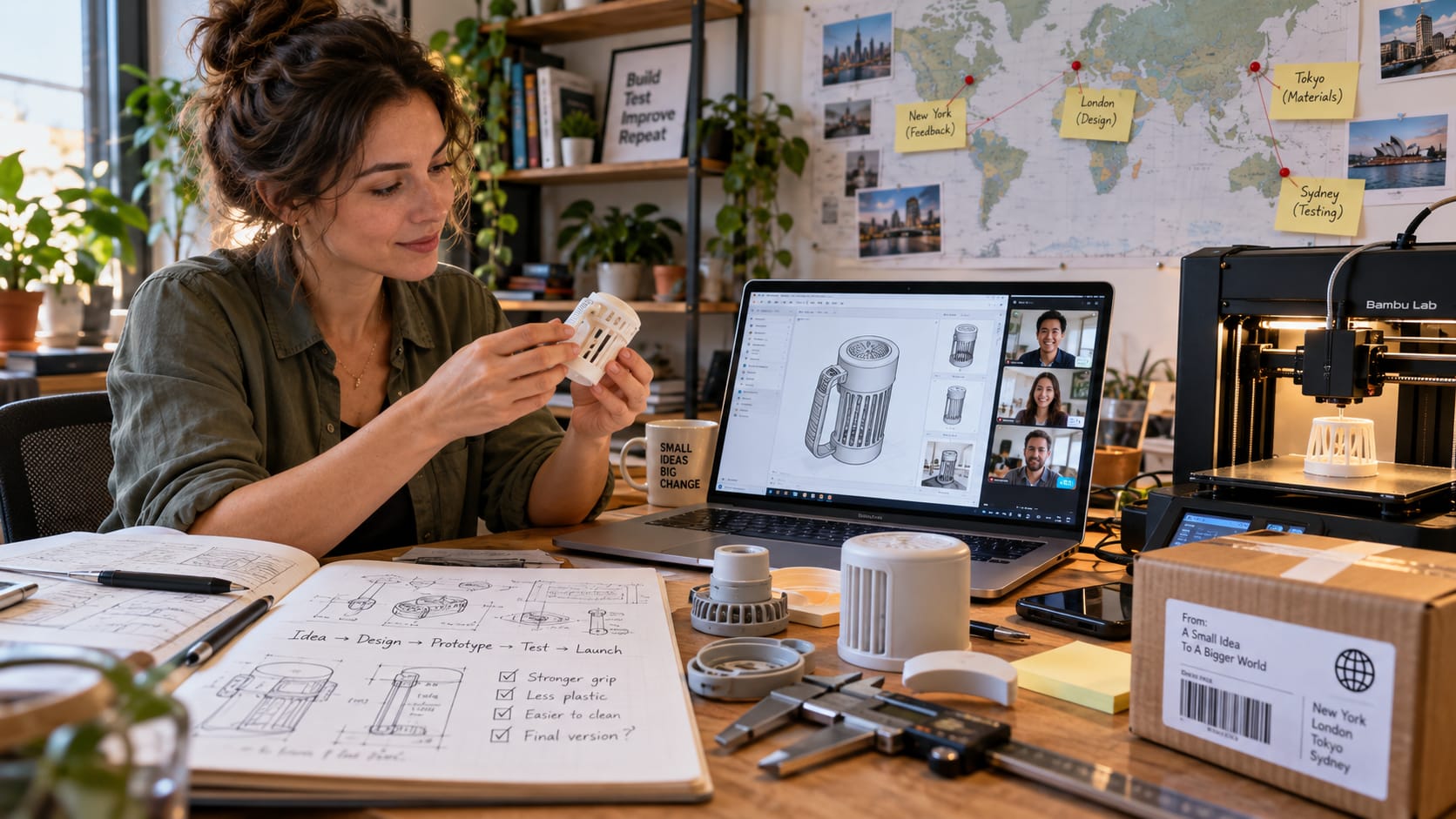
The AI Inventors' Renaissance
Don't have time to read the article? View as a short video storyboard or listen to it whilst jogging.
Publish Date: Last Updated: 12th October 2026
Author: nick smith- With the help of CHATGPT
While the world worries about artificial intelligence destroying humanity, could it actually be helping to create a whole new generation of inventors and entrepreneurs?
What happens when millions more people can experiment?
Meanwhile, Back in the Garden Shed...
If you believe everything you read in the newspapers or watch on social media, artificial intelligence is either going to take your job, destroy the economy, enslave humanity or eventually decide that human beings are surplus to requirements.
Depending on which headline you read, we are either approaching the end of civilisation or rapidly accelerating towards it.
Now, I am not suggesting that we should ignore the potential dangers of AI. There are legitimate concerns surrounding employment, security, misinformation and the longer-term implications of increasingly capable artificial intelligence.
But I do wonder whether we are spending so much time discussing what AI might take away from humanity that we are overlooking something rather extraordinary that it could give us.
The ability for millions of ordinary people to become inventors.
And I don't mean inventors working for multinational corporations, university research departments or businesses with substantial financial backing.
I mean ordinary people. Gardeners, farmers, retired engineers, students, tradespeople, people with disabilities and individuals living in some of the poorest parts of the world.
People who have ideas but have never had the money, knowledge or equipment to turn those ideas into reality.
Because something rather interesting is happening at the intersection of artificial intelligence, affordable 3D printing, electronics and modern manufacturing.
The barriers that once prevented people from experimenting with their ideas are beginning to come down.
And I suspect we are only just starting to appreciate what that might mean.

When Having an Idea Wasn't Enough
Let's imagine you had an idea for a new mechanical invention 25 years ago.
Perhaps it was a clever device for watering plants, a new kind of bird feeder, a tool that made a particular job easier or a small machine that could automate a repetitive task.
The idea might have been perfectly reasonable.
Unfortunately, having the idea was often the easy part.
You would need to design the mechanical components, understand how they fitted together and somehow manufacture them.
That might require access to a lathe, milling machine, CNC equipment or a specialist engineering workshop.
If electronics were involved, you would need to understand circuits, components and possibly printed circuit board design.
And if your invention required software, you would either have to learn an appropriate programming language or find someone who already knew one.
Alternatively, you could pay other people to do these things for you.
All perfectly possible, provided you had the necessary knowledge, equipment, contacts or financial resources.
For many people, however, that was where the idea ended.
Not because it was a bad idea, but because the gap between imagining something and actually making it was simply too great.
Of course, talented individuals have always invented things in their garages and garden sheds. Hobby electronics, home workshops and computer-aided design existed long before AI.
But there is an enormous difference between something being technically possible and something being realistically achievable for an ordinary person.
And that is the difference AI is beginning to make.
Meet Your New Workshop Assistant
Fast-forward to 2026.
Affordable desktop 3D printers have become increasingly capable. Microcontrollers, sensors and electronic components are readily available. Printed circuit boards can be designed digitally and ordered from manufacturing services.
And now we have artificial intelligence.
Imagine someone who has never written a computer program, designed an electronic circuit or used engineering software.
They have an idea for a device that automatically monitors soil moisture and waters a particular area of their garden.
Instead of abandoning the idea because they lack the technical knowledge, they can start a conversation with AI.
They could explain what they want to achieve and ask how the device might work.
AI could help them understand what sensors would be required, suggest a suitable microcontroller, explain how to connect the components and assist in developing the software.
It could also help create a design for an enclosure that could be manufactured using a 3D printer.
The first version might not work.
In fact, knowing how these things tend to go, there is a reasonable chance the first version would do something entirely unexpected, possibly watering the garden shed instead of the plants.
But that is the nature of experimentation.
The important change is that someone who previously would not have known where to begin can now start investigating, designing and building.
They don't suddenly become an electronics engineer or an experienced programmer.
But they have access to assistance that can explain unfamiliar concepts, generate initial designs, help diagnose problems and suggest improvements.
AI doesn't have to replace the inventor. It can help the inventor become capable of doing more.
And when you combine that with affordable manufacturing technology, the possibilities become considerably more interesting.
The Economics of Getting It Wrong
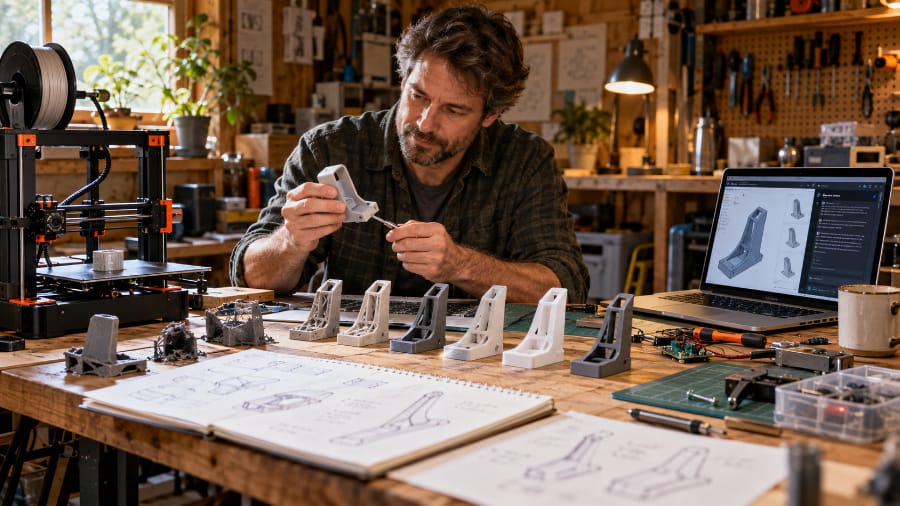
There is something about invention that we tend to overlook.
Most inventions don't arrive fully formed.
They evolve through experimentation, mistakes, redesigns and occasionally the discovery that something you thought was a wonderful idea doesn't actually work.
Failure is part of the process.
The trouble is that failure can be expensive.
Imagine paying an engineering workshop to manufacture a prototype, only to discover that one component needs to be a few millimetres longer.
You might have to revise the drawings, commission another part and wait for it to arrive.
Repeat that process several times and the costs quickly accumulate.
Now imagine having access to a desktop 3D printer.
You modify the design, print another component and try again.
For suitable materials and applications, the cost of each experiment might be little more than some printing filament, electricity and your time.
Add AI into the equation and you can also receive help redesigning the component, investigating why it failed or exploring alternative approaches.
That does not mean every engineering problem can be solved with a 3D printer. Precision machining, specialist materials and professional manufacturing will continue to be essential for many applications.
But for a surprisingly wide range of early-stage prototypes, the economics have changed.
And this has consequences that go far beyond simply saving money.
The greatest contribution of AI to invention might not be generating brilliant ideas. It might be making it affordable to test thousands of ordinary ideas until somebody discovers a brilliant one.
When experimentation becomes cheaper, people can afford to take more risks.
They can investigate unconventional ideas, try different approaches and explore possibilities that would previously have been too expensive to justify.
And sometimes it is precisely those unusual experiments that produce the most interesting results.
The Greatest Barrier Might Be One We Haven't Noticed
There is, however, another barrier that may be even more important than the financial or technical ones.
People simply don't realise what they are now capable of attempting.
Think about how many times someone has said:
"I've always thought somebody should invent something that does that."
Or:
"I've had an idea for years, but I wouldn't know where to start."
For many people, that is the end of the conversation.
They assume that developing an invention requires qualifications, programming experience, engineering knowledge or access to specialist equipment.
What they may not realise is that AI can help them begin acquiring and applying precisely that knowledge.
You don't necessarily need to know how to write software before asking AI to help develop a piece of software.
You don't need to be familiar with every aspect of electronics before asking AI to explain how a particular circuit works.
And you don't need to understand every detail of mechanical design before beginning to investigate how a mechanism might be constructed.
There will still be things to learn, decisions to make and mistakes to correct.
But the starting point has changed.
I think this is one of the areas where the public conversation about AI has been particularly unhelpful.
Social media is full of examples of AI getting things wrong.
An AI produces a ridiculous answer, invents a reference, makes a programming mistake or fails at something a human finds relatively straightforward.
Cue the laughter, thousands of comments and another round of declarations that artificial intelligence is hopeless.
And yes, AI does make mistakes. Sometimes spectacular ones.
Those mistakes matter, particularly when the technology is being used for medical, financial, engineering or safety-critical decisions.
But there is a considerable difference between using AI as an unquestionable source of truth and using it as an assistant to help research, explore and develop an idea.
You don't need AI to be right every time for it to be enormously useful. You need to understand how to work with it, recognise mistakes and verify the results.
Someone who spends weeks working with AI to develop a useful invention is unlikely to generate the same immediate attention as a thirty-second video of an AI getting a simple question wrong.
Unfortunately, the person who has never seriously experimented with AI may see only the failures.
And that could discourage them from discovering something genuinely useful.
The Inventor Who Doesn't Own a Workshop
Now let's take this idea a little further.
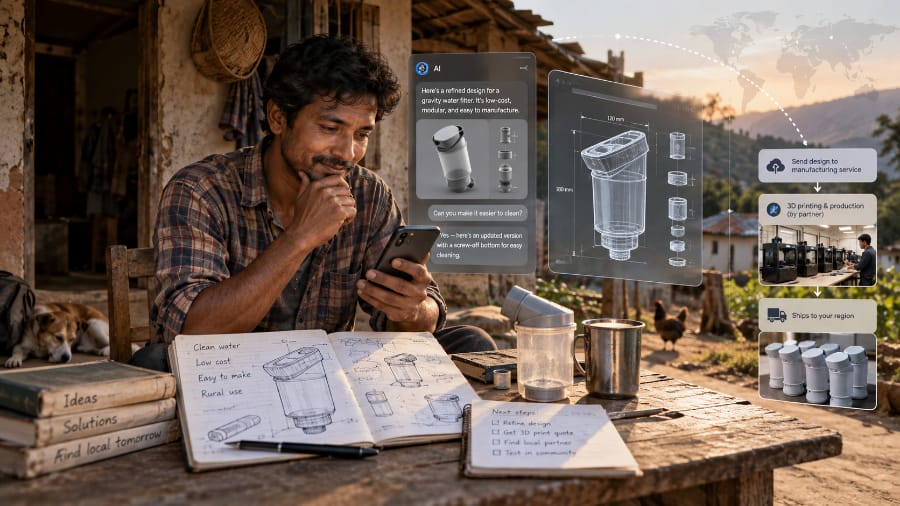
Imagine someone living in a rural community in an economically disadvantaged country.
Perhaps they are a farmer who has spent years struggling with a particular problem involving irrigation equipment.
They know exactly what the problem is because they encounter it every day.
They even have an idea for a relatively simple mechanical device that could help solve it.
But they don't have access to a workshop, engineering equipment or professional designers.
What they do have is a smartphone and access to AI.
They could explain the problem in their own language and begin working through possible solutions.
With suitable design tools, AI assistance and some patient experimentation, they might develop a preliminary design for the device.
But here's where things become particularly interesting.
They don't necessarily need to manufacture it themselves.
Once the design has been properly developed into suitable manufacturing files, it could be sent to someone with a 3D printer elsewhere in the country, or perhaps on the other side of the world.
That person could manufacture the prototype and send it back.
The inventor tests it, identifies problems and makes improvements.
The revised design is sent for another print.
Suddenly, we have something resembling a distributed invention and manufacturing network.
The person with the idea, the person helping develop the design and the person manufacturing the prototype do not need to be in the same location.
They might never even meet.
Of course, this example does not mean the barriers of poverty have disappeared. Reliable internet access, suitable devices, shipping costs, material limitations and access to manufacturing services remain significant challenges.
But the basic principle is important.
A person no longer necessarily needs to own the means of manufacturing to begin developing an invention.
This could be particularly valuable in communities where local knowledge of everyday problems is abundant but access to technical expertise and manufacturing equipment is limited.
And it could create entrepreneurial opportunities at both ends.
One person develops an invention. Another establishes a small manufacturing service. Others provide electronic assembly, design assistance or distribution.
The United Nations Development Programme explored precisely this wider potential in its July 2025 publication, 3D Printing: The Future of Work and Opportunities for Developing Countries, examining how additive manufacturing could support entrepreneurship, local innovation and distributed micro-manufacturing.
The technology alone will not eliminate economic inequality, but it could provide new ways for people to participate in technological development.
And that is a possibility worth taking seriously.
A New Generation of Entrepreneurs
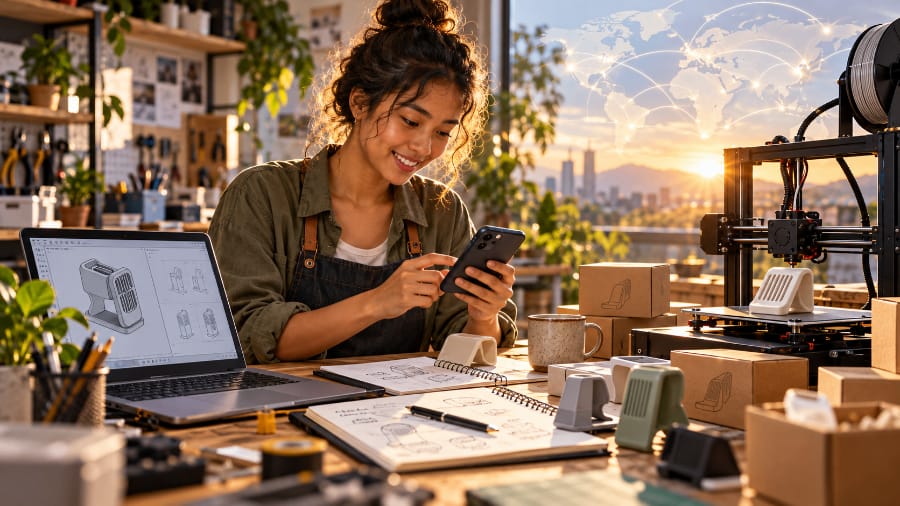
There is another consequence to all this.
Not everyone who develops an invention wants to change the world.
Some people simply want to solve a problem and perhaps make a living from it.
Imagine someone who develops a clever attachment for a gardening tool.
They print a prototype, test it, improve the design and discover that other gardeners would also find it useful.
Previously, turning that idea into a business might have required substantial upfront investment in manufacturing, product development and technical expertise.
Today, they could potentially begin with small-scale production, establish an online presence, test customer interest and gradually expand.
AI could assist with much of the supporting work: software, research, documentation, marketing, customer communications and business planning.
None of this guarantees a profitable business. Market demand, product quality, regulations and commercial judgement remain essential.
But once again, some of the barriers have been reduced.
And we are already seeing indications that AI is influencing entrepreneurship.
A May 2026 report from the US business platform Gusto surveyed 1,051 people who started businesses in 2025.
It found that 60% had used AI to help launch their businesses. Half reported that AI had made the process significantly faster or less expensive.
Interestingly, only 3% said they probably would not have started their businesses without AI.
That is an important distinction.
For now, the strongest evidence suggests that AI is making entrepreneurship easier and more efficient, rather than single-handedly creating an entirely new population of business owners.
But what happens as awareness improves?
What happens when people who have never considered starting a business begin to understand what they can now achieve with relatively modest resources?
What happens when that understanding spreads beyond technologically confident people to farmers, carers, craftspeople, pensioners, students and people living in communities with limited access to traditional business support?
I suspect that is where the really interesting developments may begin.
Because the next generation of entrepreneurs may include people who, until recently, never imagined they could become entrepreneurs at all.
The Inventions Nobody Else Would Bother Making
One of the most exciting possibilities is that AI could encourage invention in areas that have traditionally received relatively little commercial attention.
Large companies understandably concentrate on products that have significant markets and the potential to generate a financial return.
But many real-world problems affect relatively small groups of people.
A person caring for someone with limited mobility might have an idea for a simple device that makes a daily task easier.
A gardener might need a specialised tool that no manufacturer currently produces.
A wildlife enthusiast might develop equipment for monitoring a particular species.
A tradesperson might imagine a modification that saves a few minutes on a repetitive task.
A farmer might find a simple improvement to a piece of existing machinery.
These ideas might never attract venture capital or the attention of a major manufacturer.
But they could still be extremely useful.
And if the costs of experimenting continue to fall, more people may be willing to pursue them.
Not every invention needs to become a billion-pound business.
Sometimes making life easier for a few hundred people is a perfectly worthwhile achievement.
In fact, we may discover that there is an enormous amount of untapped inventiveness among people who understand particular problems better than any professional product development department ever could.
They simply haven't had the means to act on their ideas.
Until now, perhaps.
AI Doesn't Repeal the Laws of Physics
Before we all rush out to buy 3D printers and start designing nuclear-powered lawnmowers, there are a few practical considerations.
AI is not an infallible engineer.
It can suggest components that don't exist, generate incorrect code, misunderstand mechanical requirements and confidently explain why a design will work when it most certainly will not.
A 3D-printed component that looks impressive on a computer screen might fail the first time it is placed under load.
Electronic circuits can overheat. Batteries can be dangerous. Moving machinery can cause injuries.
And there is a considerable difference between creating a working prototype and manufacturing a product that is reliable, compliant with regulations and safe for other people to use.
Researchers at MIT have been investigating some of these challenges. Their MechStyle system, reported in January 2026, combines AI-assisted 3D model modification with mechanical simulation to help preserve structural integrity.
The work itself illustrates an important limitation: generating a convincing design is not the same as ensuring that the resulting object will survive real-world use.
Human knowledge, verification, testing and professional expertise remain essential.
But I don't see this as an argument against AI-assisted invention.
I see it as an argument for using AI intelligently.
It should help people understand engineering principles, investigate risks and develop safer designs, rather than encourage them to blindly trust whatever it produces.
After all, AI can help you design a bridge, but gravity remains remarkably unimpressed by how convincing the AI's explanation sounds.
The objective is not to remove the need for learning.
It is to make learning and experimentation more accessible.
An Inventors' Renaissance?
There is an interesting historical parallel here.
During the Renaissance, the spread of knowledge, improvements in technology and new ways of thinking helped stimulate extraordinary developments in art, science and engineering.
Later, the printing press contributed to a transformation in how knowledge could be distributed.
Much more recently, personal computers and the internet enabled millions of people to create software, publish information and establish businesses without the infrastructure that previously would have been required.
Each of these developments changed who could participate.
I wonder whether AI, combined with affordable manufacturing technologies, could bring about another such change.
Not because AI will suddenly produce millions of revolutionary inventions on its own.
But because millions of people may gain the confidence and practical ability to explore ideas that would otherwise never have progressed beyond their imagination.
And the effect could become cumulative.
Inventors can share designs, software, manufacturing techniques and lessons learned. Other people can build upon that work, adapt it and develop new solutions.
One person's invention becomes another person's starting point.
Open-source software has already demonstrated how powerful that process can be.
Combine shared knowledge with AI assistance and increasingly accessible manufacturing, and it becomes possible to imagine an expanding network of individual inventors and small businesses collaborating across geographical and economic boundaries.
There are challenges, of course, including intellectual property, access to technology, commercial restrictions and the danger that useful knowledge becomes increasingly concentrated behind expensive subscription services.
An inventors' renaissance is not inevitable.
But the foundations are beginning to emerge.
And perhaps the most important thing we can do at this stage is make people aware of what is becoming possible.
The Next Great Inventor Might Be You
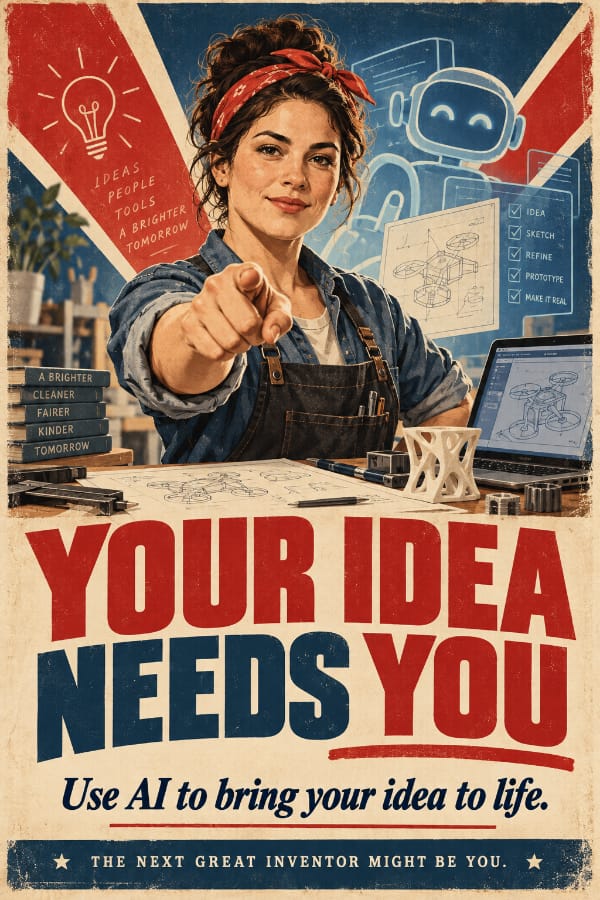
We spend an extraordinary amount of time discussing what artificial intelligence might take away from humanity.
Perhaps we should spend a little more time discussing what it might give us.
Somewhere in the world today, somebody has an idea that could improve their life, help their community or perhaps become a successful business.
They may have no engineering qualifications, no programming experience and no money to employ a development team.
What they may not yet realise is that they already have access to a tool that can help them take the first step.
They don't necessarily need to buy expensive machinery.
They don't need to know everything before they begin.
They don't even need to know whether their idea will work.
They need curiosity, a willingness to learn, some patience and the confidence to experiment.
The next generation of inventors may not come exclusively from universities, engineering companies or research laboratories.
They could come from anywhere.
And perhaps the greatest obstacle remaining is that millions of potential inventors haven't yet realised they can start.
So, if you have an idea that has been sitting in the back of your mind for years, something you've always thought somebody ought to invent, perhaps it's time to revisit it.
Find an AI assistant and explain what you've been thinking about.
Ask whether it's feasible. Ask what knowledge you would need. Ask how you might build a simple prototype.
Challenge its answers. Check its suggestions. Learn from its mistakes.
You might discover that your idea is completely impractical.
You might discover that somebody else invented it twenty years ago.
Or you might discover that you have the beginnings of something rather interesting.
Either way, you'll have learned something.
And who knows?
Perhaps the next great inventor won't be sitting in a university laboratory or the research department of a multinational corporation.
They might be sitting in a garden shed, arguing with an AI about why their third prototype still doesn't work.
Latest Future AI Articles
AI Extinction Risk: Should We Fear AI or Humans More?
AI researchers warn there could be a greater than 10% chance advanced AI will destroy humanity. That sounds terrifying — until you...

What We’re Missing About Intelligence in AI
AI can answer questions with incredible accuracy—but is that true intelligence? This article explores what’s missing: continuous...

The Restaurant at the End of the AI Universe
Humanity does not need AI to destroy itself. It is already pulling AI into the oldest loop of all: fear, escalation and war. From...
When Waste Is Not Waste: AI, Sustainability & the Future of Design
When Waste Is Not Waste: AI, Sustainability, and the Cost of Designing for Disposal. Nature doesn’t survive because it avoids...

AI Questions and Answers section for The AI Inventors' Renaissance
Welcome to a new feature where you can interact with our AI called Jeannie. You can ask her anything relating to this article. If this feature is available, you should see a small genie lamp above this text. Click on the lamp to start a chat or view the following questions that Jeannie has answered relating to The AI Inventors' Renaissance.
Be the first to ask our Jeannie AI a question about this article
Look for the gold latern at the bottom right of your screen and click on it to enable Jeannie AI Chat.