Type: Article -> Category: Smoke & Mirrors
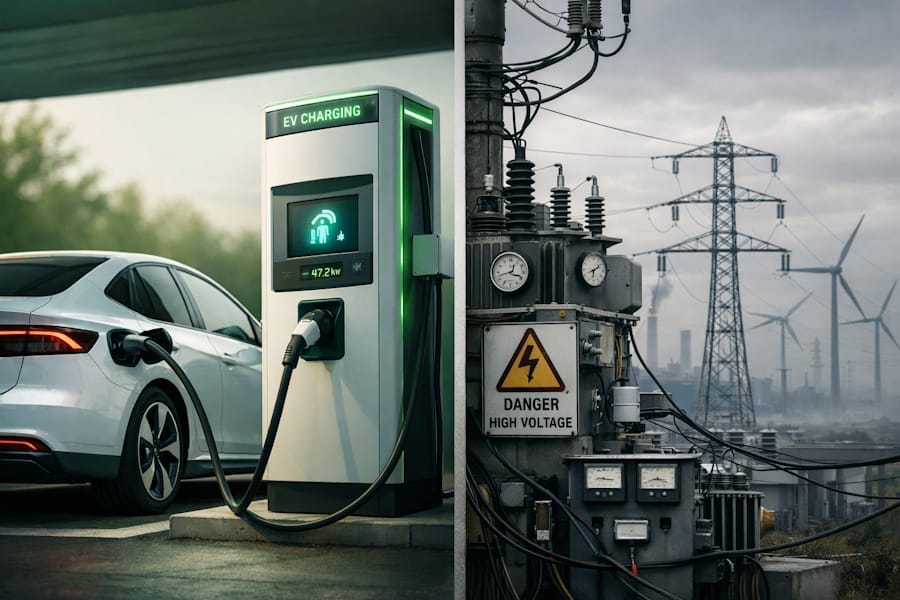
Smoke & Mirrors: The West’s Headlong Rush into Electrification
Publish Date: Last Updated: 17th February 2026
Author: nick smith- With the help of CHATGPT
Introduction: When the Narrative Becomes the Policy
There is broad acceptance that internal combustion engines emit pollutants and contribute to environmental harm. Few dispute that reality.
What deserves scrutiny, however, is not whether change is needed, but how recklessly that change is being pursued in the West, and who will ultimately pay the price.
This article is not an argument against climate measures. It is an examination of policy theatre, short-term political optics, and the dangerous assumption that swapping one system for another, without infrastructure, resilience, or realism, constitutes progress.

The Myth of the “Dirty West”
One of the most persistent distortions in the climate debate is the idea that Western vehicle emissions are wildly uncontrolled.
In reality:
- Modern petrol and diesel vehicles in Western countries operate under some of the strictest emissions standards in the world
- Euro 6 / Tier regulations have reduced particulates and NOx dramatically
- Many older vehicles already represent sunk carbon cost, their emissions have largely already occurred during manufacture
Yet instead of recognising this progress, policy has pivoted toward outright bans, followed by regulatory pressure designed to forcibly remove otherwise serviceable vehicles from the road.
This isn’t environmental optimisation, it’s political absolutism.
From One Monopoly to Another
We are being told that electrification represents freedom from fossil fuels.
In practice, it risks replacing one dependency with an even more concentrated one.
Once transport is fully electrified:
- Every journey depends on the electrical grid
- Every failure becomes systemic, not local
- Consumers become entirely beholden to energy suppliers
Unlike fuel markets, electricity:
- Cannot be easily stockpiled at scale
- Is often controlled by private corporations, not national infrastructure
- Is already under strain before mass EV adoption
The uncomfortable truth is this:
A fully electric transport system centralises control in a way petrol never did.
The Green Marketing vs the Grey Reality
Electric vehicles are marketed as “clean”, but that cleanliness is largely geographical accounting.
Consider:
- Lithium, cobalt, nickel, and rare earth mining
- Energy-intensive battery production
- Global shipping of components
- Short battery lifecycles and uncertain recycling pathways
The emissions have not vanished, they have simply been exported.
Calling an EV “zero emissions” only works if you ignore:
- The supply chain
- The energy source powering the grid
- The vehicle’s end-of-life reality
This is not decarbonisation.
It is carbon displacement wrapped in marketing.
A Missed Opportunity: Managed Transition, Not Forced Collapse
A more rational path was available.
Instead of banning combustion engines outright:
- Continue incentivising efficiency improvements
- Encourage hybridisation and cleaner fuels
- Fund EV R&D until the technology naturally out-competes ICE vehicles
Electric vehicles should win on merit, not mandate.
Given their mechanical simplicity, EVs should eventually:
- Be cheaper to manufacture
- Require less maintenance
- Become the obvious consumer choice
That transition would have occurred organically, without coercion, without premature scrappage, and without destabilising infrastructure.
Infrastructure Before Ideology
Perhaps the greatest failure has been sequence.
Policy has prioritised:
- Bans
- Targets
- Deadlines
Before ensuring:
- Grid capacity
- Charging availability
- Energy storage resilience
- Backup generation
This has led to absurdities such as:
- Paying renewable generators even when no power is produced
- Curtailing wind output while importing energy
- Pretending intermittency isn’t a structural problem
Until green energy proves stable, scalable, and reliable, it will require:
- Nuclear
- Gas
- Or other dispatchable sources
Ignoring this reality does not make it disappear, it simply moves the risk downstream.
The Real Reform: Tax the Supply Chain, Not the Consumer
The same flawed thinking extends beyond transport.
Today:
- Products are cheap to make
- Expensive to clean up
- And taxpayers fund the consequences
A genuinely responsible system would:
- Tax products based on full lifecycle impact
- Include supply chain emissions
- Enforce end-of-life responsibility on manufacturers
If a product is cheap only because its environmental cost is deferred, then it is not cheap at all, it is subsidised damage.
This would:
- Reward durable, repairable design
- Penalise planned obsolescence
- Shift responsibility back to producers, where it belongs
Conclusion: Reality Is Not Anti-Green
None of this is an argument for doing nothing.
It is an argument for doing things properly.
Decarbonisation should be:
- Technically grounded
- Infrastructure-led
- Economically honest
- Socially fair
Instead, we have:
- Compressed timelines
- Ideological targets
- Corporate capture
- And the illusion of progress
Smoke and mirrors do not cool a planet, they simply obscure accountability.

Latest Smoke & MIrrors Articles
Don't Shoot the Messenger!
AI agents are beginning to uncover vulnerabilities in real-world systems. That's alarming—but perhaps we're asking the wrong...

Smoke & Mirrors: Protecting Children or Building the Architecture of Digital Control?
The UK's proposed device-level nudity scanning raises important questions about privacy, age verification, false positives,...

When Humans No Longer Believe Anything
AI can now fabricate reality at scale—but the real danger is the collapse of trust. As synthetic content floods the internet, can...
Why the UK May Soon Be Praying for Wind
Electric cars and renewables promise energy independence—but the UK grid still relies on gas and unpredictable weather. As demand...

AI Questions and Answers section for Smoke & Mirrors: The West’s Headlong Rush into Electrification
Welcome to a new feature where you can interact with our AI called Jeannie. You can ask her anything relating to this article. If this feature is available, you should see a small genie lamp above this text. Click on the lamp to start a chat or view the following questions that Jeannie has answered relating to Smoke & Mirrors: The West’s Headlong Rush into Electrification.
Be the first to ask our Jeannie AI a question about this article
Look for the gold latern at the bottom right of your screen and click on it to enable Jeannie AI Chat.
Type: Article -> Category: Smoke & Mirrors